

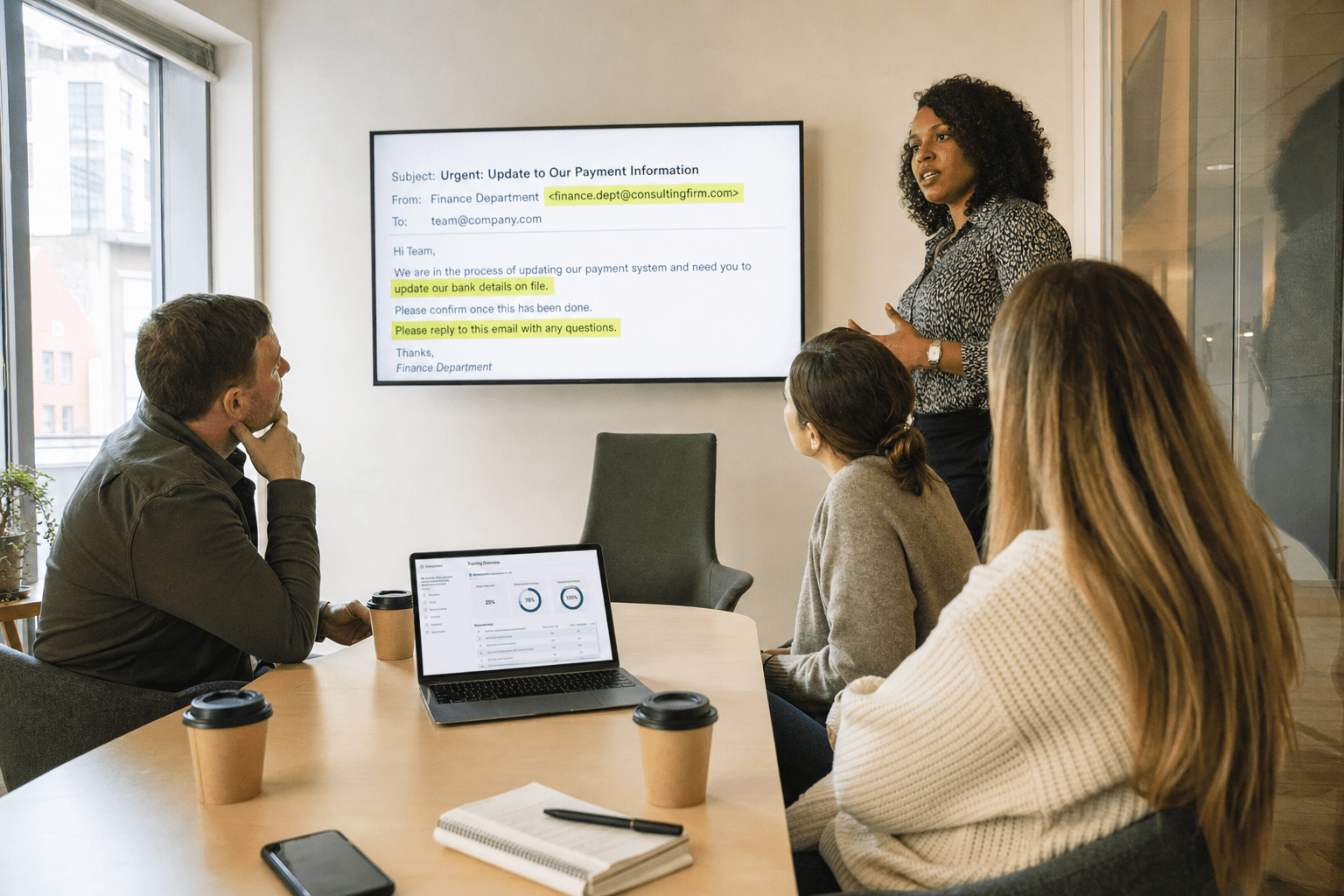
The best AI tools for security awareness training content in 2026 earn their place by producing scenarios that look like your own organisation. That is the one thing a stock library cannot do at any price, and it is the one thing that reliably changes what people click.
Awareness training is usually bought on library size and reported on completion rate. Neither number tells you anything useful. A thousand modules is a catalogue, not a curriculum, and a 96 percent completion rate mostly measures how effectively your reminder emails work. Staff finish generic training and forget it because nothing in it resembled their Tuesday. A scenario naming your actual finance platform, your actual approval flow and a supplier your team recognises is remembered, and generated content is how a small organisation gets that without a production budget.
Overview: five things that decide whether training content works
- Specificity beats volume. One scenario built around your real workflow outperforms twenty polished generic ones.
- Role-based content is where generation pays off. Finance, clinical and warehouse staff face different attacks and stock libraries treat them alike.
- Simulation realism has an ethical ceiling. Some lures are effective and will damage trust, and that line has to be set in advance.
- Evidence matters as much as delivery. Auditors ask who completed what and when, so the record is part of the product.
- Frequency beats duration. Short and regular changes behaviour; annual and long satisfies a checkbox.
Written for owners, HR leads and IT managers at 10 to 500 person organisations who have either no awareness programme or one nobody takes seriously.
Why localised scenarios outperform stock content
Localised scenarios work because recognition is what people carry out of training. A module about a generic invoice fraud teaches a concept. A simulated message referencing your actual accounting system, your actual approvals process and a supplier name your team knows teaches a reflex.
Building that has historically been the problem. Custom scenario writing meant either an agency or someone internal with time nobody has, so organisations bought the library and accepted the generic material. Generation changes the economics: describing your environment once and producing tailored scenarios from it is now a short task rather than a project.
Start from your own incident history
The best source material is what has actually been attempted against you. Pull the phishing attempts your filters caught and the ones staff reported over the last year, and use those as the basis rather than inventing threats.
That grounds the programme in reality and it also makes the training defensible internally, because you are showing staff something that genuinely arrived rather than a hypothetical. Our breakdown of a real campaign in when security emails are the breach is the kind of material that lands precisely because it happened.
Keep a named-brand boundary
One caution on realism. Using a real supplier’s name and branding in a simulation can create a genuine problem with that supplier and, in some framings, a legal one. Use recognisable categories and plausible internal detail rather than impersonating a specific named third party.
Internal impersonation carries its own limit. A simulation appearing to come from your CEO is highly effective and it can also damage the relationship between staff and leadership in a way that outlasts the exercise. Decide where that line sits before you generate anything, not after a complaint.
Role-based content is where the return is
Generic training treats a warehouse supervisor and a finance manager as the same reader, and they face different attacks. Finance sees invoice fraud and payment redirection. Clinical staff see credential harvesting dressed as system notices. Field and warehouse staff see device and physical access issues. Executives see targeted impersonation.
Producing four to six role-specific variants of each topic used to be uneconomic for a small organisation. It is now a small amount of work, and it is where the measurable difference shows up, because content aimed at somebody else is content people skim.
Map roles to threats before you produce anything
Spend an hour listing your role groups and, for each, the two or three attacks they realistically face. That mapping is the specification for everything you generate, and it prevents the common outcome of producing a lot of content with no structure behind it.
It also surfaces gaps in your controls. If the mapping says finance faces payment redirection, the follow-up question is whether a callback verification step exists, because training people to spot something you could prevent structurally is the weaker fix. That interplay between training and control is why we treat awareness as part of managed security services rather than as a standalone product.
Distributed teams need their own scenarios
Staff working from home face a different set: home network exposure, personal device overlap, and the absence of a colleague to turn to when something looks odd. Content written for an office assumes a context that no longer applies to a large share of the workforce.
Those specific exposures are worth addressing directly, and we cover the underlying costs in our piece on hybrid work security risks.
Evidence is part of what you are buying
Whatever produces your content, the record is what an auditor asks for. Who was assigned what, who completed it, when, and what the assessment showed. Regulated organisations need this and unregulated ones increasingly need it for cyber insurance.
This is where a pure content-generation approach falls short and a platform earns its licence. Generating excellent material and delivering it by email leaves you with no defensible record, and reconstructing one after the fact is not really possible.
The sensible split is platform for delivery, generation for content
Most organisations land on using a training platform for assignment, tracking and reporting, with generated material filling the gap where the stock library is too generic. Many platforms now allow custom content upload, which makes this straightforward.
Check that before committing, because a platform that only serves its own catalogue locks you into exactly the generic content the exercise is meant to escape. Our guidance on conducting employee cybersecurity awareness training covers the delivery mechanics, and the documentation duties in our annual HIPAA risk assessment piece show what the evidence needs to look like in a regulated setting.
Frequency and length beat production value
The strongest finding across awareness programmes is unglamorous: short and frequent beats long and annual. A five minute item monthly, tied to something currently circulating, produces more behaviour change than a forty minute module once a year.
Annual training exists because it is easy to administer and easy to evidence. It is close to useless as a behaviour intervention, because the interval is longer than anyone’s retention of material they were not especially interested in.
Generation makes monthly affordable
The obstacle to monthly content was always production cost. Twelve tailored pieces a year is a real commitment with an agency and a modest one with generated material reviewed by someone who knows the organisation.
Keep the review step. Generated content occasionally contains a plausible-sounding detail that is wrong for your environment, and training staff on a procedure you do not actually follow is worse than not training them. Someone who knows how the organisation works should read every piece before it goes out.
Tie the topic to something real that month
The single easiest improvement is relevance to now. If a supplier invoice fraud attempt reached three people last week, that is this month’s topic and it should say so in general terms.
Nothing improves attention like the opening line being something colleagues have discussed. The generic alternative arrives as one more compliance email. Supply-chain themed scenarios are particularly effective in sectors where that risk is live, as we discuss in our piece on defence supply chain security mistakes.
Measuring something other than completion
Completion rate measures compliance with your reminder emails. The measures worth tracking are report rate, which is the share of simulated messages staff actively reported rather than merely not clicking, and time to first report, which tells you how quickly a real campaign would surface.
Report rate is the better behavioural signal because it is active. Someone who ignored a suspicious message and someone who reported it look identical in a click-rate figure and are in completely different places.
Make reporting frictionless and consequence-free
A one-click report button in the mail client, and a policy that nobody is criticised for reporting something that turned out to be legitimate. The moment reporting feels risky, report rate falls and you lose your earliest warning signal.
Where staff use Microsoft 365 heavily, building this into the tooling they already have removes the friction entirely, which is part of what we cover under Microsoft 365 training alongside our security awareness training work.
A practical way to start
Map your role groups to the attacks each realistically faces. Pull a year of real attempts from your filters and reported messages. Generate role-specific scenarios from those, and have someone who knows the organisation review each one. Deliver monthly through a platform that records completion. Track report rate rather than completion. Set your simulation ethics boundary in writing before the first send.
The step teams skip is the review, and it is the cheapest insurance in the list. Content that references a process you do not have teaches staff something false about their own workplace, and that is a harder problem to undo than generic training.
Frequently Asked Questions
Can AI write our whole awareness programme?
It can produce the content efficiently, and the structure and review still need a person. Someone has to decide which roles face which threats, where the simulation ethics boundary sits, and whether each generated scenario matches how your organisation actually works. The generation is the cheap part.
Are AI-generated phishing simulations too realistic?
They can be, which is why the boundary is a decision rather than a setting. Impersonating a specific named supplier or your own CEO is highly effective and can cause lasting damage to trust. Use recognisable categories and plausible internal detail instead, and agree the limit before you generate anything.
How often should we run awareness training?
Monthly and short beats annual and long. A five minute item tied to something currently circulating produces more behaviour change than a forty minute module once a year, and generated content is what makes monthly affordable for a small organisation.
What should we measure instead of completion rate?
Report rate, meaning the share of simulated messages staff actively reported, and time to first report. Completion mostly measures your reminder emails. Report rate distinguishes someone who spotted a message from someone who merely did not click it.
Do we still need a training platform?
For assignment, tracking and reporting, usually yes, because the record is what auditors and insurers ask for. What you can replace is the generic catalogue, so check that any platform you choose accepts custom content upload before committing to it.
Who is behind this guidance
Our team runs awareness programmes alongside the technical controls for mid-sized organisations, which means we see both what staff click and what the filters caught before they got the chance. We have watched a generic annual module produce excellent completion figures and no change in report rate, and we have also seen a single scenario built from a real attempted invoice fraud change how a finance team handled bank detail changes within a fortnight. That contrast is why this article puts specificity ahead of library size.
Matt Rosenthal, our CEO, is direct about where the responsibility sits: training people to catch something you could have prevented structurally is the weaker half of the job, and the two have to be designed together. That is why the role-to-threat mapping above doubles as a control review, and it shapes how we scope awareness work for clients.
Build one scenario from something that actually happened
The organisations whose awareness programmes work in 2026 did not buy the largest library. They looked at what had actually been attempted against them, worked out which roles faced what, produced short scenarios that named their own systems and processes, and measured whether people reported rather than whether they finished. The content took less effort than the mapping did.
If you are starting from nothing, the useful first step is not a platform demonstration. It is pulling last year’s reported and blocked messages and seeing what your people are genuinely being sent.
Book a free strategy call and we will look at your real attempt history and build the first scenario with you.

