

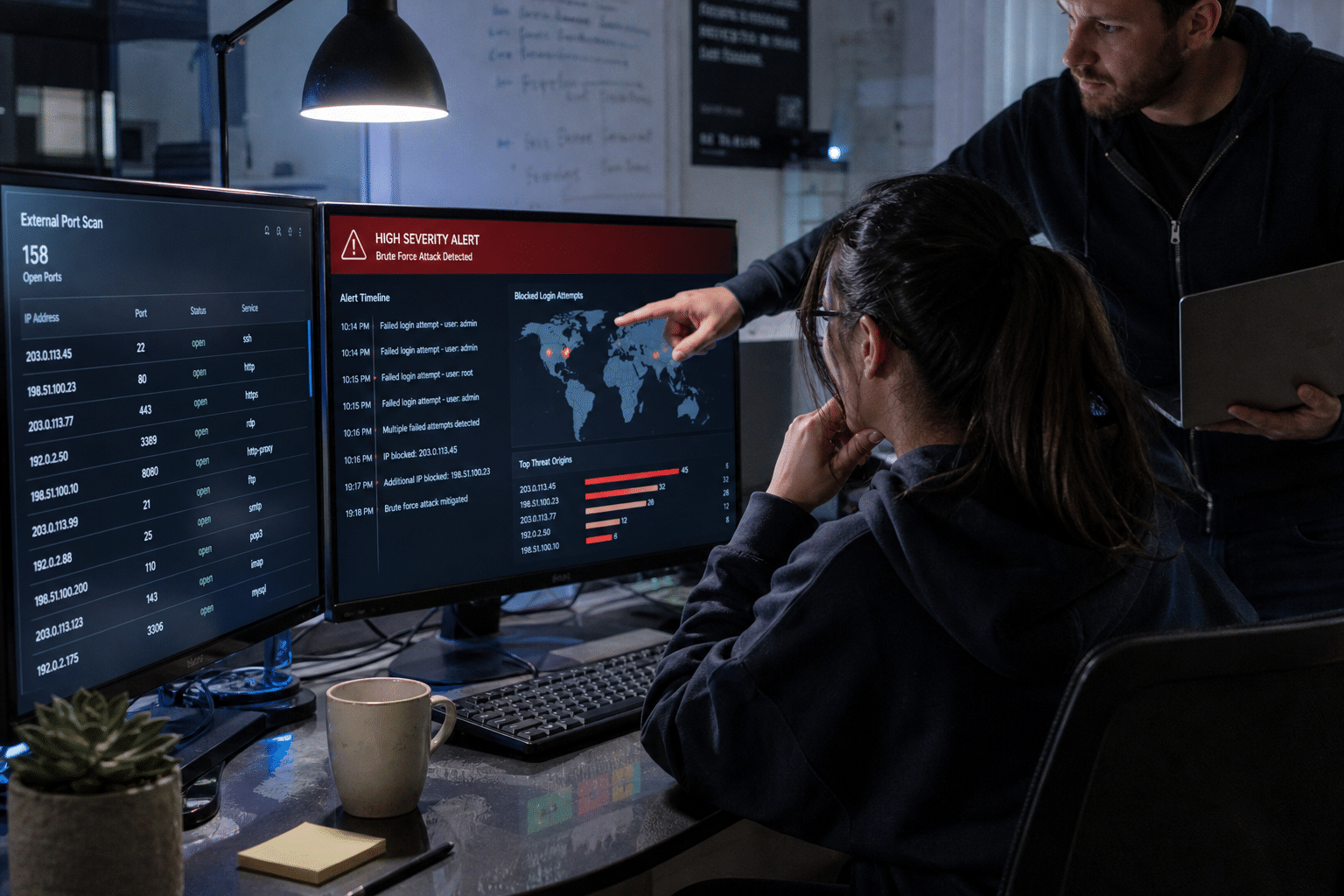
AI-powered cyberattacks are not a new category of attack. They are the old categories, phishing, credential theft, exposed services and unpatched software, executed far faster and with far fewer mistakes. When SecurityWeek reported in October 2026 that attackers had used AI tooling in breaches at Korean banks, the notable detail was not a futuristic technique. It was speed. Reconnaissance that once took a human crew days was compressed into hours, and the window between “an attacker notices you” and “an attacker is inside” shrank with it. For a small or midsize business, that changes the math. Your defenses are no longer measured only by whether they block an attack. They are measured by how quickly you notice and respond when something gets through. The seven defenses below are built around that single idea: shrink your own response window faster than attackers shrink theirs.
Five Principles Behind Defending Against AI-Powered Cyberattacks
Before the seven defenses, here are the five principles our team uses to judge whether a control actually holds up against AI-assisted attackers.
- Speed beats sophistication. AI mostly accelerates attackers. A control that alerts in minutes matters more than one that is clever but reviewed weekly.
- Exposure is the starting line. Automated scanning finds an exposed login page, admin panel or monitoring dashboard within hours of it going online. If it is reachable, assume it has been found.
- Identity is the new perimeter. Most AI-assisted intrusions we see still begin with a stolen or phished credential, so the strength of your sign-in matters more than the strength of your firewall.
- Polish is no longer a warning sign. AI writes clean, well-targeted lures in any language. Staff training that teaches people to spot typos is now out of date.
- You do not need “AI security” to fight AI attacks. The businesses that weathered this year best did the fundamentals faster, not the ones that bought the newest label.
These principles apply to a 15-person accounting office and a 400-person manufacturer alike. The difference is only in how much of the work you run in house and how much you hand to a partner.
Why AI-Powered Cyberattacks Break the Old Small Business Playbook
AI-assisted attacks break the traditional SMB playbook because that playbook assumed attackers were slow, noisy and expensive to run. For years, a small firm could reasonably rely on being a less attractive target than a bank. A human attacker had to choose where to spend scarce hours, and a 40-person firm rarely made the list.
That logic has collapsed. When reconnaissance, lure writing and exploit adaptation are partially automated, the cost of targeting one more company drops close to zero. Attackers no longer choose between you and a bank. They can run both campaigns at once.
How AI Shortens Reconnaissance for Attackers
AI shortens reconnaissance by automating the tedious work of mapping who works at a company, what software it runs and which services face the internet. In our engagements, we now see attackers reference a firm’s real vendors, recent job postings and staff names within the first message.
There is a fair counterpoint. Much of this was possible before with open-source intelligence tools, and determined human attackers always did their homework. What has changed is the volume. A task that used to justify itself only for a high-value target now costs almost nothing.
Both views lead to the same practical conclusion: assume your public footprint has already been mapped. Review what your website, job ads and social profiles reveal about your systems, and remove anything an attacker could turn into a convincing pretext.
Why Exposed Interfaces Are Found Within Hours
Exposed interfaces are found within hours because automated scanners sweep the entire public internet continuously, and AI helps attackers sort the results and decide what to try first. The same SecurityWeek roundup noted GPU monitoring dashboards left open to the internet and leaking telemetry, which is a textbook example.
Some administrators argue that an obscure port or an unlisted URL offers protection. In practice, obscurity buys days at most. Scanners do not need a link; they enumerate every address.
The honest middle position is that obscurity is not worthless, but it is never a control on its own. Every management console, remote desktop gateway and monitoring panel belongs behind a VPN or an identity-aware proxy, full stop.
Where Small Firms Lose the Race on Response Time
Small firms lose the race on response time because alerts land in an inbox nobody watches after 5 p.m. We regularly find environments with perfectly reasonable security tools whose alerts went unread for a weekend.
Others point out that a small business cannot staff a 24-hour operations center, and that is true. The answer is not to build one; it is to make sure someone, internal or a partner, is accountable for every high-severity alert around the clock.
Defense 1 and 2: Shrink the Attack Surface AI Scanners Find First
The first two defenses against AI-assisted attackers target the doors that automated scanning reaches before any human attacker does: exposed services and outdated software.
Defense 1: Inventory and Close Every Internet-Facing Service
Closing internet-facing services starts with a real inventory, not a memory of what IT set up three years ago. Run an external scan of your own address ranges and domains, list every open port and login page, and assign an owner to each one.
Our team typically finds two or three forgotten services in a first scan: an old remote desktop port, a vendor’s support portal, a camera system or a printer management page. Each one is a door that an AI-assisted scanner will try within a day.
Some argue that a properly configured firewall makes this unnecessary. A firewall only blocks what it is told to block, and exceptions accumulate. Our managed firewall services include quarterly rule reviews precisely because exceptions drift. The goal is a short, documented list of services that truly need public exposure, with everything else behind a VPN.
Defense 2: Patch Edge Devices on a 72-Hour Clock
Edge devices such as VPN appliances, firewalls and file-transfer servers should be patched within 72 hours of a critical advisory, because AI helps attackers turn a published fix into a working exploit far faster than before.
There is a real tension here. Rushing patches onto production systems can break things, and some businesses have been burned by a bad update. A sensible compromise is a two-tier schedule: internet-facing devices on a 72-hour clock with a tested rollback, and internal systems on a normal monthly cycle.
The penetration testing work we do frequently shows that one unpatched edge device outweighs dozens of well-patched laptops. Prioritize what faces the internet.
Defense 3 and 4: Make Stolen Credentials Worthless
These two defenses accept that AI-written phishing will eventually fool someone, and focus on making a stolen password useless once it is taken.
Defense 3: Move to Phishing-Resistant MFA
Phishing-resistant multi-factor authentication, such as FIDO2 hardware tokens or device-bound platform authenticators, stops credential theft because there is no code for an attacker to relay. Push notifications and text codes can be intercepted or approved by a tired employee during an MFA fatigue attack.
Critics note that hardware tokens cost money and add friction. That is fair, and the rollout does not have to be universal on day one. Start with administrators, finance staff and anyone who approves payments, since those accounts are what AI-assisted business email compromise campaigns target first.
Defense 4: Retrain Staff for Polished Lures
Security awareness training must now teach staff to verify requests, not to spot sloppy writing. AI produces flawless grammar, mimics a CEO’s tone and references real projects, so the old “look for typos” advice no longer works.
Some leaders question whether training helps at all when lures are this convincing. The evidence from our clients says yes, if the training changes behavior rather than just recognition. Our security awareness training focuses on one habit: any request involving money, credentials or data gets confirmed through a second, known channel. That habit defeats a voice clone as easily as an email.
Where Deepfake Voice Calls Fit In
Voice cloning is the same problem in a different channel. A phone call that sounds like your CFO asking for an urgent wire is simply a phishing lure delivered by audio. The callback rule above covers it, provided the callback goes to a number already on file, never the number that called.
Defense 5 and 6: Detect and Respond Inside the Attacker’s Window
Defenses five and six address the original insight of this article: when AI compresses an attacker’s timeline, your detection and response timeline has to compress too.
Defense 5: Put 24/7 Eyes on High-Severity Alerts
Around-the-clock monitoring of high-severity alerts is the single most effective change most small businesses can make. Endpoint detection and response tools are already widely deployed; the gap is almost always who reads the alerts at 2 a.m. on a Saturday.
There is an honest argument for keeping this in house: your staff know the environment. The counterargument is coverage. Few firms under 500 employees can staff nights and weekends. Our managed security services exist to fill exactly that gap, and many clients run a co-managed model where internal IT owns business hours and we own the rest.
For a closer look at how behavioral detection catches what signatures miss, see our guide to AI-powered threat hunting and our breakdown of AI-powered malware and how to defend against it.
Defense 6: Pre-Approve Your First Response Moves
Pre-approving response actions means deciding in advance who can isolate a laptop, disable an account or cut a VPN session without waiting for a meeting. In incidents we have worked, the costliest delay was rarely technical. It was a responder waiting for permission.
Some owners worry that pre-authorized isolation will disrupt operations over a false alarm. That risk is real but small, and an hour of lost productivity on one laptop is trivial next to a ransomware event. Write a one-page playbook, name the decision makers, and rehearse it twice a year. Our article on protecting your business from AI-powered cyber extortion and ransomware walks through what that playbook should contain.
Defense 7: Govern the AI Tools Your Own Team Uses
The seventh defense recognizes that attackers increasingly target the AI tools businesses themselves have adopted, along with the software packages those tools depend on.
Control What Data Flows Into AI Assistants
Controlling AI assistant usage means approving which tools staff may use, which data they may paste in, and which accounts those tools connect to. Unapproved browser extensions and AI plug-ins with broad mailbox access have become a quiet path into business email.
A reasonable objection is that banning AI tools drives usage underground. We agree, which is why we recommend an approved list with sensible data rules rather than a blanket ban. Our piece on whether AI tools like GPT and Claude are vulnerable to cyberattacks covers the common weak points.
Watch the Software Supply Chain Behind AI Integrations
The same SecurityWeek roundup reported a compromised software development kit published to a public package registry. Any business running custom integrations should pin package versions, review dependency updates before deploying them, and limit the permissions those integrations hold. A compromised package with read-only access is an inconvenience; one with administrator rights is a breach.
Frequently Asked Questions
Are AI-powered cyberattacks a real threat to small businesses?
Yes, AI-assisted attacks are a real and growing threat to small businesses because AI lowers the cost of targeting any individual company. Attackers can now run polished, personalized campaigns against many small firms at once, which removes the old protection of being too small to notice.
Do I need AI security tools to defend against AI attacks?
No, most small businesses defend best by executing proven fundamentals faster rather than buying products labeled as AI security. Phishing-resistant MFA, closed external exposure, fast patching of edge devices and 24/7 alert coverage stop the large majority of AI-assisted intrusions we see.
How fast should we respond to a high-severity security alert?
A high-severity alert should be triaged within minutes and contained within the hour, at any time of day. Because AI compresses an attacker’s timeline, an alert that waits until Monday morning often arrives after the damage is done.
How can employees recognize AI-generated phishing?
Employees usually cannot recognize AI-generated phishing by its writing quality, so the reliable defense is verifying the request rather than judging the message. Any request involving payments, credentials or sensitive data should be confirmed through a separate, known channel before anyone acts.
What should we ask our IT provider about AI-powered threats?
Ask your provider who watches your alerts overnight, how quickly internet-facing devices are patched after a critical advisory, and which of your accounts still rely on text or push MFA. Clear answers to those three questions reveal more about your exposure than any product list. Our explainer on how cyberattacks really start in businesses offers more questions to raise.
Who Is Behind This Guidance
Mindcore Technologies has spent years protecting small and midsize businesses across healthcare, finance, legal and manufacturing, and the seven defenses above come directly from incidents our security team has investigated and environments we have hardened. We see AI-assisted attacks in client environments every week, and our advice reflects what actually stopped them, not what vendors claim might. Our role is to guide your team through the decisions; your people remain the ones who carry the plan out day to day. Mindcore CEO Matt Rosenthal focuses the company on practical, measurable security outcomes for growing businesses, with an emphasis on response speed and clear accountability over tool sprawl.
Book a Free Strategy Call to Close Your Response Gap
AI-powered cyberattacks reward the attacker who moves fastest, so the most valuable thing a small business can do is shorten the time between an attacker’s first step and its own response. Close the internet-facing doors that automated scanners find first, patch edge devices on a short clock, make stolen credentials worthless with phishing-resistant MFA, retrain staff to verify rather than to spot typos, put round-the-clock eyes on high-severity alerts, pre-approve your first response moves, and govern the AI tools and software packages your own team relies on. None of these defenses requires a new product category, and each one can be measured: how many services are exposed, how many hours a critical patch takes, how many minutes an alert waits. If you are not sure where your business stands on those numbers, we can help you find out and build a realistic plan to improve them. Book a free strategy call with our security team and we will walk through your exposure, your alert coverage and your response playbook together.

