

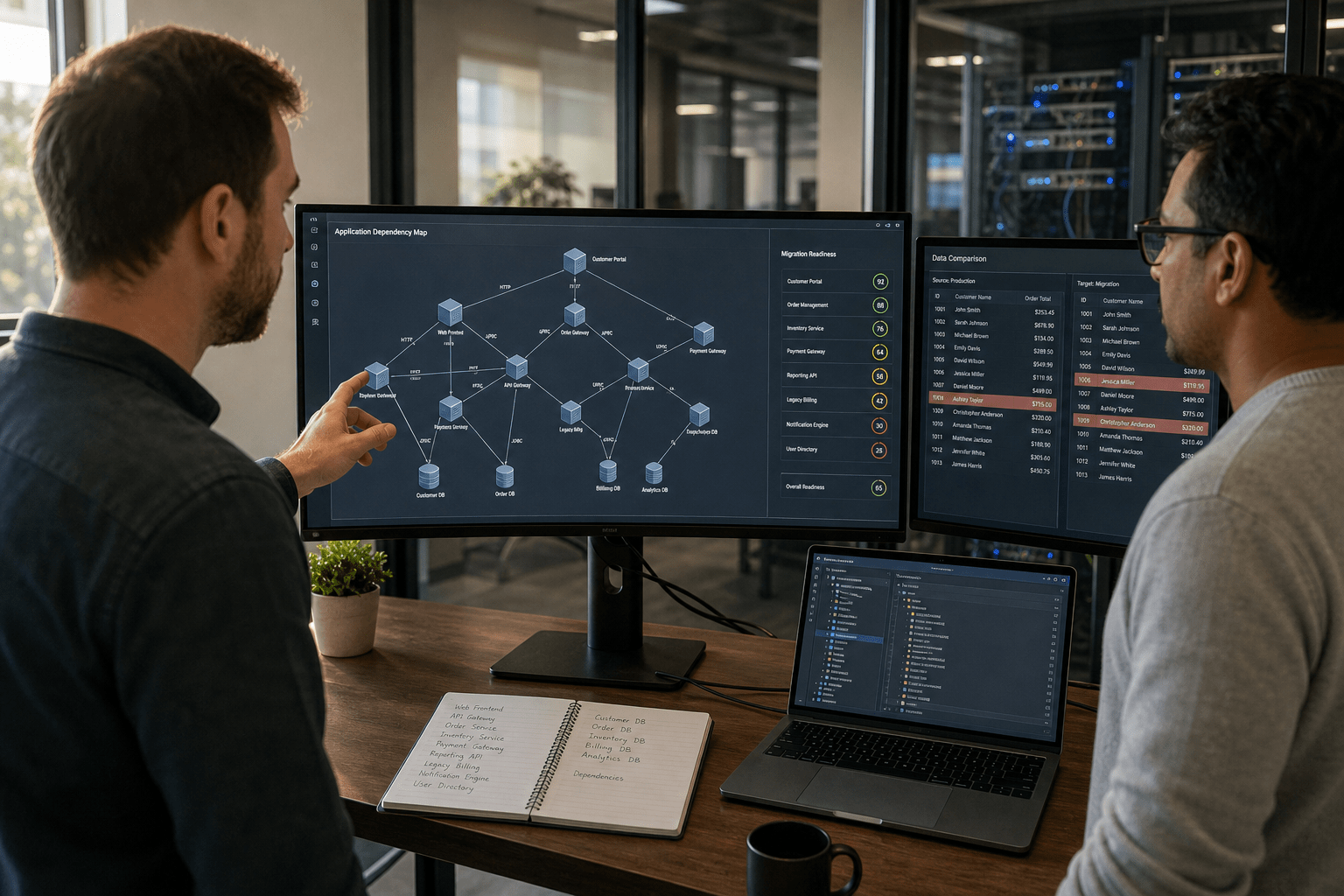
The best AI tools for enterprise software migration projects cluster at two ends of the work, and neither end is the rewrite. At the front, dependency discovery platforms such as Faddom, AWS Application Discovery Service, and readiness scoring in Cortex tell you what actually talks to what before anything moves. At the back, reconciliation engines such as Datafold’s Migration Agent prove row by row that the target system returns the same answers as the source. In the middle sits conversion tooling: AWS Schema Conversion Tool for database objects, Copilot-class assistants for application code, and vendor-tied converters for older stacks. We buy the ends first. The middle is where teams instinctively spend, and it is the part that rarely decides whether a migration lands on time.
Overview: Five Things That Decide a Migration Before the Tools Do
- Migrations slip in discovery, not development. The integration nobody documented is the one that halts cutover at 3 a.m., and no amount of generated code fixes an unmapped dependency.
- Reconciliation is the deliverable, not the receipt. A migration is finished when the target reproduces the source’s outputs under real queries, not when the last record copies across.
- Buy tools that produce evidence. Scorecards, dependency graphs, and row-level diffs survive an audit and a steering committee. Chat transcripts do not.
- Older stacks change the math. COBOL, Delphi, and heavily customized ERP carry conversion tooling that is narrow, vendor-tied, and worth paying for precisely because it is narrow.
- The audience matters. A 60-person firm moving one ERP and a 4,000-seat manufacturer moving 300 applications need different tooling, and the vendor comparison charts almost never say so.
Why Enterprise Migration Projects Overrun Long Before Cutover Weekend
Enterprise migration projects overrun because the scope discovered in month three was never in the plan written in month one. Our team has watched this pattern hold across ERP moves, data-center exits, and platform consolidations: the engineering was fine, and the inventory was wrong. Tooling that front-loads discovery buys back more schedule than anything applied later, which is the same lesson we wrote up in avoiding the pitfalls of a cloud migration.
The Integrations Nobody Documented
Undocumented integrations are the single largest source of unplanned migration scope, and dependency mapping tools find them by watching traffic rather than reading documentation. Faddom builds its map from network flow without agents, which is why it surfaces the finance server quietly calling a reporting database that no architecture diagram shows. AWS Application Discovery Service does similar work inside AWS-bound programs, feeding an inventory that later planning stages consume directly.
The opposing case is real. Flow-based discovery observes a window, so a process that runs quarterly can be invisible during a four-week capture, and teams have moved workloads confident in a map that simply never saw the year-end job. Agent-based collection catches more but takes change-control approval on every host, which is its own schedule cost.
Both readings are defensible, and the honest position is that neither method returns a complete inventory on its own. We run flow-based discovery for breadth, then interview the application owners about anything that runs monthly or annually, because the calendar-driven job is the recurring blind spot in every automated map we have seen.
Freeze Windows Collide With the Business Calendar
Migration freeze windows fail when they are planned against the IT calendar instead of the revenue calendar. Readiness platforms such as Cortex help here in an indirect way: their scorecards expose which services have owners, runbooks, and rollback paths, so the cutover sequence follows operational maturity rather than a wishlist. A service with no named owner is a service nobody can approve a freeze for.
Set against that, scorecards measure what teams have written down. A well-documented service can still be the one carrying an undocumented batch job, and a thinly documented service run by an engineer who knows it cold may migrate without incident. Maturity scoring rewards paperwork, and paperwork is a proxy for readiness rather than readiness itself.
We treat the scorecard as a sequencing aid and nothing more. It tells us where to start asking questions, and the answers come from the people who run the systems. Firms without that internal bench usually bring in co-managed support to keep a migration plan on course rather than staffing the whole program in-house.
The Test Environment That Never Matched Production
Migration testing gives false assurance when the lower environment carries a fraction of production’s data and none of its concurrency. We see this most often on ERP and line-of-business applications: the test instance holds last year’s refresh, the integrations point at stubs, and a batch process that takes eleven minutes on a thin dataset takes four hours against the real one. The cutover plan was built on the eleven minutes.
AI tooling helps at the edges here. Discovery platforms record actual transaction volumes and peak concurrency, which turns the sizing conversation into arithmetic rather than an argument between the application owner and the infrastructure lead. Readiness scoring flags services whose test coverage is thin before those services reach the migration wave, and load figures pulled from observed traffic beat estimates supplied from memory.
The limitation is that no tool builds you a faithful lower environment. Refreshing production data into test raises privacy and licensing questions, masking changes cardinality in ways that alter query plans, and a full-scale test environment costs real money for a project that ends. Plenty of competent teams accept a partial test environment as a deliberate trade and manage the residual risk through staged cutover instead.
Our position is that the trade is fine when it is named. Write down which behaviors the test environment cannot prove, decide what a pilot wave will prove instead, and stop treating a green test result as coverage it does not provide.
Best AI Tools for Enterprise Software Migration Projects: Data Reconciliation
Data reconciliation tools decide whether a migration can be signed off, because they answer the only question an auditor asks: does the new system return the same numbers as the old one. Datafold’s Migration Agent compares source and target at row and column level and reports where they diverge, which converts a subjective sense that the data looks right into a defensible artifact. This is the stage teams under-budget most reliably, and the risks of a cloud migration we see most often trace back to it.
Row-Level Parity Versus Sampling
Row-level comparison catches the errors sampling is built to miss, which is why we push for it on anything touching finance, payroll, or clinical records. Automated diffing runs the same query against both systems and flags mismatches by count, checksum, and value, so a truncated decimal or a timezone shift on a date column surfaces as a list of records rather than a complaint from accounting six weeks later.
The counter-argument is cost. Full comparison on a large estate consumes real compute and can extend a cutover window past what the business will approve, and for low-stakes reference data the spend is hard to justify. Sampling with tight thresholds catches systemic faults, which are the common kind, at a fraction of the runtime.
Neither position wins outright, and the split we recommend follows consequence rather than volume. Financial and regulated tables get full row-level parity, reference and log data get sampled, and the decision gets written down before the cutover so nobody relitigates it during the freeze. One practical note from recent projects: run the comparison once against the source alone, before any data moves, so you learn what your own systems disagree about at baseline. Teams are routinely surprised, and finding a pre-existing mismatch during migration testing wastes a day chasing a fault the migration did not cause.
Schema Drift Between Plan and Production
Schema drift is the gap between the data model the migration was designed against and the one production actually carries, and conversion tooling exposes it early. AWS Schema Conversion Tool reads source objects and reports what converts cleanly, what converts with change, and what needs manual work. That third bucket is the useful output: it is a scoped task list rather than a percentage.
Read the other way, automated conversion reports can create false confidence. A stored procedure that converts without error is not a procedure that behaves identically, and generated equivalents have shipped subtle changes in null handling and sort order that only appeared under production load. The tool reports syntax, and the risk lives in semantics.
Our practice is to treat conversion output as a first draft with a test obligation attached. Anything the tool rewrote gets a parity test against real inputs, and anything it flagged for manual work gets an owner and a date. Firms moving mailboxes and files alongside applications hit the same pattern, which is why we scope Office 365 migration with the same evidence requirement.
Where AI Genuinely Falls Short in a Migration
AI tooling does not decide cutover risk, and treating it as though it does is the failure mode we see in 2026. Generated code, converted schemas, and automated maps all produce output that reads as authoritative, and every one of them carries an accuracy figure that vendors quote against benchmark estates rather than yours. Legacy conversion vendors working in COBOL and Delphi are candid about this, and their own material frames the tool as an accelerator with human review attached.
There is a second gap worth naming, because it costs money rather than accuracy. Most of these platforms price against estate size, and the pricing model assumes the estate you have at signature rather than the one you find in discovery. A firm that starts with an inventory of 90 applications and finds 140 has just changed its own licensing tier partway through the project. We push clients to negotiate discovery and migration licensing separately for exactly this reason, and to run the discovery pass before committing to the platform that consumes its output.
The judgment calls stay human. Which application moves first, what the rollback trigger is, whether the business will accept four hours of downtime or forty minutes: none of that is in the training data, and a model asked to opine will answer anyway. Teams that build enterprise AI integration into their operating model tend to be clearer about this boundary than teams adopting tools mid-project, because they have already decided where a model’s output needs a signature. The same discipline applies to the broader software estate that runs day-to-day operations.
Frequently Asked Questions
What are the best AI tools for enterprise software migration projects in 2026?
The strongest picks pair dependency discovery with data reconciliation: Faddom or AWS Application Discovery Service for mapping, Cortex for readiness scoring, AWS Schema Conversion Tool for database objects, and Datafold’s Migration Agent for parity verification. Platforms such as Glossa bundle planning and execution for teams that want one workspace. The right set depends on estate size and how much of it is legacy.
Can AI tools replace a migration consultant?
No, and the vendors do not claim otherwise. AI tooling compresses discovery, conversion, and verification work that used to run for weeks, but sequencing decisions, rollback criteria, and business sign-off remain human calls. Our team uses these tools to shorten the mechanical work so the planning gets more attention, not less.
How much of a legacy application can AI convert automatically?
That varies by language and by how customized the code is, and any single number quoted without your codebase in hand is marketing. Conversion tools reliably handle mechanical translation and reliably struggle with business logic that was patched over decades. Treat the converted output as a draft requiring parity testing rather than a finished port.
Do these tools work for a mid-sized company, or only large enterprises?
Several work well below enterprise scale, though licensing often assumes a large estate. For firms in the 50 to 500 employee range we usually assemble a smaller set: discovery, one conversion tool matched to the stack, and reconciliation on the tables that carry financial or regulated data. Paying for a full platform rarely pays back at that size.
What should we do before buying any migration tooling?
Inventory first. Run a discovery pass, get the application list confirmed by the people who operate each system, and only then decide what to buy, because tool selection follows estate shape. Buying a platform before the inventory exists is how firms end up with licenses matched to the migration they imagined rather than the one they have.
Who Is Behind This Advice
Mindcore has run migrations across managed IT, cloud, and compliance-bound environments for organizations that cannot afford an unplanned outage, and our cloud migration practice exists because those projects go wrong in predictable ways. The patterns in this article come from that work: the undocumented integration, the reconciliation nobody scoped, the freeze window planned against the wrong calendar. We would rather hand a client a dependency map they did not know they needed than a schedule that looks good until month three.
Matt Rosenthal, Mindcore’s CEO, focuses the firm on the operational side of technology decisions, which is why our migration work starts with inventory and evidence rather than platform selection. That emphasis shapes how our engineers scope every project we take on.
Plan Your Migration With People Who Have Done It
Enterprise migration is not a tooling problem wearing a project’s clothes. The tools in this article are good, and several of them will save your team real weeks, but they save those weeks only when the inventory is honest, the reconciliation is scoped up front, and somebody has decided what triggers a rollback. Teams that get this right treat discovery as the deliverable it is, verify parity with evidence rather than confidence, and keep human judgment on the sequencing calls no model can make for them. Teams that get it wrong tend to buy well and plan late.
If you are scoping a migration for the next two quarters, we can help you size the estate before you commit to a platform. Our engineers work through the application inventory, the dependency map, and the reconciliation plan with your team, and we do that work whether the destination is cloud, hybrid, or a consolidated data center. Firms across the region start with our cloud migration services in New Jersey and move outward from there. Book a free strategy call and we will walk your estate with you.

