

Cloud migration services Louisiana is not the same purchase as cloud migration in a low-risk inland state, and the businesses that treat it as identical get caught by the one factor that defines operating here: storm season. A Gulf-coast company that moves to the cloud gains a real advantage, since systems keep running when an office loses power or internet for days. But that advantage only holds if the migration is designed for regional outages rather than copied from a national playbook that assumes the lights stay on. We have moved Louisiana small and midsize businesses to the cloud for years, and this guide covers what to ask, what it really costs, and where a remote vendor’s quote quietly leaves you exposed.
What Cloud Migration in Louisiana Involves
Cloud migration services Louisiana means moving your business systems, files, email, applications, and databases from local servers or aging desktops into hosted platforms your team reaches from anywhere. For most small and midsize businesses the move centers on three things: email and collaboration, document storage, and the line-of-business applications that run daily operations. The point is not to chase technology. It is to give your team reliable access to the same current information whether they are in the office, working from home, or riding out a storm from another parish.
The platforms most Louisiana SMBs land on are Microsoft Azure, Amazon Web Services, and Microsoft 365 for productivity, with the right choice depending on the applications you already run and the compliance rules your industry carries. A Microsoft Azure migration often fits businesses already invested in Windows and Microsoft tooling, while other workloads suit AWS. The platform matters less than the design, because a well-architected migration on either platform beats a rushed one on the “best” platform every time.
The Louisiana Factor: Building for Storm Season
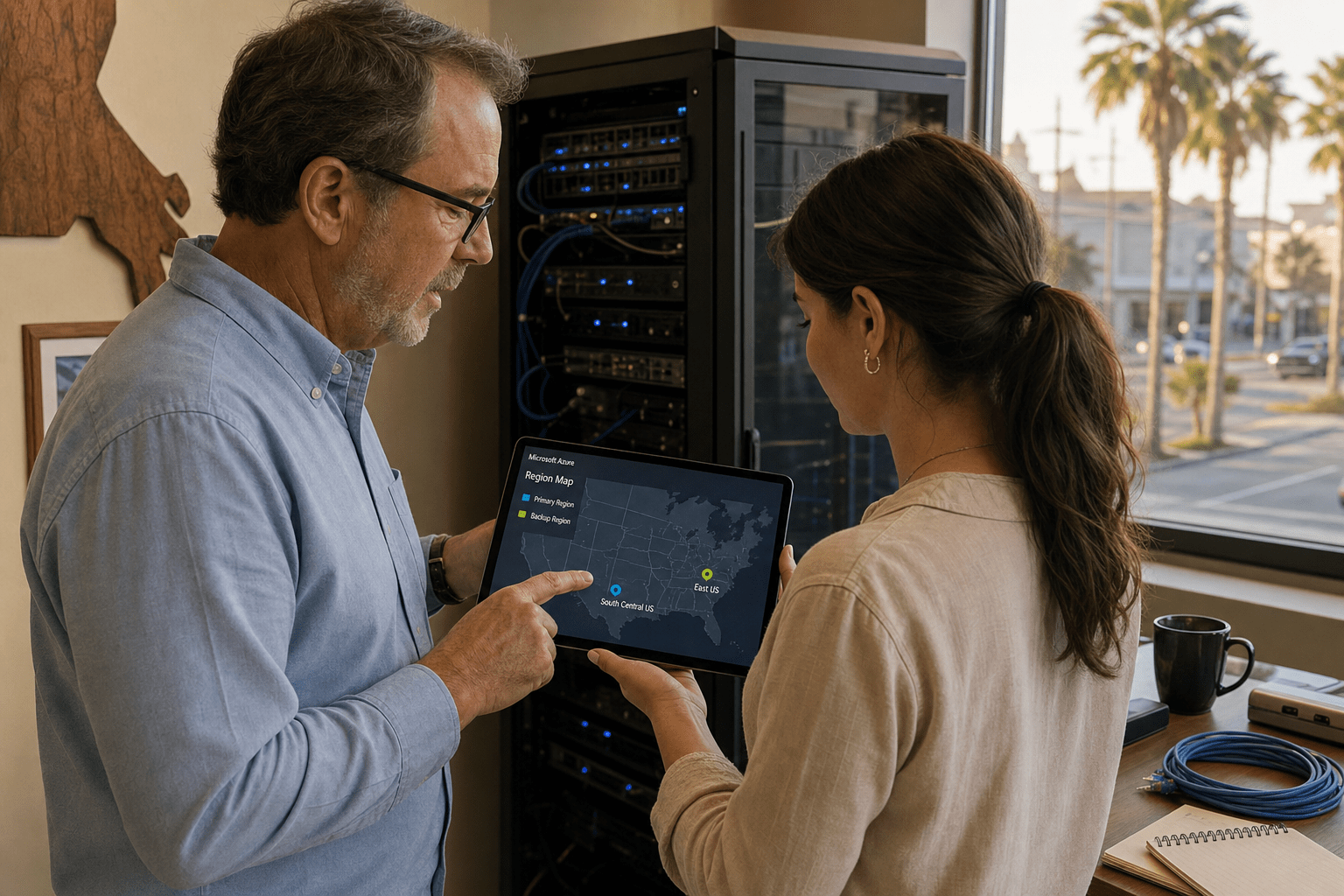
The Louisiana factor in any cloud migration is hurricane-season resilience, and it is the piece a national provider quoting from out of state is least likely to price for you. A migration plan built for a low-risk region often assumes a single availability zone is enough. For a business on the Gulf coast, that assumption is thin. The federal Ready.gov business guidance is direct that continuity planning has to account for the disruptions a region actually faces, and in Louisiana that means multi-day power loss, connectivity outages, and physical access limits during and after a storm.
Cloud can be the strongest answer to that risk, because your systems live in data centers far from the weather, and your team can work from anywhere with a connection. But that only works if the design includes redundancy rather than a single-zone default. A lean quote often leaves out the second region because it costs more, which looks like savings until the season it matters. We build cloud backup with a geographically separate copy for our Louisiana clients precisely because a regional outage during hurricane season is not a hypothetical here, it is a seasonal certainty somewhere in the state.
Why Local Support Shortens Recovery
Local support shortens recovery when a storm disrupts your region, and its value shows up in the hours you stay working, not on the migration invoice. A national help desk handles routine tickets fine. When a regional event hits and every business in the state calls at once, a queue is a queue. The counterpoint is fair: cloud infrastructure itself is location-independent, so in theory support can come from anywhere. In practice, a team that already knows your setup and your region responds faster and asks fewer questions when the pressure is on. That is why pairing the migration with ongoing cloud security and monitoring from a team that knows your environment beats a remote contract that meets you for the first time mid-incident.
What Cloud Migration Costs a Louisiana SMB
Cloud migration services Louisiana costs more than the initial quote when a business plans for the move and nothing after it. Migrations here typically run a few weeks to a couple of months depending on complexity, and the headline transfer fee is only one of several cost drivers. The ones that decide whether the project pays off tend to arrive later.
- Application re-work. Legacy line-of-business apps rarely run well as-is in the cloud. Some need re-platforming, and that work is separate from the migration itself.
- Data movement fees. Getting data into the cloud is cheap. Moving it between regions or pulling it back out carries egress charges that stack up monthly, and a multi-region storm-resilience design increases that traffic on purpose.
- License reshaping. Software you bought once can become a monthly subscription in the cloud, changing your cost model. Some businesses come out ahead, others pay more over three years, so budget for the new shape.
- Resilience engineering. The multi-region backup and tested failover that a Louisiana address needs is a real line item, and treating it as optional is the false saving that surfaces at the worst time.
Microsoft’s own Cloud Adoption Framework treats migration as distinct assess, migrate, and optimize phases for exactly this reason. When a provider quotes only the migrate phase, the assess and optimize costs do not disappear. They land on you later.
Security and Compliance for Louisiana Businesses
Security cannot be an afterthought in a Cloud migration services Louisiana, because moving your data to the cloud changes where the risk lives, not whether it exists. Businesses here handle customer financial data, health records, and contracts that attackers want, and a migration that ignores access controls and monitoring just relocates the target. The CISA cloud security reference architecture is a solid checklist for confirming the security pieces are designed in rather than bolted on after a breach.
Louisiana businesses in regulated industries carry the extra weight of compliance. Healthcare practices answer to HIPAA, financial firms to the safeguards their regulators require, and any business taking cards to PCI rules. A cloud migration is a good moment to get these right, because the same access controls and logging that satisfy an auditor also stop the account takeovers that lead to breaches. The rule is simple: design the security and compliance layer as part of the migration, not as a project you promise to get to next quarter.
How to Choose a Cloud Migration Provider in Louisiana
Choosing a cloud migration provider in Louisiana comes down to whether they plan for how your business actually operates, storm season included. Start by asking any vendor to walk you through their assessment: a provider who quotes a price before inventorying your applications is guessing. Ask specifically how they handle regional resilience, because a provider who does not raise multi-region backup for a Gulf-coast address is quoting for a lower-risk business than yours.
Then confirm the phasing. A phased cloud migration that starts with a scoped Office 365 migration delivers an early win while the heavier application work is planned, and it lowers the risk of a disruptive cutover. Finally, weigh support. When a storm knocks out your region, the difference between a provider who knows your environment and a remote queue is measured in downtime. The businesses that ask these questions up front get a migration sized for Louisiana. The ones who take the cheapest national quote find the gaps during the first bad storm.
Frequently Asked Questions
How long does cloud migration take for a Louisiana small business?
Most small to midsize migrations in Louisiana take a few weeks to a couple of months depending on how many applications and how much data you move. A phased approach that starts with email and collaboration before line-of-business apps spreads the work and lowers risk.
Does moving to the cloud protect my business during a hurricane?
It can, and that is one of the strongest reasons to migrate here, because cloud systems keep running when your office loses power or internet. The protection only holds if the design includes multi-region backup and a tested failover plan rather than a single-zone default.
Which cloud platform is best for a Louisiana business?
The best platform depends on the applications you already run and your compliance requirements. Businesses invested in Microsoft tooling often fit Azure and Microsoft 365, while other workloads suit AWS. A good provider recommends a platform after an assessment, not before.
How much does cloud migration cost in Louisiana?
Cost varies widely because the transfer fee is only one driver. Application re-work, data movement fees, license changes, and the resilience engineering a Gulf-coast address needs all add up. An assessment is the only way to get a real number for your systems.
What should I ask a Louisiana cloud migration provider?
Ask how they assess your applications before quoting, how they design multi-region resilience for storm season, how your licensing will change, and what support looks like during a regional outage. A provider who cannot answer the resilience question clearly is not planning for your address.
Plan a Louisiana Migration That Holds Through Storm Season
Cloud migration services Louisiana rewards the businesses that plan for the region they actually operate in, not the ones who take a national quote at face value. The mobility and collaboration are the easy wins. The resilience that keeps you running when a storm takes out your parish, and the local support that shortens recovery when it does, are the parts a remote vendor is least likely to price and the parts that matter most here. Get the assessment done first, budget for the full year instead of the move alone, and treat storm-season resilience as a required line rather than an upgrade. If you want a plan sized for a Louisiana address, our team will walk your systems, design the resilience layer, and flag the hidden costs before they hit. Book a free strategy call and we will start with the assessment.

