

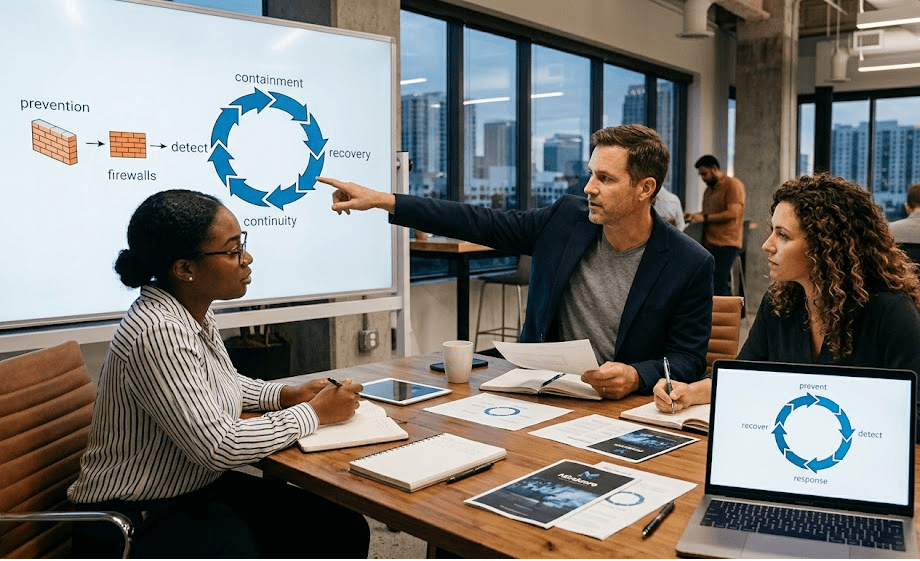
Most business owners think about cybersecurity as a wall. You build it high enough, keep it maintained, and threats stay on the other side. That mental model made sense ten years ago. In 2026, it is the kind of thinking that leaves businesses exposed in ways they do not discover until it is too late.
The conversation has shifted. The question is no longer only whether your defenses can keep attackers out. It is whether your business can keep functioning, recover quickly, and limit damage when an attack gets through. That shift is the difference between cybersecurity and cyber resilience, and understanding it is one of the most important things a business owner or IT decision-maker can do right now.
What Cybersecurity Actually Means
Cybersecurity is the set of tools, practices, and technologies designed to prevent unauthorized access to your systems, data, and networks. It includes your firewall, your endpoint protection, your email filtering, your multi-factor authentication, your patch management, and every other layer of defense built to keep threats out.
Done well, cybersecurity is essential. It reduces your attack surface, catches known threats before they land, and makes your environment significantly harder to penetrate than an unprotected one. No serious conversation about protecting a business starts anywhere other than having strong cybersecurity fundamentals in place.
But cybersecurity operates on a specific assumption: that the goal is prevention. Stop the threat at the perimeter. Block the malicious email. Catch the exploit before it executes. When prevention works, it works well. The problem is that in 2026, prevention alone is not a complete strategy.
Why Prevention Alone Is No Longer Enough
The threat landscape has changed in ways that make perimeter-only thinking genuinely dangerous for modern businesses.
Attackers are faster, better resourced, and more patient than they were even a few years ago. Ransomware groups operate with the sophistication of professional organizations, complete with customer service teams, negotiation specialists, and technical staff who spend weeks inside a target environment before triggering an attack. Phishing campaigns are increasingly personalized and difficult to distinguish from legitimate communication. Zero-day vulnerabilities, by definition, are exploited before defenses exist for them. How ransomware attacks unfold from initial access through encryption explains the extended dwell period that makes prevention-only strategies so costly when they fail.
The data reflects this reality. A significant percentage of businesses that experience a cyberattack had security tools in place at the time of the incident. The tools did not fail in every case. The attackers simply found a path that the tools were not positioned to catch. A misconfigured setting. A credential obtained through social engineering. An older account with elevated permissions that had not been reviewed in years. A vendor connection that created an indirect path into the environment.
Prevention is necessary. It is not sufficient. And building a security strategy around the assumption that prevention will always work is building a strategy around an assumption that attackers are actively working to disprove every day.
What Cyber Resilience Means
Cyber resilience is a broader framework. It encompasses prevention, but it extends beyond it into detection, response, recovery, and continuity. A cyber-resilient business is not just one that is hard to breach. It is one that can detect a breach quickly when it occurs, contain it before it spreads, recover its systems and data without catastrophic downtime, and continue operating through the process.
The components of a cyber-resilient organization include several disciplines working together. Strong prevention controls remain the foundation. But layered on top of that foundation are continuous monitoring systems that can identify anomalous activity in real time, incident response plans that define exactly who does what and when the moment a threat is detected, tested and current backup and recovery systems that can restore critical data and operations on a defined timeline, and business continuity planning that determines how the organization functions while recovery is underway.
Each of those components addresses a different failure mode. Prevention addresses the threat getting in. Monitoring addresses the threat going undetected. Incident response addresses the threat spreading before containment. Backup and recovery addresses the threat destroying data and forcing extended downtime. Business continuity addresses the organization losing operational capacity during the recovery window.
A gap in any one of those areas creates a gap in the overall resilience of the business. An organization with excellent prevention but no tested backup and recovery strategy is one ransomware attack away from extended downtime or a painful ransom decision. An organization with strong backups but no monitoring may not discover a breach until an attacker has been inside the environment for weeks. Each component depends on the others.
The Real Cost of Downtime in 2026
One of the reasons cyber resilience has become a non-negotiable conversation for businesses of every size is the true cost of downtime, which most business owners significantly underestimate until they experience it firsthand.
Direct financial losses from a cyberattack are the most visible cost: ransom payments if made, costs of incident response and forensic investigation, recovery and remediation expenses, and regulatory fines if sensitive data was exposed and breach notification requirements apply.
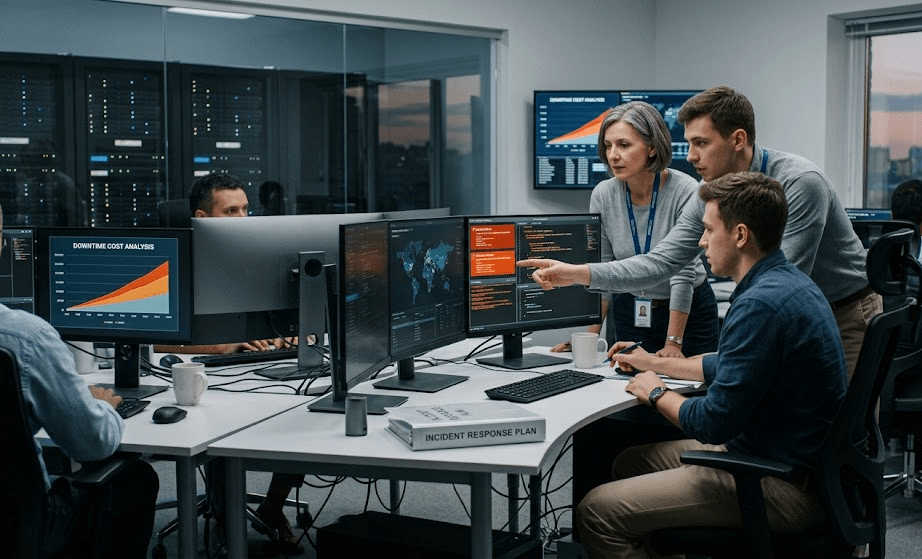
But the indirect costs often exceed the direct ones. Every hour your systems are down is an hour your team cannot operate at full capacity. Every day your customer-facing systems are unavailable is a day your clients are experiencing your business at its worst. Every week your recovery drags on is a week your competitors are available and you are not. And in industries where compliance and data protection obligations exist, the reputational damage from a disclosed breach can affect customer relationships for years. Calculating the true cost of system downtime provides the financial framework that helps businesses quantify this exposure before an incident makes it concrete.
The businesses that recover fastest from a cyberattack are almost never the ones that were simply lucky. They are the ones that had thought through the recovery scenario before it happened, tested their backup systems, defined their incident response process, and built a relationship with a security team that could act immediately when something went wrong. That preparation is what cyber resilience looks like in practice.
What Modern Businesses Actually Need in 2026
Translating the concept of cyber resilience into a practical framework for a small or mid-sized business means addressing several areas that many organizations currently have gaps in.
Continuous monitoring is the most common gap. Many businesses have security tools that generate alerts but no team actively reviewing and responding to those alerts around the clock. An alert that nobody acts on is not security. It is the illusion of security. Effective monitoring requires either an internal team with the capacity to respond immediately when something surfaces or a managed security partner that provides that function on your behalf.
Tested backup and recovery is another area where the gap between what businesses think they have and what they actually have is often significant. Having a backup system is not the same as having a tested, current, recoverable backup. Backups that have not been tested regularly may not restore cleanly. Backups that are stored on systems connected to the primary network can be encrypted in a ransomware attack along with everything else. A backup and recovery strategy that has not been walked through end to end is a strategy that has never been proven to work. Disaster recovery services that include backup isolation architecture and documented restoration testing address this gap specifically.
Incident response planning is the area businesses most consistently skip entirely until after they have experienced an incident. When a breach happens, the worst time to figure out who calls whom, who has authority to take systems offline, who contacts affected parties, and who manages communications is in the middle of the event. Organizations that have a documented, practiced incident response plan contain breaches faster, recover faster, and make better decisions under pressure than those who are improvising. What a complete incident response plan must include gives business leaders the specific framework for building this capability before an attack makes it urgent.
Vendor and third-party risk management has become increasingly important as attackers use supply chain and vendor access as entry points into target environments. Reviewing the security posture of vendors with access to your systems and data is no longer optional due diligence. It is a core component of a complete resilience strategy.
How Mindcore Approaches Cyber Resilience for SMBs
At Mindcore Technologies, we work with small and mid-sized businesses across Florida, New Jersey, South Carolina, and Louisiana to build security programs that go beyond the perimeter. Our managed cybersecurity services are designed around the full resilience framework: prevention, detection, response, and recovery working together as an integrated program rather than a collection of individual tools.
We bring 24/7 monitoring with human response, backup and disaster recovery solutions that are tested and verified, incident response planning tailored to each client’s environment, and the ongoing strategic guidance that allows businesses to stay ahead of a threat landscape that does not stop evolving.
The businesses we work with are not large enterprises with dedicated security teams and unlimited budgets. They are companies like yours, running lean, growing, and carrying real risk that a single serious incident could disrupt significantly. Our job is to make sure that if something gets through, the damage is contained, the recovery is fast, and the business keeps moving.
Meet Our CEO, Matt Rosenthal
Matt Rosenthal is the President and CEO of Mindcore Technologies. With extensive experience in cybersecurity strategy and managed IT services for small and mid-sized businesses, Matt leads a team focused on building security programs that protect businesses not just from attacks, but from the operational disruption that follows one. He works directly with business owners and executives to ensure their security posture matches the real risk their businesses face in today’s threat environment.
Frequently Asked Questions
What is the difference between cybersecurity and cyber resilience?
Cybersecurity focuses on preventing threats from accessing your systems. Cyber resilience is a broader framework that includes prevention but extends into detection, response, recovery, and business continuity. A cyber-resilient organization is prepared not just to block attacks but to survive and recover from them quickly when prevention is not enough.
Does my small business really need cyber resilience, or is basic cybersecurity enough?
Basic cybersecurity is the foundation, but it is not a complete strategy on its own. Small and mid-sized businesses are targeted frequently precisely because attackers know their defenses are often less mature than larger enterprises. A resilience framework ensures that if a threat gets through, your business can detect it, contain it, and recover without extended downtime or catastrophic data loss. The top cybersecurity threats facing small businesses today covers the specific attack patterns that make resilience planning, not just prevention, the appropriate standard for SMBs in 2026.
What does a tested backup and recovery strategy actually involve?
A tested backup strategy means regularly verifying that your backups are completing successfully, that the data can be restored cleanly, and that the restoration process has been walked through end to end so your team knows exactly what to do. It also means ensuring backups are stored in a location that cannot be reached by ransomware affecting your primary systems.
How quickly should a business be able to recover from a cyberattack?
Recovery timelines depend heavily on preparation. Businesses with tested backup and recovery systems, documented incident response plans, and a managed security partner in place recover significantly faster than those without. The goal of cyber resilience planning is to define your acceptable recovery time objective before an incident occurs and build the infrastructure to meet it.
What is an incident response plan and does my business need one?
An incident response plan is a documented process that defines exactly what your organization does when a security incident is detected: who is notified, who has authority to take action, how affected systems are isolated, how stakeholders and potentially affected parties are communicated with, and how recovery is managed. Every business that relies on its IT systems to operate needs one.
How do I know if my current security program covers cyber resilience or just prevention?
If your current security program consists primarily of antivirus, a firewall, and periodic patching, you have a prevention layer but not a resilience framework. The questions to ask are: do we have 24/7 monitoring with human response, have we tested our backups in the last 90 days, and do we have a documented incident response plan? If the answer to any of those is no, there are gaps worth addressing. Contact Mindcore to assess your current resilience posture and identify where the gaps are before an incident surfaces them.

