

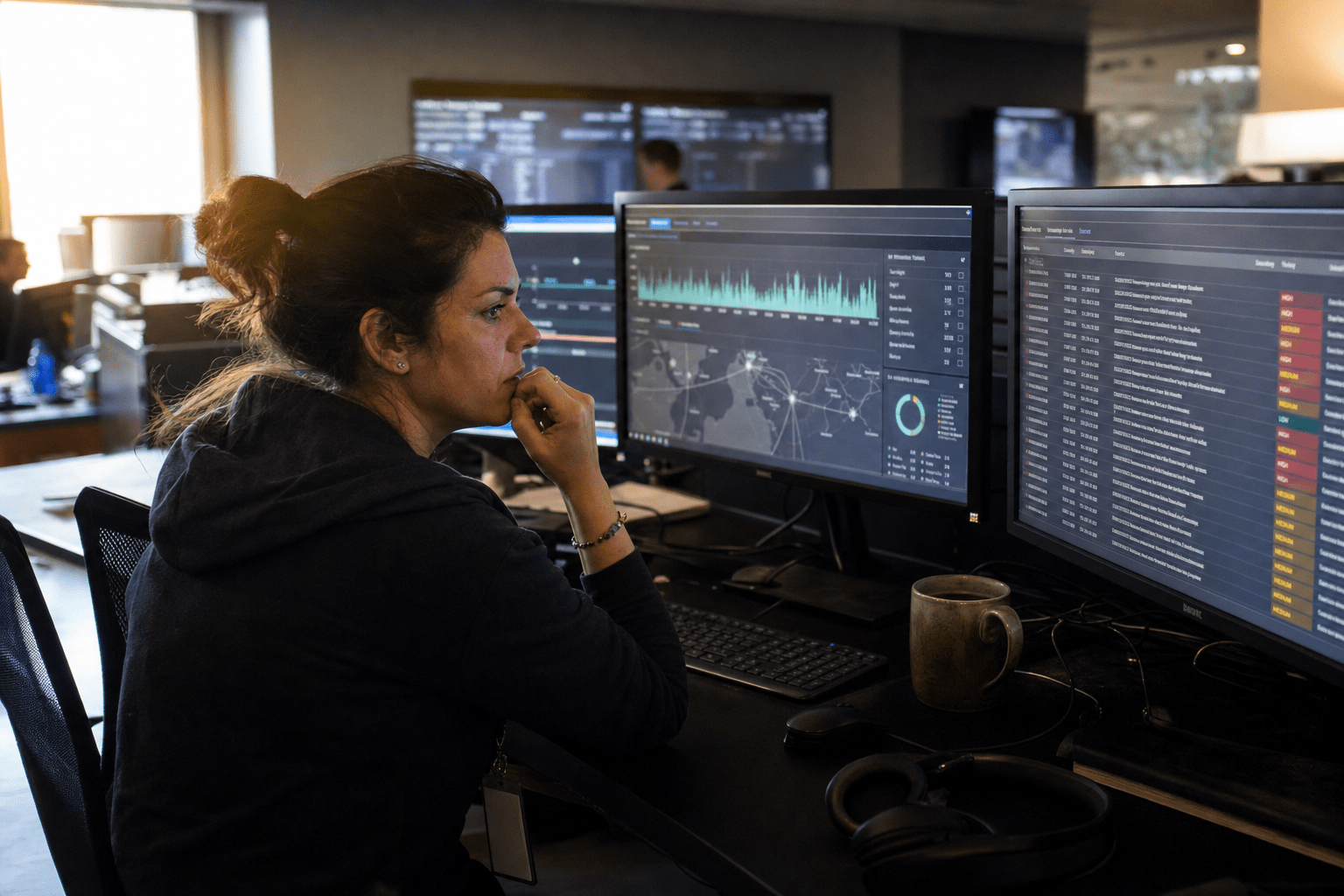
For most Savannah businesses, choosing between an in-house hire and Cybersecurity Savannah provider depends on coverage hours, regulatory obligations like CMMC, and acceptable risk levels. A managed Cybersecurity Savannah provider delivers a team, 24/7 monitoring, and documented compliance, compared to relying on a single in-house hire. Below we lay out both paths honestly, with the coastal Georgia and Lowcountry market in mind, so you can decide which one fits the company you are running today.
The Five Things That Actually Decide This Call
Most owners frame this as “employee versus vendor,” but the real decision turns on five practical realities we see across coastal Georgia and South Carolina:
- Coverage hours. One analyst works roughly 40 hours a week. Attackers do not keep that schedule, and ransomware crews favor nights, weekends, and holidays precisely because nobody is watching.
- Compliance weight. If you touch a Department of Defense contract through Savannah’s logistics, port, or manufacturing supply chain, CMMC compliance is not optional, and it demands evidence one generalist rarely produces alone.
- Bus-factor risk. When your entire security program lives in one head, a resignation, illness, or PTO week leaves you exposed with no handoff.
- True cost. A salary is the visible number. Tools, training, certifications, and turnover are the invisible ones.
- Speed to maturity. A provider arrives with stacks, playbooks, and a SOC already running. A new hire builds all of that from zero.
Hold these five against your own situation as you read. They matter more than headcount preference.
Why One In-House Hire Rarely Covers a Savannah SMB
A single in-house cybersecurity hire gives you presence and ownership, but it almost never delivers the coverage a modern threat picture requires. The Savannah and Lowcountry market sits next to a busy port, a defense logistics corridor, and a growing manufacturing base, which means local SMBs face the same targeted attacks that hit larger firms. We have watched promising in-house programs stall not because the person was weak, but because the role was impossible to fill alone. One human cannot monitor a network overnight, respond to an incident at 3 a.m., maintain compliance documentation, and still patch systems by Friday.
Can One Analyst Realistically Provide 24/7 Coverage?
Without a Cybersecurity Savannah provider, a single analyst cannot cover 24/7, leaving gaps that attackers frequently exploit. In favor of the in-house model, an on-site person knows your systems intimately and responds fast during business hours. Against it, the math is unforgiving: 168 hours in a week, roughly 40 worked, leaving more than 120 hours where alerts pile up unanswered. The Cybersecurity and Infrastructure Security Agency notes that threat actors routinely time intrusions for off-hours. Some owners bridge the gap with alerting tools that page the analyst at night, which works until burnout sets in. Both sides have merit, and the honest read is that one person plus tooling buys partial coverage, not the continuous watch a managed SOC delivers, which is the same conclusion we reach in the Boca Raton version of this comparison.
What Happens When Your Only Security Person Leaves?
When your only security person leaves, your program leaves with them, and that single-point-of-failure risk is the quietest danger in the in-house model. Supporters of the in-house approach point out that documentation and cross-training can soften the blow, and a disciplined hire who writes runbooks does reduce exposure. Critics counter that small teams rarely find time for that discipline, so institutional knowledge walks out the door during a two-week notice. We have been called in after exactly this scenario, inheriting a network where passwords, vendor contacts, and configuration logic existed only in a departed employee’s memory. Neither view is wrong. The reality is that bus-factor risk is real and grows sharper the leaner your team is.
Does an In-House Hire Cost Less Than It Looks?
An in-house hire almost always costs more than the salary line suggests once you add the full picture. The case for in-house is straightforward: one predictable salary, full attention on your business, and direct control. The case against is everything orbiting that salary, including security tooling licenses, ongoing certification renewals, conference travel, and the cost of replacing the person when they move on. A capable mid-level security professional in the region commands a competitive wage, and the surrounding stack often matches or exceeds it. Both framings are fair. We simply encourage owners to compare the loaded cost, not the headline number, before deciding.
How Managed Cybersecurity Savannah Providers Change the Equation
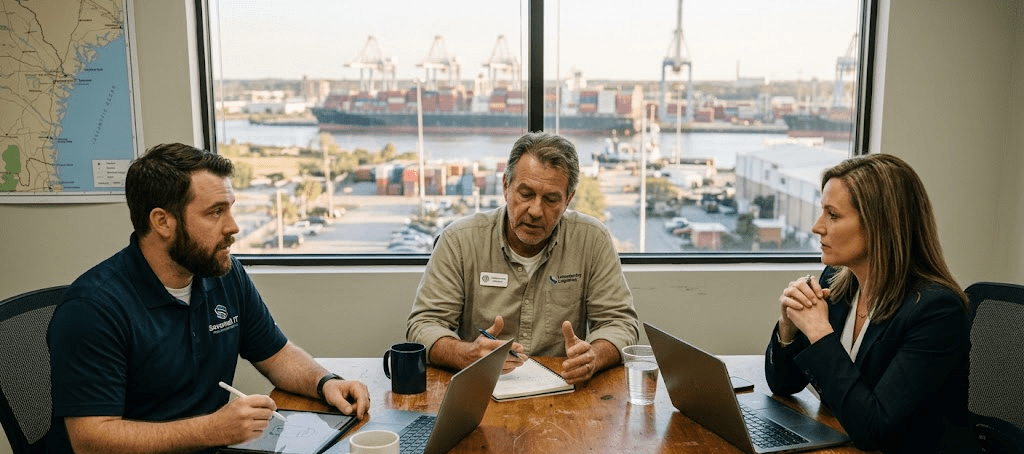
A managed cybersecurity Savannah provider changes the equation by replacing one person with a team, a 24/7 security operations center, and pre-built compliance machinery. A security operations center, or SOC, is a staffed facility that monitors and responds to threats continuously. Instead of waiting for your single analyst to build maturity over years, you inherit an established program on day one. That said, the managed model is not a cure-all, and we will hold both sides of that honestly below. The right answer depends on your risk tolerance, your compliance exposure, and how much control you want to keep in-house.
How Does 24/7 SOC Coverage Compare to a Single Hire?
A 24/7 SOC compares to a single hire the way a fire department compares to a single smoke detector: both detect, only one responds at scale at any hour. For the managed side, continuous monitoring means an analyst sees the suspicious login at 2 a.m. and contains it before it spreads. Our managed cybersecurity services and emergency response capability are built around exactly that always-on posture. For the in-house side, a dedicated employee may understand your specific quirks better than a rotating SOC roster. The fair conclusion is that depth of coverage favors the SOC, while depth of context can favor the hire, and mature providers close that context gap with onboarding and named account leads.
Can a Provider Handle CMMC and Defense-Contractor Requirements?
Engaging a Cybersecurity Savannah provider ensures CMMC and defense-contractor compliance is managed effectively with documented, repeatable processes. The Cybersecurity Maturity Model Certification, governed by the Department of Defense CMMC program and built on NIST SP 800-171 controls, requires evidence across more than a hundred practices. For Savannah firms in the port and logistics supply chain, this is increasingly a condition of winning work. Supporters of in-house argue a dedicated compliance-minded hire can own this. Skeptics note that one person assembling, maintaining, and auditing that evidence is stretched thin. Our cybersecurity compliance practice exists for this exact pressure. Both paths can reach certification; the provider path usually reaches it faster with less single-person dependency.
Do You Lose Control by Outsourcing Security?
You do not lose control by outsourcing security, though you do trade some direct oversight for scale and resilience. The argument for keeping it in-house is autonomy: decisions stay under your roof, and response reflects your priorities without a service ticket. The argument for the managed model is that real control comes from visibility and outcomes, not from physical proximity, and a good provider gives you dashboards, regular reviews, and a clear escalation path. We have seen this work cleanly, as our cloud cybersecurity case study illustrates, where a client kept strategic control while we ran the daily watch. The balanced view: outsourcing shifts the type of control you hold, not the amount.
Frequently Asked Questions
Is managed cybersecurity in Savannah better than hiring in-house?
Managed cybersecurity in Savannah is better for most SMBs that need continuous coverage and compliance support without the overhead of building a full team. An in-house hire can be the right call for larger firms with steady budgets and well-defined internal processes. The deciding factors are coverage hours, compliance exposure, and how much single-person risk you can absorb, the same math behind managed IT versus in-house IT.
How much does cybersecurity cost for a small business in Savannah?
Cybersecurity cost for a small Savannah business depends on whether you hire or partner with a provider. A single qualified analyst carries a competitive salary plus tooling, training, and turnover costs that often double the headline figure. A managed provider typically bills a predictable monthly fee that bundles the team, the SOC, and the compliance work.
Do Savannah businesses need CMMC compliance?
Savannah businesses need CMMC compliance if they handle controlled information through a Department of Defense contract, directly or through the supply chain. Given the city’s port, logistics, and manufacturing footprint, more local firms fall under this requirement than expect to. Reviewing your contracts and data flows is the first step to knowing where you stand.
What is a SOC and why does it matter for coverage?
A SOC, or security operations center, is a staffed facility that monitors and responds to security threats around the clock. It matters because attacks frequently occur outside business hours, when a single in-house analyst is offline. A SOC keeps eyes on your environment continuously, closing the overnight and weekend gaps.
Can a managed provider work alongside our existing IT staff?
A managed provider can work alongside existing IT staff, and the two often complement each other well. Your internal team keeps the institutional knowledge and day-to-day operations, while the provider supplies specialized security depth and 24/7 monitoring. Clear roles and a shared escalation path keep the arrangement smooth.
Make the Call With Confidence
When evaluating Cybersecurity Savannah, the key decision centers on coverage, compliance, and single-point-of-failure risk, rather than just comparing in-house personnel to vendors. A single hire brings ownership and on-site familiarity, and for some firms that is enough. For the many Savannah and Lowcountry SMBs sitting near the port and the defense supply chain, the gaps in overnight coverage, the weight of CMMC, and the danger of resting everything on one person tend to point toward a managed partner with a real SOC behind it. The honest path forward is to weigh your loaded costs, your contract obligations, and your tolerance for single-point failure, then choose deliberately. If you want a clear read on where your business actually stands, our team is ready to walk through it with you. Book a free strategy call and explore our cybersecurity resources to start mapping the right fit.
Savannah Cybersecurity Strategy and In-House vs. Managed Security Expertise from Matt Rosenthal
Matt Rosenthal, CEO of Mindcore Technologies, has over 30 years of experience helping Savannah and Lowcountry SMBs make the in-house versus managed security decision with clear eyes about coverage hours, CMMC exposure, and the single-point-of-failure risk that grows sharper the leaner the team. He has seen firsthand how promising in-house programs stall not because the hire was weak but because the role was impossible to fill alone, and how firms in Savannah’s port, logistics, and defense supply chain inherit a compliance obligation one generalist rarely has the bandwidth to document and maintain. Matt leads a team that provides 24/7 SOC coverage, pre-built CMMC compliance machinery, and a named account structure that closes the context gap managed providers are often criticized for, so Savannah businesses get continuous coverage without resting their entire security program in a single person who can resign, burn out, or go on vacation.

