Posted on

In-House vs. IT Company Orlando: Pros, Cons, Real-World Tradeoffs

In-House vs. IT Company Orlando

Orlando’s business landscape spans hospitality and tourism technology, healthcare systems, defense and aerospace contractors, financial services firms, and a growing professional services sector. Each of these industries has different technology demands, different regulatory obligations, and different risk profiles that shape what IT support actually needs to look like.

The choice between building an in-house IT team and partnering with an IT company in Orlando is not a generic decision. It is a decision specific to your organization’s size, your industry’s requirements, your budget constraints, and your realistic assessment of what each option actually delivers rather than what it theoretically could deliver.

This article covers the real-world tradeoffs between in-house IT and managed IT company relationships in the Orlando market, industry-specific considerations that affect the decision, and the honest assessment of where each model tends to succeed and where it tends to fall short.

What In-House IT Actually Provides

In-house IT means employing one or more IT professionals directly. What that provides depends heavily on who you hire, how many people you can afford, and what their specific skill sets cover.

The Genuine Advantages of In-House IT

  • Environmental familiarity. An in-house IT professional who has worked in your environment for years knows exactly which systems are most operationally critical, which processes are most sensitive to downtime, which vendors have the best service relationships, and what the quirks of your specific infrastructure are. This knowledge accelerates troubleshooting and makes system changes less risky.
  • Organizational relationship depth. An in-house IT person attends the same meetings, knows the same people, and understands the business context that determines technology priorities. When the marketing team needs a new tool or the operations manager wants to streamline a process, the in-house IT person has the organizational context to evaluate those requests against the broader technology strategy.
  • Physical presence. For organizations with significant on-premises infrastructure or with operations that require frequent hands-on hardware work, having someone who can physically be present is genuinely valuable. An in-house IT person can walk to a server room, sit next to a user who is having a problem, and be visibly present during critical periods.

The Real Limitations of In-House IT

  • Skill coverage is constrained by headcount. Modern IT environments require expertise across networking, security, cloud platforms, endpoint management, backup and recovery, compliance, and application support. A single in-house IT professional or even a small team of two to three people cannot have deep expertise in all of these domains. They will be competent generalists with specific depth in some areas and meaningful gaps in others.
  • Coverage gaps outside business hours. The ransomware attacks, system outages, and security incidents that cause the most damage frequently occur outside business hours, on weekends, and during holidays. An in-house IT team of two or three people provides on-call coverage through rotation and personal sacrifice, not through institutional infrastructure. The coverage quality outside business hours degrades relative to business hours in ways that create real operational and security risk.
  • Turnover creates vulnerability. When a key in-house IT person leaves, organizational knowledge leaves with them. Documentation that they promised to write but never did becomes an immediate problem. Coverage during the transition creates gaps. Recruiting a replacement in Orlando’s competitive technology talent market takes months and does not guarantee that the replacement has the same institutional knowledge.
  • Scaling with growth is lagged. As your organization grows, IT complexity grows faster than IT headcount does in most in-house models. The IT professional who was adequate for 50 users becomes inadequate for 150 users not because they became less capable but because the environment grew beyond what one or two people can manage at the same quality level.

What an IT Company in Orlando Actually Provides

Managed IT companies in Orlando range from small local shops to regional firms with broad capabilities. What any specific IT company provides depends on their size, their specific capabilities, their service model, and how well their capabilities match your organization’s requirements.

The Genuine Advantages of an IT Company Relationship

  • Breadth of expertise across a team. An IT company employs specialists across the domains that modern IT environments require. The network engineer, the security analyst, the cloud specialist, and the help desk team are all part of the same organization. Your organization accesses this breadth through the managed relationship without employing each specialist individually.
  • Infrastructure for 24/7 coverage. IT companies with genuine security operations capability maintain staffed monitoring around the clock through institutional infrastructure rather than personal on-call sacrifice. Alerts at 2am on a Sunday reach an analyst whose job it is to respond, not someone pulled from personal time who needs to establish VPN access and remember which system the alert came from.
  • Consistent coverage through personnel changes. When an IT company employee leaves, the relationship with your organization continues through the institutional knowledge the firm maintains about your environment. The new analyst assigned to your account has access to documented environmental knowledge, not just whatever their predecessor remembered.
  • Scalable capacity. As your organization grows, the IT company scales resources applied to your environment without the lag of recruiting and hiring. Additional monitoring, additional help desk support, and additional project resources are available through the existing relationship rather than through a new hire cycle.
  • Vendor relationships and purchasing leverage. IT companies maintain relationships with technology vendors that provide better pricing, faster support escalation, and access to resources that individual organizations cannot access at their scale.

The Real Limitations of an IT Company Relationship

  • Environmental knowledge requires investment. An IT company that is new to your environment starts without the institutional knowledge that a long-tenured in-house person possesses. Building genuine environmental familiarity requires time, effort from both sides, and investment in documentation that captures your environment’s specific characteristics. IT companies that do not invest in this documentation maintain shallow relationships that surface as problems during incidents.
  • Organizational relationship depth is limited. An account manager and technical team at an IT company know your technology environment. They do not know your organization the way a colleague does. They are not in the room for strategic discussions. They do not have the informal relationships with department heads that help an in-house IT person navigate organizational dynamics.
  • Quality varies significantly across providers. The Orlando IT company market includes firms with genuine depth and firms with impressive marketing. The gap between what excellent managed IT companies provide and what mediocre ones provide is large, and the gap is not obvious from sales conversations or proposal documents. How to identify and move on from an underperforming IT provider covers the signals that separate genuine capability from well-packaged marketing before you are locked into a contract.
  • Response to highly specific requirements requires confirmation. Some organizations have IT requirements so specific to their industry, their technology stack, or their regulatory environment that not every IT company has the relevant expertise. Healthcare organizations with specific EHR platforms, defense contractors with CMMC requirements, and hospitality organizations with complex point-of-sale and property management integrations all need to confirm that a prospective IT company has genuine expertise in those specific areas rather than general IT experience.

Industry-Specific Tradeoffs in the Orlando Market

Industry-Specific Tradeoffs in the Orlando Market

Healthcare Organizations

Orlando’s healthcare sector includes major health systems, specialty practices, outpatient facilities, and a significant telehealth presence. Healthcare IT requirements include HIPAA compliance, EHR system management, medical device connectivity, and clinical downtime procedure support.

For healthcare organizations, the regulatory expertise argument favors IT companies that specifically serve healthcare: HIPAA risk analysis capability, breach notification support, and clinical system recovery expertise are specialized capabilities that generalist in-house IT professionals typically do not have. The organizational relationship argument favors in-house for larger health systems with complex interdependencies between clinical and IT decisions.

The practical model for most Orlando healthcare organizations below the health system scale is a managed IT company relationship with specific healthcare regulatory expertise, supplemented by in-house IT coordination for clinical-facing decisions.

Defense and Aerospace Contractors

The Orlando defense and aerospace sector, centered around the defense simulation and training technology cluster, includes organizations with CMMC requirements that directly affect contract eligibility. CMMC compliance is not a checkbox. It is a documented, assessed security program that C3PAO assessment organizations evaluate against specific NIST SP 800-171 requirements.

For defense contractors, the CMMC argument strongly favors managed IT companies with specific CMMC expertise over general in-house IT capability. The System Security Plan documentation, the SPRS score submission, and the preparation for C3PAO assessment all require expertise that most in-house IT generalists do not have and cannot develop quickly. An in-house IT director with CMMC knowledge is valuable but typically needs external support for the compliance program specifics.

Hospitality and Tourism Technology

Orlando’s hospitality sector has specific technology requirements including property management system integration, point-of-sale management, guest network infrastructure, and the high-availability demands of operations that run 24 hours a day, 365 days a year.

For hospitality organizations, the 24/7 coverage argument favors managed IT companies because hospitality operations do not stop when the IT team goes home. The specific technology argument requires confirmation that the managed IT company has experience with hospitality-specific platforms and integrations. Managed security services with continuous monitoring address the coverage gap that in-house IT cannot sustain across a 24/7 operational environment.

Financial Services

Orlando financial services firms, including insurance companies, wealth management firms, and fintech operations, face FFIEC guidance, SEC cybersecurity rules for registered entities, and state financial regulatory requirements. These compliance obligations require security program documentation and monitoring capability that benefit from managed IT company expertise in financial services regulatory frameworks. Cybersecurity compliance services built around these specific frameworks provide the documentation and audit readiness that financial services firms need without building that capability entirely in-house.

The Co-Managed Model: When Neither Pure Option Fits

Many Orlando organizations find that the binary choice between fully in-house IT and fully outsourced IT company is a false one. The co-managed model, where an in-house IT function coordinates with a managed IT company, captures advantages from both while mitigating limitations of each.

In a co-managed model, the in-house IT professional or team maintains the organizational relationship depth, the day-to-day user support familiarity, and the institutional knowledge that in-house presence provides. The managed IT company provides the specialized expertise, the 24/7 monitoring infrastructure, the security operations capability, and the breadth of resources that a small in-house team cannot maintain independently.

The division of responsibilities in a co-managed relationship requires explicit definition. Without clear boundaries, both sides assume the other is handling specific functions and gaps appear. With clear boundaries, the model produces better outcomes than either pure option because it combines complementary strengths. Co-managed IT services are structured specifically around this model, with defined responsibilities that eliminate the gaps that informal co-managed arrangements create.

For Orlando organizations with two to ten employees in an in-house IT function, co-managed IT with a focused managed security services layer frequently produces better security outcomes at lower total cost than trying to build all capabilities internally.

Cost Comparison: What the Numbers Actually Look Like

The cost comparison between in-house IT and an IT company in Orlando requires accounting for all costs, not just the visible ones.

In-house IT costs include salary and benefits at Orlando market rates for IT professionals, which have increased significantly with the technology sector’s growth in the region. They include the hidden costs of turnover: recruiting fees, onboarding time, and the productivity loss during transitions. They include the cost of the gaps in coverage and expertise that a small team produces. And they include the tool and licensing costs for the infrastructure the team needs to do their jobs.

IT company costs include the monthly managed service fee, which is visible, and the per-incident or project costs that supplement the base service, which are variable. Well-structured managed IT relationships have predictable costs that facilitate budget planning.

The comparison that most accurately reflects real-world tradeoffs accounts for the in-house team’s vacation and sick coverage gaps, the cost of incidents that occurred during those gaps, and the cost of security failures that resulted from expertise gaps. These costs are real but invisible in a simple salary comparison. How managed IT services reduce costs and increase productivity covers the full cost accounting that makes this comparison accurate rather than misleading.

For most Orlando organizations between 25 and 200 employees, total cost of ownership modeling consistently shows that managed IT company relationships are cost-competitive with in-house IT of equivalent capability because equivalent capability in-house requires more headcount than organizations typically budget.

Mindcore’s Presence in the Orlando Market

Mindcore provides managed IT services and cybersecurity services to organizations across Florida, including Orlando and Central Florida. Our experience spans healthcare, financial services, defense contracting, and professional services organizations in the region, with specific expertise in the regulatory frameworks applicable to each.

Our approach to the Orlando market combines the local presence and regional understanding that effective IT relationships require with the institutional capabilities and continuous monitoring infrastructure that individual in-house teams cannot maintain. For Orlando organizations evaluating their current IT model or considering the co-managed approach, Mindcore provides the assessment and the ongoing relationship that produces measurable security and operational improvement.

Meet Our CEO, Matt Rosenthal

With more than 30 years of experience in business and technology leadership, Matt Rosenthal has helped organizations across Florida and the country make the in-house versus managed IT decision and build the IT infrastructure that their specific industry and operational requirements demand. As President and CEO of Mindcore Technologies, Matt leads a team serving organizations across Florida including the Orlando and Central Florida market.

Frequently Asked Questions

How do we evaluate IT companies in Orlando to find one with genuine capability?

Ask specifically about their experience with organizations in your industry and regulatory environment. Request references from clients of similar size in similar industries and conduct those reference conversations with specific questions about outcomes rather than general satisfaction. Ask about their 24/7 monitoring staffing model specifically, the response time guarantees in the service level agreement, and the forensic and incident response capability they maintain. Evaluate whether their assessment process produces specific findings or general framework ratings. Tour their operations center if they have one. The operational reality of how they work becomes visible through specific questions that sales conversations do not naturally surface.

What should an IT company in Orlando service level agreement include?

The SLA should specify response time commitments separately for different severity levels of issues, with severity definitions that reflect real-world urgency rather than arbitrary categories. It should specify uptime commitments for managed infrastructure. It should describe the monitoring capability including what is monitored, how continuously, and how alerting reaches the response team. It should specify what is included in the base service and what triggers additional charges. It should address data ownership and portability so that transitioning away from the provider does not create data access problems.

How does the Orlando technology talent market affect in-house IT hiring?

Orlando’s technology sector has grown significantly with the expansion of technology companies in the region and the broader growth of the Central Florida economy. This growth has tightened the technology talent market and increased compensation expectations for experienced IT professionals. Organizations competing for experienced IT security talent, cloud specialists, and compliance-experienced IT professionals face competition from technology companies, healthcare systems, defense contractors, and hospitality technology organizations that offer attractive compensation packages. Managed IT company relationships provide access to specialized talent that many organizations cannot attract or retain independently.

What is the typical transition timeline when moving from in-house IT to a managed IT company?

Structured transitions from in-house to managed IT typically require 60 to 90 days for the managed company to complete environmental discovery, document the existing infrastructure, establish monitoring and management tool deployment, and build the institutional knowledge needed to provide effective ongoing support. Organizations that attempt to accelerate this timeline by skipping documentation and discovery phases typically experience service gaps and incidents that result from the managed company operating without adequate environmental knowledge. Planning for a structured 90-day transition produces better outcomes than a rushed handoff.

Should we keep any in-house IT capability when working with an Orlando IT company?

For organizations above approximately 50 employees, maintaining at least an internal IT coordination function, even if that is one person rather than a full team, typically produces better outcomes than complete outsourcing. The internal IT coordinator maintains the organizational relationship depth, translates between business needs and technical requirements, manages the vendor relationship with the IT company, and provides the institutional knowledge that supports business decisions. For smaller organizations, complete outsourcing to a well-selected managed IT company is often appropriate. The benefits of co-managed IT services covers the specific value the hybrid model produces for organizations in this size range.

Make the Decision Based on What Each Option Actually Delivers

The in-house versus IT company decision in Orlando is made well when it is based on accurate assessment of what each option actually delivers for your specific organization, not on assumptions about what each should provide or on the lowest visible cost comparison.

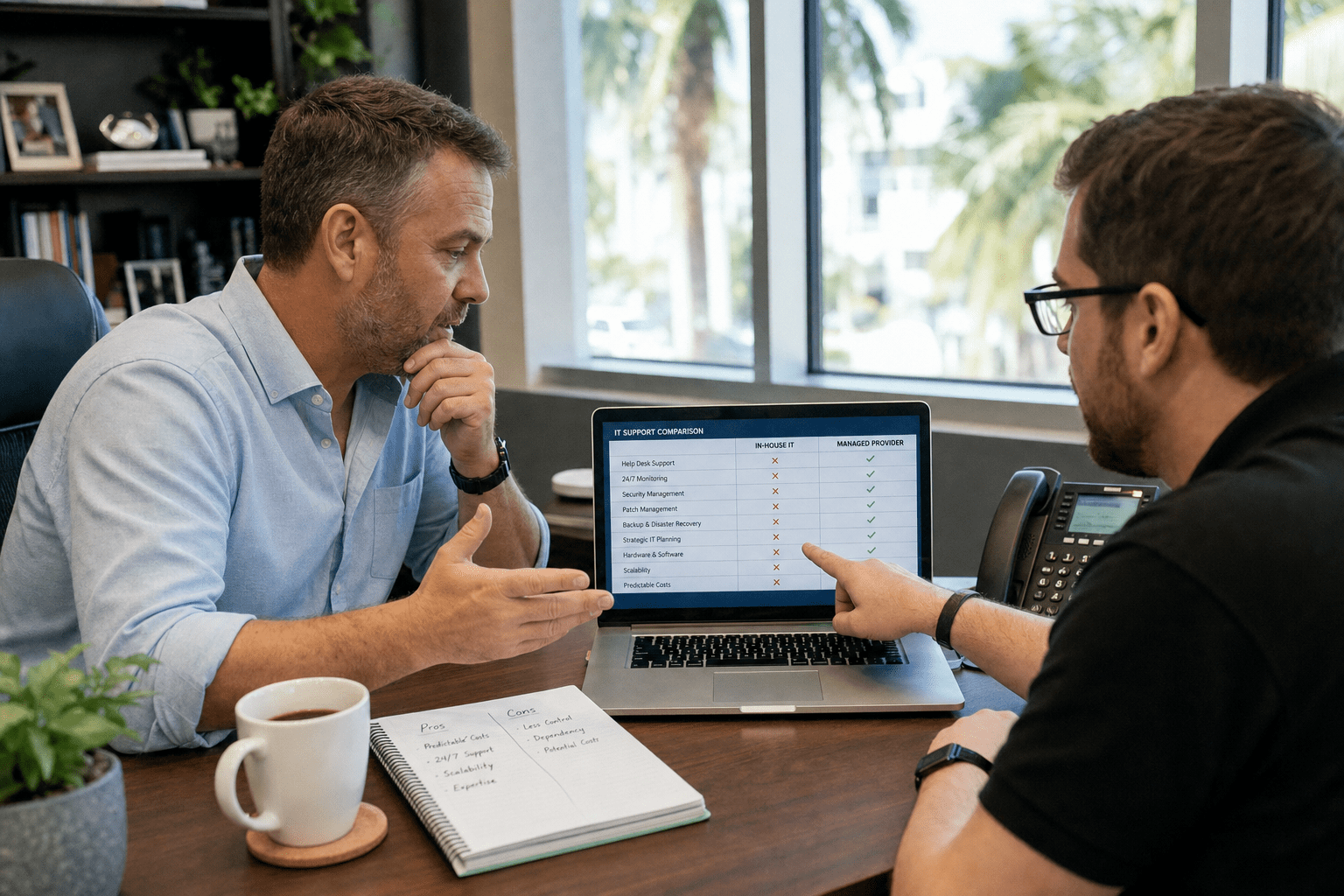
In-house IT delivers organizational presence, relationship depth, and environmental familiarity. It struggles with breadth of expertise, 24/7 coverage, and scalability. Managed IT companies deliver expertise breadth, institutional coverage infrastructure, and scalable resources. They require investment in environmental knowledge and explicit organizational relationship management.

The right decision for your Orlando organization depends on your size, your industry’s specific requirements, your regulatory environment, and your honest assessment of which limitations are more tolerable in your specific situation.

Mindcore’s managed IT services and cybersecurity services are available to Orlando organizations evaluating this decision. Contact Mindcore to discuss your specific situation and assess which model produces the outcomes your organization requires.

Related Posts

Matt Rosenthal