


Updated in 2026
Many organizations evaluating 5G business internet are considering whether speed, coverage, and reliability meet enterprise operational needs. Coverage varies, stability is inconsistent, and certain business environments benefit far more than others. This guide explains what local companies need to know before deciding whether 5G is the right fit for their operations.
Five Key Points
• For businesses exploring 5G business adoption, coverage consistency and environmental factors are critical to delivering reliable connectivity.
• Compared to fiber, 5G business internet offers flexibility and rapid deployment for mobile and temporary operations.
• 5G excels in mobility, fast deployment, temporary setups, and internet-backup strategies.
• Local signal strength in Boca Raton varies by location, elevation, and building materials.
• Before adopting 5G business internet, businesses must evaluate usage needs, device volume, and contract terms.
5 Why’s
• Businesses depend on stable internet for cloud apps, VoIP, POS systems, and security cameras, making inconsistent wireless signals risky.
• 5G performance varies street by street due to tower density, environmental obstacles, and line-of-sight limitations.
• Many 5G business plans include data caps or throttling, which hurt companies with large teams or high upload demands.
• Buildings with concrete, metal framing, or tinted glass weaken wireless signals, reducing reliability.
• Traditional fiber and cable provide predictable throughput and congestion resistance, which many businesses still require.
What Makes 5G Different from 4G, Fiber, or Cable?
5G uses wireless cell towers instead of cables, offering speed and flexibility without physical installation. Compared to 4G, it has lower latency and higher peak speeds. Fiber and cable deliver consistency through hardwired lines, making them less affected by weather or congestion. In Boca Raton, a business’s exact address heavily influences whether 5G is viable.
Where 5G Excels for Businesses
5G stands out in environments where mobility and rapid setup are priorities:
• 5G business connections are ideal for rapid deployment, allowing mobile teams to start operations without waiting for wired installations .
• Excellent for mobile operations: food trucks, contractors, pop-ups.
• Many companies use 5G business internet as a backup to maintain operations during primary network outages.
• Useful for powering guest Wi-Fi without touching core systems.
• Strong performance in areas with dense tower coverage.
Businesses in strong coverage zones often report smooth video calls, browsing, and cloud use.
Where 5G Falls Short
Limitations businesses must consider:
• Spotty or uneven coverage across neighborhoods.
• Weak indoor signals due to concrete, glass, and elevation issues in high-rises.
• Data caps and throttling after certain usage levels.
• Congestion during busy hours or large local events.
• Not ideal for offices with dozens of devices or heavy cloud-upload workflows.
• Speed fluctuations during storms or heavy rain.
Fiber and cable remain more stable for organizations with intensive digital operations.
How to Assess If 5G Is Right for Your Business
Boca Raton businesses should evaluate:
• Number of devices needing continuous connectivity.
• Dependence on cloud apps, VoIP, or security cameras.
• Requirements for large uploads or video conferencing.
• Local 5G coverage maps and real-world speed tests.
Testing throughout the workday is key—peak hours often reveal limitations.
Many companies adopt 5G as a backup connection to keep POS systems, bookings, and communications running during outages.
Before signing a contract, confirm:
• Usage caps
• Speed throttling
• Device limitations
• Business-grade service guarantees
Boca Raton Factors: Local Considerations
Coverage varies by district:
• Business parks and major roads often have stronger tower presence.
• High-rise floors above certain elevations may have weaker indoor coverage.
• Street-level retail often sees more stable performance.
• Newer construction materials may interfere with signal strength.
Local carriers are expanding 5G networks, but performance is not uniform city-wide.
Setting Up 5G for Business: Best Practices
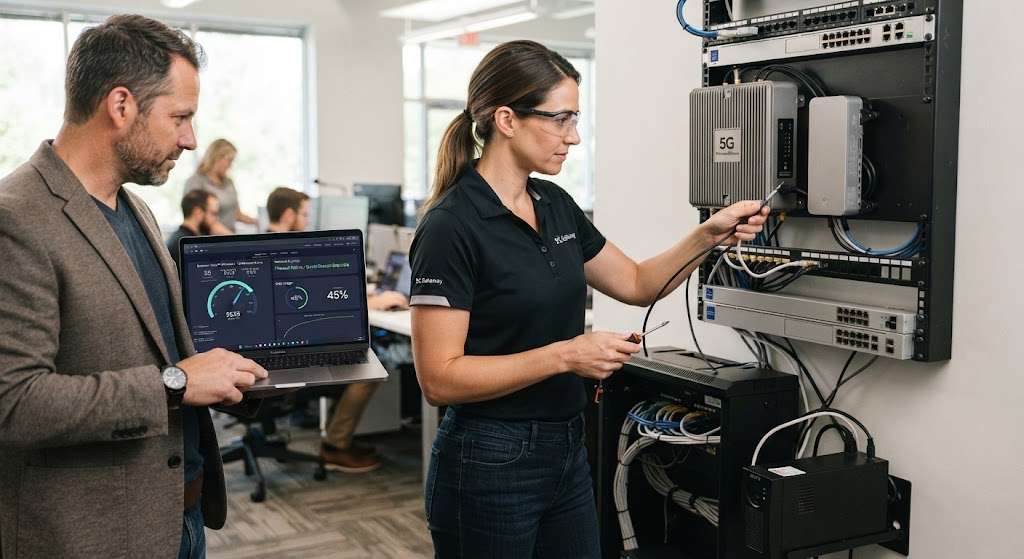
When deploying 5G business internet, maximize stability by using a business-grade modem or router rather than a pocket hotspot:
• Using a business-grade modem or router, not a pocket hotspot.
• Setting up a firewall plus a separate guest network.
• Running speed tests during business hours, not just weekends or evenings.
• Securing backup power for your 5G router and modem.
• Monitoring usage to avoid hitting data caps.
• Treating 5G as part of a larger redundancy plan.
These steps ensure 5G integrates smoothly with existing security and Wi-Fi practices.
Infobox Summary
5G offers speed, portability, and rapid deployment, making it ideal for mobile teams, temporary spaces, or backup connectivity. However, performance in Boca Raton varies by location, building structure, and network congestion. Fiber and cable remain more consistent for multi-device offices, heavy uploads, or cloud-dependent workflows. Testing coverage, reviewing contract terms, and starting with 5G as a backup can help businesses determine real-world value.
Final Thoughts: Should Boca Raton Businesses Switch to 5G Now?
5G is promising but not universally ready to replace hardwired internet. For mobile operators or businesses with light internet use, it may offer meaningful benefits. For larger teams, cloud-heavy environments, or companies requiring high uptime, fiber and cable still deliver superior consistency.
The most strategic approach:
Test 5G as a secondary or pilot connection. Evaluate real-world speed, stability, and coverage. Then decide whether it enhances operations—or simply complements your existing infrastructure.
Frequently Asked Questions
Is 5G ready for business internet?
5G can be ready for business internet when local coverage is strong, device demand is moderate, and uptime requirements allow for some wireless variability. Businesses should test real-world speed, latency, congestion, indoor signal strength, and carrier terms before relying on 5G as a primary connection.
For many organizations, the best approach is to pilot 5G before making it the primary connection. Test performance throughout the workday, especially during peak hours, and evaluate whether the network can reliably support cloud applications, VoIP, video conferencing, security systems, and other critical workloads.
What are the benefits of 5G for businesses?
The main benefits of 5G for businesses include fast deployment, mobility, flexible connectivity, lower latency, and strong support for temporary sites or backup internet. It can be especially useful for mobile teams, pop-up locations, guest networks, and organizations that need rapid connectivity without waiting for wired installation.
5G can also provide an additional connectivity path when a primary wired service fails. Businesses with temporary locations, field teams, seasonal operations, or sites waiting for fiber or cable installation may benefit from its faster deployment.
What are the limitations of 5G for business use?
The main limitations of 5G for business use include uneven coverage, weaker indoor signals, congestion, data caps, throttling, and performance changes caused by building materials or weather. These factors can make 5G less predictable than fiber or cable for large offices and cloud-heavy environments.
Coverage can vary considerably by location. Concrete, metal framing, tinted glass, elevation, tower density, and network congestion can all influence performance. Businesses should also review usage caps, throttling policies, device limits, and service guarantees before committing.
How can businesses integrate 5G with existing networks?
Businesses can integrate 5G with existing networks by using it alongside fiber, cable, Wi-Fi, and firewall infrastructure as a secondary or failover connection. A business-grade 5G modem or router, proper security controls, monitoring, and backup power can help maintain continuity when the primary internet connection fails.
This hybrid approach allows businesses to gain the flexibility of wireless connectivity without immediately abandoning established wired infrastructure. Organizations should also separate guest traffic, maintain firewall protections, monitor usage, and test failover behavior regularly.
Should 5G replace fiber or cable for business internet?
5G should not automatically replace fiber or cable for every business. It is often better suited for backup connectivity, mobile operations, temporary locations, or lighter workloads. Businesses with many devices, heavy cloud usage, large uploads, or strict uptime requirements may still benefit more from stable wired internet.
Fiber and cable generally provide more predictable throughput for demanding business environments, while 5G adds flexibility and redundancy. Testing 5G as a secondary connection first can help determine whether it is reliable enough to take on a larger role.
Matt Rosenthal’s Expertise in 5G for Business Internet
Matt Rosenthal, CEO of Mindcore Technologies, brings decades of IT, cybersecurity, cloud, and infrastructure leadership experience. He helps organizations understand 5G speed, latency, coverage, device compatibility, and security considerations. Under his leadership, businesses assess whether 5G supports critical operations, hybrid network strategies, and long-term growth while maintaining secure, reliable connectivity Cybersecurity Services.

