

Manufacturers relying on Managed IT services for Manufacturing gain specialized coverage for plant-floor systems, ensuring operational continuity and security that general office IT cannot provide. After supporting manufacturing clients for more than fifteen years, our team sees the same gap: a manufacturer hires a managed IT provider that is excellent at laptops, email, and the front office, then assumes that coverage extends to the production network. It does not. Managed IT Services for Manufacturing include response standards that reflect the true cost of downtime on production lines, protecting high-value equipment and operations. This article names the six risks that managed IT services for manufacturers most often miss, why each one is sharper in a plant than in an office, and what to require from any provider before you sign.
What This Article Covers
Before the detail, here is the shape of the problem and who it affects most. Managed IT services are outsourced technology support, monitoring, and security delivered by a provider; for a manufacturer that scope has to reach the production floor, not just the office.
- Production downtime is a different number. An hour of stopped line can cost more than a day of office disruption, so the response standard has to match.
- OT and IT are converging, often ungoverned. A core feature of Managed IT Services for Manufacturing is governance of OT and IT convergence, isolating production equipment from office network risks.
- Plant equipment resists standard tooling. Many controllers cannot take routine patches or endpoint agents, so they need a different protection model.
- Compliance reaches the floor. Defense and aerospace suppliers carry obligations like CMMC that office-grade managed IT was never scoped for.
- The reader is an operations director, plant manager, or CIO at a 10 to 500 person manufacturer, accountable for both uptime on the line and the security of the business. Every risk below assumes you own that floor.
Why Managed IT Services for Manufacturers Miss the Plant Floor
Managed IT services for manufacturers miss the plant floor because most providers are built around office technology and price every minute of downtime the same way. In an office, a slow morning is an annoyance. On a production line, a stoppage can idle a crew, miss a shipment, and spoil in-process material. When a provider applies an office response standard to that environment, the math breaks the first time a line goes down and the ticket sits in a normal queue.
We have walked into manufacturers where the factory equipment shared one flat network with the front office, where a decade-old machine controller ran an operating system no vendor patches anymore, and where the backup plan covered file servers but not the configuration that makes a production line run. None of those gaps showed up in a sales demo. They showed up the first time something went wrong. The federal guidance on this is mature, and NIST’s Guide to Operational Technology Security exists precisely because plant environments need a model office IT does not provide. The six risks below are where that gap lives, and they are the same points to press on when you are working out what to look for in a manufacturing IT provider.
The 6 Hidden Risks in Managed IT Services for Manufacturers
The six hidden risks below share one root: a provider applying office assumptions to an environment that runs on machines. Each risk is survivable on its own, but together they are why a manufacturer can have managed IT on paper and still be exposed where it matters most.
Risk 1: Pricing Plant Downtime Like Office Downtime
The first risk is a response standard built for offices applied to a production line. The provider view is understandable, since most tickets really are office issues and a single queue is simpler to run. There is a fair argument that not every plant alert is an emergency. The problem is that a stopped line and a stuck mailbox cannot share the same response clock. When they do, the most expensive failure in the building waits behind routine requests. We recommend you define production-line incidents as their own severity tier in the contract, with a response time tied to the real cost of a stopped line and a named escalation path. If a provider cannot describe how a downed line is handled differently from a slow laptop, the coverage is office coverage wearing a manufacturing label.
Risk 2: Ungoverned OT and IT Convergence
The second risk is operational technology and office IT sharing a network with no governance between them. Operational technology, the controllers and sensors that run machines, used to be isolated. Connecting it to the network brought real visibility and efficiency, and reversing that is neither possible nor desirable. The counterweight is that convergence without segmentation turns the whole plant into one blast radius. A flat network lets a compromise in the office reach equipment that was never built to defend itself. CISA’s industrial control systems guidance treats segmentation as foundational for exactly this reason. We recommend you require a network design that separates the production environment from the office with controlled, monitored boundaries, so a problem on one side does not become a problem on both.
Risk 3: Machine Controllers That Cannot Be Patched
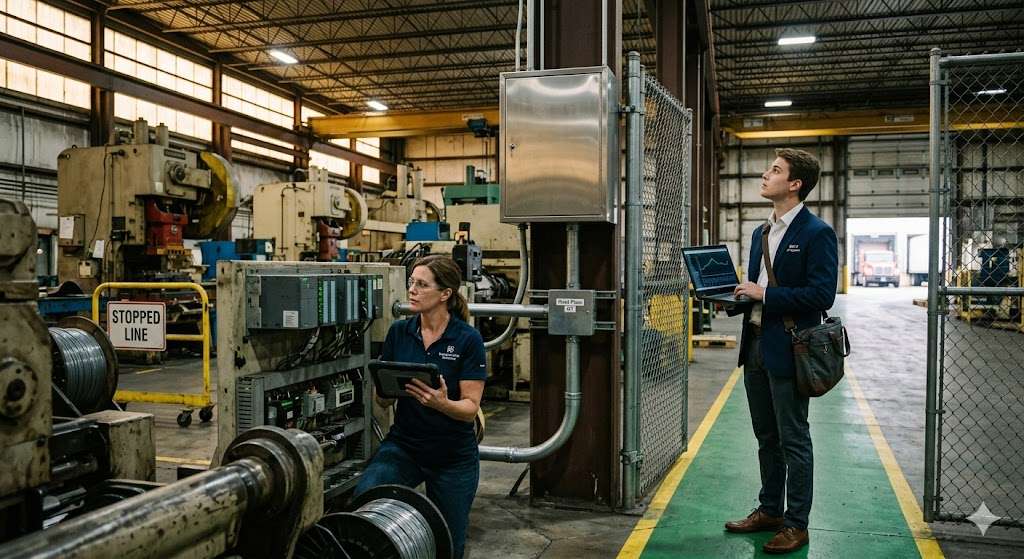
The third risk is plant equipment that cannot take standard patches or endpoint agents. A programmable logic controller or a machine human-machine interface often runs firmware or an operating system the vendor stopped updating years ago, and the machine itself may run for fifteen years or more. The instinct from office IT is to patch everything or install an agent everywhere, which can crash equipment that was never designed for it. The opposite instinct, leaving it alone, leaves known weaknesses open. Neither extreme fits. We recommend you protect unpatchable equipment with compensating controls, network isolation, strict access rules, and monitoring around the device, rather than forcing tools onto hardware that cannot run them. A provider that proposes to simply patch the plant has not worked on a plant.
Risk 4: Backups That Ignore What Runs the Line
Managed IT Services for Manufacturing ensure backup strategies cover machine configurations and production system data, enabling rapid line recovery after an incident. Backing up file servers and email is standard, and a provider can honestly say backups are in place. The gap is that machine configurations, the programs on controllers, and the data in a manufacturing execution or ERP system are what actually restore a line after a failure. Lose those and a clean file-server backup will not restart production. We recommend you require the recovery plan to name production systems explicitly, including machine programs and MES or ERP data, and to prove a restore with a tested recovery time for the line, not just for the office. Recovery on a plant floor is measured in lost production, so the plan has to be tested against that clock.
Risk 5: No Segmentation Between Office and Floor
The fifth risk is the absence of segmentation, so a single office compromise reaches the production network. This overlaps with convergence, but it is worth naming on its own because it is the most common and most damaging gap we find. The convenience of a flat network is real, since everything reaches everything and setup is simple. The cost is that one phishing click in accounting can travel to the floor. A zero-trust approach to network design, described in Microsoft’s zero-trust networking guidance, treats segmentation and least-privilege access as the default rather than an upgrade. We recommend you require segmentation between office and production as a baseline, enforced at the firewall layer, with access between zones granted only where a business reason exists and logged when it happens.
Risk 6: Compliance Blind Spots for Manufacturers
Managed IT Services for Manufacturing include compliance management that maps regulatory obligations directly to production operations, including standards like CMMC, ensuring the floor is covered, not just the office. A manufacturer that supplies the defense or aerospace sector may carry requirements like the Cybersecurity Maturity Model Certification, and traceability rules can apply to production data itself. An office-focused provider may not scope for any of it. The fair point is that not every manufacturer faces these rules, and over-applying them wastes money. The risk is the supplier who does face them and assumes general managed IT covers it. The Department of Defense publishes the CMMC program requirements, and they reach systems that touch controlled information, including on the floor. We recommend you confirm which obligations apply to your contracts and require a provider who can map controls to the actual production environment, not just the front office.
How Manufacturers Vet Managed IT Services for the Plant Floor
Manufacturers vet managed IT services for the plant floor by testing whether the provider understands production, not just technology. The benefit-driven pages that fill search results all promise monitoring, security, and support. Those words mean something different in a plant, and the difference is what you are buying.
In a first conversation, a provider built for manufacturing will ask about your production environment before quoting, will treat line downtime as its own severity, and will raise OT segmentation and unpatchable equipment without prompting. Our team approaches a manufacturer as a business that runs on machines, which means the questions about the floor come first because that is where the cost and the risk concentrate. Ask any candidate to describe how they would protect a controller that cannot be patched, or how they would recover a line after a failure. A provider who only talks about laptops and email is telling you which environment they actually cover. The right partner covers both, and can prove it on the floor.
Frequently Asked Questions
What should managed IT services for manufacturers include?
Managed IT services for manufacturers should include everything office IT covers plus protection for the production environment: a separate response standard for line downtime, network segmentation between office and floor, a protection model for equipment that cannot be patched, and recovery planning for machine and production-system data. The office coverage is table stakes. The plant-floor coverage is what makes it manufacturing IT rather than office IT with a different label.
Why is downtime more costly for a manufacturer?
Downtime is more costly for a manufacturer because a stopped production line idles people, equipment, and material at once, and can cascade into missed shipments and spoiled in-process work. An office outage usually slows tasks that can resume later, while a line stoppage often cannot be recovered, only restarted. That difference is why a manufacturer needs a response standard tied to the cost of lost production.
Can managed IT providers secure old machine equipment?
Managed IT providers can secure old machine equipment, but not by patching it like a laptop. Many controllers cannot accept standard updates or endpoint agents without risk to the machine, so the right approach is compensating controls: isolating the device on the network, restricting who can reach it, and monitoring around it. A provider that proposes to patch or install agents on all plant equipment does not understand the constraint.
Do manufacturers need CMMC compliance?
Some manufacturers need CMMC compliance, specifically those in the defense supply chain whose systems handle controlled unclassified information. Manufacturers outside that supply chain usually do not, though other rules may apply. The risk is assuming general managed IT covers a CMMC obligation it was never scoped for, so confirm which requirements apply to your contracts and choose a provider who can map them to your production environment.
How is manufacturing IT different from regular managed IT?
Manufacturing IT is different from regular managed IT because it has to cover operational technology on the plant floor, not just office systems. That means network segmentation between office and production, protection for equipment that cannot be patched, recovery planning for machine and production data, and a faster response standard for line downtime. Regular managed IT often stops at the office boundary, which is exactly where a manufacturer’s highest risk begins.
Talk Through Your Plant Floor Coverage
The six risks in this article share one defense: hold your provider to the standard of the plant floor, not the office. Price line downtime for what it actually costs, segment production from the office, protect equipment that cannot be patched with controls around it, back up what truly restores a line, and confirm which compliance obligations reach your floor. An office-grade provider can do none of this well, and most manufacturers do not discover the gap until something stops.
If you run a plant and you are not certain your current managed IT reaches the production floor, our team can help you find out. We support manufacturers as businesses that run on machines, which means we look at OT segmentation, unpatchable equipment, line recovery, and compliance as part of the job rather than add-ons. Bring us your environment and your current coverage, and we will show you where the office boundary leaves your floor exposed. Book a free strategy call and we will walk your plant-floor coverage with you, no obligation to move forward.
Manufacturing IT Security and Operational Technology Expertise from Matt Rosenthal
Matt Rosenthal, CEO of Mindcore Technologies, has over 30 years of experience helping manufacturers close the gap between office IT and plant-floor operational technology. He has seen firsthand how flat networks, unpatchable controllers, and office-grade response standards leave production environments exposed in ways a standard managed IT contract never addresses. Matt leads a team that approaches manufacturing clients as businesses that run on machines, covering OT segmentation, line recovery planning, and compliance obligations like CMMC as core deliverables, not add-ons.

