

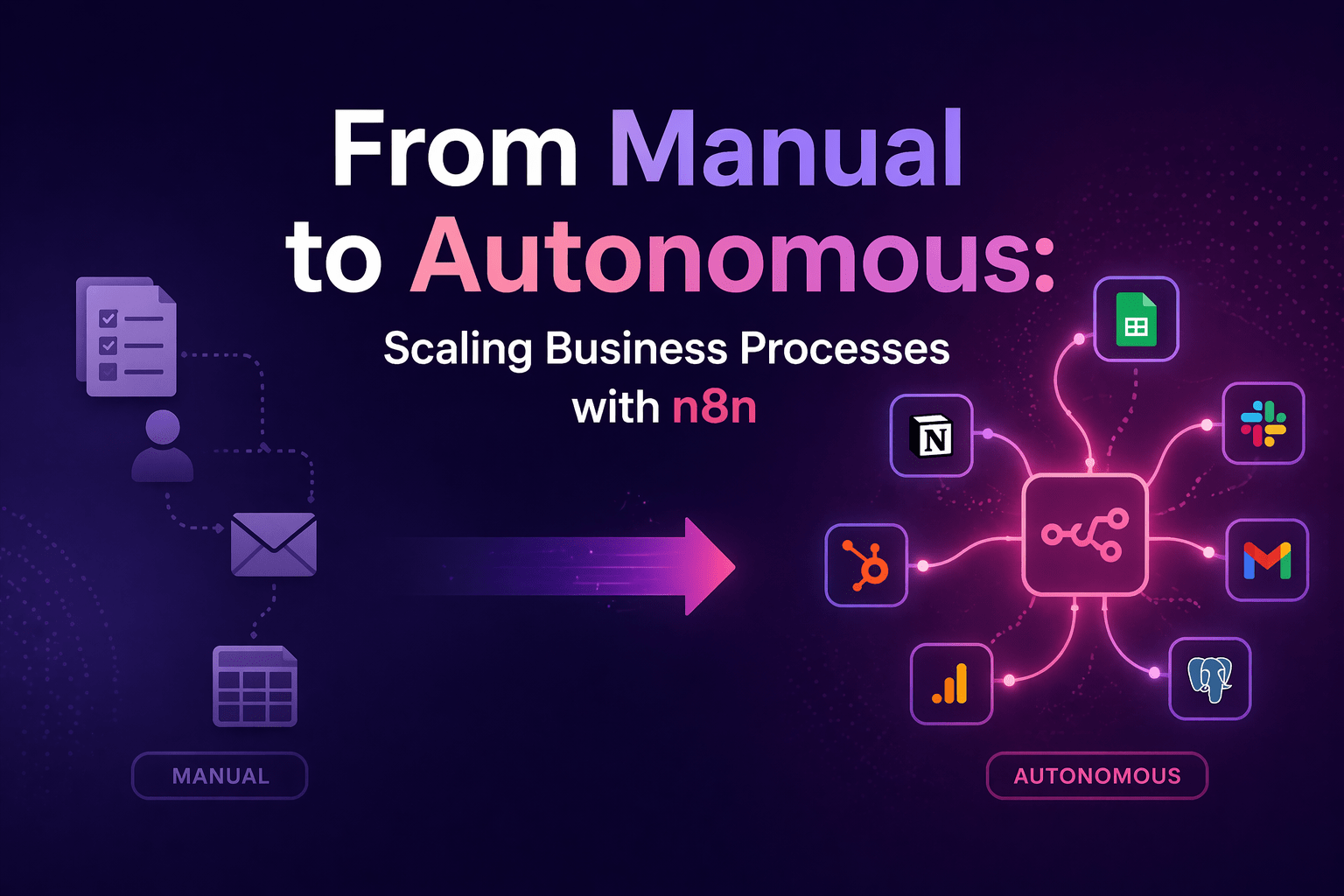
The transition from manual to autonomous business processes is not a single project. It is a program — a systematic progression from identifying the workflows that automation can address, to building automation that is reliable in production, to scaling automation coverage across the organization, to governing the automation portfolio as it grows.
Organizations that approach this transition correctly build compounding operational leverage: each automation they deploy frees capacity that enables the next automation, and the capability developed through early automation projects accelerates the velocity of subsequent ones. Organizations that approach it as a collection of ad hoc projects build fragmented automation that is hard to maintain, hard to trust, and hard to scale.
This is the framework for making the transition correctly.
Overview
Scaling from manual to autonomous processes with n8n requires five sequential capabilities: process identification (knowing which processes to automate and in what order), workflow design (building automation that is reliable, not just functional), deployment discipline (releasing automation with the monitoring and error handling that production reliability requires), portfolio management (maintaining visibility and governance over the growing automation estate), and continuous improvement (optimizing workflows based on operational performance data). Each capability builds on the previous one. Organizations that skip steps produce automation that works initially and degrades over time.
- Process identification: systematic assessment of manual workflow volume, value, and automation suitability
- Workflow design: building for production reliability from the first deployment, not retrofitting it later
- Deployment discipline: monitoring, error handling, and documentation as deployment prerequisites
- Portfolio management: governance that prevents automation debt accumulation
- Continuous improvement: performance data driving workflow optimization over time
This aligns with modern AI automation strategies and enterprise transformation initiatives.
The 5 Why’s
Why is process identification specifically the highest-leverage starting point for automation programs?
The automation candidate assessment determines where investment goes. Organizations that automate the most visible workflows (rather than the highest-value ones) produce impressive automation counts with limited operational impact. Those that identify and prioritize by value — volume × time per execution × error rate × strategic importance — direct automation investment where it produces the most leverage. n8n makes automation accessible; process identification makes it strategic.
Why does designing for reliability from the first build matter more than iterating to reliability later?
Retrofitting reliability into workflows that are already in production creates disruption: users who depend on the automation experience the gaps that error handling is being added to address, and the workflow must be modified while it is serving production load. Designing error handling, retry logic, and monitoring into the workflow during initial build produces automation that is trustworthy from deployment day, not after a period of discovering what breaks in production.
Why does deployment discipline specifically determine whether automation is trusted or bypassed by operational teams?
Automation that fails without visible notification produces a specific organizational response: the team that the automation was built for stops trusting it and resumes doing the process manually as a backup. That response is rational and appropriate. Automation that fails visibly and is restored quickly retains trust. Deployment discipline — monitoring, alerting, and fast response to failures — is what keeps automation trusted after the initial deployment success wears off.
Why does portfolio management specifically become critical as automation scale increases?
At five workflows, tracking them informally is feasible. At fifty, undocumented dependencies between workflows cause unexpected failures when one workflow is modified. At five hundred, deprecated workflows continue consuming resources and generating misleading logs. Portfolio management — documentation, dependency mapping, performance visibility, and deprecation processes — prevents the automation estate from becoming a maintenance liability that grows with every new deployment.
Why does continuous improvement specifically increase the ROI of automation programs over time?
Workflows that were built correctly for the process as it existed at build time may become inefficient or incorrect as the process evolves. Regular performance review — execution time, failure rate, exception volume, downstream accuracy — identifies workflows that need updating and surfaces optimization opportunities that were not visible at initial build. Programs that continuously improve their automation portfolio produce increasing returns; programs that treat automation as built-and-forgotten see returns plateau and then degrade.
The Automation Maturity Framework
Stage 1: Foundation (Months 1-3)
Goal: Build the first 5-10 high-value automations and establish the operational practices that will govern subsequent automation.
Activities:
- Conduct workflow assessment: identify all manual process steps across target departments, estimate time per execution and frequency
- Prioritize by value: calculate automation value score for each candidate (time saved × frequency × error risk reduction)
- Build top 3-5 automations with full enterprise-grade architecture from the start
- Establish monitoring, error alerting, and documentation standards
- Measure baseline metrics: execution volume, failure rate, time saved
Stage 2: Expansion (Months 4-9)
Goal: Scale automation across additional departments and workflow categories.
Activities:
- Apply foundation learnings to accelerate new automation builds
- Expand automation to additional departments with the governance model established in Stage 1
- Build sub-workflow library of common operations (API calls, data transformations, notifications) that new workflows reuse
- Conduct first portfolio review: assess foundation automations for performance and optimization opportunities
- Train additional staff in n8n workflow building within established standards
Stage 3: Optimization and Advanced Automation (Months 10+)
Goal: Optimize existing automation based on performance data and expand to complex AI-augmented workflows.
Activities:
- Implement continuous monitoring with performance dashboards for the full automation portfolio
- Identify and optimize underperforming workflows based on execution data
- Begin AI-augmented workflow development for processes requiring content understanding
- Implement n8n AI agent workflows for complex multi-step automated tasks
- Establish quarterly portfolio reviews: performance, optimization, deprecation, and roadmap
Measuring Automation Progress
- Automation coverage: percentage of identified manual workflow steps that have been automated
- Execution volume: total workflow executions per period — proxy for operational automation scale
- Failure rate: percentage of executions that fail — primary reliability metric
- Time saved: estimated staff hours eliminated per period — primary efficiency metric
- Manual exception rate: percentage of automated workflow instances that require human intervention — proxy for automation quality
Final Takeaway
The transition from manual to autonomous business processes is the most significant operational leverage investment a growing business can make. Done systematically — with process identification that prioritizes value, workflow design that builds reliability in from the start, deployment discipline that maintains trust, portfolio management that prevents debt accumulation, and continuous improvement that compounds returns — it produces an automation estate that is an operational advantage. Done as a collection of ad hoc projects, it produces technical debt and fragmented capability that is harder to maintain than the manual processes it replaced.
Execute the Manual-to-Autonomous Transition With Mindcore Technologies
Mindcore Technologies works with businesses at every stage of the automation maturity curve — process assessment, automation strategy development, n8n deployment, governance framework implementation, and continuous improvement programs that produce automation portfolios that grow in value over time.
Schedule your free strategy call to assess your automation maturity and design your roadmap to autonomous operations.

