

Standard workflow automation is deterministic. You define every step in advance: when X happens, do Y, then Z. That model works well for processes where every input type and every correct response can be specified in advance. It fails when the correct response depends on reasoning about context, content, or conditions that were not fully anticipated when the workflow was built.
AI agents are what automation becomes when the steps cannot be fully specified in advance. An agent receives an objective, reasons about how to achieve it, determines the sequence of actions required, executes those actions using defined tools, and adapts when intermediate results change what the next step should be. It is automation that plans rather than automation that follows.
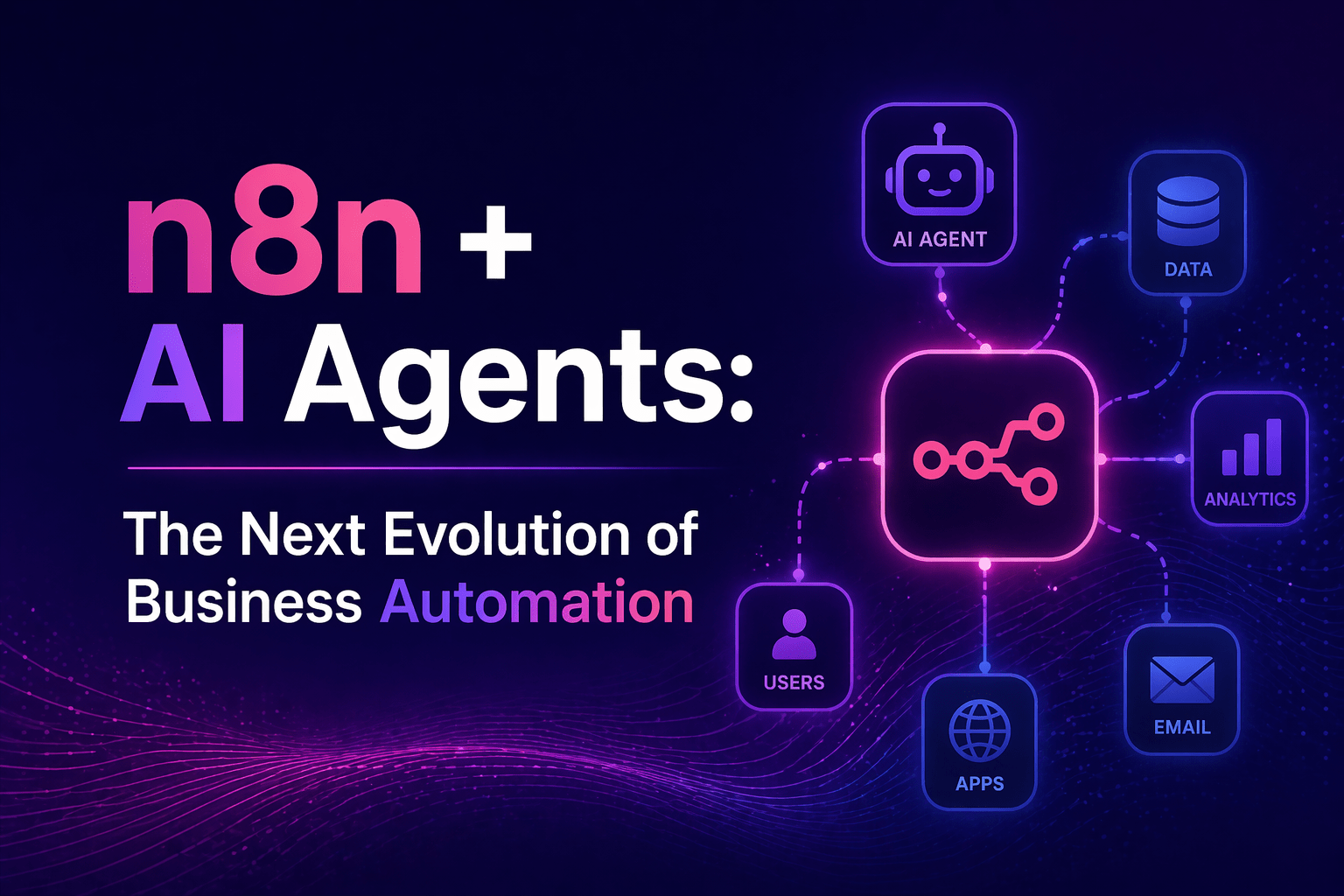
n8n is the orchestration platform that makes AI agent automation operational in enterprise environments — connecting agent reasoning to the real enterprise systems where the actions need to happen, governing what those actions can be, and maintaining the audit trail that enterprise deployment requires.
Overview
n8n + AI agents enables a category of automation that was previously impossible without custom development: workflows where the task definition is an objective rather than a sequence of steps, where the agent determines the execution path based on intermediate results, and where multi-step actions across enterprise systems are coordinated by AI reasoning rather than pre-defined workflow logic. n8n provides the tool execution layer that agents use to interact with enterprise systems, the orchestration framework that governs agent operation, and the workflow context that connects agent actions to the broader operational processes they support.
- AI agents receive objectives and determine execution paths rather than following pre-defined step sequences
- n8n provides the tool layer: every system the agent can interact with is a configured n8n connection
- Agent actions are bounded by n8n’s credential and access model — agents cannot reach systems they are not configured to access
- Execution is auditable: every agent action through n8n generates an execution log
- Human oversight is maintained through configurable approval requirements and scope limits
This aligns with modern AI automation strategies and enterprise workflow transformation.
The 5 Why’s
Why do AI agents specifically represent the next evolution beyond standard workflow automation rather than just a feature addition?
Standard workflow automation handles tasks where the logic can be fully specified. The automation landscape is defined by that specification gap — the tasks that cannot be automated because their correct execution depends on reasoning that cannot be pre-defined. AI agents close that gap: they bring reasoning capability to automation, enabling the class of tasks that deterministic workflows cannot handle. That is not an incremental improvement; it is an expansion of what automation can do.
Why is n8n specifically the right orchestration platform for enterprise AI agent workflows?
AI agents need to take actions in real systems to be operationally useful — querying databases, creating records, sending communications, triggering processes. n8n’s integrations provide the tool library that agents operate through. n8n’s credential management governs what systems agents can access. n8n’s workflow context connects agent actions to the broader workflow they are part of. An agent without an orchestration platform can reason but not act; n8n is the action layer that makes agent reasoning operational.
Why is scope governance specifically critical for AI agent automation in enterprise contexts?
AI agents that can take any action in any connected system create risk proportional to the number and sensitivity of those systems. Enterprise AI agent deployment requires explicit scope governance: the agent can use these tools, take these action types, access these systems — and nothing beyond that scope regardless of what the agent’s reasoning produces. n8n’s access model governs agent tool access at the configuration level, making scope limits a property of the deployment rather than a policy the agent might reason around.
Why does audit trail generation specifically matter for AI agent automation in ways it does not for standard automation?
Standard workflow automation follows a defined path; the audit trail confirms that the defined steps executed. AI agent automation follows a path determined by reasoning; the audit trail is the only record of what the agent decided to do and why. In enterprise contexts — compliance, incident investigation, and quality assurance — the ability to review exactly what an agent did, in what sequence, based on what intermediate results, is a governance requirement. n8n’s execution logging provides that record for every agent action.
Why does the combination of n8n + AI agents produce outcomes that neither produces alone?
AI reasoning capability without a tool execution layer can plan but not act. Workflow automation without AI reasoning can execute but not adapt. The combination enables automation that plans based on objective understanding, executes through enterprise system connections, adapts based on intermediate results, and operates within the governance framework that enterprise deployment requires. That combination is the architecture of the next generation of business automation.
n8n + AI Agent Workflow Patterns
Research and Synthesis Agent
Objective: “Research the top three competitors’ pricing models and summarize the key differences in a structured report.”
Agent execution with n8n tools:
- Query web search tool for competitor pricing pages
- Extract pricing data from each result using browser automation tool
- Query internal CRM tool for existing competitive intelligence records
- Synthesize findings using reasoning
- Generate structured comparison report
- Post report to defined Slack channel and Google Drive folder
Customer Support Triage Agent
Objective: “Review this support ticket and take the appropriate initial response action.”
Agent execution with n8n tools:
- Query CRM tool for customer account and history
- Query knowledge base tool for relevant documentation
- Classify ticket type and urgency based on content and customer context
- For common issues: generate and send appropriate response using email tool
- For complex issues: route to specialist queue with enriched ticket summary
- Log all actions to support platform using ticketing tool
Data Aggregation and Reporting Agent
Objective: “Generate the weekly executive summary with key metrics from all relevant systems.”
Agent execution with n8n tools:
- Query CRM tool for pipeline and closed revenue metrics
- Query finance tool for P&L summary data
- Query project management tool for delivery status
- Query HR tool for headcount and hiring pipeline
- Identify week-over-week variances exceeding defined thresholds
- Compose executive summary with metrics and variance callouts
- Distribute via email tool to executive distribution list
Governance Requirements for Agent Automation
- Tool scope definition — explicit list of which n8n tools (system connections) each agent can access
- Action type limits — read-only vs. read-write access per tool; specific action types permitted per system
- Confidence thresholds — actions above defined impact level require human approval before execution
- Audit requirements — all agent actions logged with full context; logs retained per compliance requirements
- Scope review cadence — quarterly review of agent tool access against current operational requirements
Final Takeaway
n8n + AI agents is the automation architecture that handles the tasks that standard automation cannot: those where the correct execution path depends on reasoning about context that cannot be fully anticipated in advance. The combination of AI reasoning capability and n8n’s enterprise system integration produces automation that plans, executes, and adapts — within the governance framework that enterprise deployment requires. This is the next evolution of business automation, and it is deployable today.
Deploy n8n + AI Agent Automation With Mindcore Technologies
Mindcore Technologies designs and deploys n8n AI agent workflows for enterprise environments — agent architecture design, tool scope governance, n8n integration configuration, human oversight implementation, and audit trail infrastructure that makes AI agent automation trustworthy in production.
Schedule your free strategy call to identify where AI agent automation can create the most value in your operations.

