

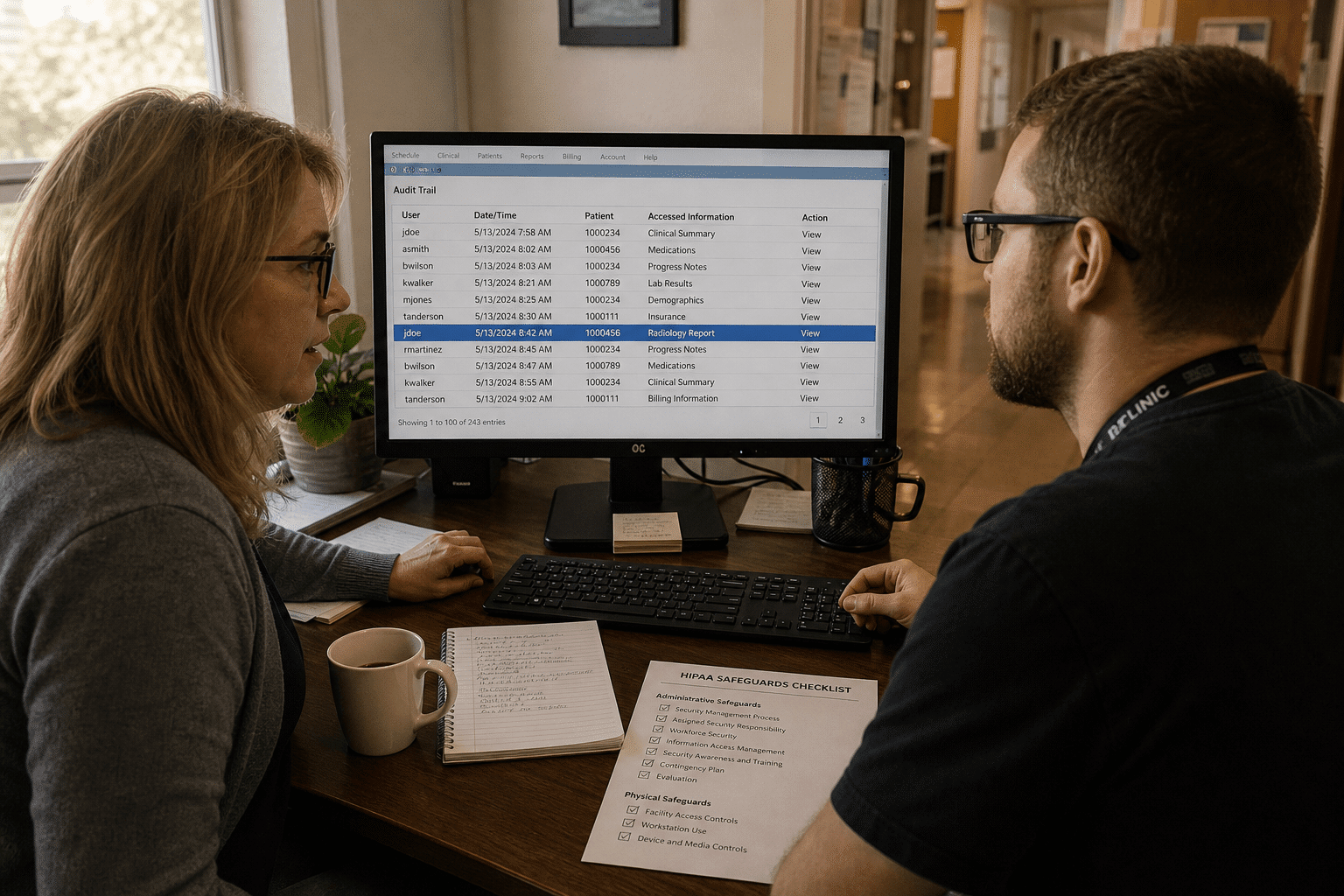
A working PHI data protection guide has to do more than restate the HIPAA Security Rule. It has to name the places where a small clinic actually loses control of patient data: shared logins at the front desk, an imaging vendor nobody has re-papered since 2019, a backup that has never been restored, and an access log nobody reads until the Office for Civil Rights asks for it. Our team has spent years inside 10-person practices and 400-bed systems, and the pattern holds. Small clinics rarely fail on policy language. They fail on the seven operational gaps below, and every one of them leaves a trace in a log file long before it becomes a breach notification.
The five principles this guide keeps returning to:
- PHI protection is an access problem first. Most incidents we investigate start with a credential that should have been switched off, not with a sophisticated intrusion. Identity hygiene buys more risk reduction per dollar than any product purchase.
- Written safeguards you cannot evidence do not count. OCR asks for artifacts: log reviews, risk analyses, training rosters, signed agreements. A policy binder with no supporting records reads as an unimplemented policy.
- Your vendors carry your exposure. Billing services, imaging partners, transcription tools, and cloud platforms all touch electronic PHI. Their controls become your findings.
- Backups are a PHI control, not just an IT chore. Ransomware turned availability into a patient-safety issue. An untested restore is an assumption, not a safeguard.
- Small size is not a lighter standard. HIPAA applies the same core requirements to a two-person dental office and a hospital. Scale changes the effort, not the obligation.
Why PHI Data Protection Fails in Small Clinics
PHI data protection fails in small clinics because the people responsible for it are also responsible for patient flow, billing, and staffing, so security work gets deferred until an audit or an incident forces it forward. That is not negligence. It is arithmetic. A practice manager with 40 clinical hours of coverage to solve this week will not spend Thursday reconciling an access-review spreadsheet.
The result is a familiar shape. Documentation exists because a consultant produced it during an earlier engagement. The technical controls drifted the moment staff turned over. I have opened Active Directory at practices where three former employees still had active accounts, one of them a departed contractor with remote access to the practice-management system. Nobody made a decision to leave those accounts live. No process existed to close them.
OCR has spent the last several years in its most active enforcement posture since the Omnibus Rule, and its requests are consistent: show the risk analysis, show the access reviews, show the business associate agreements, show the training. Practices that treat those four artifacts as living records tend to close investigations quickly. Practices that treat them as a one-time project tend to learn about their gaps in a response letter. The distinction is operational discipline, and it is learnable.
Size works against small practices in one more way worth naming. A hospital has a compliance officer whose entire role is this work. A six-provider clinic distributes the same obligations across a practice manager, an office administrator, and whichever outside firm answers the phone fastest. Responsibility that is shared three ways is frequently owned by nobody, and the artifacts that prove compliance are exactly the kind of task that falls through a seam like that. Naming a single owner for each safeguard, even a part-time one, changes outcomes more than any tool we could sell you.
PHI Data Protection Guide, Part One: Access and Identity Gaps
Access and identity gaps account for the majority of PHI exposure we see in practices under 100 staff, because credentials outlive the people and purposes they were created for. The three below are the ones that appear most often when we pull logs during an assessment.
Gap 1: Shared and orphaned credentials
A shared login makes PHI access unattributable, which breaks both the technical safeguard and any hope of a defensible audit trail. Front-desk teams share accounts for practical reasons: a rotating schedule, a workstation used by four people across two shifts, a locum who needs access on day one. The convenience is real. The cost is that when a record is accessed inappropriately, the log shows a role, not a person.
The opposing view deserves airtime. Some practice leaders argue that individual accounts slow down triage and that clinical delay is its own patient risk. That tension is genuine, and the answer is rarely a blanket rule. Badge-tap or PIN-based fast user switching preserves per-user attribution without forcing a full logout between patients. What does not survive scrutiny is a shared account with no compensating control and no review. Pair individual accounts with a monthly reconciliation against your HR roster, and orphaned credentials stop accumulating.
Gap 2: Standing access nobody re-justifies
Standing access to PHI is defensible only when someone periodically confirms the person still needs it, and in most small clinics that confirmation never happens. Access is granted at hire and inherited at promotion. A biller who moved to scheduling keeps the billing rights. A clinical assistant who covered records during a leave keeps the records role.
There is a reasonable counterargument that least-privilege reviews are overhead a small team cannot absorb, and that trust within a 15-person practice makes broad access low-risk. Insider misuse data does not support that comfort, but the operational point stands: a quarterly review of 15 users is a 30-minute task, while a quarterly review of 60 roles is not. Reduce the number of distinct roles first, then review. We walk clients through this alongside the workspace-isolation approach described in our write-up on healthcare data protection through workspace isolation, which limits what a single compromised account can reach.
Gap 3: Unread access logs
An access log that nobody reviews satisfies the letter of the audit-control requirement and none of its purpose. Practice-management and EHR platforms generate access records by default, so most clinics technically have them. Very few sample them. The gap surfaces during investigations, when a practice finds out that a curious staff member viewed a neighbor’s chart eleven months earlier.
Reviewing everything is not the goal, and any consultant who tells a five-provider practice to read its full audit trail is describing a task that will be abandoned by week three. Sample deliberately instead: VIP and employee records, same-surname access, after-hours activity, and any account flagged during offboarding. Ten minutes weekly against a documented sampling rule produces the artifact OCR wants and catches real misuse.
PHI Data Protection Guide, Part Two: Storage, Backup, and Vendor Gaps
Storage, backup, and vendor gaps determine how far an incident spreads once access controls fail, which is why they belong in the same conversation rather than in a separate IT project. These three carry the largest recovery cost when they go unaddressed.
Gap 4: Encryption assumed rather than verified
Encryption protects PHI only where it is actually applied, and “our vendor handles it” is an assumption we disprove regularly. Practices commonly encrypt the server and overlook the laptop a physician takes home, the workstation in the billing office, the USB drive used for imaging transfers, and the phone with a mail client holding attachments.
Some argue full-disk encryption on every endpoint creates support burden and lockout risk for non-technical staff, and on older hardware that concern has merit. The honest resolution is an inventory: list every device and service that stores or transmits electronic PHI, record the encryption state of each, and remediate by exposure rather than by device count. Encryption also has a longer horizon worth planning for, which we cover in our analysis of healthcare data encryption against AI and quantum threats and in our look at quantum-ready infrastructure for PHI protection.
Gap 5: Backups that have never been restored
A backup becomes a PHI safeguard at the moment you prove it restores, and not before. Ransomware against provider organizations turned data availability into a clinical concern, because a practice that cannot reach its schedule and charts is a practice that cannot safely see patients that morning.
The counterposition is that restore testing consumes a weekend and risks disrupting production, so many practices settle for backup-success notifications. Those notifications confirm a job ran. They say nothing about whether the resulting data opens. Restore one full chart and one full database to an isolated location twice a year, time it, and write down the number. That number is your real recovery objective, and it is frequently three times what leadership assumed. Two details decide whether the test means anything. Restore to somewhere other than the source system, because overwriting production during a drill has ended more than one practice’s appetite for testing. And have a clinical user open the restored record rather than an engineer confirming the file exists, since a database that mounts but renders empty charts is a failed restore that looks like a passing one on paper. Practices running records across several platforms should read our notes on patient data protection across multi-cloud environments before setting those targets.
Gap 6: Business associate agreements that no longer match reality
A business associate agreement protects a clinic only while it reflects the vendors currently touching PHI, and most small-practice inventories are years behind. The billing service changed platforms. The transcription tool was replaced by an AI scribe that nobody papered. A cloud storage account holds scanned intake forms outside the EHR entirely.
Vendors will argue their standard terms cover the arrangement, and often the language is adequate. The failure is rarely the contract text; it is the missing agreement for a tool adopted by a clinical team without a procurement step. Rebuild the inventory from your accounts-payable ledger and your identity provider’s application list rather than from memory, because both record what is actually in use.
AI documentation tools deserve their own line in that register this year. Ambient scribes and summarization assistants are being adopted clinic by clinic, often by an enthusiastic provider on a trial license, and they ingest the most sensitive material in the practice: the full patient encounter. Before one goes into a room, our team asks three questions. Where is the audio stored and for how long. Is the recording used to train a model, and can that be switched off contractually. Does a signed agreement exist that names this tool rather than a predecessor product. A yes to the first two without a clear answer to the third is the most common new PHI gap we found in provider environments over the past year. Our guidance on healthcare data management walks through keeping that inventory current as tools change.
The Seventh Gap: Being Able to Prove Any of It
The seventh gap is evidentiary: a clinic doing reasonable security work cannot always demonstrate it, and undemonstrated safeguards are treated as absent. This is the gap that turns a manageable investigation into a costly one.
Our team sees practices with genuinely sound controls fail their first document request because the proof lives in individual memories and email threads. The risk analysis was performed, verbally, during a staff meeting. Training happened, but the roster was never signed. Access reviews occurred whenever the office manager remembered.
Fix this with four artifacts, each owned by a named person with a review date: a current risk analysis, a dated access-review record, a signed training roster, and a vendor register with executed agreements. Keep them where a substitute could find them within an hour. When an incident does occur, timelines and reporting obligations move quickly, and our breakdown of breach notification reporting requirements covers what has to go out and when. If an event is already underway, data breach incident response support and incident response help for healthcare data breaches are the fastest paths to containment.
Frequently Asked Questions
Does a small clinic really need the same PHI data protection guide as a hospital?
Yes, because HIPAA applies its core requirements to covered entities regardless of headcount. A solo practice and a regional system owe the same risk analysis, safeguards, and breach-notification duties. What changes is scope and effort, not obligation, so a small clinic should scale the work down rather than skip categories of it.
How often should we review PHI access logs?
Weekly sampling against a written rule works better for small practices than periodic full reviews, because it is sustainable. Ten to fifteen minutes covering employee records, same-surname access, and after-hours activity catches most real misuse. Document the sampling rule itself, since the rule is what demonstrates a deliberate audit-control process.
Is a signed business associate agreement enough for cloud vendors?
An executed agreement is necessary and not sufficient. It establishes obligations, while your own configuration determines whether PHI is exposed inside that platform. Sharing settings, retention rules, and administrative access still belong to you, so pair every agreement with a configuration review at onboarding and after major platform changes.
What is the fastest way to reduce PHI risk this quarter?
Reconcile every account against your current staff roster and switch off what does not belong. This single pass closes the orphaned-credential gap that shows up in a large share of incidents we investigate, costs nothing beyond an afternoon, and produces a dated artifact you can hand to an auditor.
Do we need encryption on devices that only display PHI?
Treat any device that can cache, download, or sync PHI as a device that stores it, because most do so without the user’s awareness. Mail clients retain attachments, browsers cache documents, and imaging viewers write temporary files. Inventory by data flow rather than by intended use, then encrypt accordingly.
Close These PHI Data Protection Gaps With Help That Has Done It Before
Every gap above is closable within a quarter by a practice willing to sequence the work, and none of them require a large capital purchase. Start with the account reconciliation, because it is the cheapest and removes the most probable cause of an incident. Then build the four evidence artifacts, since they convert work you are already doing into something you can demonstrate. Encryption inventory, restore testing, and the vendor register follow naturally once someone owns them by name.
Our team does this alongside clinical operations rather than on top of them, and we would rather help you find the gaps now than triage them during a notification window. If you want a second set of eyes on where patient data actually sits in your practice, book a free strategy call and we will walk your environment with you.

