

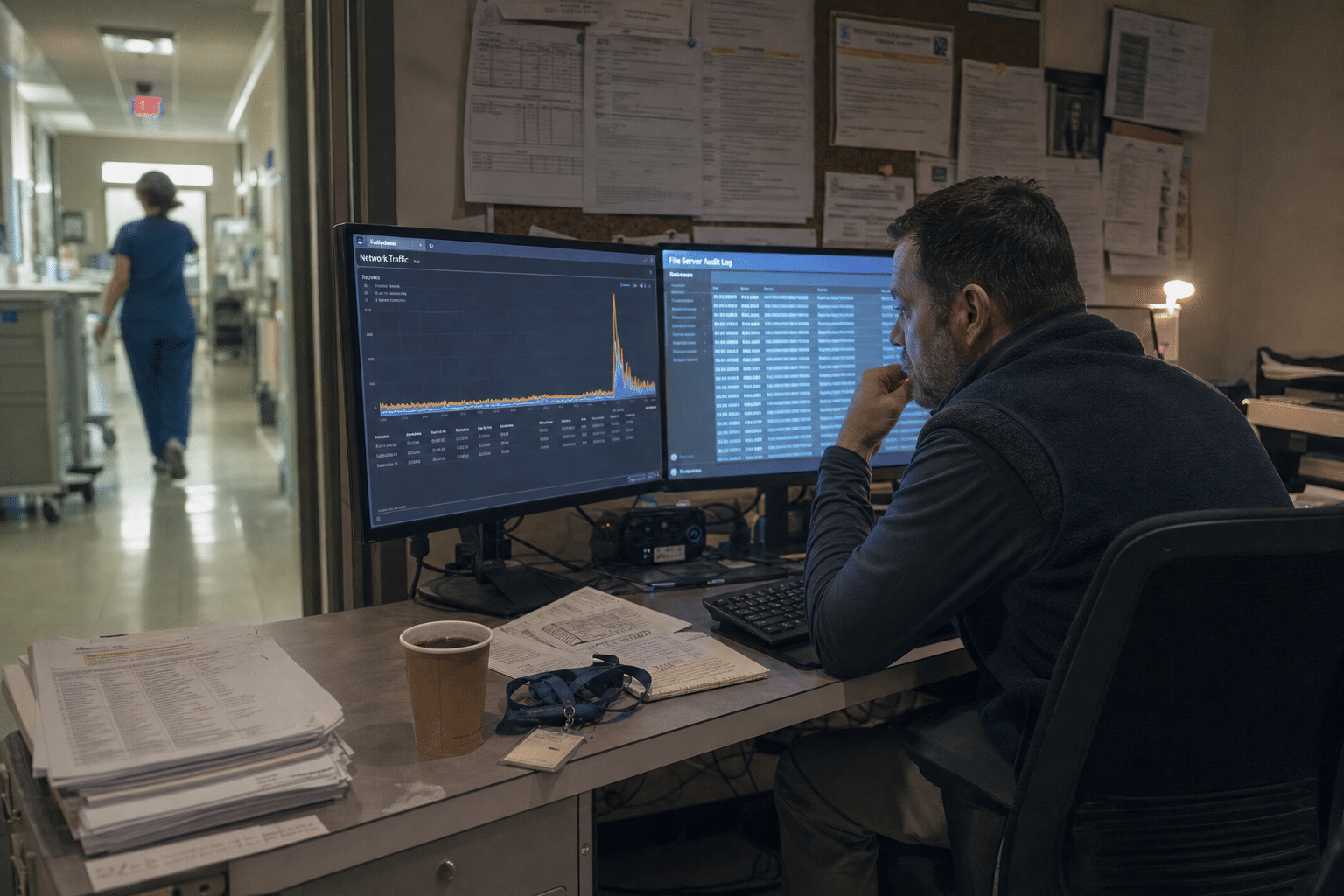
A rural hospital cyber incident rarely starts with a locked screen and a ransom note. It usually starts with an outsider moving quietly through the network for days or weeks while clinical work carries on as normal. Bacon County Health Services, the health system serving Bacon County in southeast Georgia, offers a clear recent example. According to its public notice, the organization spotted unusual activity on its internal network on July 27, 2026. Its investigation found an unknown actor had been inside since July 10, and that files were copied and potentially viewed during those seventeen days. Months later, the organization said it was still too early to tell what information was involved, and attorneys had begun soliciting affected patients for a possible class action. This article uses that timeline to show where small health systems lose visibility, how the HIPAA notification clock works against them, and which controls shorten both gaps.
Overview: Five Points From a Seventeen Day Intrusion
The Bacon County notice is short, but it maps onto a pattern our team sees across community and critical access hospitals. These five points frame the rest of the article.
- Dwell time is the expensive part. Every day an intruder stays inside adds systems touched, files copied and patients who may need notice.
- Copying files is quiet. Data theft without encryption creates no outage, so the clinical staff who usually raise the alarm never see a symptom.
- Not knowing what was taken is its own cost. When logs cannot show which files left the network, the organization has to assume the worst and review everything in reach.
- The HIPAA clock starts at discovery. Notification is due without unreasonable delay and no later than 60 days after discovery, whether or not the forensic review has finished.
- Rural budgets are not the real barrier. The controls that would have shortened this timeline cost less per year than a single breach review, and most can be shared or outsourced.
Why a Rural Hospital Cyber Incident Goes Unnoticed for Weeks
A rural hospital cyber incident goes unnoticed because the network was built to keep care running, not to watch for an intruder who is careful not to disrupt it. Small health systems often run a lean IT team of two or three people who handle everything from printers to the electronic health record. Security monitoring, when it exists, is often a firewall alert inbox that nobody has time to read. An attacker who copies files and leaves the EHR alone simply blends into normal traffic.
What attackers do during the quiet days
The seventeen days between initial access and detection are rarely idle. In incidents we have helped contain, intruders spend the early days mapping the network, harvesting credentials from memory and scripts, and finding file shares that hold scanned records, billing exports and HR data. Then they stage data in a compressed archive and send it out over a cloud storage service or an encrypted channel that looks like ordinary web traffic. That pattern matches what Bacon County described: access, copying, and potential viewing, without a reported outage.
Why clinical staff never see a symptom
Nurses, registrars and physicians are the best early warning system a hospital has for an outage, because they notice immediately when the EHR slows or a scanner stops working. They have no way to notice an archive leaving a file server at two in the morning. Data theft is invisible at the bedside, which removes the human tripwire that rural hospitals quietly depend on.
Where the alert usually comes from
When detection finally happens, it often comes from a side effect. A backup job fails because a disk filled up with staged archives. An endpoint tool flags an unfamiliar remote access program. A vendor calls about strange logins. In Bacon County’s case the notice says only that unusual activity was observed, which is typical. The question for every small health system is whether that signal would have reached a human on day one or day seventeen.
How Attacker Dwell Time Raises the Cost of a Healthcare Breach
Attacker dwell time raises breach costs because it multiplies three things at once: the number of systems an incident responder must examine, the volume of data that may have been taken, and the number of people who may need notification. A two day intrusion might touch one server. A seventeen day intrusion can touch every share the stolen credentials could open. Forensic firms bill by scope, so the bill grows with the calendar.
The review scope expands to everything reachable
When an investigation cannot prove which files were copied, counsel generally treats every file the attacker could reach as potentially exposed. For a hospital, that can mean years of scanned intake forms, lab results, insurance cards and employee records. Document review vendors then work through those files to identify whose data is in them, which is slow and costly work that explains why many small health systems take months to issue letters.
Notification and monitoring scale with the patient count
Each person identified in the affected files needs a letter, and organizations commonly offer credit monitoring as well. For a rural system serving a county population, that can mean tens of thousands of letters. Our article on AI tools for data breach notification drafting covers how teams speed up the writing, but the underlying count is set by what the attacker could reach.
Litigation follows the notice, not the intrusion
Plaintiff firms track breach notices closely, and solicitations for Bacon County patients appeared before the organization had finished its review. Class actions in healthcare increasingly name small providers, and the claims usually focus on whether reasonable safeguards were in place. A long dwell time is easy for a plaintiff to describe as a monitoring failure, which is why closing that gap matters for legal exposure as much as for security.
What the HIPAA Breach Notification Timeline Means While the Review Continues
The HIPAA breach notification timeline requires covered entities to notify affected individuals without unreasonable delay and no later than 60 calendar days after discovering a breach, and the HHS Office for Civil Rights has repeatedly said that an unfinished investigation does not pause that clock. For a July 27 discovery, the outer limit falls in late September. A system that still cannot say what was taken is in a hard spot, because the rule assumes it can.
Discovery means when someone should have known
Under the HIPAA Breach Notification Rule, a breach is treated as discovered on the first day it is known, or by exercising reasonable diligence would have been known, to any workforce member other than the person who caused it. That second clause matters. If an alert sat unread in an inbox on day three, a regulator may argue discovery happened on day three, not day seventeen. Monitoring that nobody reviews can work against the organization.
Substitute notice and the media rule
When a breach affects more than 500 residents of a state or jurisdiction, the organization must also notify prominent media outlets and report to HHS within the same 60 day window. If contact information is out of date for ten or more people, substitute notice on the website or by toll-free number is required. Rural systems with aging patient address data often end up using both, which keeps the incident in local news longer.
Interim notice is allowed and often wise
Bacon County posted a web notice before its review finished, which is a reasonable approach. A preliminary notice describing what is known, what is being done and how patients can protect themselves meets the spirit of the rule and buys goodwill. The data breach incident response plans we help build include a template for exactly this interim stage.
How Critical Access Hospitals Can Shorten Detection and Review
Critical access hospital security improves fastest when the organization focuses on two measurable outcomes: how many hours it takes to spot an intruder, and how many days it takes to say what they touched. Both depend on visibility rather than expensive new platforms. Our experience with community hospitals, including the work described in our Louisiana hospital IT modernization case study, is that a handful of changes moves both numbers.
Put endpoint detection on every server and workstation
Endpoint detection and response tools catch the credential harvesting, remote access installs and archive staging that fill the quiet days. The tool is only half of it. Someone has to watch the alerts around the clock, which a two person IT team cannot do. A managed detection service covers nights and weekends, but read the contract carefully; our breakdown of managed detection and response contract traps lists the gaps that leave small providers exposed.
Log file access on the shares that hold records
File server auditing records who opened, copied or deleted which files. With those logs retained for at least a year and stored off the server, an investigator can often narrow a breach from every file to the few thousand that actually moved. That single control can cut notification counts and review costs by a large margin, and it costs little beyond storage.
Watch outbound traffic for bulk transfers
Most hospital firewalls can alert on unusual outbound volume, connections to new cloud storage services, or large transfers at odd hours. Turn those alerts on, route them to a monitored queue, and test them once a quarter by moving a dummy archive. Pair this with a periodic cyber security audit so the configuration does not drift as staff change.
Frequently Asked Questions
How long do attackers usually stay inside a hospital network?
Dwell time varies from hours to months, and small organizations without round-the-clock monitoring tend to sit at the longer end. The Bacon County intrusion lasted seventeen days by the organization’s own account. Shortening that window is the single most effective way to limit a breach.
Does the HIPAA 60 day deadline wait for the forensic review?
No, the 60 day outer limit runs from discovery, not from the end of the investigation. Organizations can and often should send preliminary notice while the review continues, then follow up as facts are confirmed.
Why can’t a hospital tell right away what data was taken?
Many networks do not log file access or outbound transfers in enough detail to show which files left. Without those logs, investigators have to review every file the attacker could have reached, which takes weeks or months.
Is a rural hospital more likely to be targeted?
Attackers usually target weak defenses rather than hospital size. Rural and critical access hospitals often have smaller IT teams and older systems, which makes them attractive, but the same controls that protect large systems work at small scale.
What should a small health system do first after spotting unusual activity?
Contain first, then preserve evidence. Isolate affected systems, disable compromised accounts, keep logs and disk images intact, and bring in incident response help before cleaning anything, so the investigation can still answer what was taken.
Who Is Behind This Guidance
Mindcore Technologies supports healthcare organizations with security monitoring, incident response planning, compliance reviews and hands-on cyber incident containment when something goes wrong. Our team has worked alongside lean hospital IT departments that carry enormous responsibility with very few people, and the recommendations here come from that experience. If you are building out the people side of a response plan, our article on building your cyber incident response team is a practical starting point, and insurers increasingly ask about these same controls, as covered in our piece on cyber insurance requirements owners miss. You can see our broader healthcare IT work on the industry page. Mindcore is led by CEO Matt Rosenthal, who focuses on helping regulated organizations reduce cyber risk with controls that leadership and auditors can verify.
Close the Seventeen Day Gap Before It Opens at Your Hospital
The Bacon County notice describes a rural hospital cyber incident in a few sentences, but the lesson underneath is concrete. An intruder spent seventeen days inside the network, copied files without causing an outage, and left the organization unable to say for months what had been taken. Each of those gaps has a known fix: endpoint detection watched around the clock, file access logging on the shares that hold patient records, outbound transfer alerts that reach a person, and an incident plan with an interim notice ready to go. None of these require a large security department. They require a clear owner, a realistic budget and a partner who can cover the hours a small team cannot. If you want to know how long an intruder could stay unnoticed in your environment today, and how quickly you could tell regulators what was touched, our team can walk through it with you. Book a free strategy call and we will help you find the visibility gaps that would cost the most in a breach and close them first.

