


Savannah Cybersecurity in 2026 involves defending SMBs against threats from the busy container port, local defense contractors, and healthcare providers holding highly valuable records. For local firms, Savannah Cybersecurity considers unique coastal risks, including port-adjacent logistics, defense contracting, and healthcare exposure. Companies in sensitive supply chains benefit from Savannah Cybersecurity measures to reduce continuous probing by attackers targeting port-adjacent logistics. A robust Savannah Cybersecurity program helps defense suppliers maintain CMMC compliance, preventing contract losses due to security gaps. We wrote this guide to give Savannah owners a clear read on what is actually coming at them and what to fund first, and it pairs with our Savannah IT consultancy guide.
The Five Things Every Savannah SMB Owner Should Know
Most local owners we talk to want a few honest takeaways before they spend a dollar. Here are the five that matter.
- Your location changes your threat model. Port logistics, defense contracting, and healthcare each draw a different attacker, and Savannah has all three concentrated in one metro.
- Georgia has a breach-notification law with teeth. If personal data is exposed, state code sets your disclosure duty, and “we didn’t know” is not a defense.
- CMMC is now a gating requirement, not a future one. Contractors handling federal information must meet the Cybersecurity Maturity Model Certification standard to keep bidding.
- Email and identity are still the front door. Phishing and stolen logins beat firewalls, so multi-factor authentication and email filtering buy more safety per dollar than almost anything else.
- Budget in tiers, not all at once. Start with the controls that block the most common attacks, then layer monitoring and response as you grow.
These principles apply whether you run a 12-person marine services shop on Hutchinson Island or a 200-bed clinic off Abercorn. The order you fund them in is what separates a resilient business from an exposed one.
How the Savannah Threat Landscape Differs From the Rest of Georgia
The Savannah threat landscape is defined by its economic anchors: the Port of Savannah, a defense-contractor cluster tied to Hunter Army Airfield and Fort Stewart, and a growing coastal healthcare network. Each anchor pulls in attackers with different motives, and an SMB that supplies any of them inherits that exposure, much like the port-driven threats Louisiana SMBs face.
Why Port and Logistics Firms Are a Priority Target
Port and logistics firms are a priority target because they sit inside a national supply chain, and disrupting one link can ripple outward. The Port of Savannah moves a large share of East Coast container traffic, and the trucking, warehousing, and freight-brokerage companies around it run on tight margins and aging systems. The U.S. Cybersecurity and Infrastructure Security Agency treats transportation systems as critical infrastructure, which means attacks on this sector carry both criminal and geopolitical motives.
There is a fair counterargument: a small freight broker may reason that it is too minor to interest a sophisticated attacker. That view holds for nation-state operators chasing the terminal itself. It falls apart for ransomware crews, who target small vendors precisely because they connect to larger partners and rarely run strong defenses. The honest read sits in the middle. A logistics SMB is unlikely to be the headline victim, yet it is a common entry point, and that is reason enough to harden it.
Why Defense Contractors Face the Highest Bar
Defense contractors in the Savannah area face the highest compliance bar because federal contracts now require certified security maturity. Any firm that handles Controlled Unclassified Information must meet CMMC requirements, a tiered standard the Department of Defense uses to vet its supply chain. For a subcontractor near Fort Stewart, this is not optional paperwork. It gates eligibility to bid.
Some owners argue the standard is heavy for a small shop, and the implementation work is real. Others point out that the same controls block the breaches that would end the contract anyway. Both are true. The practical position we take with clients is to treat CMMC compliance as a business-development investment, not a cost center, because the certification is what keeps the revenue flowing.
Why Healthcare Records Draw Persistent Attacks
Healthcare providers draw persistent attacks because patient records sell for far more than credit-card numbers on criminal markets. Coastal Georgia clinics, dental groups, and specialty practices hold protected health information governed by the federal HIPAA Security Rule, and a breach triggers both federal penalties and state notification duties.
One perspective says smaller practices fly under the radar. The opposing view, which the data supports, is that attackers automate their scanning and do not care how small a clinic is if the door is open. We hold both: a five-provider practice is not individually hunted, but it is constantly swept for, and weak email security or an unpatched server is enough to make it a victim. The right framing is exposure by volume, not by reputation, which is also how we scope infrastructure services for SMBs.
What Georgia Law Requires After a Breach
Georgia law requires that any business which suffers a breach of unencrypted personal information notify affected residents without unreasonable delay, under the state’s breach-notification statute. Personal information covers names tied to Social Security numbers, driver’s license numbers, or financial-account credentials. The duty applies to the business that owns the data, and a vendor that discovers a breach must alert the data owner so notice can go out.
How Notification Timing Actually Works
Notification timing works on a “without unreasonable delay” standard rather than a fixed countdown, which sounds lenient but is not. Regulators and plaintiffs’ attorneys read delay against what a reasonable company should have done, so a business that lacked the logging to even detect the breach looks worse, not better. We advise clients to build the detection and documentation that lets them notify quickly, because the ability to respond fast is itself part of the legal defense.
How State and Federal Duties Stack
State and federal duties stack rather than replace one another, so a Savannah healthcare or defense SMB often answers to two regimes at once. A clinic that loses patient data faces HIPAA’s federal breach rule and Georgia’s state notification law together. Reconciling them is straightforward in principle: meet the stricter requirement on every dimension. In practice, that is where having mapped your cybersecurity compliance obligations ahead of time turns a chaotic week into a managed process.
What Coastal Georgia SMBs Should Budget First
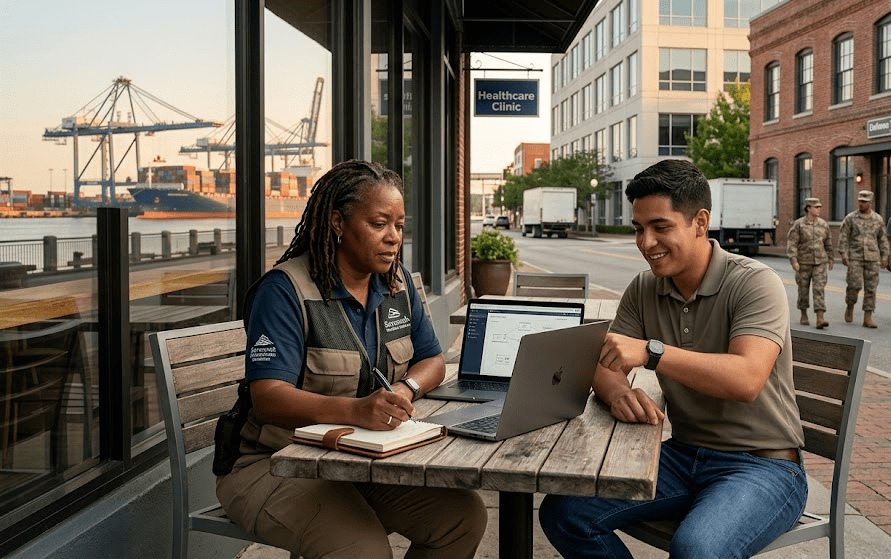
Coastal Georgia SMBs should budget for cybersecurity in tiers, funding the controls that stop the most common attacks before buying advanced tooling. The pattern we see in real incidents is consistent: most breaches start with a stolen password or a phishing email, not an exotic exploit. So the first dollars should go to the basics that close those paths.
Which Controls Deliver the Most Protection Per Dollar
The controls that deliver the most protection per dollar are multi-factor authentication, managed email filtering, endpoint protection, and tested backups. Multi-factor authentication alone blocks the large majority of account-takeover attempts, and it costs very little to deploy across a small team. Layer on email filtering to cut phishing volume, endpoint detection to catch what gets through, and offline backups so ransomware cannot hold you hostage. These four form the foundation of our cybersecurity services for exactly this reason.
A reasonable objection is that tools without people are not enough, and that is correct. A firewall nobody monitors is a false comfort. The resolution is sequencing: install the foundational controls first because they reduce risk immediately, then add monitoring and response as the next tier rather than skipping the basics to chase a managed detection platform you are not yet ready to staff.
When to Add Monitoring and Incident Response
Monitoring and incident response become worth funding once the foundational controls are in place and the business has data or uptime it cannot afford to lose. Continuous monitoring catches the attacker who slips past the front-line tools, and a tested response plan turns a potential disaster into a contained event. Our work on cloud security for a growing client shows how that layering pays off as a company scales.
The trade-off is cost against maturity. A 10-person firm may not need a full security operations capability on day one, while a defense contractor or a busy clinic likely does. The unbiased read is that monitoring is not the starting line, but it is the line every growing Savannah SMB eventually has to cross, and pretending otherwise leaves a gap an attacker will find. When the worst happens, having an emergency cybersecurity response partner already in place is what shortens the damage.
Frequently Asked Questions
Is Savannah a high-risk area for cybersecurity threats?
Savannah carries elevated risk because its economy concentrates port logistics, defense contracting, and healthcare, three sectors that attract motivated attackers. The risk is sector-driven rather than geographic, so an SMB connected to any of those industries should treat its exposure as above average and plan accordingly.
Does my small Savannah business have to comply with CMMC?
Your business must comply with CMMC if it handles Controlled Unclassified Information under a federal defense contract, regardless of company size. If you subcontract to a prime that serves the Department of Defense, the requirement typically flows down to you, and certification gates your ability to keep the work.
What does Georgia law require if my business is breached?
Georgia law requires you to notify affected residents without unreasonable delay when unencrypted personal information is exposed. The duty falls on the business that owns the data, and meeting it depends on having the detection and documentation to know what happened quickly.
What cybersecurity should a Savannah SMB pay for first?
A Savannah SMB should pay first for multi-factor authentication, managed email filtering, endpoint protection, and tested backups. These four controls block the most common attack paths for the lowest cost, which is why they belong ahead of advanced monitoring tools in any budget.
How much should a small business in coastal Georgia spend on cybersecurity?
A small business should size its cybersecurity spend to its risk tier rather than a flat percentage, funding foundational controls first and adding monitoring as it grows. A defense contractor or healthcare provider will invest more than a low-data retail shop because the consequences of a breach are far higher.
Talk Through Your Savannah Security Plan With Us
Savannah’s mix of port logistics, defense contracting, and healthcare means no two SMBs here carry the same risk, and the right plan starts with an honest look at where your business actually sits. Our team advises on Savannah Cybersecurity to help coastal Georgia businesses prioritize controls, meet state and federal obligations, and sequence budgets so foundational protections deliver maximum impact. You do not need to become a security expert to make good decisions. You need a guide who has seen what works for businesses like yours and can tell you the truth about what to fund and when. If you want a clear, no-pressure read on your current exposure and a prioritized path forward, book a free strategy call with our team. You can also browse our cybersecurity resources to get started on your own time.
Savannah Cybersecurity and Coastal Georgia Risk Management Expertise from Matt Rosenthal
Matt Rosenthal, CEO of Mindcore Technologies, has over 30 years of experience helping Savannah and coastal Georgia SMBs understand that their location shapes their threat model in specific ways, with port-adjacent logistics firms sitting inside a supply chain attackers probe as an entry point to larger partners, defense contractors near Fort Stewart and Hunter Army Airfield carrying CMMC obligations that gate their ability to keep bidding, and healthcare practices holding patient records that automated criminal scanning sweeps for regardless of practice size. He has seen firsthand how small Savannah firms across all three sectors reason that they are too minor to interest a sophisticated attacker, then discover that ransomware crews and opportunistic scanning do not discriminate. Matt leads a team that helps coastal Georgia businesses sequence their cybersecurity budget from foundational controls through monitoring and response, map their stacked Georgia and federal compliance obligations before a breach forces the question, and build the detection and documentation that makes rapid, defensible notification possible.

