

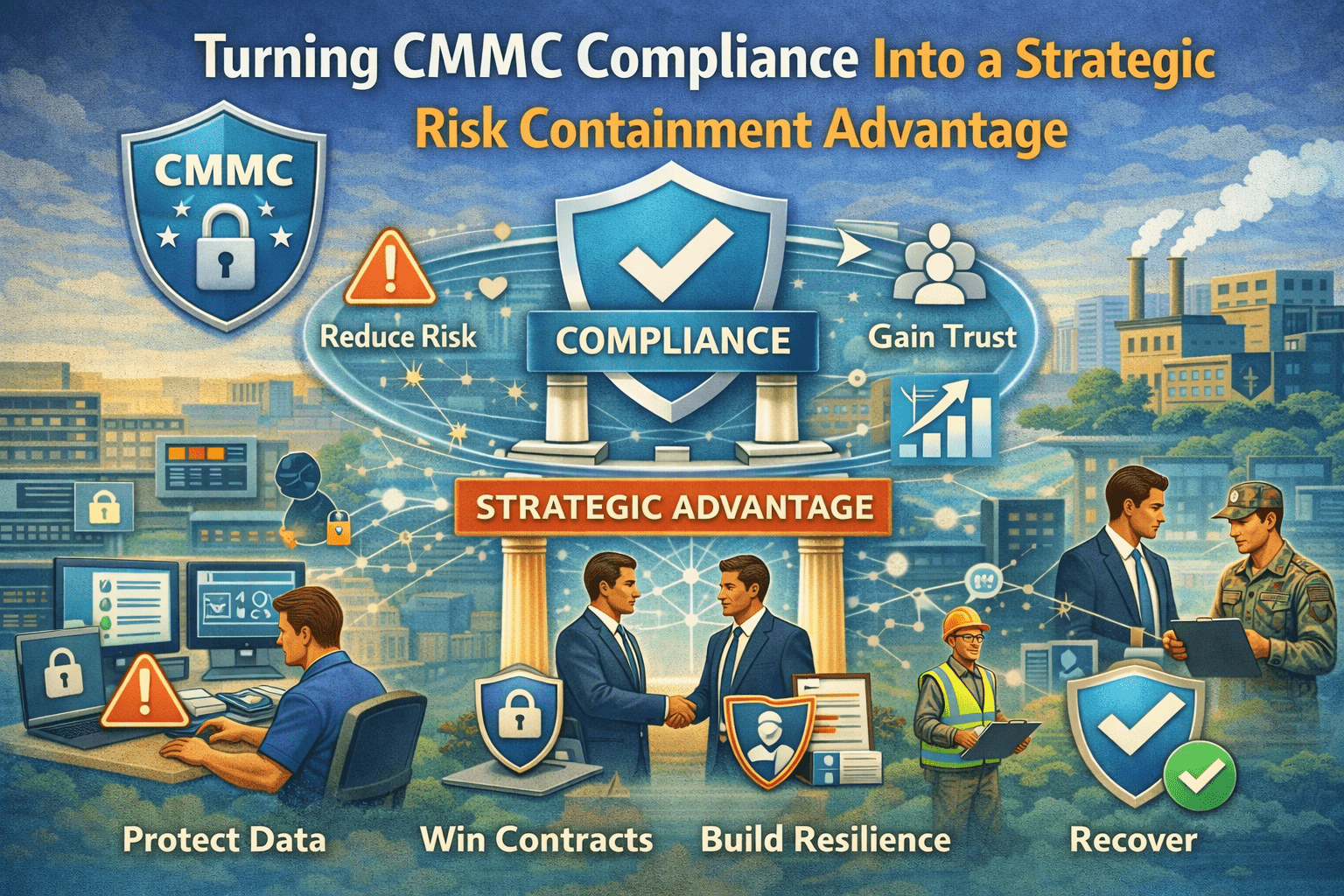
CMMC compliance is mandatory for DoD contractors. That is the baseline. Organizations that build their CMMC program around meeting the minimum requirement produce a compliance program — one that costs money, consumes staff time, and generates documentation, all for the purpose of maintaining contract eligibility.
Organizations that build CMMC compliance as governance infrastructure produce something different: an environment where the security architecture that DoD requires also contains the operational and financial risks that threaten the business independent of any contract requirement. The access controls that protect CUI also protect intellectual property. The audit infrastructure that satisfies CMMC AU also provides the forensic capability that limits cyber incident damage and duration. The incident response program that meets CMMC IR also reduces the cyber insurance premium that has become one of the largest and most variable operating costs for mid-market manufacturers and service providers.
CMMC compliance and strategic risk containment are not competing investments. Implemented correctly, CMMC compliance is the strategic risk containment investment.
Overview
The 110 practices in CMMC Level 2, implemented as architectural discipline rather than documentation compliance, produce security infrastructure that contains the operational, financial, and reputational risks that affect business continuity independent of DoD contract status. The access control architecture that stops lateral movement after a credential theft limits business disruption from any breach, not just CUI-targeting attacks. The configuration management program that reduces the vulnerability window for CUI systems also reduces the vulnerability window for every system in the organization. The governance structure that assigns CMMC compliance ownership across functions also creates the organizational infrastructure for enterprise risk management.
- CMMC access control architecture limits breach scope for every attack type, not just CUI-targeting attacks
- CMMC audit infrastructure produces the forensic visibility that limits incident duration and damage
- CMMC IR programs reduce breach notification costs, legal exposure, and insurance claim complexity
- CMMC configuration management reduces the vulnerability surface that drives most successful initial access campaigns
- CMMC governance structure creates the organizational accountability for risk management that drives down enterprise risk posture across all risk categories
The 5 Why’s
- Why does CMMC access control architecture produce strategic risk containment benefits beyond CUI protection? Ransomware, business email compromise, and data theft attacks are not limited to CUI environments. They exploit the same flat networks, standing privileges, and broad internal access that CMMC access control requirements address. An organization that has implemented least-privilege access, segmented network architecture, and session-based authorization to protect CUI has also contained the spread of every other attack that depends on those conditions. The risk containment benefit is not CUI-specific — it is architectural.
- Why does CMMC audit infrastructure reduce cyber incident financial impact? Cyber incident costs are driven by two factors: the scope of the damage and the time to detection and containment. CMMC audit infrastructure reduces both. Comprehensive logging that detects anomalous behavior during attacker dwell time reduces the time between breach and detection. Access controls that limit attacker reach reduce the scope of systems and data affected. Both factors directly reduce breach notification costs, regulatory investigation exposure, and business disruption duration.
- Why does CMMC IR program investment reduce cyber insurance costs? Cyber insurance underwriters evaluate incident response program maturity as a primary risk factor. Organizations with tested IR programs, defined response procedures, and demonstrated monitoring infrastructure receive meaningfully lower premiums than organizations without those programs — because underwriters price the risk of an extended, uncontained breach into policies for organizations without containment capability. CMMC IR investment is simultaneously a compliance requirement and an insurance cost reduction.
- Why does CMMC compliance create competitive differentiation in DoD contract competitions? CMMC compliance becomes a contract eligibility requirement for Level 2 contracts — but the differentiation goes beyond eligibility. Organizations that can demonstrate mature compliance programs, short time-to-compliance from contract award, and governance structures that give primes confidence in the security of their supply chain position win contracts over organizations that can demonstrate eligibility but not maturity. CMMC compliance quality is a competitive differentiator in a market where many contractors will meet the minimum threshold.
- Why is CMMC compliance as governance infrastructure more cost-effective than CMMC compliance as IT project? IT project compliance produces point-in-time compliance that decays between assessments as systems change, staff turns over, and configurations drift. Governance infrastructure compliance produces continuous compliance that is maintained through operational practices rather than remediation cycles. The ongoing cost of maintaining governance infrastructure compliance is lower than the recurring cost of remediation sprints that bring IT project compliance back to assessment standard before each C3PAO review.
Strategic Value Creation Through CMMC Implementation
Risk Containment Value
CMMC-compliant architecture contains risk across the full enterprise, not just the CUI environment:
- Breach scope limitation from access control architecture reduces average incident cost
- Audit trail completeness reduces average time to detection and containment
- Configuration management reduces successful initial access campaign frequency
- IR program maturity reduces regulatory investigation exposure and breach notification complexity
Competitive Value
CMMC compliance maturity creates competitive value in DoD market positioning:
- Contract eligibility for the full range of DoD contracts that will require CMMC certification
- Trust signal to primes evaluating subcontractor security maturity for supply chain risk management
- Differentiation from competitors at the eligibility threshold who cannot demonstrate program maturity
- Platform for pursuing higher-value DoD contracts as the organization’s CMMC program matures
Organizational Value
CMMC governance infrastructure creates organizational value beyond the compliance program:
- Cross-functional security accountability that was previously absent from procurement, legal, HR, and operations
- Enterprise risk management infrastructure built on CMMC governance structures
- Security awareness at the organizational level that reduces human-factor risk across all business operations
- Documentation and evidence management practices that support other compliance obligations (HIPAA, SOC 2, state privacy regulations)
Implementing CMMC for Strategic Value, Not Minimum Compliance
The difference between minimum compliance and strategic value implementation:
| Minimum Compliance | Strategic Value Implementation |
|---|---|
| Controls implemented to pass assessment | Controls implemented as architectural design |
| IT-owned compliance program | Cross-functional governance infrastructure |
| Documentation-first approach | Evidence-accumulation-first approach |
| Point-in-time compliance maintenance | Continuous compliance operational practice |
| CUI environment scoped to minimum | Security architecture applied across enterprise |
| CMMC assessed for DoD eligibility | CMMC used as enterprise risk management framework |
Final Takeaway
Organizations that build CMMC compliance as minimum-requirement documentation programs spend money maintaining contract eligibility. Organizations that build CMMC compliance as governance infrastructure spend the same money — and get contract eligibility, breach risk containment, insurance cost reduction, competitive differentiation, and organizational security culture as the return on that investment.
The requirement is the same. The implementation decision determines whether compliance is a cost or a strategic investment.
Build CMMC as Strategic Risk Infrastructure With Mindcore Technologies
Mindcore Technologies works with DIB contractors to implement CMMC compliance as governance infrastructure — architectural access control, enterprise-wide security program design, governance structures that extend beyond IT, and continuous compliance practices that produce strategic risk containment value alongside DoD contract eligibility.
Talk to Mindcore Technologies About CMMC as Strategic Risk Infrastructure →
Contact our team to assess your current CMMC program against the strategic value framework and build the implementation that turns compliance investment into competitive and risk management advantage.

