


The ransomware threat has evolved.
What began as opportunistic attacks on individual organizations has matured into a sophisticated, business-like operation targeting the infrastructure entire industries depend on.
ShinyHunters, the group that claimed responsibility for the Canvas cyberattack, represents this evolution clearly.
They do not just breach one company. They breach the platforms thousands of companies and millions of people rely on.
The scale of leverage that creates is categorically different from a conventional ransomware attack.
Understanding how these groups operate, why they target platforms, and what it means for organizations depending on shared infrastructure is essential context for any serious cybersecurity strategy.
Organizations evaluating platform exposure should review layered cybersecurity services, third-party risk management strategies, and ransomware response planning before an incident occurs.
Who ShinyHunters Are
ShinyHunters is a well-documented cybercriminal group with a history of large-scale data theft and extortion.
They have claimed responsibility for breaches affecting hundreds of millions of user records across multiple high-profile platforms.
Their model is built on dual extortion.
First, they exfiltrate data before deploying disruptive payloads. Then they threaten to publicly release stolen data unless a ransom is paid.
This approach creates two separate pressure points:
- The operational disruption caused by inaccessible systems
- The reputational and regulatory consequences of exposed sensitive data
For platforms serving educational institutions, healthcare organizations, or financial services, both forms of pressure are severe.
The data is sensitive. The disruption is public. The consequences of non-payment are visible.
Organizations handling regulated or sensitive information should also evaluate cybersecurity compliance services and strategic IT consulting.
Why Platforms Are the New Primary Target
Maximum Leverage from a Single Breach
Attacking one organization affects one organization.
Attacking a platform affects every organization and user on that platform simultaneously.
The effort required to breach a platform is significantly greater than targeting a single company, but the leverage created is exponentially higher.
The Canvas attack affected an estimated 9,000 schools and up to 275 million users from a single operation.
No single-company breach creates that level of disruption or negotiating leverage.
Centralized Data Concentration
Platforms aggregate data from thousands of organizations into centralized environments.
A successful platform breach gives attackers access to data belonging to every organization on the platform, not just the platform operator.
This creates enormous exfiltration value far beyond any individual organization’s data.
Reputational Stakes
Platform operators carry reputational obligations to every organization depending on their service.
A breach exposing customer data creates pressure not only from regulators and law enforcement, but from every affected client simultaneously.
Timing as a Weapon
Platforms cannot easily take systems offline without disrupting thousands of dependent organizations.
This continuity pressure significantly increases the likelihood of ransom consideration.
Organizations increasingly dependent on shared infrastructure should also evaluate Zero Trust security architecture and secure workspace environments designed to reduce platform-level exposure.
How These Attacks Are Executed
Platform-level ransomware attacks follow a structured methodology.
Reconnaissance
Attackers research platform architecture, integration points, employee structures, and security posture before taking action.
This phase may take weeks or months.
Initial Access
Entry is commonly gained through:
- Compromised credentials from phishing or credential markets
- Exploited vulnerabilities in internet-facing systems
- Third-party vendor access paths
Persistence and Lateral Movement
Once inside, attackers establish persistent access and move laterally through the environment while escalating privileges.
Infrastructure mapping occurs before visible disruption begins.
Data Exfiltration
Before deploying ransomware, attackers exfiltrate the most valuable data available.
This stolen data becomes the foundation of extortion leverage.
Deployment
Ransomware payloads are deployed during strategically chosen moments:
- Finals week for education platforms
- Tax season for financial organizations
- Enrollment periods for healthcare systems
Extortion
Ransom demands combine operational disruption with threats to publicly release stolen data.
Organizations defending against advanced ransomware campaigns should evaluate ransomware protection strategies, network security monitoring, and managed security services.
What Organizations Cannot Control and What They Can
When a platform your organization depends on is attacked, you did not cause the breach.
You cannot prevent it at the provider level.
But your exposure and your response are within your control.
What You Cannot Control
- The security posture of the platform provider
- Whether the provider is breached
- The timing of the attack
What You Can Control
- What data you store on third-party platforms
- Whether MFA is enforced on all platform accounts
- Whether you have a tested response plan ready
- How quickly your organization responds during a platform incident
- Whether dependencies are diversified or overly concentrated
Organizations strengthening third-party resilience should implement multi-factor authentication and IT risk assessments.
The Compliance Dimension
For organizations operating in regulated industries, platform breaches create compliance obligations regardless of where the breach originated.
HIPAA
Covered entities and business associates must notify affected individuals and regulators when protected health information is exposed, including breaches originating from third-party platforms.
CMMC
Organizations handling controlled unclassified information must maintain oversight of supply chain and platform security under CMMC requirements.
FINRA and FTC Safeguards Rule
Financial organizations maintain obligations around protecting customer financial data extending to vendor and platform relationships.
Organizations failing to map platform dependencies and compliance obligations are carrying hidden regulatory risk.
Businesses navigating complex compliance environments should evaluate CMMC consulting, compliance framework guidance, and virtual CISO services.
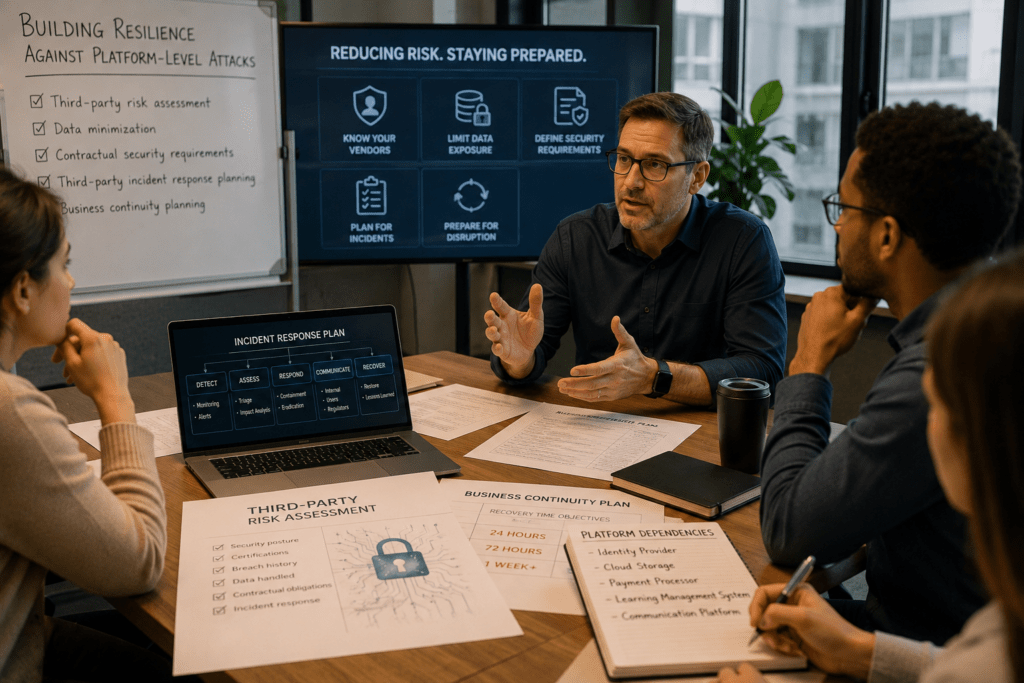
Building Resilience Against Platform-Level Attacks
Third-Party Risk Assessment
Every critical platform should be evaluated for:
- Security certifications
- Breach history
- Incident response obligations
- The type of data stored
Data Minimization
The less sensitive data stored on third-party platforms, the lower the organizational exposure when breaches occur.
Contractual Security Requirements
Security expectations, breach notification timelines, and cooperation requirements should be written directly into vendor agreements.
Incident Response Planning for Third-Party Events
Your incident response plan should specifically address platform-level incidents outside your direct control.
Questions include:
- Who communicates with affected users?
- What are the notification timelines?
- What actions happen while waiting for the provider to restore service?
Business Continuity Planning
Organizations should evaluate how operations continue if critical platforms become unavailable for:
- 24 hours
- 72 hours
- One week or longer
Organizations improving operational resilience should also review business continuity planning, incident response services, and co-managed IT services.
Actionable Steps
- Map all third-party platform dependencies – Know what platforms hold your data and operational dependencies
- Enforce MFA on all platform accounts – Compromised credentials remain the most common attack entry point
- Review vendor contracts for security obligations – Add breach notification and response requirements where missing
- Build a third-party incident response protocol – Define responsibilities before a breach occurs
- Test continuity plans – Identify operational failures before real incidents happen
- Monitor for credential exposure – Dark web monitoring helps identify leaked credentials early
Organizations seeking stronger operational oversight should also evaluate managed IT services and proactive penetration testing.
FAQ: Ransomware Groups and Platform Attacks
What is dual extortion ransomware?
Dual extortion combines system disruption with threats to publicly release stolen data. Attackers use both operational pressure and reputational risk to increase leverage during ransom negotiations.
Why do ransomware groups target platforms instead of individual companies?
Platforms provide significantly greater leverage. A single successful platform attack can impact thousands of organizations and millions of users simultaneously.
How can I check if my organization’s credentials have been leaked?
Dark web monitoring services scan breach databases and criminal marketplaces for credentials associated with your organization’s domains, helping identify exposure before attackers exploit it.
What should an organization do immediately after a platform breach?
Reset credentials, revoke API keys, assess stored data exposure, notify internal security teams, activate third-party incident response protocols, and monitor systems for unusual activity.
The Bottom Line
Ransomware groups like ShinyHunters are not targeting companies randomly.
They are making calculated decisions about where to invest attack resources for maximum leverage and maximum return.
Platforms, with their concentration of data, operational dependencies, and high-pressure user bases, offer exactly the profile these groups seek.
Organizations cannot opt out of platform risk. Cloud infrastructure, communication systems, learning platforms, and financial ecosystems are now essential operational dependencies.
What organizations can do is understand those dependencies, reduce exposure, and prepare to respond effectively when a platform incident occurs.
Mindcore Technologies helps organizations build cybersecurity programs addressing the full threat landscape, including the platform-level risks increasingly driving large-scale ransomware events.
Your security posture is only as strong as the weakest dependency in your environment.
Schedule a consultation with Mindcore to evaluate your platform exposure, strengthen third-party risk management, and improve your organization’s resilience against modern ransomware threats.

