

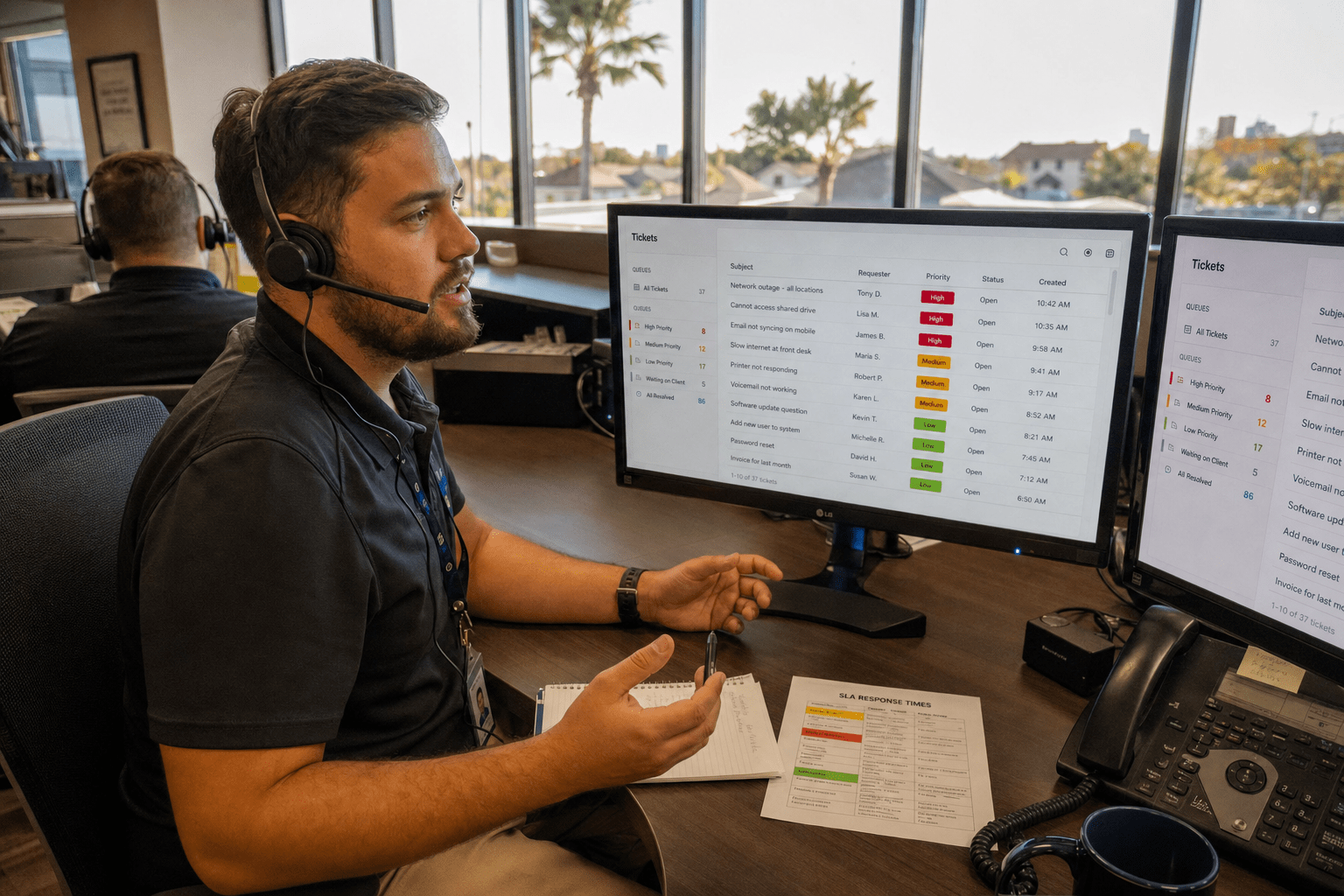
Most Help Desk Louisiana services look solid on the contract but fall short in the moment a business actually needs support. A provider advertises 24/7 coverage and a fast answer time, and for routine password resets and printer tickets that holds up fine. The gaps show later: no written SLA that separates a stuck laptop from a downed server, a queue that backs up when hurricane season knocks out half the state at once, and a remote-only team three time zones away that has never seen your setup. We have run help desks for small and midsize businesses across Baton Rouge, New Orleans, and Metairie for years, and the five gaps below are the ones that quietly cost owners the most. Every one of them is easy to check before you sign, and hard to fix after a storm.
The 5 Help Desk Gaps Louisiana SMBs Miss Most
Help Desk Louisiana services tend to break down in predictable areas, and identifying them turns a vague vendor pitch into a practical checklist. These five gaps are the ones we see catch SMB owners off guard, and each one is answerable with a direct question during the sales call.
- No tiered SLA. A single “we respond fast” promise means nothing without written response and resolution targets that separate a minor ticket from a business-down outage.
- Weak triage. Without clear ticket tiers, a password reset and a failed server land in the same queue, and the urgent problem waits behind the trivial one.
- Hurricane-season continuity. A help desk that cannot operate when Louisiana loses power and connectivity for days is a help desk that disappears exactly when you need it.
- Remote-only, no local context. A distant team that has never seen your network asks more questions, escalates slower, and takes longer to close the tickets that matter.
- No proactive monitoring. A reactive desk waits for you to notice the problem and call it in, which means you are already down before the clock even starts.
Why Help Desk Support in Louisiana Needs a Written SLA
Help Desk Louisiana services is only as good as the service level agreement behind it, because response speed means nothing without a definition of what counts as fast. A service level agreement, or SLA, is the written promise that spells out how quickly a provider will respond to and resolve a ticket. Many local providers advertise a headline answer time and stop there. That single number tells you how fast someone picks up, not how fast your business gets back to work. The businesses that get real value from their managed IT support insist on an SLA that ties targets to ticket severity before they sign anything.
How Ticket Triage Tiers Protect Your Business
Ticket triage tiers keep an urgent outage from waiting behind a trivial request, and a help desk without them treats every problem as equally important. A tiered system usually sorts tickets into severity levels: a business-down emergency, a single-user problem, and a routine request. The case for skipping tiers sounds reasonable at first, since a small shop may feel every ticket is urgent to the person who filed it. The stronger reality is that when a server goes dark for forty staff while one person waits on a font install, treating both the same is a choice that costs real money. We recommend you ask any provider to show you their tier definitions in writing, because a desk that cannot describe how it prioritizes is a desk that answers in the order tickets arrive.
How Response and Resolution Times Actually Differ
Response time and resolution time are two different promises, and confusing them is where many Louisiana SMBs get burned. Response time is how long until a human acknowledges your ticket. Resolution time is how long until the problem is actually fixed. A provider can hit a seven-second answer time and still leave you down for two days, and both numbers can be technically true. The counterview is that some issues genuinely cannot carry a fixed resolution target, since a hardware failure depends on parts. That is fair, which is why a good SLA sets resolution targets by tier and states plainly where a target is a goal rather than a guarantee. Ask for both numbers, and ask what happens when either is missed.
The Louisiana Factor Remote Help Desks Skip
The Louisiana factor in help desk support is storm-season continuity, and it is the gap an out-of-state provider is least likely to price for you. A help desk built for a low-risk region quietly assumes its clients and its own staff will have power, internet, and office access on any given day. On the Gulf Coast, that assumption fails on a schedule. Federal Ready.gov business continuity guidance is direct that planning has to account for the disruptions a region actually faces, and for Baton Rouge, New Orleans, and Metairie that means multi-day power loss, connectivity outages, and physical access limits. A help desk that runs from a single site with no failover is a help desk that goes quiet the same week you need it most.
How a Help Desk Stays Open During a Hurricane
A help desk stays open during a hurricane only when it is built to run from more than one location and route tickets when a site goes dark. During a regional storm, every business in the state files tickets at once, and a provider staffed from a single Louisiana office may lose power alongside its clients. The argument that cloud tools make location irrelevant holds partway, since a distributed team can log in from anywhere with a signal. It breaks where the signal itself is gone, which is why continuity planning has to cover staff, connectivity, and a documented failover, not just software. Our 24/7 emergency help desk is designed to keep answering when a single region is offline, because in Louisiana a seasonal outage is a certainty, not a maybe.
How Local Support Cuts Recovery Time
Local support shortens recovery when something breaks during a Louisiana outage, and its value shows up in the hours you are down rather than on the monthly invoice. A remote-only team can handle routine tickets well enough. When a regional network outage hits and the whole state calls in, a distant queue is still a queue, and a technician who has never seen your environment burns time learning it. The honest counterpoint is that cloud infrastructure is location-independent, so support can technically come from anywhere. In practice, a team that already knows your systems and your region responds faster and asks fewer questions. That head start is the difference between a two-hour recovery and a two-day one.
How to Vet Help Desk Support in Louisiana Before You Sign
Vetting Help Desk Louisiana services comes down to asking for proof on the five gaps instead of trusting the headline numbers. Start by requesting the written SLA and reading the tier definitions, since that single document exposes whether triage and resolution targets are real or marketing. Ask directly how the desk operates during a hurricane, and expect a specific answer about staffing, failover, and connectivity rather than a reassurance. Confirm whether monitoring is proactive, because a desk that catches problems before you do is worth more than one that waits for your call, a point echoed in the CISA Cyber Essentials guidance for small organizations. Check that the team can support your specific stack, and lean on resources like the NIST small business cybersecurity program to frame what good looks like. If you want a deeper primer first, our explainer on what a managed help desk is and how it works covers the model in plain terms.
Frequently Asked Questions
How much does help desk support in Louisiana cost for a small business?
Help Desk Louisiana services is usually priced per user per month, which gives a small business a predictable flat fee instead of surprise hourly bills. The exact rate depends on coverage hours, the number of users, and whether monitoring and security are bundled in. A short assessment of your team size and systems is the only way to get a real number for your setup.
What response time should a Louisiana help desk guarantee?
A Louisiana help desk should guarantee response times that vary by ticket severity, not a single number for everything. A business-down emergency needs a far faster acknowledgment than a routine request, and a good SLA states each target in writing. Be sure to separate response time, meaning acknowledgment, from resolution time, meaning an actual fix.
Does help desk support in Louisiana stay open during hurricanes?
Quality help desk support in Louisiana is built to stay open during hurricanes through multi-site staffing and a documented failover plan. A provider running from a single local office can lose power alongside its clients, so ask specifically how the desk operates when a region loses connectivity. Storm-season continuity is a required feature here, not an optional upgrade.
Is a local help desk better than a remote one for a Louisiana SMB?
A local help desk often resolves Louisiana tickets faster because the team already knows your environment and your region’s risks. Remote desks can handle routine issues well, but a technician unfamiliar with your setup spends more time diagnosing during an outage. The strongest option pairs local context with the reach to keep answering when a single site goes dark.
What is the difference between a help desk and managed IT?
A help desk answers and resolves support tickets, while managed IT is the broader service that includes the help desk plus proactive monitoring, security, and strategy. A standalone help desk is reactive by design and waits for you to report a problem. Managed IT aims to catch and prevent issues before they ever reach the ticket queue.
Talk to a Louisiana Team Before the Next Storm
Help desk support in Louisiana rewards the businesses that check the gaps up front and punishes the ones who trust the headline answer time. The five gaps, a missing tiered SLA, weak triage, no hurricane-season continuity, remote-only teams with no local context, and reactive-only coverage, are all easy to test with a direct question during the sales call. The owners who come out ahead treat the vetting like hiring: they ask for the written SLA, they push on the storm plan, and they confirm someone will actually know their systems before an incident starts. That is the difference between a desk that answers when it is convenient and one that answers when it counts. If you want a clear read on whether your current support covers those gaps, our team serving businesses across Louisiana will walk your setup, show you where the risks sit, and build a support plan sized for a Gulf Coast address. Book a free strategy call and we will start with a look at your SLA and your storm readiness.

