

VoIP and unified communications in New Jersey is usually shopped the wrong way, on the per-seat price and the length of the feature list, when the things that actually decide whether the system serves your business are barely mentioned in the sales conversation. Two questions matter more than any feature comparison. Can the system reliably send emergency responders to the right address when someone dials 911, and do your phones keep working when the internet or power goes down. A cheap quote that ignores both is not a bargain, it is a liability waiting for the wrong moment. This guide walks a New Jersey business through what VoIP and unified communications should deliver, so you buy a phone system that holds up when it counts rather than one that looks good on a spreadsheet.
What VoIP and Unified Communications Actually Are
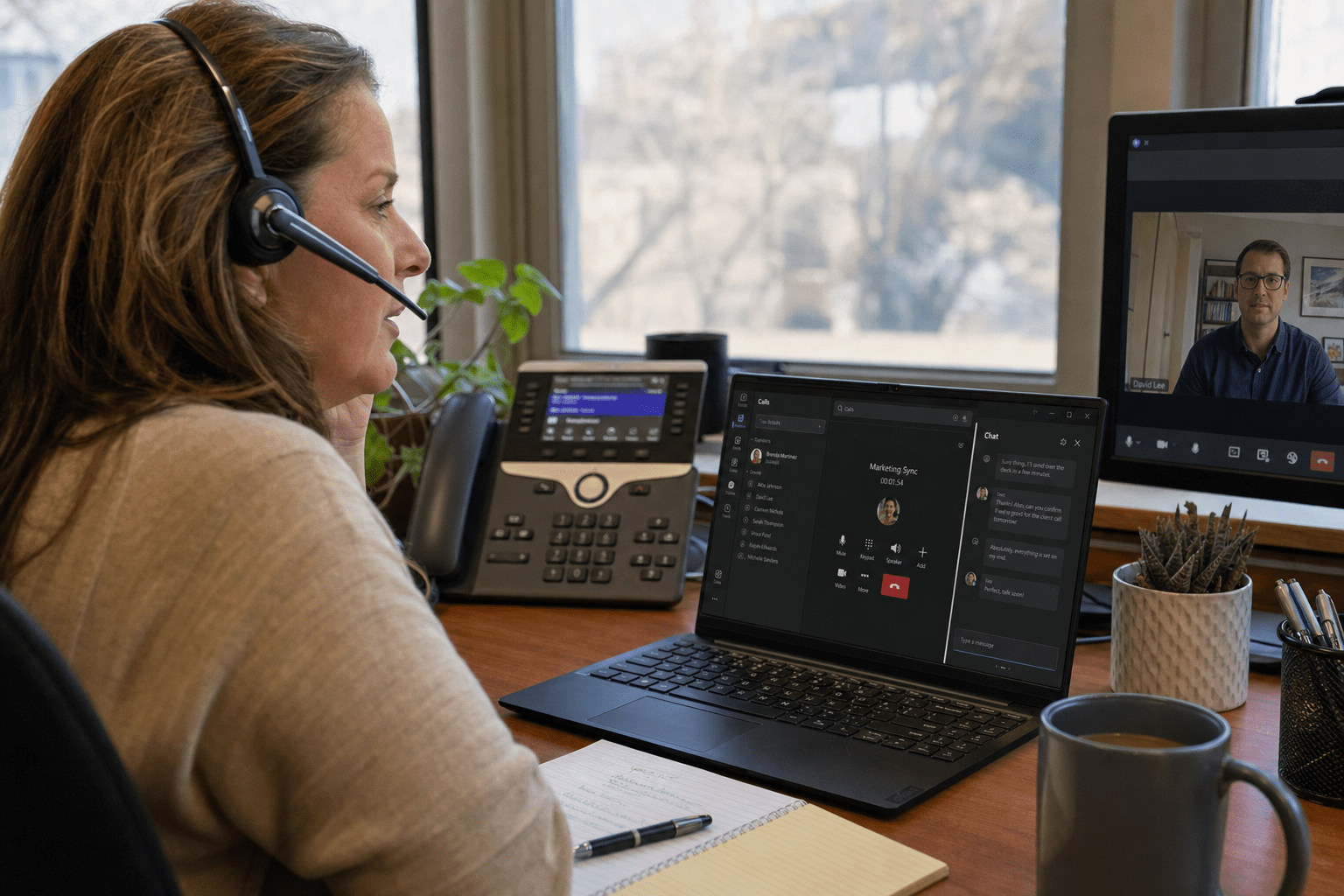
VoIP and unified communications in New Jersey means moving your phone system to the internet and bringing voice, video, chat, and messaging together into one platform your team uses from anywhere. VoIP is the voice piece, calls carried over your data connection instead of traditional phone lines. Unified communications is the broader idea, one integrated system for all the ways your team communicates, rather than a phone system, a separate chat tool, and a video app that do not talk to each other. The appeal is real: lower long-distance costs, flexibility for remote and hybrid staff, and features that old phone systems could not touch. Many New Jersey businesses get there by consolidating onto a platform they already own, which is where a Microsoft Teams phone system turns the collaboration tool your staff already use into their business phone line too.
Consolidation Is the Real Win
The strongest reason to move to unified communications is consolidation, folding separate tools into one platform, and it is a bigger win than the per-minute savings that get quoted first. When voice, video, chat, and file sharing live in one place, your team stops switching between apps and losing context, and you stop paying for and managing several overlapping subscriptions. For a business already invested in Microsoft 365, extending Microsoft Teams into a full communications hub avoids adding yet another vendor. The counterview that a dedicated phone system does voice better than an all-in-one platform held more weight a few years ago than it does now, when the integrated platforms have closed most of the gap and the friction of juggling separate tools has only grown.
Flexibility for Hybrid and Remote Work
Unified communications suits how New Jersey businesses actually work now, with staff split between the office, home, and the road. A cloud-based system gives every employee the same number, features, and access whether they are at a desk in Newark or a kitchen table in the suburbs. That flexibility is genuinely valuable and is often the reason a business makes the move. It also raises a fair question about reliability, because a system that depends entirely on internet connectivity is only as dependable as that connection, which is exactly the issue the next section addresses.
The Two Questions That Actually Matter
The two questions that decide whether a VoIP and unified communications system is right for a New Jersey business are almost never on the sales sheet: emergency calling compliance, and what happens during an outage. Get these wrong and the cheapest quote becomes the most expensive decision. Get them right and the rest of the feature comparison is straightforward. Both are solvable, but only if you ask about them before you sign rather than discovering the gap during an emergency.
E911 Compliance Is Not Optional
Emergency 911 calling is where VoIP carries a real regulatory obligation that businesses often overlook. Because a VoIP call is not tied to a physical phone line, the system has to be configured to tell emergency services where the caller actually is, which is the point of enhanced 911. The FCC’s E911 rules require that a 911 call routes to the right emergency center with an accurate address, and for a business with multiple locations or remote staff that takes deliberate setup. A provider who treats E911 as an afterthought is exposing your business to a genuine safety and compliance risk. Ask any New Jersey VoIP provider exactly how they handle emergency calling for your locations and your remote workers, and treat a vague answer as a warning.
Voice Continuity When the Connection Drops
The second question is what happens to your phones when the internet or power goes down, because a VoIP system lives on your data connection and dies with it unless it was designed not to. In New Jersey, where storms and outages are a regular fact, this is not a hypothetical. A well-designed system includes failover, automatic rerouting of calls to mobile devices or a backup connection so your business stays reachable when the primary link is down. The Ready.gov business continuity guidance treats communications as a core part of any continuity plan, and voice is often the first thing customers try when something goes wrong. A phone system with no outage plan is a phone system that goes silent exactly when your customers most need to reach you. Security matters here too, since a hosted communications platform is another system to protect, and the CISA cybersecurity best practices apply to your voice platform as much as to your email.
How to Choose a Provider in New Jersey
Choosing a VoIP and unified communications provider in New Jersey comes down to the questions that separate a real partner from a reseller chasing a low quote. How do you configure E911 for our locations and remote staff. What happens to our phones during an internet or power outage, and is failover included or extra. Do you consolidate our tools onto one platform, or add another vendor to the pile. Can you support us locally when something needs hands-on help. How do you secure the platform. The provider who answers these clearly, rather than steering back to the monthly per-seat price, is the one worth shortlisting. For a sense of the New Jersey provider landscape, our roundup of the top managed service providers in New Jersey is a useful reference, and if you are already on Microsoft 365, folding voice into your existing Office 365 environment is often the cleanest path. Local support across the state matters too, which is why working with a provider covering New Jersey businesses directly beats a distant call center.
Frequently Asked Questions
How much does VoIP and unified communications cost in New Jersey?
VoIP and unified communications is usually priced per user per month, and the range depends on the features you need and whether outage failover and full unified communications are included. Focus less on the lowest per-seat number and more on what the plan covers, since a cheap quote that skips E911 configuration or outage continuity costs far more when either gap is exposed.
Do VoIP phones work during a power or internet outage?
Not on their own. Because VoIP runs over your internet connection, the phones go down with it unless the system was designed with failover, such as automatic rerouting to mobile devices or a backup connection. In New Jersey, where outages happen, confirming that failover is included is one of the most important questions to ask.
Is E911 emergency calling handled automatically with VoIP?
No, it has to be configured. Since VoIP is not tied to a fixed line, the system must be set up to route 911 calls to the correct emergency center with an accurate address, which the FCC requires. For businesses with multiple sites or remote staff this takes deliberate setup, so ask your provider exactly how they handle it.
Can we use Microsoft Teams as our business phone system?
Yes. If your business already uses Microsoft 365, a Teams phone system turns Teams into your full business phone line, consolidating voice, chat, and video into one platform your staff already know. This avoids adding another vendor and is often the cleanest path to unified communications.
What is the difference between VoIP and unified communications?
VoIP is the voice piece, phone calls carried over the internet. Unified communications is the broader platform that brings voice together with video, chat, and messaging in one integrated system. VoIP can be a standalone phone service, while unified communications ties all your communication channels together.
Get VoIP and Unified Communications Done Right in New Jersey
VoIP and unified communications in New Jersey is worth getting right because the two questions that decide whether it serves you, emergency calling and outage continuity, are exactly the ones a low quote skips. A system that consolidates your tools, keeps your phones reachable when the connection drops, routes 911 calls accurately for every location and remote worker, and is supported by a team that can help locally is worth more than the cheapest per-seat price by a wide margin. Those differences stay invisible until the day they are not, and by then the decision is already made. If you want a clear read on whether your current phone system or a prospective provider handles the questions that matter, our team supporting New Jersey businesses will review your setup, flag the E911 and continuity gaps, and lay out a plan built for how your business actually communicates. Book a free strategy call and we will start with the outage question most providers never raise.

