

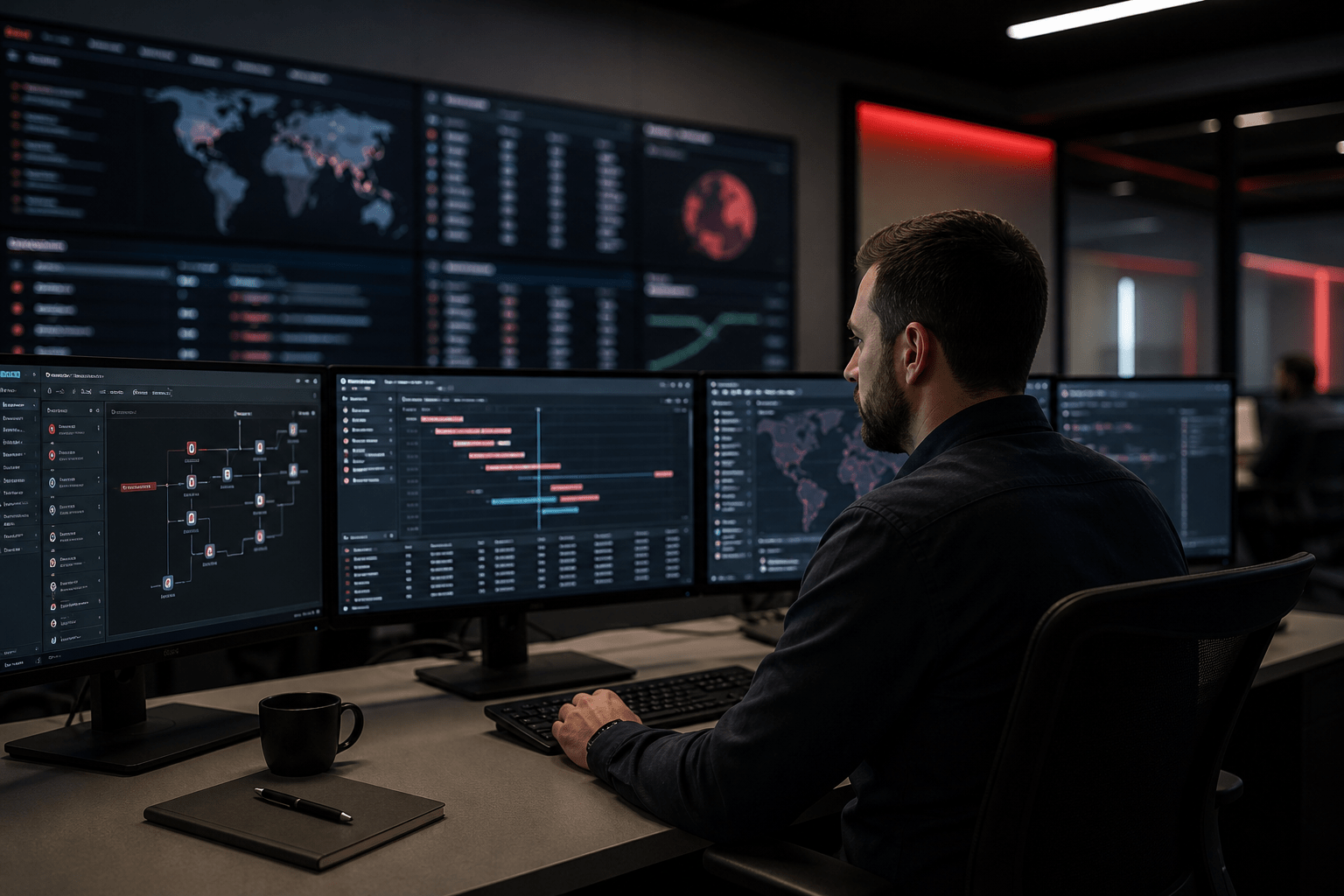
The best AI tools for incident response documentation in 2026 are judged on whether their output holds up a year later, not on how fast they draft a postmortem. Platforms including incident.io, Rootly, FireHydrant, and PagerDuty now assemble timelines, draft status updates, and produce retrospective documents from chat history and alert data. That output serves three readers with different standards: the engineering team learning from the event, the customer waiting for a status update, and the regulator or insurer reviewing your file after a claim. Our team assesses these products against the third reader, because that is the one who can turn weak documentation into a financial loss. Speed matters. Defensibility decides whether the record was worth writing.
The Five Questions That Decide Which Platform Fits
We advise firms between fifty and eight hundred employees, usually with a small security team and no dedicated incident commander. Five questions settle the choice faster than any product comparison.
- Does the timeline cite its sources? A generated sequence of events is only useful if each entry links back to the log line, alert, or message it came from.
- Can it hold a regulatory clock? Breach notification windows run in hours, and the tool should track the deadline from the moment of determination, not from when someone remembered to start a timer.
- Is the evidence immutable? Retrospective documents get edited. The underlying record must not be editable by the people whose actions it describes.
- Does it separate fact from inference? A model writing “the attacker likely pivoted through the VPN” has produced a hypothesis, and a document that presents it as finding is a liability.
- Who can read it without training? Your insurer, your largest customer, and your lawyer will all read this file. None of them know your service names.
Why Incident Records Fall Apart Weeks After the Incident
The documentation problem is not that teams refuse to write things down. It is that the record gets assembled from memory after the adrenaline fades, and the details that matter most are the ones that decay fastest. We have reviewed enough post-event files to see the same three failures repeat.
Reconstruction from chat is lossy, and everyone does it
Most incidents are actually worked in a chat channel, so the channel becomes the primary record by default. That works while the event is live. Two weeks later, the channel holds jokes, dead ends, three people reporting the same symptom, and a decision made in a call that nobody typed. AI summarization genuinely helps here, because it can lift a coherent sequence out of hundreds of messages in seconds. The opposing case deserves weight: summarization smooths over exactly the confusion that mattered, and a clean narrative implies the team knew things it did not know at the time. We recommend keeping both artifacts. Preserve the raw channel export as evidence, and treat the generated summary as the readable layer on top, clearly labeled as derived.
The notification clock starts before anyone feels ready
Regulatory and contractual notification windows do not wait for certainty. Depending on the framework and the customer contract, you may owe notice within seventy-two hours of determining a reportable event occurred, and some contracts run tighter. Teams miss these deadlines because the clock started at a moment nobody recorded. A documentation platform that stamps the determination moment, names who made the call, and counts down against it removes the most avoidable failure in this whole area. Firms that rehearse this in a tabletop exercise rarely miss it, which is the argument for the approach in our guide to running a cyber incident response simulation.
Evidence gets modified by the people it describes
Retrospectives are usually written by the responders. That is correct for learning and wrong for defensibility. When the same account can edit the timeline it appears in, the record loses weight with anyone assessing it later. Write access to the underlying event log should be separate from write access to the narrative document. This is a permissions decision your existing tooling can probably support today, and it costs nothing to set up before you need it.
How the Best AI Tools for Incident Response Documentation Build a Timeline
The best AI tools for incident response documentation build timelines by correlating alerts, deploys, chat messages, and ticket transitions into a single ordered sequence. The difference between products shows up in what they do when those sources disagree.
Source-linked entries versus generated prose
Rootly and FireHydrant both assemble retrospectives from captured event data, with each entry traceable to its origin. That traceability is the property worth paying for. A generated paragraph reading “the team rolled back at approximately 14:20” is far weaker than an entry that names the deploy id and links the pipeline record. When you evaluate a trial, take one real past incident, feed it in, and check whether you can click from any claim to its evidence. If you cannot, the document is a story rather than a record.
Handling clock skew and disagreeing sources
Real incidents produce contradictory timestamps: a monitoring system in one timezone, a cloud provider log in another, and a customer report with no reliable time at all. Products that normalize everything to a single zone and present one clean sequence look better and hide the disagreement. Products that surface the conflict look messier and are more honest. We favor the messier presentation for anything with regulatory weight, because a reviewer who later finds a discrepancy you did not flag will discount the whole file. Normalization is fine for the internal learning copy.
Separating what happened from what we think happened
Model-drafted analysis blends observation and inference fluently, which is precisely the risk. “Failed logins spiked at 02:14” is an observation. “An automated credential-stuffing attempt began at 02:14” is a conclusion that may be right and has not been proven. Require the tool, or your template, to keep those in separate sections. The same discipline governs how we report findings in software penetration testing, where an observed behavior and an exploited path are never written as the same claim.
Comparing the Best AI Tools for Incident Response Documentation on Audit Readiness
Comparing the best AI tools for incident response documentation on audit readiness means testing the export, not the dashboard. The dashboard is for your team. The export is what leaves the building.
Export quality is the real product
Ask every vendor for a full export of a closed incident, then read it as though you know nothing about the company. Can you tell what broke, who decided what, when customers were told, and what changed afterward? Most exports fail on the third item, because customer communication lives in a separate system. Products that capture the status page update and the customer email into the same record save you assembling that under pressure later. Groups already keeping evidence for vulnerability scanning and penetration testing can file incident exports under the same retention policy rather than inventing a second one.
Retention, and the trap of keeping everything
Longer retention sounds safer and is not automatically so. Every retained artifact is discoverable, and an unstructured five-year archive of chat logs is a burden as much as a protection. Set a retention period deliberately, apply it consistently, and document the reasoning once. A defensible short retention beats an accidental long one. Talk to counsel before choosing the number, because this decision is legal rather than technical.
Cost of adoption during an actual incident
A documentation product only works if responders use it while the building is on fire. Tools that require a separate window, a new vocabulary, or manual timeline entry get abandoned mid-incident and backfilled badly afterward. The products that survive are the ones that capture from where work already happens, usually the chat channel, and ask almost nothing of the responder. Our general view on picking tooling people will actually use appears in choosing the best IT tools for your company.
Rolling These Tools Out Without Creating New Risk
Adding an AI layer to incident work introduces its own exposure, and a short written policy prevents most of it. The instinct to automate everything is strong during the calm period between incidents.
Decide what the model may never send on its own
We recommend a rule that no model-generated text reaches a customer, a regulator, or a status page without a named human approving it. Internal summaries can flow freely. External communication during an incident is a legal act, and a fluent wrong sentence published under your logo is harder to undo than a slow one. Keeping this boundary written down means it survives staff turnover, and it pairs naturally with the operational hygiene covered in testing, patching, and vulnerability scanning.
Watch what the tool ingests
Incident channels contain credentials, customer records, and occasionally health or payment data pasted in during triage. Any product summarizing that channel is now processing it. Confirm where that processing happens, what is retained by the vendor, and whether your customer contracts permit it. This question is usually answered in a paragraph of the vendor agreement that nobody reads, and it is the paragraph your largest client will ask about during their next security review. Teams running regular adversarial testing through our penetration testing service already have the vendor-review habit this needs.
Assign the documentation role before the incident, not during it
Every incident needs someone whose only job is the record. Teams that skip this end up with the incident commander typing a timeline between decisions, which produces a thin record and a distracted commander. The objection we hear is reasonable for small teams: at four responders you cannot spare a person to take notes. That is fair during the first hour of a severe event. Our compromise is to name a scribe in the rotation who picks up the role as soon as the immediate containment work is done, usually within the first hour, and who owns the record from that point through the retrospective. AI capture reduces the burden of the role substantially, since the tool assembles the raw sequence and the scribe corrects and annotates rather than transcribing. The correction step is where the value sits. A generated timeline with no human annotation records what the systems saw, and misses every decision made verbally, which is usually where the interesting judgment happened.
Rehearse the export, not just the response
Most tabletop exercises end when the simulated threat is contained, which trains the half of the process that already gets attention. The documentation half never gets rehearsed, so the first time anyone produces a regulator-facing export is during a real event under real time pressure. Add thirty minutes to your next exercise and have the team generate the full export from the simulated incident, then hand it to someone outside the response team to read cold. The gaps surface immediately and they are almost always the same ones: no record of when the determination was made, no customer communication captured, and no clear separation between confirmed facts and working theory. Fixing those in a rehearsal costs nothing. Fixing them while a notification clock runs is a different experience entirely, and the same reasoning we apply to operational tooling reviews in essential tools for streamlining operations applies here.
Frequently Asked Questions
Can AI write a postmortem good enough to submit to a regulator?
Not on its own. AI drafts a usable first version from captured data, which saves hours, but a regulator-facing document needs a named human who verified every factual claim and separated confirmed findings from working theories. Treat the generated draft as raw material that a responder edits and signs.
How much time do these platforms actually save?
Teams we work with typically recover most of the retrospective writing time, which is often four to eight hours per serious incident. The savings shrink for complex events where the disagreement between sources needs human judgment, and those are the incidents where documentation matters most.
Do we need a dedicated tool if we already use a ticketing system?
If your incidents are rare and simple, a disciplined ticket template works. Once you are running multiple concurrent incidents, or you owe notification under contract or regulation, the dedicated products earn their cost through timeline capture and deadline tracking that a ticket cannot do.
What is the biggest mistake teams make with AI incident documentation?
Publishing the generated narrative as the record without preserving the raw evidence underneath it. The narrative is a reading of the event. If the underlying logs and channel exports are gone, nobody can check that reading later, including you.
Does automated documentation reduce the value of a blameless retrospective?
It can, if the tool produces a tidy report and the team stops meeting. The document is not the learning. Groups that keep the discussion and use the generated draft as the agenda get both benefits.
Who Is Behind This Guidance
Mindcore works with small and mid-sized firms across managed IT, cloud, and security, and incident documentation is one of the areas where we see the widest gap between what a company believes it has and what it can actually produce when asked. Our reviews start from the same place every time: show us the file from your last real incident, and we will read it the way your insurer will. That standard reflects how Matt Rosenthal has built the firm, focused on giving technical leaders a straight assessment of where their operational record is thin rather than a longer list of products to buy. The teams we work with are competent under pressure. What tends to be missing is the discipline applied after the pressure lifts, when the writing gets done.
Talk Through Your Incident Record With a Strategist
Choosing among the best AI tools for incident response documentation depends on facts about your own operation: what you owe under contract, how fast your notification clock runs, and who is expected to read the file after the fact. A firm with no regulatory exposure and quarterly incidents needs something very different from a healthcare vendor answering to both customers and a state attorney general. If you are not certain your last incident produced a record that would survive outside scrutiny, that is worth an hour of someone’s attention before the next one arrives. Send us the export from your most recent event and we will tell you where it is thin, what a reviewer would question, and whether a dedicated product would close the gap or just add a subscription. Book a free strategy call and bring the file with you.

