

Comparing managed IT services vs break-fix for manufacturers exposes an odd pairing: manufacturing spends less of its revenue on IT than any other major sector, commonly 2 to 5 percent, while carrying one of the highest downtime costs, with unplanned stoppages averaging around 50,000 dollars per hour. A plant that saves 3,000 dollars a month on reactive support gives that back in the first four minutes of a line stoppage caused by a switch nobody was monitoring. We have watched operations directors run that arithmetic in a post-incident meeting and change the support model the same week.
The 5 Points That Decide a Plant’s Support Model
Five points settle which model a manufacturer can run on. The sections below expand each.
- Downtime cost dwarfs the fee difference. At plant scale, a single stoppage exceeds a year of managed support.
- OT and IT have converged, and the attack surface came with it. Manufacturing has ranked as the most attacked sector for three consecutive years.
- ERP is a production dependency, not back-office software. When it stops, shipping and receiving stop with it.
- Legacy control systems cannot simply be patched. They need compensating controls and someone assigned to maintain them.
- Cybersecurity should hold 15 to 20 percent of the IT budget. Reactive support allocates nothing to it by definition.
Why the Reactive Model Breaks Down on a Plant Floor
Reactive IT breaks down in manufacturing because production is sequential, so an hour lost at one station propagates through everything downstream. An office can shift work to the afternoon. A line cannot rewind, and the makeup shift costs overtime on top of the original loss.
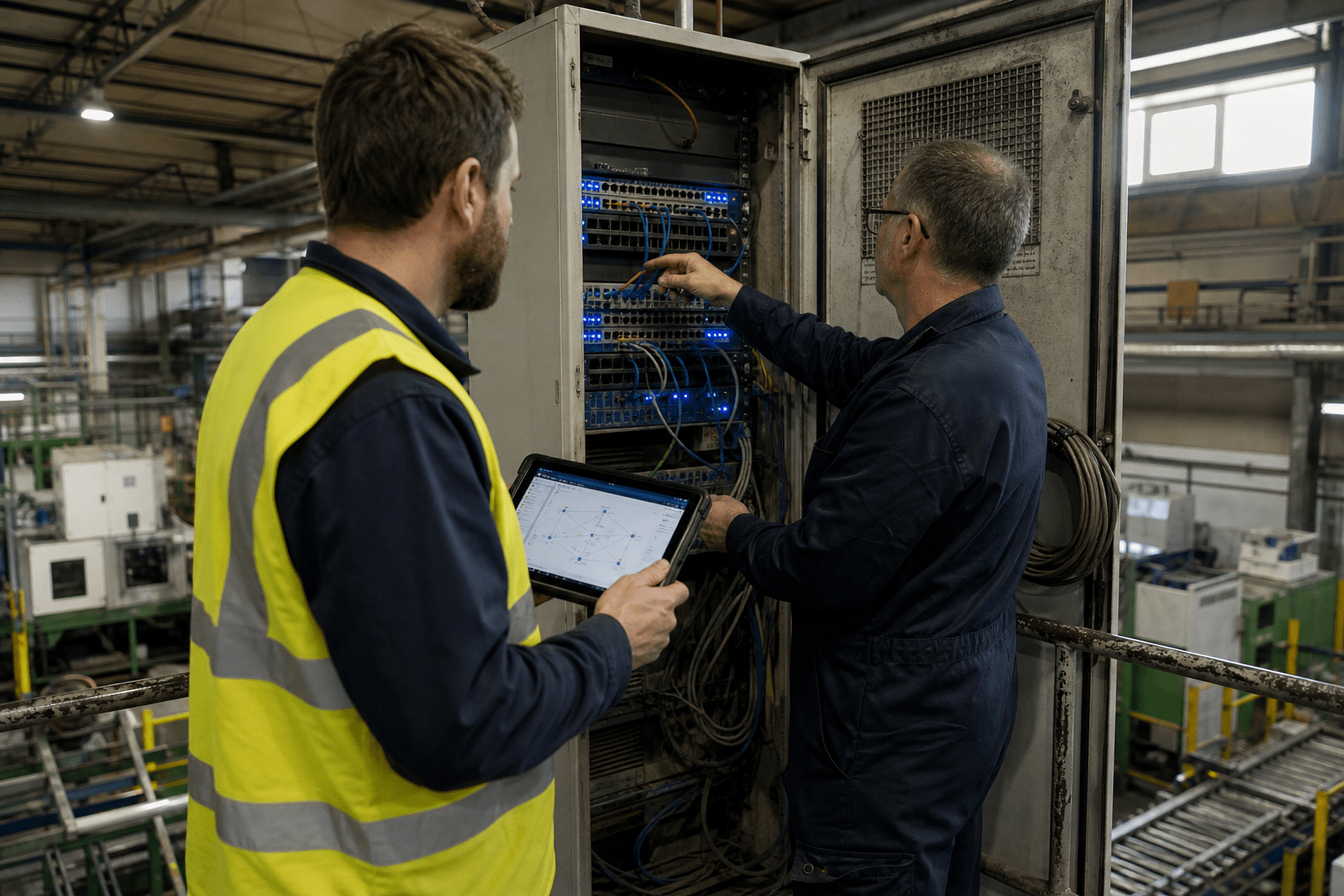
Our team usually meets a manufacturer during that reckoning. The pattern repeats with little variation. An unmanaged switch in a plant cabinet begins dropping packets intermittently, causing scanner timeouts that operators work around by rescanning. Nobody escalates, because rescanning works and a service call costs money. Months later the switch fails entirely during a shift, the warehouse management system loses visibility, and shipping halts for most of a day while a technician sources a replacement. The repair invoice is modest. The lost shift, the expedited freight, and the customer service recovery are not, and none of them are recorded against the IT decision that caused them.
The quieter failure matters more. Under break-fix nobody owns firmware currency on plant network gear, nobody owns segmentation between the business network and the control network, and nobody owns the backup of the ERP database. None of that generates a ticket, so none generates a bill, so none happens.
What OT Convergence Changed
The convergence of operational technology with corporate IT changed the risk profile faster than most support arrangements adapted. Machines that once sat on isolated serial networks now carry Ethernet, report telemetry upstream, and receive recipes and work orders from the ERP. That connectivity produced real gains in scheduling and quality, and it also connected a control environment designed with no security assumptions to a network reachable from an email attachment.
Manufacturing has ranked as the most attacked industry globally for three consecutive years, and the reason is structural: attackers know a plant cannot tolerate downtime, which makes it more likely to pay. Reactive IT support has no answer to this, because the answer is architectural. Segmentation between business and control networks, monitored egress, hardened remote access for machine vendors, and tested recovery all require ongoing ownership.
There is a fair counterargument. Some manufacturers keep OT firmly under engineering rather than IT, on the grounds that a generalist technician touching a PLC is a bigger hazard than the network exposure. That reasoning is sound, and we have never pushed a client to hand control systems to a helpdesk. The failure is not choosing engineering ownership, it is leaving the boundary between the two undefined, because an undefined boundary is where an intrusion moves laterally while each side assumes the other is watching. Our breakdown of that split sits in our practical guide for manufacturers.
Where Break-Fix Is Still Defensible
Break-fix remains defensible for a small shop running a handful of standalone machines with no networked control systems, a cloud-hosted accounting package, and fewer than a dozen office workstations. Most of what a managed agreement covers has already moved to vendors, and a line stoppage is not one network fault away.
We say that plainly because the opposite claim, that every manufacturer of every size needs a full agreement, is a sales position rather than an engineering one. The test worth running is whether the failure of any single network component would stop production or shipping for more than an hour, and whether anyone could restore the ERP database today if asked to prove it.
The trap is that manufacturers rarely re-run that test after adding capacity. An arrangement chosen with eight employees and two machines is still in place at 60 employees with a networked CNC cell, a warehouse management system, and a customer portal, and nobody revisited it. That inertia causes most of what we get called in to repair, and it is the theme of our piece on hidden risks for manufacturers.
The Five Cost Traps Hourly Support Hides
Hourly support hides five costs at a manufacturer, and none of them land on the IT line of the budget.
Production lost during the wait. By far the largest number, recorded as a bad shift rather than an IT cost.
Expedited recovery. Overnight freight for a replacement switch, contractor overtime, and a makeup shift, all triggered by a component nobody was monitoring.
Rediscovery on every visit. A technician with no standing knowledge of your plant network relearns it on the clock, every time, and plant networks are rarely documented.
Deferred firmware and patching. Plant gear left at shipping firmware for years does not stay neutral. It becomes the entry point, or the failure, later.
No security budget at all. Guidance puts cybersecurity and OT protection at 15 to 20 percent of IT spend. Reactive support allocates zero, because prevention generates no billable event.
How the Cost Comparison Actually Resolves
The comparison resolves against break-fix quickly at plant scale, because the downtime figure is so large that it swamps everything else. With unplanned downtime averaging near 50,000 dollars per hour across manufacturing, a single four-hour stoppage exceeds what most mid-sized plants spend on managed IT in a year. Reported outcomes for firms moving to managed support show meaningful reductions in IT cost alongside the uptime gain, which is the unusual case where the cheaper option is also the more capable one.
That said, the counterweight deserves stating. A managed agreement priced without reference to what a plant actually runs is money spent on capability nobody uses, and we have reviewed proposals selling enterprise security stacks to shops with nine office PCs and no networked machinery. The model was right and the scope was wrong. Ask a prospective provider to map every line of the agreement to something that exists in your facility, and strike whatever does not map.
Manufacturers also have a genuine third option. Plants with a capable internal controls engineer frequently run a hybrid, keeping OT under engineering while buying co-managed IT services for monitoring, patching, and after-hours coverage of the business network. For multi-shift operations that is often the strongest structure, because it puts continuous coverage behind the internal knowledge rather than replacing it.
What a Manufacturing-Scoped Agreement Should Contain
An agreement written for a plant differs from a generic small business contract in four places, and a provider who cannot name them has not worked in a facility.
The first is network segmentation with a documented boundary between business and control networks, including who maintains the rules and who approves a change to them.
The second is a change-window discipline that respects production. Patching a warehouse management server mid-shift is a self-inflicted stoppage, so the agreement should state when work happens and what constitutes an emergency exception.
The third is vendor remote access. Machine builders need to reach their equipment, and the common arrangement, a permanently open remote tool installed by the vendor years ago, is the exposure we find most often. The agreement should define brokered, logged, time-boxed access instead.
The fourth is recovery for production systems. ERP and warehouse databases need tested restores with a stated recovery time objective measured against what a shift costs, not a generic nightly job nobody has verified. Our detail on evaluating providers is in managed IT services for manufacturers: what to look for, and managed security services covers the monitoring layer.
What the First 90 Days Look Like at a Plant
A manufacturer moving off hourly support should expect the first phase to be discovery rather than service, and it runs longer than an office transition because plant networks are almost never documented. The provider maps every cabinet, every switch, every wireless access point on the floor, every device with an IP address, and every remote-access tool a machine vendor installed at commissioning. What surfaces is usually uncomfortable: a flat network with no separation between the office and the control segment, three different vendor remote tools running permanently with shared credentials, consumer-grade wireless bridging a scanner to the warehouse system, and an ERP backup nobody has ever restored.
That map produces a remediation list, and the remediation list produces a one-time cost outside the monthly fee, plus scheduling constraints, because segmentation work usually needs a planned production window. This is where plant transitions stall. An operations director who approved a per-user rate now receives a separate proposal for network rework and a request for four hours of downtime, and it reads as a bait and switch. It is not, but the sequencing invites that reading, so ask for the discovery phase first and let the remediation scope and the required window be part of the original decision.
There is a legitimate objection. Some manufacturers take the discovery output and execute the remediation with their own maintenance team at lower cost, which is entirely reasonable and occasionally faster, since internal staff already know which machines tolerate a restart. Providers know this happens, which is why several charge for discovery and credit it against the first invoice. What does not work is accepting a monthly quote from a provider who has never walked the floor, because that number is a guess about a network nobody has mapped.
Frequently Asked Questions
How much does unplanned downtime actually cost a manufacturer?
Cross-industry figures put average unplanned downtime near 50,000 dollars per hour, though the real number depends on line throughput, margin, and whether the stoppage triggers expedited freight or a missed customer commitment. Most plants can calculate it from output value per shift more accurately than any benchmark.
Should IT manage our OT and control systems?
Not necessarily, and many well-run plants keep control systems under engineering. What matters is that the boundary between the two is documented, that segmentation is maintained by a named owner, and that neither side assumes the other is monitoring the space between them.
What share of a manufacturing IT budget should go to security?
Common guidance puts cybersecurity and OT protection at 15 to 20 percent of the IT budget, covering network security, monitoring, training, and incident response. Manufacturing has ranked among the most attacked sectors for several years, so this allocation reflects exposure rather than caution.
Can legacy machines be patched under a managed agreement?
Frequently not, because the machine builder certified the controller on a fixed software version and patching voids support. The workable answer is compensating controls: isolate the device, restrict what it can reach, monitor its traffic, and document the decision rather than leaving it undiscussed.
How long does moving from break-fix to managed IT take at a plant?
Expect 60 to 90 days, longer than an office because the network discovery phase has to map plant cabinets and control segments that are usually undocumented. Schedule the remediation work around production, and treat the discovery findings as part of the original decision rather than a later surprise.
Who Is Behind This Advice
Mindcore has worked with manufacturers through this transition, and the plant engagements taught us something the office work did not: documentation is usually the first deliverable, because most plant networks grew by accretion and nobody holds a current map. We start there now, since neither monitoring nor segmentation means much against an inventory nobody trusts.
Matt Rosenthal, Mindcore’s CEO, keeps the practice focused on fitting the support model to what a business genuinely operates rather than selling the largest agreement a client will sign. For a manufacturer that means reading the production dependency honestly, including the cases where a small shop with standalone machines is already covered well enough.
Talk Through Your Plant’s Support Model
The comparison between managed IT services vs break-fix for manufacturers is settled by one number most plants can produce in an afternoon: what an hour of stopped production costs. Set that against the monthly difference between the two models and the decision usually makes itself, because at plant scale the fee gap is smaller than a single bad morning.
Run this before your next renewal. List every system that would stop production, shipping, or receiving if it failed during second shift tonight. For each, name who is monitoring it right now, when its firmware or patches were last current, when its backup was last restored successfully, and who is contractually obligated to respond within the hour. Most plants cannot complete that table, and the blanks in it are the real comparison.
If the exercise leaves you uncertain, our team will walk your facility and say plainly which model fits, including whether your current arrangement already works. Book a free strategy call, or read our approach to managed IT services and the general framing in break-fix vs managed IT first.

