

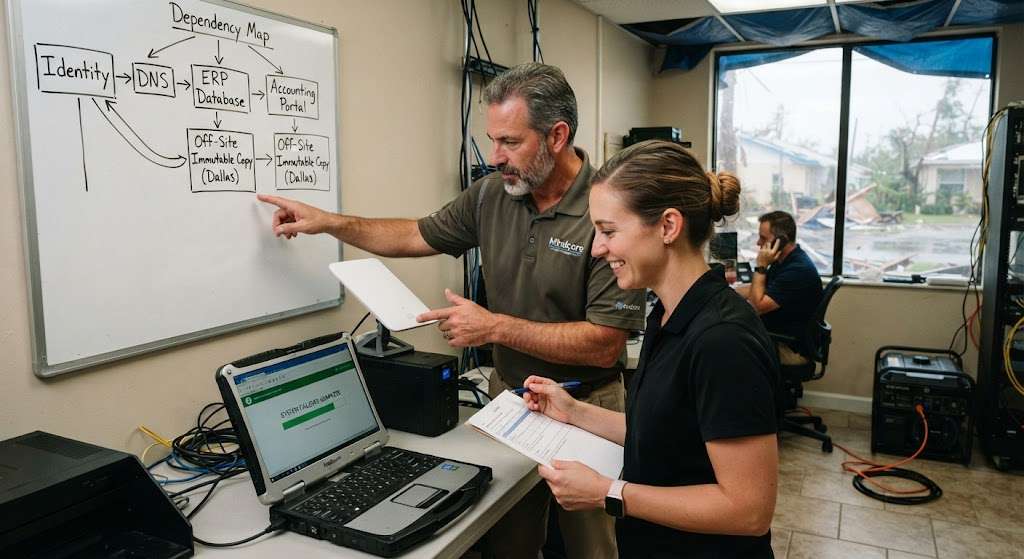
Disaster recovery for a Florida business usually fails on day three, not at landfall. The backups restore fine. The problem is that the domain controllers, the MFA broker, and the phone system all sat in the same county as the water. Hurricane IT continuity in Florida is a geography problem before it is a technology problem, and most plans we review treat it as the reverse. A working plan sets recovery time and recovery point objectives per system rather than one number for the whole company, replicates data off the peninsula rather than across it, keeps at least one immutable copy that neither ransomware nor a botched restore can reach, and has been failed over in a live test within the past twelve months. If your plan has not been tested since the day it was written, you do not have a disaster recovery plan. You have a document.
Overview
- Distance beats redundancy. Two data centers in Florida are one data center as far as a Category 4 storm cone is concerned.
- Identity is the first dependency, not the last. If nobody can authenticate, the restored file server is worthless.
- RTO and RPO are per-system numbers. Billing, clinical records, and the marketing site do not deserve the same recovery target or the same spend.
- Immutability is the difference between a backup and a hope. Object lock and air-gapped copies survive both encryption and operator error.
- An untested plan fails at the worst moment. Backup dashboards report job success, not application recovery.
The 5 Why’s
This is written for IT managers, directors, and CISOs at mid-market and enterprise organizations operating in Florida, particularly in healthcare, financial services, legal, insurance, and manufacturing, where an outage carries regulatory weight on top of revenue loss. These environments typically run hybrid infrastructure: some workloads in Azure or AWS, some still on premises in an office or colocation facility inside the storm corridor.
The regulatory driver varies by vertical but the obligation does not. HIPAA requires a contingency plan with a data backup plan, a disaster recovery plan, and an emergency mode operation plan under the administrative safeguards. FINRA Rule 4370 requires a written business continuity plan with defined recovery objectives and annual review. The FTC Safeguards Rule requires a written information security program that addresses system recovery. Insurers increasingly ask for evidence of tested recovery before renewal.
The trigger is seasonal and predictable. Hurricane season runs June through November, with peak activity from mid-August through October. What is not predictable is which week your staff will be evacuated, on generator power, or without residential internet.
The consequence of getting this wrong is not lost files. It is days of unbillable downtime, breach notification obligations if recovery attempts expose data, insurance disputes over undocumented losses, and clients who move to a competitor that answered the phone.
Building a Hurricane Business Continuity Plan That Holds After Landfall
The plans that fail are rarely the ones with no backups. They are the ones written by someone who assumed the building would be standing, the staff would be local, and the internet would work.
What we see in the field is a repeating pattern of dependency blindness. An organization replicates its production servers to a second site, tests the replication, and marks the item closed. Then a storm takes out grid power across the region, the secondary site is on the same utility footprint, the generator has fuel for a day and a half against a five-day outage, and the fuel contract is with a vendor serving four hundred other customers in the same order queue.
The second pattern is identity. Organizations that moved most workloads to Microsoft 365 often still authenticate through on-premises domain controllers or a hybrid connector sitting in the affected office. When that hardware goes dark, cloud applications that appeared independent stop accepting logins. Staff who evacuated to Georgia or Alabama then hit conditional access policies scoped to Florida IP ranges and get blocked out of systems that are technically running.
The three questions below are the ones we work through with every Florida client before June.
Why Do Florida Disaster Recovery Plans Fail on Day Three?
Florida disaster recovery plans fail on day three because recovery has a dependency order, and almost nobody has written theirs down. Day one is adrenaline and generators. Day two is triage. Day three is when the organization discovers that restoring the ERP database requires a license server that requires DNS that requires a domain controller that is underwater.
Backup software reports on jobs, not on sequence. A green dashboard tells you the data exists somewhere. It does not tell you that the restore takes nineteen hours over your available bandwidth, that the application owner who knows the reconfiguration steps evacuated to Nashville, or that the break-glass administrator account has an expired password nobody has rotated since the last audit.
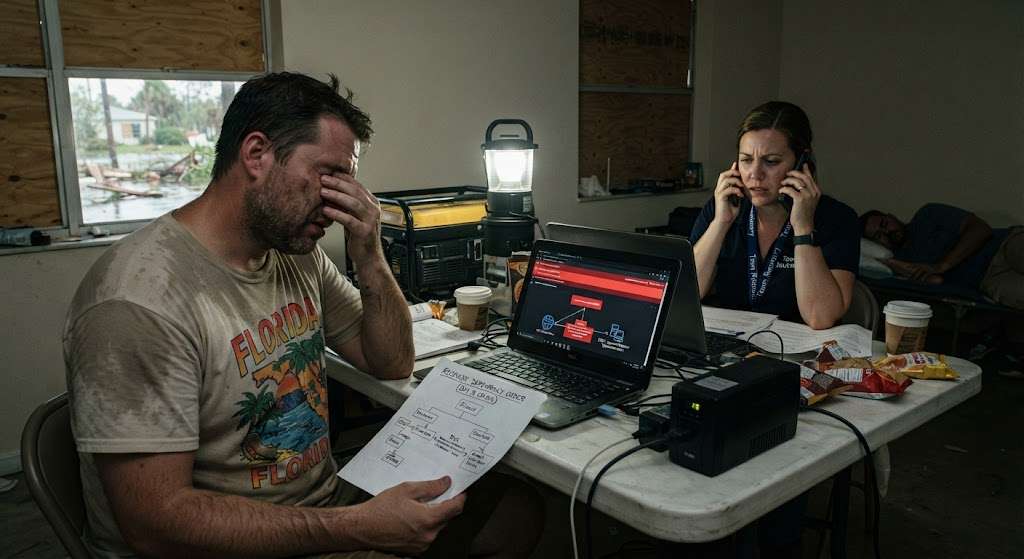
This changes for organizations that are genuinely SaaS-native with cloud-only identity and no on-premises dependency. For those environments the failure mode shifts away from infrastructure sequence and toward connectivity and workforce dispersion: whether staff have power and bandwidth, whether the contact center can route to mobile devices, and whether anyone has authority to make decisions when leadership is scattered across three states. The dependency map still matters, it just maps people and access rather than servers.
What we recommend you do about it:
- Write the restore order before you need it. List every production system, then list what each one requires to come back up. Identity, DNS, licensing, and time sync sit at the top for most environments and get restored first.
- Create and test break-glass accounts. Cloud-only administrator accounts with long unique passwords stored offline, excluded from conditional access, verified quarterly. If your only path to the tenant runs through on-premises hardware, you have a single point of failure disguised as a security control.
- Audit conditional access for geographic assumptions. Policies that trust Florida office IP ranges will lock out your own evacuated staff. Build an emergency policy set you can enable during a declared event.
- Verify MFA does not depend on the affected site. On-premises MFA servers and RADIUS extensions fail with the building. Move to cloud-based authentication with FIDO2 keys or authenticator apps as the primary method.
- Contract fuel and runtime, then check the math. Compare generator runtime and refueling contract terms against the multi-day outages the region actually experiences, not against a four-hour utility blip.
Where Should a Florida Business Replicate Its Data?
Replicate outside the peninsula. Tampa to Miami is not geographic separation when a single storm cone can cover both, take the regional grid with it, and disrupt the same telecom backbone. For most Florida organizations the practical answer is a cloud region or colocation facility well inland and out of state, far enough that no single weather system reaches both your production and your recovery copy.
The distance question is really a correlation question. You are not asking how many miles separate two sites. You are asking what shared conditions could take both down at once: the same power utility, the same fiber path, the same evacuation zone, the same regional workforce. Two Florida data centers can fail those tests while sitting three hundred miles apart.

The answer shifts when contractual or regulatory terms constrain where data can live. Some government and criminal justice workloads carry residency requirements. Some healthcare vendors have business associate agreements scoped to named facilities, and replicating outside those facilities without amending the agreement creates a compliance problem while solving an availability one. Latency-sensitive manufacturing and clinical systems may also need a nearby warm copy for routine failures, in which case you run two tiers: a local copy for hardware failure and a distant copy for regional disaster. Confirm the paperwork before you move the bits.
What we recommend you do about it:
- Choose recovery regions outside the Southeast hurricane corridor. Pair Florida production with a region in the central or midwestern United States rather than another coastal Gulf or Atlantic location.
- Keep at least one immutable copy. Object lock or write-once storage that cannot be deleted or encrypted within its retention window, including by a compromised administrator account.
- Follow 3-2-1-1-0. Three copies, two media types, one offsite, one immutable or offline, zero errors on the last verified restore test.
- Measure restore time from the recovery region, not from local disk. Calculate how long a full restore takes at your actual egress and ingest bandwidth. That number, not the backup window, is your real RTO.
- Check that your agreements follow the data. Business associate agreements, data processing terms, and cyber insurance policies should explicitly cover the secondary region.
What Does a Real Disaster Recovery Test Look Like?
A real test is a live failover of a production business system with real users doing real work on the recovered environment. Anything less is a backup verification, which is useful and is not the same thing. The distinction matters because the failures that hurt during a hurricane are integration failures: hardcoded IP addresses, certificates bound to the old hostname, an interface between the practice management system and the clearinghouse that nobody documented.
Restore testing catches data problems. Failover testing catches architecture problems. Only one of those categories is what puts you in the news.

Full failover is not always available. Clinical environments running around the clock, manufacturing lines with physical safety interlocks, and trading operations inside market hours cannot simply cut over to prove a point. For those environments the workable version is staged: fail over one non-clinical or non-production-line system end to end each quarter, run tabletop exercises for the systems that cannot be interrupted, and use isolated recovery environments to validate the untestable ones. Regulated organizations should also confirm what their framework requires, since FINRA and HIPAA both expect documented review on a defined cadence rather than testing at your convenience.
What we recommend you do about it:
- Test between December and May. Do not schedule your annual test during hurricane season, when a real event can collide with a planned outage.
- Fail over one full business system, not one server. Include the application, its database, its integrations, and the authentication path users take to reach it.
- Time the recovery and compare it to your stated RTO. If the documented objective is four hours and the test takes eleven, the objective is wrong or the architecture is. Fix one of them.
- Include phones and identity in scope. Voice and authentication are the two systems clients and staff notice within minutes, and they are the two most often left out of test plans.
- Document the test for auditors and insurers. Date, scope, measured recovery time, what failed, what you changed. This record is what supports a claim and satisfies a regulator later.
Florida Disaster Recovery Expertise from Matt Rosenthal
In 30 years working with organizations across Florida, I have seen the same failure more times than I can count: a company invests in a solid backup platform, then discovers during an actual storm that it never mapped what depends on what. The data was there. The order of operations was not. Our team now starts every continuity engagement with dependency mapping and a live failover test before we discuss any product at all, because a plan you have not proven is a plan you do not have. If your last test predates your current infrastructure, start there. See our approach to business continuity planning and managed IT services in Florida.
What to Fix Before the Next Named Storm
The organizations that come through a hurricane without a continuity crisis are not the ones with the largest recovery budget. They are the ones that treated recovery as an operational discipline with a schedule attached, rather than as a purchase they made once and filed. They know the order in which their systems come back, they hold a copy of their data somewhere no Florida storm can reach, and they have watched a failover work with their own users on it.
Start with the dependency map, because everything else depends on knowing what depends on what. Then confirm your recovery copy sits outside the peninsula and outside the reach of a compromised administrator. Then put a live failover test on the calendar for the offseason and treat the date as fixed. Per-system RTO and RPO targets come out of that work naturally, because once you have failed a system over and timed it, you stop guessing what recovery costs and start negotiating what it is worth.
Hurricane season is a deadline, not a surprise. It arrives on the same date every year, and the work that makes disaster recovery for a Florida business actually function takes longer than the days between a forecast cone and landfall.
If your continuity plan has not been tested against your current environment, our team will run a dependency and recovery assessment and show you exactly where it breaks. Contact Mindcore to schedule it before the season starts.
Florida Disaster Recovery Expertise from Matt Rosenthal
In 30 years working with organizations across Florida, I have seen the same failure more times than I can count: a company invests in a solid backup platform, then discovers during an actual storm that it never mapped what depends on what. The data was there. The order of operations was not. Our team now starts every continuity engagement with dependency mapping and a live failover test before we discuss any product at all, because a plan you have not proven is a plan you do not have. If your last test predates your current infrastructure, start there. See our approach to business continuity planning and managed IT services in Florida.

