

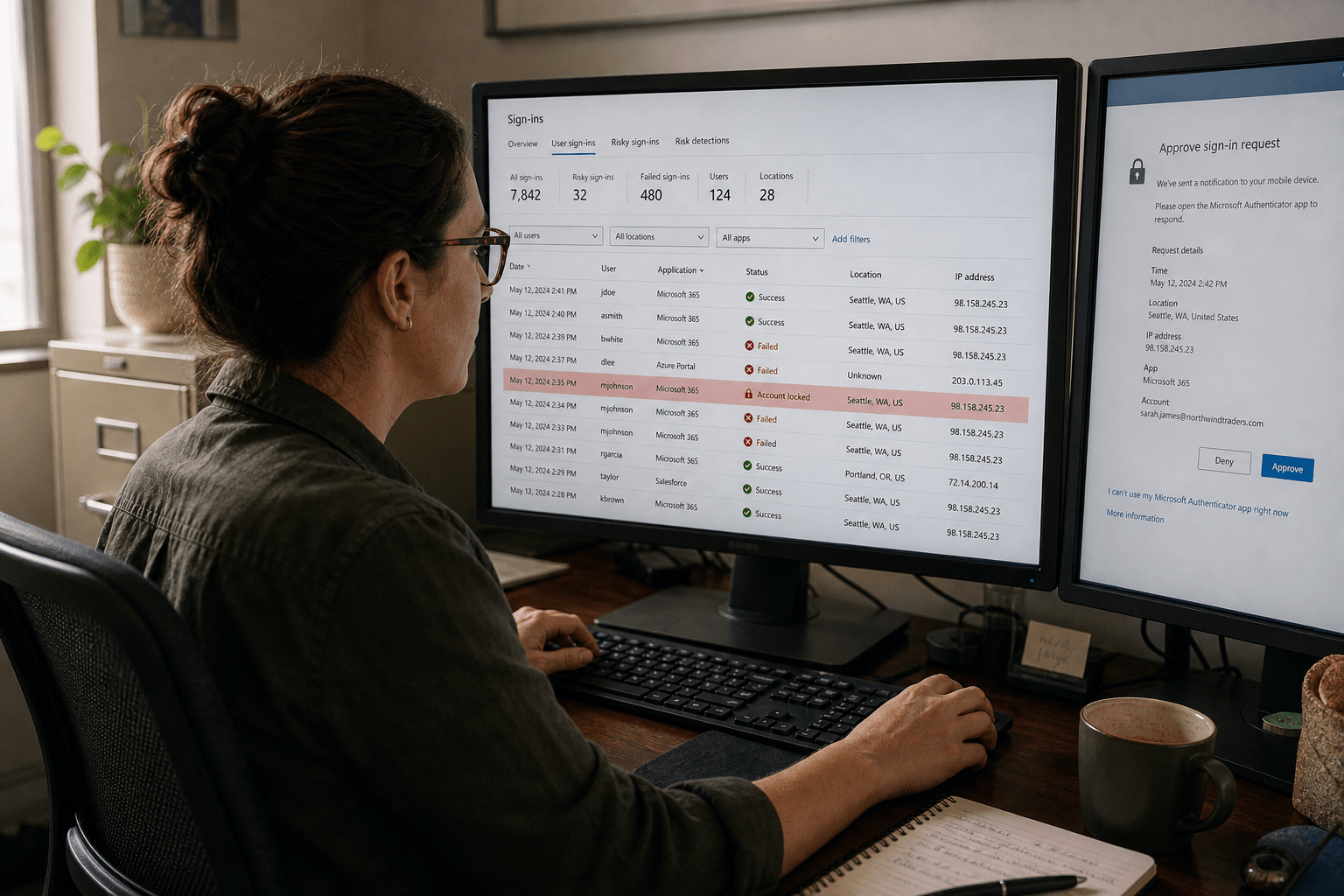
Identity-based attacks cost small and midsize businesses far more than the incident invoice suggests, because the damage arrives as a dozen separate charges instead of one. An identity-based attack is an intrusion that uses a real employee login rather than malware, so the attacker walks in through the front door with a valid session. The recovery bill gets split across helpdesk overtime, outside forensic hours, a renewal-time insurance premium bump, money wired to the wrong account, and revenue that quietly walks away during a client security review. No single line reads large enough to fight for budget, which is exactly why the total keeps growing year over year at companies that already pay for antivirus and a firewall.
Why Identity-Based Attacks Cost SMBs More Than the Ransom Does
Most of the money leaves the building before anyone sees an encrypted file. Our team spends a lot of time in post-incident reviews at 40 to 400 employee companies, and the pattern repeats: the login was stolen weeks earlier, the attacker read email quietly, and the loud event at the end was only the last chapter. If you want the loud-event math, we covered it in our breakdown of the true cost of ransomware beyond the ransom demand. This article covers the quiet part that comes first.
Here is what an owner or IT manager should take away before reading further:
- The attacker does not need malware. A working username, password, and one approved sign-in prompt is enough to reach mail, file storage, and finance apps.
- The cost is fragmented on purpose. Resets, forensic hours, legal review, insurance, and fraud losses land in five different budget lines and five different months.
- Your smallest accounts carry your largest risk. A dormant contractor login with mailbox access does more damage than a compromised laptop.
- Insurance now prices identity controls directly. Carriers ask what protects privileged sign-ins, and the answer moves your premium and your claim outcome.
- Recovery speed is a purchasing decision, not a heroics decision. Firms that rehearsed the reset sequence finish in hours. Firms that improvise finish in weeks.
The Five Line Items Where Identity-Based Attacks Cost Real Money
Identity-based attacks cost money in five places, and in our experience an SMB underestimates at least three of them. The list below follows the order the charges usually arrive, from the first frantic afternoon through the deal that goes cold four months later.
1. The Reset Scramble Nobody Budgets Hours For
The first charge is internal labor, and it is larger than most IT managers expect. One confirmed account takeover does not mean one password reset. It means forcing sign-out of every active session, rotating credentials for any shared mailbox that account touched, revoking app passwords and OAuth grants the attacker may have created, and checking mail rules across the tenant because a hidden forwarding rule is the standard souvenir an intruder leaves behind.
A fair counterargument exists. A small team with tidy documentation and a single identity provider can work through this in a day, and paying internal salary for internal work feels cheaper than calling anyone. That holds up when the environment is clean. It falls apart when the compromised account was an owner, a controller, or an admin with delegated access to other mailboxes, because then the reset spreads to every account that trusted the first one. We have watched a two-hour estimate become three weeks of part-time cleanup at a professional services firm, all of it billed to a team that also had a normal job to do.
2. Forensics and Legal Review You Cannot Skip
The second charge shows up when someone asks a question you cannot answer from memory: what did the intruder actually see? Answering that requires sign-in logs, mailbox audit records, and file-access history, retained long enough to cover the whole dwell period. Outside forensic help is priced by the hour, and the hours climb when logging was set to a default retention window that already expired.
There is a real argument for restraint here. Not every incident needs a full investigation, and a small business that confirms a single failed sign-in attempt does not owe anyone a report. The problem is that the decision is not yours alone once regulated data is in scope. Contract language with clients, state breach-notification rules, and professional obligations for legal, accounting, and medical practices all convert a technical question into a legal one. Paying a lawyer to review a mailbox you cannot reconstruct is the most avoidable cost on this list, and prevention is mostly a logging configuration you set once.
3. Cyber Insurance Premiums and Claim Friction
The third charge arrives at renewal, months after the incident closed. Carriers underwrite identity controls now, and their applications ask direct questions about how privileged sign-ins are protected across email and remote access. An honest answer that admits gaps moves the premium. A dishonest answer risks the claim itself, which is the worse outcome by a wide margin. We walk clients through the questions carriers actually ask in our rundown of cyber insurance readiness gaps that cost small businesses.
Some owners reasonably note that premiums rise across the market regardless of one incident, and that a claim paid is a claim paid. True enough. What changes after an identity incident is the friction: adjusters request the sign-in evidence, the mailbox audit trail, and proof that stated controls were live on the date of loss. Firms that can produce that in a week get paid faster and argue less. Firms that cannot spend the difference in legal hours.
4. Wire Fraud and Invoice Redirection
The fourth charge is the one that actually empties a bank account. Business email compromise does not require the attacker to break anything. Sitting inside a real mailbox, the intruder reads a live payment thread, learns the tone, waits for the invoice, and sends updated bank details from the address the recipient already trusts. Most of these attempts begin with a targeted message rather than a mass campaign, which is why we keep a plain-language reference on spear phishing attacks for client staff training.
Recovery is possible and it is not reliable. Funds recalled within roughly the first day have a fighting chance, and funds noticed a week later usually do not, especially once they move through several accounts. Banks are not obligated to reverse a transfer their customer authorized. That is the uncomfortable part for any finance team that treats email as an approval channel: the money left because a person followed a legitimate-looking instruction, not because a system failed.
5. Deals That Die in a Client Security Review
The fifth charge never appears in an incident report, and it is often the largest. Enterprise buyers, healthcare systems, and defense-adjacent primes now send vendor security questionnaires before signing. Those forms ask about incidents in the past 24 months, about authentication standards, and about detection coverage. One honest disclosure in a competitive bid is enough to lose a contract you had already won on price and service.
The counterpoint deserves airtime, because it is often correct: a disclosed and well-handled incident can build trust when your answers are precise, dated, and paired with the control you added afterward. Buyers assume every vendor gets attacked. What they will not accept is a vendor who cannot describe what happened. So the cost here is not really the incident, it is the quality of your paperwork about it, and that quality is decided long before the questionnaire arrives.
How Attackers Reach a Real Login Without Malware
Credential theft is now a logistics business, not a hacking spectacle, which is why endpoint tools alone miss it. The methods below account for most identity intrusions we investigate at SMBs, and none of them require the attacker to write code.
Phishing Pages That Sit in the Middle of a Real Login
Modern phishing kits proxy the genuine sign-in page. The employee sees the real prompt, types the real password, approves the real code, and the kit captures the resulting session cookie. Because a session token proves a completed sign-in, replaying it can bypass the second factor entirely.
Plenty of practitioners still argue that one-time codes stop the overwhelming majority of attacks, and the data supports that at volume. Our own writeup on how multi-factor authentication reduces account takeover makes that case. The nuance is that code-based factors and proxy-resistant factors are not the same purchase. Codes handle the broad, noisy attempts. Hardware-backed passkeys handle the targeted ones, because the credential is bound to the site and cannot be replayed elsewhere.
Push Fatigue and the Midnight Approval
Push-approval prompts fail differently. An attacker with a valid password fires prompts repeatedly, often overnight, until a tired employee taps approve to stop the buzzing. It works because the request is technically legitimate and the human is the only control standing in front of it.
Defenders split on the fix. One camp wants number matching and prompt rate limits, which keeps the current app and costs almost nothing. The other camp wants push approvals removed for privileged roles altogether. Both positions are defensible, and the honest answer depends on who holds the account: a shared front-desk login and a controller with wire authority do not deserve the same control. We work through those tiers with clients in our best practices for multi-factor authentication guidance.
Stale Accounts and Protocols Nobody Retired
The third path needs no phishing at all. A departed employee’s mailbox left active for continuity, a legacy authentication protocol still permitted for one old scanner, a service account with a password set in 2019 and never rotated: each is a quiet doorway. Attackers test these constantly because the attempt is cheap and the alerting is usually absent. This is also the stage where an intrusion turns into something worse, a progression we map in how ransomware attacks start.
What Cuts the Cost Before the Next Attempt
The controls that lower identity risk are unglamorous, and they are mostly configuration rather than new spend. Start with the accounts that can move money or read everyone else’s mail, then work outward.
- Bind privileged sign-ins to phishing-resistant credentials. Passkeys or FIDO2 keys for owners, finance, IT admins, and anyone with delegated mailbox access. Our multi-factor authentication work usually starts with that short list rather than the whole company.
- Disable legacy authentication and inventory service accounts. Anything that cannot support a modern sign-in gets scoped, documented, or retired.
- Extend log retention past 90 days. Cheap insurance against a forensic question you cannot answer later.
- Alert on identity behavior, not only endpoints. Impossible-travel sign-ins, new mail-forwarding rules, and fresh OAuth grants are the earliest honest warnings, and they are the daily work of our managed security services team.
- Take payment changes off email. A callback to a number already on file, made to a person you know, defeats the entire wire-fraud line item.
- Rehearse the reset once. A written sequence for sessions, credentials, app grants, and mail rules turns a three-week scramble into an afternoon.
Frequently Asked Questions
How much do identity-based attacks cost a small business?
Total cost for an SMB identity incident usually lands well above the visible response invoice, because internal labor, forensic hours, legal review, insurance movement, and fraud losses accumulate separately over several months. The largest variable is dwell time: the longer a stolen login stays usable, the more mailboxes, payment threads, and client records fall into scope. Firms with mailbox auditing and identity alerting in place typically close incidents in days rather than weeks.
Does multi-factor authentication stop identity-based attacks?
Multi-factor authentication stops the large volume of low-effort attempts and remains the highest-value control an SMB can turn on this week. It does not stop everything, because proxy phishing kits capture live session tokens and push fatigue attacks target the person approving the prompt. Phishing-resistant credentials on privileged accounts close that remaining gap.
What is the first sign an employee account has been taken over?
The earliest reliable signals are configuration changes rather than dramatic events: a new mail-forwarding or hidden inbox rule, a sign-in from a location the employee did not travel to, or an unfamiliar app consent granted to the account. Ordinary users rarely create forwarding rules, so that alert deserves attention every time it fires.
Will cyber insurance cover a business email compromise loss?
Coverage depends on your policy language and on whether the controls you described in the application were actually live at the time of loss. Social engineering and funds-transfer fraud are often sublimited or endorsed separately from the main cyber tower, which surprises owners at claim time. Read those sublimits before renewal rather than after an incident.
How long does recovery from an account takeover take?
An SMB with documented identity ownership, current logging, and a rehearsed reset sequence generally completes technical recovery within a few days. Environments with shared credentials, unclear account ownership, and expired logs routinely take several weeks, most of it spent proving what the intruder could reach rather than removing them.
Put a Real Number on Your Identity Risk
The reason identity-based attacks cost SMBs so much is that the bill never arrives as one number anyone can defend a budget against. Split across five departments and several months, the total stays invisible until a renewal, a wire, or a client questionnaire forces it into the open. The work that shrinks the total is not exotic, and it is not a rip-and-replace project. It is a short list of privileged accounts hardened properly, logging retained long enough to answer questions, alerting that watches sign-ins instead of only laptops, and a payment process that stops trusting email. Our team does this with SMBs every month, and the firms that finish the list rarely regret the timing.
If you want to know which accounts in your environment would do the most damage today, we will walk your sign-in configuration with you and show you the gaps in plain language. Book a free strategy call with Mindcore and bring your last insurance application to the conversation.

