


Most guides to choosing an IT provider ask the same five generic questions, and they are worth asking anywhere. These five are specific to operating in El Paso, because this market has conditions that catch providers out and that most buyers never think to raise. A provider who answers all five precisely has worked here. A provider who has to think about them has not. Ask every candidate, including us, and get the answers into the agreement rather than the proposal.
Overview
- Time zone is a real gap here. El Paso runs on Mountain Time and most Texas providers publish Central hours.
- Cross-border data raises questions standard agreements ignore. Residency, access by location, and export control.
- Bilingual support affects adoption, not just courtesy. A help desk your staff cannot use gets routed around.
- Distance makes onsite a written commitment, not an assumption. El Paso is the most isolated major market in Texas.
- Where staff are located is a compliance question for some organizations. Particularly anyone in the Fort Bliss supplier base.
1. Which Time Zone Are Your Published Support Hours In?
This sounds trivial and it is the most common practical complaint we hear from organizations in this market.
El Paso is the only major Texas metro on Mountain Time. A provider based in Dallas, Houston, or Austin publishing support from eight to six is publishing Central hours, which means their desk opens at seven local time and closes at five. On the surface that looks generous. In practice the coverage lands an hour earlier than your working day, so your late afternoon, which is when most people discover a problem they need resolved before tomorrow, sits outside the window.
Multiply that across a year and it is a meaningful amount of uncovered time in the part of the day when it costs most.
What a good answer sounds like: support hours stated in Mountain Time in the agreement, with an explicit answer on after-hours coverage and what triggers it.
Red flag: a provider who has not considered the question, or who answers in Central and treats the difference as immaterial. It is not immaterial to you.
Ask the same question about escalation and about your account contact, not just the first-line desk. A desk covering your hours does not help if the engineer who can actually fix the problem works Central.
2. How Do You Handle Data That Crosses the Border?
If any part of your operation runs in Ciudad Juárez, and for a large share of El Paso manufacturers it does, your data crosses an international border as a matter of routine. Standard managed services agreements do not address that at all.
Three questions sit underneath it. Where does your data physically reside, including backups and replicas, because the answer may differ from where you think it does. Who can access which systems from which side of the border, and is that enforced technically or by policy. And is any of the data export-controlled technical data, which matters because access by non-US persons is restricted regardless of intent and regardless of whether anyone did anything wrong.
That last point is not theoretical for anyone supporting aerospace or defense programs. It reaches into identity design, cloud tenant selection, and who your provider staffs on your account.
What a good answer sounds like: a provider who asks about your operations in Mexico before answering, then talks about data residency, access control by location and by person status, and export control scoping as design decisions.
Red flag: a general reassurance about encryption. Encryption is necessary and it does not answer any of the three questions above.
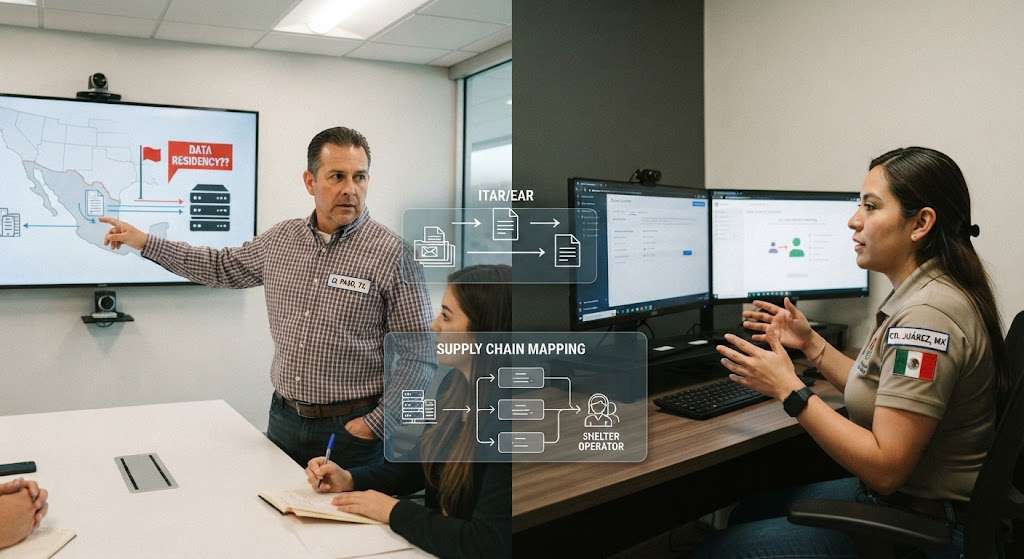
Maquiladora and shelter operations add a further wrinkle worth raising early, because the shelter company may hold or route some of your data, which makes them part of your supply chain whether or not anyone has documented it. Our compliance work usually starts by mapping that.
3. Is Your Help Desk Available in Spanish?
Ask directly, and ask about the whole path rather than the first line.
In a borderplex workforce this is an operational question rather than a courtesy. If your staff on a plant floor or in a warehouse cannot describe a problem comfortably in the language they think in, two things happen. Tickets get filed by someone else, second hand, with detail lost. And people stop filing them, working around the problem instead, which is how small issues become undocumented ones that nobody can trace when something larger goes wrong.
What a good answer sounds like: bilingual coverage at the first line during your hours, with clarity on what happens at escalation and after hours.
Red flag: yes without specifics. Ask how many bilingual staff, on which shifts, and what happens when they are unavailable.
Worth extending the question to documentation and end-user communication. Outage notices, security awareness training, and onboarding instructions that only exist in English will reach part of your workforce and not the rest.
4. What Onsite Response Can You Commit To, in Writing?
El Paso is several hundred miles from the nearest major Texas metro, which makes this a sharper question here than almost anywhere else in the state.
Most of a managed services relationship is delivered remotely and that is true of every provider regardless of address. Monitoring, patching, ticket resolution, security operations, identity work, and cloud administration do not require anyone to be nearby. What does require presence is hardware replacement, cabling, plant floor work, and the problem that needs somebody standing in front of the equipment.
How much of that you need varies enormously. An office-based business running cloud infrastructure may need someone onsite a few times a year. A manufacturer with a production floor, a warehouse operation, or a business with no technical staff on site needs a genuine commitment, and it should be a written response window rather than something inferred from a street address.
What a good answer sounds like: a stated response window, and a straight answer about whether it is delivered by employees, by a local partner, or by dispatch.
Red flag: a local address treated as proof of local staffing. Ask how many people work there and what they do. Some local offices are a mailbox.
We will answer this one plainly. Ask us what we can commit to for your site before you go further, because if same-day hands-on response is a hard requirement for your operation, you deserve a number rather than an implication. For organizations whose needs are mostly remote, which is most office-based businesses, the distance changes nothing about the quality of the work.

5. Where Are Your Staff Located, and Who Will Hold Credentials in Our Environment?
Ask for names, consistent assignment, and physical locations for every tier, including overnight, plus any subcontractors who would hold administrative access.
The Fort Bliss footprint means a meaningful number of El Paso organizations handle controlled unclassified information or export-controlled technical data. For those organizations this is a compliance question rather than a service preference: a technician outside the United States holding administrative credentials in an environment containing export-controlled data is a problem regardless of intent, and administrative access counts as access.
Even without that exposure, the answer tells you something. A provider who cannot say where their overnight staff sit is describing a service they do not fully control.
What a good answer sounds like: named engineers, a documented escalation path, physical locations for each tier, and a clear statement on subcontractors.
Red flag: vagueness about overnight staffing, or an answer that covers business hours and goes soft after that.
Anyone in the defense supplier base should also ask how the provider handles NIST 800-171 and CMMC scoping. Note that the program changed in July 2026, when third-party certification requirements were suspended pending review while self-assessment and annual affirmation obligations remained in force, so what you owe comes from your contracts and flow-down clauses rather than from the headlines.
Two More Worth Adding
What is excluded, and what is the out-of-scope rate? Most competing proposals differ on scope rather than price. Send every provider the same requirements document, require line-item responses, and read the exclusion list before the inclusion list.
What happens when we leave? Ask during the sales process, because it is easiest to get answered before you are a customer. Your network diagrams, configurations, licence records, and administrator credentials should be yours in a usable format at any point.
Texas Adds a Notification Deadline
One statutory point worth knowing regardless of provider. Texas requires notification to affected individuals within a short fixed window after a breach is discovered, and notification to the Attorney General once a threshold number of Texas residents is affected. The practical consequence is the same as everywhere with a short clock: meeting it depends on detection, logging, and having an incident response plan with names and phone numbers already in it. Confirm the current deadlines and thresholds with counsel, because these have been amended in recent years.
Local IT Expertise from Matt Rosenthal
In 30 years of running technology organizations, I have learned that the questions that separate providers are rarely the ones on a feature comparison. What I have seen firsthand is a company in a border market signing with a provider that had never once considered how data moved between its two plants, and discovering during a customer audit that nobody could say where the backups lived or who could reach them. Our team asks about your operations before we describe ours, and we will tell you when our answer on onsite response is not the one you need. Ask all five. The answers will sort the field quickly. See our managed IT services in El Paso and cyber security services in El Paso.
How to Use These
Send the same requirements document to every provider on your list, then ask these five questions in the same order on each scoping call and write the answers down. Two of them will eliminate candidates immediately, which is the point.
Then ask for three references at organizations of similar size in this region, and ask those references four things: whether communication was clear, whether problems surfaced early enough to fix, whether commitments were met, and whether the invoices contained surprises.
Then read the contract before you negotiate the rate. Term length, escalators, the out-of-scope rate, and the exit terms determine what the relationship costs more than the monthly figure does.
For related reading on this market, see our guides to IT support in El Paso, co-managed IT services in El Paso, IT consulting in El Paso, and the full Texas service area overview.
If you are evaluating providers now and want a second opinion on your requirements rather than another proposal, that is a reasonable place to start. Schedule a consultation to talk it through.

