

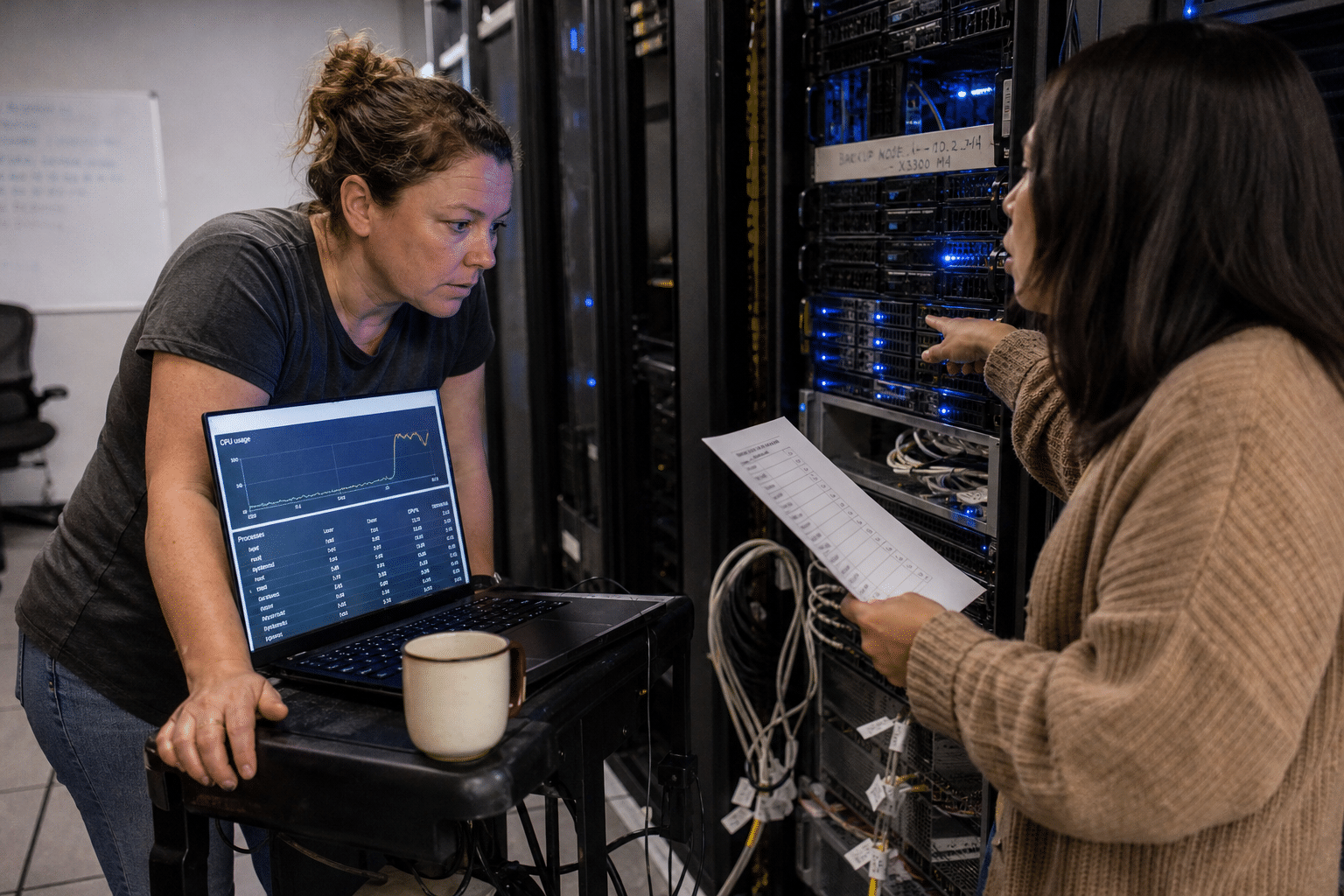
Two AhsayCBS vulnerabilities, CVE-2026-105133 and CVE-2026-105134, are being exploited right now to take over backup servers, plant web shells and run XMRig cryptocurrency miners disguised as Microsoft Edge. The first flaw lets an attacker skip a password check in the AhsayCBS API, and the second allows operating system command injection through the Replication Receiver component. Researchers at Huntress traced the first exploitation to October 7, and both The Hacker News and SecurityWeek reported the campaign on October 9. AhsayCBS versions up to 10.3.2 are affected and 10.3.4 is not. If your company or your IT provider runs AhsayCBS, update it, take its management console off the open internet and check the host for signs of compromise this week. The larger lesson reaches past one product: the backup server is an attack surface, and most businesses guard it far less carefully than the systems it protects.
Why the Backup Server Is the Attack Surface Nobody Watches
A backup server holds a copy of everything your business cares about, and in our experience it is the system least likely to have an owner, a patch schedule or a monitoring alert. That combination is exactly what attackers look for. Here is the short version for owners and IT managers:
- The flaws are being used, not just disclosed. Huntress observed hands-on intrusions at multiple organizations within a day of exploitation starting, so treat this as an active incident rather than a routine advisory.
- The miner is the visible symptom, not the whole risk. A web shell gives an attacker a door they can reuse later for data theft or ransomware, long after the miner is removed.
- Backup consoles are often exposed on purpose. Remote offices and laptops need to reach the server, so the web console tends to end up reachable from the internet with nothing in front of it.
- Backup systems are the last line against ransomware. If an attacker controls the backup platform, they can delete or encrypt your recovery points before they strike production, which is why cloud backup design matters as much as the backup software itself.
- The fix is mostly ownership. An update, a firewall rule and a named person who reads vendor advisories would have closed most of this window.
How the Two AhsayCBS Flaws Work Together
CVE-2026-105133 is an improper authentication flaw in the checkSysPwd() function of the AhsayCBS API, which means a request can pass a password check it should fail. On its own it scores in the medium range, around 5.5 under CVSS version 4, and some teams will be tempted to file it for later. CVE-2026-105134 is the serious half: manipulating a parameter in the Replication Receiver lets an attacker inject operating system commands. Chained, the first opens the door and the second runs whatever the attacker wants on the server. That is a fair argument that severity scores mislead when read one at a time. The opposite view also has merit, because a medium score usually does mean a narrower attack path, and most teams cannot patch everything at once. Our position sits between them: rank by exploitation status first, then by score. Once a flaw is confirmed in use, its number matters far less than the fact that someone is already using it.
What the Attackers Did After Getting In
The intrusions Huntress described followed a recognizable pattern. After gaining code execution, the attackers ran reconnaissance commands, dropped web shells for persistent access and launched XMRig, a common open source Monero miner, renamed to look like a Microsoft Edge process. One added touch stands out: a PowerShell script that closed Windows Task Manager if it stayed open too long overnight, so a curious administrator would struggle to watch the miner at work. Cryptomining can look like a nuisance rather than a breach, since it burns electricity and CPU time but does not obviously steal anything. That reading is understandable and wrong. Whoever can run a miner on your backup server can also read the backups, which often contain every file share, mailbox and database in the company.
Why Backup Platforms Fall Behind on Patches
Backup software tends to be installed once, configured carefully and then left alone, because nobody wants to break the thing that saves them during a disaster. We hear the same reasoning on almost every assessment: the backups work, so nobody touches the server. There is real logic in that caution, since a failed upgrade can interrupt backup jobs and leave a gap in protection. The counterweight is that an unpatched backup console exposed to the internet is a standing invitation. The practical middle path is a tested update routine: snapshot or export the configuration, apply the update in a maintenance window, then confirm the next scheduled job finishes cleanly.
How to Check Whether Your AhsayCBS Server Is Affected
The quickest way to know where you stand is to answer three questions in order: do you run AhsayCBS, which version is it and can the internet reach it. The same exposure logic applies to any appliance with a web console, as we covered in phone system security for internet facing PBX servers. Many businesses do not know the first answer, because backup is frequently delivered by a provider under its own brand, and the platform underneath may be AhsayCBS.
Find Out Who Runs Your Backup Platform
Start by asking whoever manages your backups, in writing, which software powers the service and where the server lives. If you host it yourselves, the server name, installed version and console address belong on an asset list. If a provider hosts it, ask them to confirm they have patched these two CVEs and to tell you when. Some owners feel awkward asking a provider to prove its work. A competent provider will welcome the question, and a vague answer is useful information on its own.
Confirm the Version and Update to 10.3.4
Versions up to 10.3.2 are affected, and 10.3.4 is the release reported as fixed. Check the version in the administration console and plan the update immediately, not at the next quarterly window. Export the server configuration first, record which backup sets and users exist, and run a test restore after the update so you know the platform still does its real job. A backup that completes but cannot restore is worse than an honest failure, because it creates false confidence. If you cannot update today, restrict access to the console as described below, then update as soon as possible.
Test Whether the Console Faces the Internet
Ask your IT team or provider to test, from outside your network, whether the AhsayCBS web console and its replication ports answer. Huntress advised restricting access to the management console until patching is done. If remote backup clients need to reach the server, limit that access by source address or route it through a VPN, rather than leaving the full administrative interface open to every scanner on the internet. Our guide to common network security vulnerabilities and how to fix them walks through the firewall habits that keep consoles like this private.
Questions to Put to Your Backup Provider
If a provider runs your backup platform, a short written list of questions settles most of the uncertainty. Ask which product and version powers the service, whether CVE-2026-105133 and CVE-2026-105134 are patched and on what date, and whether the management console is reachable from the internet. Ask how they would detect a web shell or a disguised miner on the server, and how quickly they would tell you. Ask where the copy they cannot delete lives, and when they last restored from it. Some providers will answer every question in an hour. Others will need time because the information sits with a subcontractor, which is understandable but worth knowing before an emergency. What matters is that the answers arrive in writing and are concrete. A reply that says only that security is taken seriously tells you nothing about this server, these flaws or your recovery.
Signs Your Backup Server Is Already Mining Crypto
A compromised backup server usually shows itself through performance and process clues before anything else, so look at what the machine is doing, not just whether the backup jobs report success.
The Performance and Process Clues
Watch for CPU usage pinned near maximum at odd hours, fans running loud, backup jobs suddenly taking longer and processes named after Microsoft Edge on a server where nobody browses the web. That last clue matters: a backup server has no reason to run a browser, so an msedge.exe in the process list deserves a hard look at its file path and its parent process. Task Manager closing by itself overnight is another tell given this campaign. Each clue alone has an innocent explanation, such as a large full backup or a scheduled update. Two or three together, on a server that should be quiet, call for an investigation.
Web Shells and Unexpected Files
Look in the web application folders for recently created script files, especially JSP files, that nobody on your team deployed. Review the server’s scheduled tasks and startup entries for anything unfamiliar, and compare the list of administrator accounts in AhsayCBS against the people who should have them. Endpoint detection tools that flag new executables and unusual child processes from the backup service are worth their cost here, because the backup service spawning PowerShell is rarely normal behavior. Continuous network security monitoring also catches the outbound connections a miner makes to its mining pool.
What to Do If You Find Evidence
If you find a web shell or a disguised miner, treat the server as compromised rather than cleaning it in place. Isolate it from the network, preserve logs for investigation and rebuild it from known good media on the fixed version. Rotate every credential the server stored, including the accounts it uses to reach file servers, databases and cloud storage. Then check whether your backup data itself was altered or deleted. Some teams prefer to remove the miner and move on, which is faster and tempting when the business is busy. The risk with that shortcut is the web shell or a second access path you did not find. A provider of managed security services can run the investigation and rebuild while your team keeps the business running.
How to Protect Backup Infrastructure Beyond One Patch
Backup security comes down to treating the backup platform as a critical system with the same patching, access control and monitoring you apply to email or finance, because an attacker who owns your backups owns your recovery.
Shrink the Management Surface
Put the backup console on a management network or behind a VPN, require multifactor authentication for every administrator and remove accounts nobody uses. Separate the identity used to administer backups from everyday domain accounts, so a phished employee login cannot reach the backup platform. Fewer doors means fewer flaws an attacker can reach, regardless of which product you run.
Keep an Offline or Immutable Copy
Keep at least one copy of your backups that the backup server itself cannot delete or overwrite, such as immutable cloud storage with retention locks or an offline copy rotated on a schedule. This is the copy that saves you if the platform is fully compromised. Test restores from it quarterly, and time them, so you know how long recovery actually takes. If part of your data lives in SaaS platforms, the gaps in Google Workspace backup deserve the same scrutiny.
Monitor the Backup Server Like Production
Most companies alert on a failed backup job and on nothing else, so a server can be fully compromised while every job report stays green. Add alerts for sustained high CPU, new local or console administrator accounts, new scheduled tasks and outbound connections to unfamiliar addresses. Send the backup platform’s audit logs to the same place as your other security logs, so someone sees a login from an odd location or a mass deletion of recovery points. Some teams worry this will bury them in noise, and a poorly tuned alert set can do exactly that. The answer is a small set of high value signals reviewed weekly, then adjusted. A periodic cyber security audit is a sensible checkpoint that the backup server is still in scope, because it falls out of scope quietly.
Put Someone in Charge of Advisories
Name a person, internal or at your provider, who reads security advisories for every product on the backup path and reports within 24 hours whether you are exposed. This campaign moved from first exploitation to multiple victims in about a day, so a monthly review cycle is too slow for internet facing management consoles. Cryptojacking sits alongside ransomware and data theft among the types of cyber security threats that start with one neglected server.
Frequently Asked Questions
What are the AhsayCBS vulnerabilities?
They are CVE-2026-105133, an improper authentication flaw in the AhsayCBS API, and CVE-2026-105134, an operating system command injection flaw in the Replication Receiver. Attackers have chained them to run commands on backup servers, plant web shells and deploy XMRig miners.
Which AhsayCBS versions should I install?
Versions up to 10.3.2 are affected, and version 10.3.4 is reported as unaffected. Update to 10.3.4 or later, export the configuration first and run a test restore afterward.
Is cryptomining on a backup server really a security incident?
Yes. The miner proves an attacker can run code on the server, and the same access can read or destroy the backups. Treat it as a breach, not a performance problem.
How do I know if my provider uses AhsayCBS?
Ask them directly which backup platform powers the service and whether they have patched both CVEs. Many backup services run on platforms sold under a different brand name, so the product name may not appear on your invoice.
Can someone review our backup security for us?
Yes. Our team can review your backup platform, its exposure and your recovery copies during a free strategy call.
Who Stands Behind This Guidance
Mindcore Technologies manages backup, recovery and security for small and mid-sized businesses, and we write from what we find during real assessments of backup servers, consoles and recovery plans. The pattern in this campaign is one we see often: a backup platform that works well, that nobody has touched in months, sitting on the open internet. Matt Rosenthal, our CEO, keeps the company focused on making recovery dependable for the people whose businesses rely on it.
Secure Your Backup Server Before It Becomes the Breach
The takeaway from the AhsayCBS campaign is that backups only protect you when the backup platform itself is protected. Find out who runs your backup software, update AhsayCBS to 10.3.4 or later, take the console off the open internet and check the server for disguised miners and web shells. Then keep a copy the server cannot delete and name someone who reads advisories. Book a free strategy call and we will help you review your backup platform and recovery plan.

