

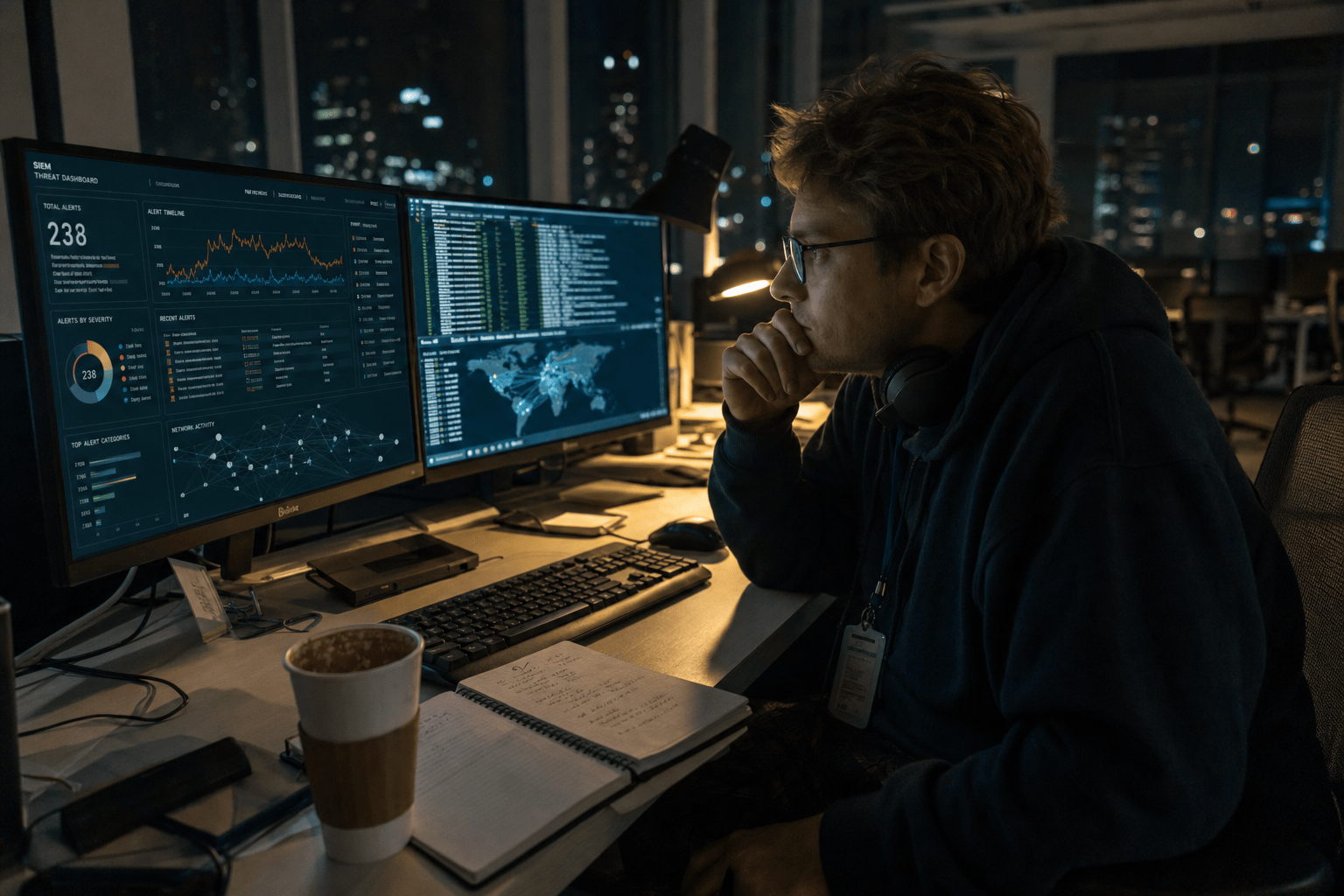
AI cybersecurity operations monitoring runs the night shift well for routine work: it watches logs, correlates alerts, and quarantines obvious threats in seconds while your team sleeps. What it does not do is exercise judgment on the messy cases that attackers deliberately time for 2 a.m. on a holiday weekend. We have spent years watching breaches unfold in exactly that window, and the pattern holds. The tooling stops the noise; a small set of decisions still waits for a person. This article names the five after-hours gaps we see most often, and how a mid-sized business covers them without hiring a full overnight team.
Overview: 5 Things This Article Answers
Most articles tell you AI now handles security around the clock. That is half true, and the missing half is where companies get hurt. Here is what we cover:
- AI is strong at volume, weaker at ambiguity. It triages thousands of overnight events, but stalls on the judgment calls attackers engineer on purpose.
- The five blind spots are predictable. Novel attack patterns, business-context decisions, physical and identity edge cases, alert fatigue in the model itself, and the containment call that has real business cost.
- This is a staffing question, not just a tooling one. The fix is a staffed escalation path behind the automation, not more dashboards.
- SMBs can get 24/7 coverage without a 24/7 payroll. A managed detection model gives you the overnight human without five new hires.
- The reader here is the IT Manager or CISO at a 50 to 500 person company who already bought detection tooling and still feels exposed after hours.
Why After-Hours Is Where AI Monitoring Gets Tested
After-hours is the window where the gap between automated detection and real response shows up first, because attackers plan around your staffing calendar. In our incident work, the intrusions that turned into full breaches almost never started during business hours. They started Friday evening or over a long weekend, when the reasoning was that nobody senior would look at the console until Monday.
Automated tooling did fire. That is the part people misread. The alerts existed. What failed was the handoff: an alert with no human behind it is a log entry, not a response. AI cybersecurity operations monitoring shortened the detection time to seconds, then the clock ran for 60 hours because the escalation path dead-ended at an unstaffed inbox. If you want the mechanics of catching risk without grinding the business to a halt, we walk through that tension in our guide on how to mitigate cybersecurity risk without slowing down operations. The lesson we keep relearning: the model buys you minutes, and those minutes only pay off if someone is positioned to act on them.
The 5 After-Hours Blind Spots in AI Security Operations
AI cybersecurity operations monitoring leaves five recurring gaps after hours, and each one traces back to a decision the model is not built to make alone. Below we name them in the order we see them cause damage.
Blind Spot 1: Novel Attack Patterns the Model Has Not Seen
The first gap is the attack that does not match any prior pattern, which is exactly what a capable adversary aims to produce. Detection models score events against what they have learned. A living-off-the-land intrusion that uses only signed Windows binaries, or a slow credential-stuffing run paced to stay under rate thresholds, can read as normal activity. The model is not wrong so much as under-informed.
The counter-argument is fair: modern behavioral analytics catch anomalies without a prior signature, and they do. We have watched them flag a lateral-movement sequence no signature would have caught. Both sides hold. The honest position is that behavioral detection widens the net without closing it. Overnight, a novel pattern that scores just below the alert threshold sits silent until a human reviews the baseline. We cover the trajectory of this arms race in our look at the future of AI in cybersecurity, and the short version is that novelty will always lead the model by a step.
Blind Spot 2: Business Context the Model Does Not Have
The second gap is business context: the model sees a data flow, not what that data means to your company. At 3 a.m. an automated system sees 40 gigabytes moving from a file server to an external endpoint and has to guess. Is that an exfiltration, or the scheduled backup your team moved to a new provider last week? The event looks identical on the wire.
A person who knows your operation answers that in ten seconds. The model either blocks a legitimate transfer, which breaks the business, or allows a real theft, which is worse. Some vendors argue that better data-classification tagging removes the guesswork, and richer tagging does help. It does not finish the job, because business context changes faster than tags get updated. This is why network security monitoring works best when the automated layer routes ambiguous calls to someone who knows what your Friday-night backup schedule actually looks like.
Blind Spot 3: Identity and Physical Edge Cases
The third gap sits at the identity and physical boundary, where an event can be technically valid and still be an attack. A valid credential logging in from an unusual location may be a traveling executive or a stolen session token. An MFA prompt approved at 2 a.m. may be the on-call engineer or an MFA-fatigue attack that wore the user down. The signals are genuinely two-sided.
We have seen strong conditional-access policies cut this risk hard, and we recommend them. We have also seen an attacker socially engineer a help-desk password reset that no policy caught, because the weak point was a human process, not a control. Holding both views: automation raises the floor on identity abuse, and a staffed reviewer is still the thing that stops the clever edge case overnight. For companies bound by regulatory rules, that reviewer also documents the decision, which matters for cybersecurity compliance audits later.
Blind Spot 4: Alert Fatigue Inside the Model Itself
The fourth gap is one people rarely name: the automation itself can be tuned into blindness. To cut false positives, teams raise thresholds and suppress noisy rules. Every suppression is a small bet that the muted signal will not matter. Overnight, when nobody is watching the tuning, those bets accumulate. We have opened investigations where the decisive early alert had been auto-suppressed months earlier as noise.
The opposing view says untuned tooling is useless, and that is true too. A system that alerts on everything trains its watchers to ignore it. The unbiased read is that tuning is necessary and quietly dangerous, and it needs periodic human audit rather than set-and-forget trust. We treat AI operations monitoring as a system that itself needs supervision, not a closed box. If you are still deciding whether to run this in-house or hand it off, our piece on what a security operations center is and whether you need one lays out the trade.
Blind Spot 5: The Containment Decision With Real Business Cost
The fifth gap is the containment call, because isolating a system stops an attacker and can also stop your revenue. When detection flags a likely compromise on a production server at midnight, the automated options are to isolate the host or hold and watch. Isolating it halts a possible breach and may also take your order-processing system offline until morning. Holding lets you gather intelligence and risks letting the intruder spread.
That is a business decision with a dollar figure attached, and few companies authorize software to make it unattended. Automated containment for clear-cut cases is right and we enable it. For the borderline call, someone with authority has to weigh downtime against exposure. This is the exact moment our after-hours cybersecurity emergency response exists for: a person who can make the containment call at 1 a.m. and own it.
How SMBs Cover the Gaps Without a 24/7 Payroll
A mid-sized company closes these after-hours gaps by pairing AI triage with a shared human escalation team, not by staffing an overnight shift of its own. Five full-time analysts across three shifts is out of reach for most 50 to 500 person firms, and that budget reality is why the gaps stay open. The workable path is a managed detection model where the automation handles volume and a staffed team owns the judgment calls, spread across many clients so no single company pays for the whole clock.
We think about it as three layers. The automated layer runs cybersecurity detection and quarantines the clear threats instantly. The human layer takes the five blind spots above and makes the calls the model should not. The process layer defines, in advance, who has authority to isolate a production system at 2 a.m. and how they reach that person. One of our clients ran exactly this model through a cloud migration, and the result was steadier growth rather than a scramble, which we documented in this cybersecurity case study. If cost is the sticking point, our walkthrough on building a cybersecurity budget for a small business shows where this coverage fits, and our SMB cybersecurity framework puts it in order of priority.
Frequently Asked Questions
Does AI cybersecurity operations monitoring fully replace overnight security staff?
No. AI cybersecurity operations monitoring replaces the routine overnight workload, not the judgment calls behind it. It triages high volumes of alerts and stops obvious threats automatically, but ambiguous cases, containment decisions with business cost, and novel attacks still need a human with authority. The practical model is automation plus a staffed escalation path.
What is the biggest after-hours risk for SMBs using automated detection?
The biggest risk is an alert that fires with no human positioned to act on it. Attackers time intrusions for nights and long weekends precisely because detection without response is only a log entry. Detection time drops to seconds, then the damage clock runs for days if escalation dead-ends at an unmonitored inbox.
Can AI make containment decisions on its own overnight?
For clear-cut cases, yes, and it should. Automated isolation of an obviously compromised host is faster than any person. For borderline cases, isolating a system can halt an attack and also take revenue systems offline, so most companies keep a human in the loop for that call. The line sits between obvious and ambiguous.
How does a company afford 24/7 coverage without hiring an overnight team?
Through a managed detection model that shares a staffed team across many clients. Instead of paying for five analysts across three shifts, you pay for a slice of an always-on team backed by automation. That gives you the overnight human decision-maker without carrying a full 24/7 payroll internally.
Is behavioral AI enough to catch attacks with no known signature?
It helps, but it does not close the gap. Behavioral analytics flag anomalies without a prior signature and catch patterns older tools miss. A capable attacker paces activity to stay just under thresholds, so a genuinely novel pattern can sit below the alert line until a human reviews the baseline. Novelty tends to lead the model.
Talk to Us About Your After-Hours Coverage
The takeaway is simple: AI cybersecurity operations monitoring is a real gain and a partial one. It runs the night shift for routine work and buys your team the minutes that decide an incident. Those minutes only convert into a stopped breach when a person stands behind the automation, ready to answer the questions the model cannot: is this novel, does this match our business, who owns the containment call. The five blind spots we named are not reasons to distrust the tooling. They are the map of where a human still belongs in the loop after hours. Most mid-sized companies do not need to build that overnight team themselves; they need a partner who already runs one. If you want a clear read on where your current setup goes quiet after dark, book a free strategy call and we will walk your escalation path with you.

