

Apache Struts CVE-2016-3081 is a remote code execution flaw in the Struts 2 web framework that lets an unauthenticated attacker run commands on the server through the “method:” prefix when Dynamic Method Invocation is switched on. It affects Struts 2.3.19 through 2.3.20.2, 2.3.21 through 2.3.24.1, and 2.3.25 through 2.3.28, and Apache fixed it in 2.3.20.3, 2.3.24.3 and 2.3.28.1 back in 2016. CISA has now added it to its Known Exploited Vulnerabilities catalog, which tells you attackers are still finding servers that carry it. Most businesses never chose Struts. It arrived inside a time-clock portal, a dispatch system, an old intranet or a vendor-built customer portal, and it has been sitting there since. The work is finding where it lives, because you cannot patch a library you do not know you own.
The Short Version: 5 Things to Know
Here is what our team wants an IT manager or CISO to take away before reading the detail below.
- Age is not safety. A flaw from 2016 joining the KEV catalog in 2026 means live attacks against old, forgotten servers, not a history lesson.
- You probably did not install Struts on purpose. It ships bundled inside Java applications as a .jar file, often several layers down in a vendor product.
- The precondition is a setting. The attack needs DMI enabled. Many apps have it off, but you only know by reading the configuration on each server.
- The whole 2.3 line is past its support life. Even a patched 2.3 build will not receive future fixes from the Apache project, so the real exit is an upgrade or a replacement.
- An inventory beats a scanner alone. A software bill of materials and a direct question to each vendor find what a network scan will miss.
Where Apache Struts CVE-2016-3081 Hides in a Small Business
Apache Struts CVE-2016-3081 shows up most often in line-of-business Java applications that were bought, built or inherited years ago and never revisited. Struts was one of the most popular Java web frameworks of its era, so a large share of enterprise and vertical software written between roughly 2008 and 2017 leaned on it. Those products are still running in plenty of companies with 20 to 300 employees.
Vendor-supplied apps installed on your own servers
The most common place we find Struts is inside software a vendor delivered as an installer: a field service platform, a lab information system, a payroll or time-clock server, a document imaging front end. The vendor picked the framework, the vendor compiled it in, and the customer received a WAR file deployed to Tomcat or JBoss. When the vendor stopped shipping updates or the maintenance lapsed, the bundled library froze at its install-day version. From the outside, the server looks like “the scheduling system,” and nobody thinks of it as a Struts server at all.
In-house and contractor-built portals
The second pattern is a portal a contractor built for you: a customer order lookup, a dealer portal, a claims status page. Java developers reached for Struts by default for years. When the contractor relationship ended, the source code may have gone with them, and the build has not been touched since. These apps are often internet-facing by design, because customers or partners were the audience.
Appliances and embedded web consoles
A smaller group of network and storage appliances used Java web consoles with Struts underneath. Firmware updates usually replace the whole console, so these are the easiest to fix once you know about them. The risk is an appliance that fell off the support contract and has not taken firmware in years. Good network management keeps a current list of every device with a management interface, which is where that question gets answered.
How the Struts 2 Remote Code Execution Flaw Actually Works
The Struts 2 remote code execution flaw works because the framework let a request name which method to call on an action, and it evaluated that name as an expression rather than as plain text. When DMI is enabled, an attacker can send a crafted “method:” parameter that carries an Object-Graph Navigation Language (OGNL) expression, and Struts runs it.
What DMI does and why it was enabled
DMI is a convenience feature: it lets one Struts action class serve several URLs by naming the method in the request instead of mapping each one in configuration. Developers liked it because it cut down on configuration files. Apache later recommended turning it off, and newer releases ship with it disabled by default. In the 2.3 era, though, plenty of applications turned it on because a tutorial or a framework template did. That history is why you cannot assume the setting either way.
Why the attacker needs no login
The vulnerable code sits in how the framework maps an incoming URL to an action, which happens before most applications check whether the user is signed in. So the request does not need a password, a session or any foothold. Anyone who can reach the web port can try it. On our assessments, that is the detail that changes how seriously a business owner takes an old portal.
What the attacker gets on the server
A successful request runs code as the account that runs the Java web container, typically the Tomcat or JBoss service account. On Windows servers that account is too often a local administrator or even SYSTEM, because the installer asked for it and nobody pushed back. From there an attacker can drop a web shell, harvest database credentials from the application’s configuration file and move toward your file servers. Ransomware crews prize these footholds because the server already has trusted connections into the network.
Why a 2016 Bug Is on the CISA KEV List in 2026
A 2016 bug lands on the CISA KEV list in 2026 because CISA adds a flaw when it has reliable evidence of active exploitation, not when the flaw is new. The listing is a statement about attacker behavior right now. Federal agencies receive a remediation deadline once a flaw is listed, and private companies can treat that same deadline as a sensible ceiling for their own response.
Attackers scan for old frameworks on purpose
Exploit code for this flaw has been public for years and is packaged into common scanning tools. Attackers sweep the internet for Struts fingerprints such as “.action” and “.do” URLs, try the payload, and move on. The 2017 Equifax breach came through a different Struts flaw, CVE-2017-5638, and it showed how much damage one unpatched framework in one customer-facing app can do.
Why patch reports show green while Struts stays red
Most patch tooling tracks the operating system and the big commercial applications. It does not look inside a WAR file to read the version of a library compiled into it. So a server can be fully current on Windows updates and still carry Struts 2.3.24 in a folder under the Tomcat webapps directory. We cover that blind spot in our patch management guide on the gaps SMBs miss, and it is the single biggest reason this class of flaw survives.
What the BOD deadline means for private firms
The binding operational directive behind the KEV catalog only governs federal civilian agencies. Even so, cyber insurers, auditors and enterprise customers increasingly ask whether you track KEV entries and how fast you close them. If you sell to the government or carry a cyber policy, expect that question at renewal, and have a dated record showing when you checked for this flaw.
How to Find Struts Inside Vendor-Supplied Java Applications
You find Struts inside vendor-supplied Java applications by combining three sources: the files on disk, the vendor’s own statement and a test from the outside. Any single source misses something, which is why we never rely on one.
Search the file system for the library itself
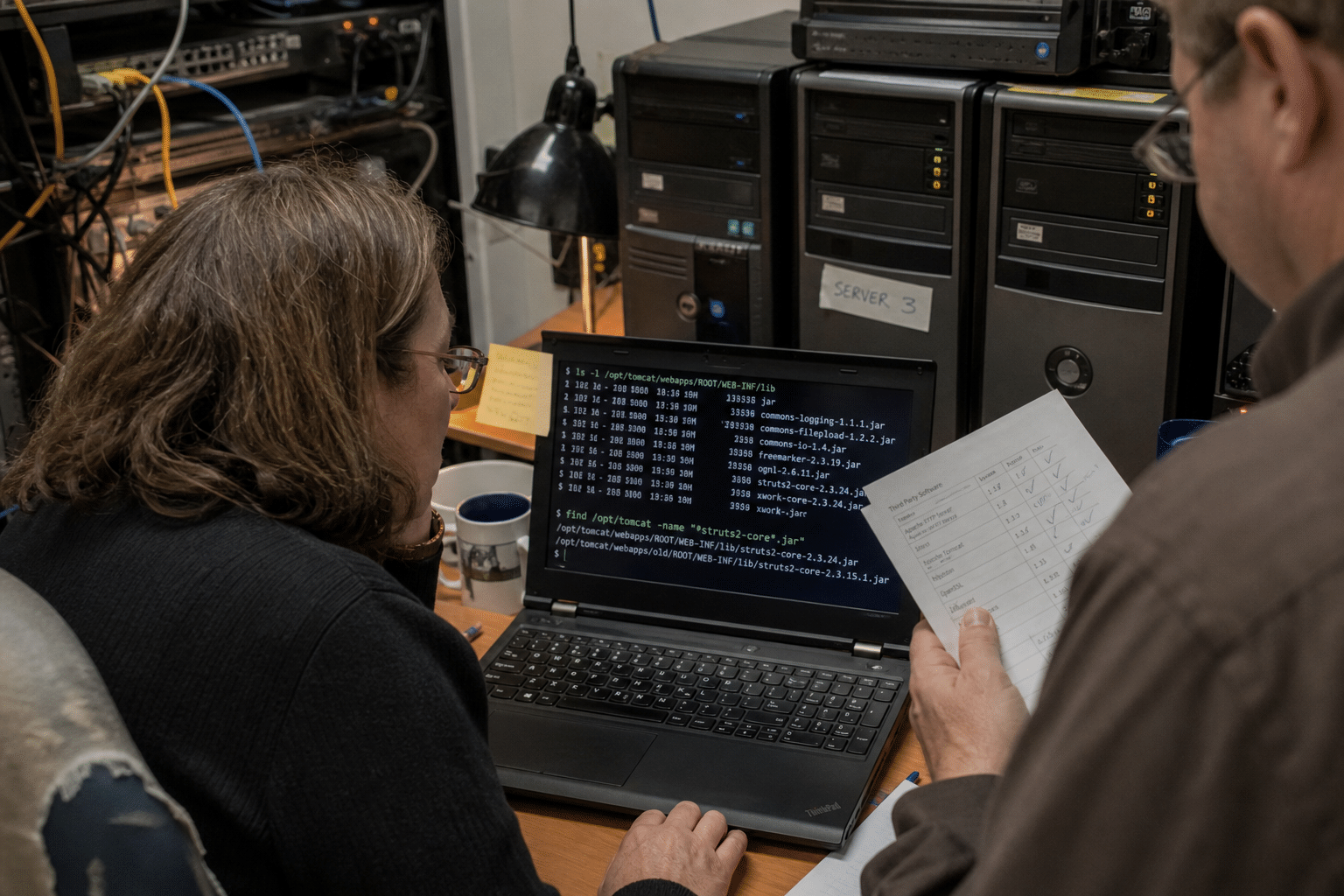
On every server that runs Java, search for files named “struts2-core” with a .jar extension, including inside WAR and EAR archives, which are just zip files. The version number is in the file name in nearly every case. Record the server, the application and the version. Our team runs this as a scripted sweep across the estate, then hand-checks anything that looks repackaged or renamed. A vulnerability assessment with authenticated scanning will usually catch the library as well, as long as the scanner has credentials to read the disk.
Ask every vendor for a software bill of materials
A software bill of materials, or SBOM, is a list of every component and version inside a product. Send each vendor of a Java-based application a short written request: does the product include Apache Struts, which version, is DMI enabled, and what is the fixed release. Vendors that publish SBOMs answer in a day. Vendors that cannot answer are telling you something about how they manage their own code, and that belongs in your vendor risk file.
Confirm exposure from the outside
A file on disk is a finding. An internet-facing URL that accepts the request is an emergency. Map which of the affected applications are reachable from the internet or from partner networks, and confirm whether the DMI setting is on in the struts.xml or struts.properties file. Our guide to vulnerability scanning versus penetration testing explains when a safe external test is worth adding to confirm what the scan suggests.
What to Do When the Vendor Has Moved On
When the vendor has moved on, your options narrow to upgrading the library yourself, shielding the application, or retiring it. Each carries trade-offs, and the right choice depends on how much the business still relies on the system.
Patching the library yourself
Replacing struts2-core and its related jars with a fixed 2.3 release inside a vendor WAR file is technically possible, and sometimes it works on the first try. The case for it is speed: the flaw closes today. The case against it is that you now own an unsupported modification, any vendor support contract is likely void, and a later reinstall will quietly bring the old version back. If you take this route, document it, test it in a copy first, and add a recurring check that the version did not revert.
Shielding the app while you plan an exit
Turning DMI off in configuration, setting “struts.enable.DynamicMethodInvocation” to false, removes the precondition for this flaw. Placing the application behind a VPN or a web application firewall rule that blocks “method:” parameters cuts off the internet path. These steps buy time and are worth doing the same day. They do not fix the other Struts 2.3 flaws published since, and the 2.3 line no longer receives security releases from the Apache project.
Replacing or retiring the application
The durable answer for an orphaned Struts app is replacement or retirement. That is a business decision, not a patch, so treat it as a funded effort with an owner, a data migration plan and a cut-over date. Disciplined IT project management keeps that from stalling for another five years. Many of the systems we find turn out to have two or three users and a modern SaaS equivalent, and retiring them removes the risk entirely.
Building a Software Inventory So the Next Struts Bug Is a Ten-Minute Answer
A software inventory that includes third-party components turns the next KEV listing from a scramble into a lookup. The goal is that when CISA names a library, you can say within minutes whether you run it, where, and who owns the fix.
Track components, not just applications
Most asset lists stop at “Accounting server, runs the scheduling app.” Extend the record to the major components inside each app: framework, version, Java runtime, web container. Software composition analysis tools and SBOM files can fill much of this automatically for anything you build or receive from cooperative vendors. Our walkthrough on how to implement a vulnerability management process shows where that inventory fits in the cycle.
Put component disclosure into vendor contracts
Add a clause to new software contracts requiring the vendor to provide an SBOM, notify you of exploited flaws in bundled components within a set number of days, and support a fixed release. This is the lever that changes vendor behavior, and it costs nothing to ask for at signing. For existing contracts, raise it at renewal.
Budget for end-of-life software
Old frameworks are a cost line, whether you plan for them or not. Our breakdown of vulnerability management cost and the hidden line items SMBs miss covers how to put a number on legacy app risk so it competes fairly for budget, and the vulnerability management guide on the risks SMBs miss lists the other blind spots that sit beside it.
Frequently Asked Questions
Is Apache Struts CVE-2016-3081 still exploited in 2026?
Yes, Apache Struts CVE-2016-3081 is still exploited, which is why CISA added it to the Known Exploited Vulnerabilities catalog. Attackers run automated scans for old Struts applications, and any server still carrying an affected version with DMI enabled is a target.
Which Struts versions does CVE-2016-3081 affect?
It affects Struts 2.3.19 through 2.3.20.2, 2.3.21 through 2.3.24.1, and 2.3.25 through 2.3.28 when Dynamic Method Invocation is enabled. The fixed releases are 2.3.20.3, 2.3.24.3 and 2.3.28.1, though the 2.3 line itself is no longer supported.
Does turning off DMI fully protect my application?
Turning off DMI removes the precondition for this flaw, so it blocks this attack path. It does not address the other Struts 2.3 vulnerabilities published since 2016, so treat it as a stopgap while you upgrade or replace the application.
How do I know if a vendor product includes Struts?
Search the server for struts2-core jar files, including inside WAR and EAR archives, and ask the vendor in writing for a software bill of materials. Use both, because vendors sometimes repackage libraries and file names can mislead.
What should I check if I suspect the server was already compromised?
Look for unfamiliar JSP files in the web application folders, unexpected child processes launched by the Java service account, and new outbound connections from the server. If you find any of these, isolate the server and rotate every credential stored in the application’s configuration before you rebuild it.
Who Is Behind This Guidance
Mindcore Technologies has spent years helping small and mid-sized businesses in New Jersey, Florida and beyond find and fix the software nobody remembers owning, from vendor-installed Java servers to contractor-built portals. Our security team runs authenticated assessments, reads the configuration files and works through vendor responses alongside your staff, so the inventory and the decisions stay with you. CEO Matt Rosenthal leads the company with a focus on practical security for growing firms: closing the exposures attackers actually use, documenting the work so it holds up to insurers and auditors, and keeping technology decisions tied to business priorities.
Get Your Java Applications Checked for Apache Struts CVE-2016-3081
Apache Struts CVE-2016-3081 is a reminder that the riskiest code in your business is often the oldest code nobody owns, buried inside a vendor product or a portal a contractor built years ago. The steps are clear: search every Java server for struts2-core, ask each vendor for a software bill of materials, turn DMI off where it is on, shield anything internet-facing, and put the orphaned applications on a funded path to replacement. Then build the component inventory and the contract language that make the next KEV listing a ten-minute answer instead of a week of digging. If you want a second set of eyes on where Struts and other aging libraries sit in your environment, our team can help you map it, rank it and plan the fixes. Book a free strategy call and we will walk through your Java estate with you.

