

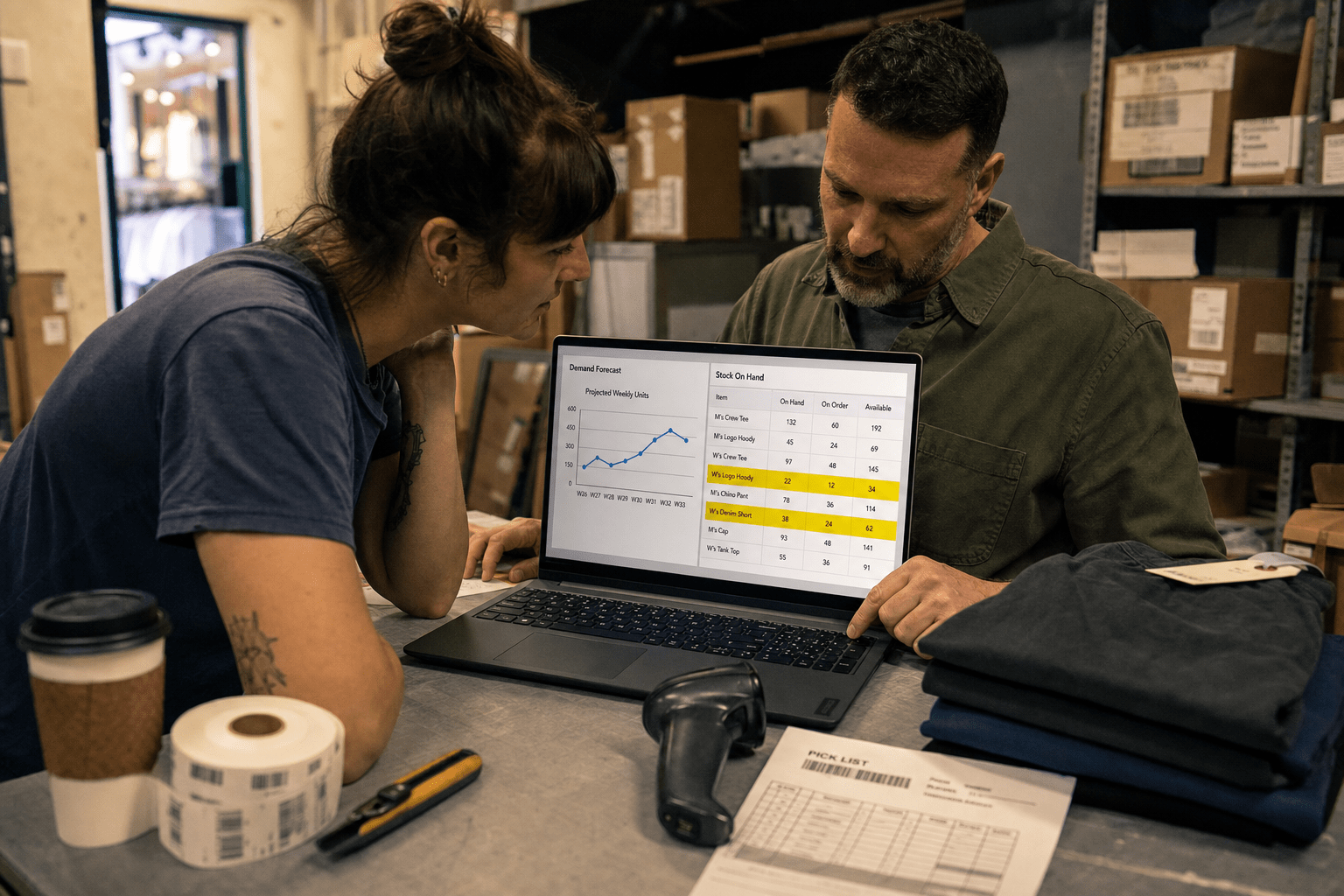
The best AI tools for retail businesses in 2026 are the ones that produce a usable forecast from the sales history and product data a retailer already keeps. Demand forecasting, inventory optimization, store-level analysis, and personalization all have working products, and forecasting in particular has moved past the point where accuracy is the limiting factor. What decides whether a purchase pays back is data hygiene: whether the product hierarchy is consistent, whether promotional periods are flagged, and whether sales history survived the last system change. We rank by how much cleanup a tool demands before it produces anything, because a forecasting engine reading a broken hierarchy will confidently order the wrong quantities.
Why the Best AI Tools for Retail Businesses Miss on the First Season
Most disappointing retail forecasting deployments we have seen failed on inputs rather than models. The engine went live, produced order quantities that looked wrong to a merchandiser who had been buying that category for a decade, and the team quietly reverted to their own numbers. Nobody logged a defect, because the tool was technically working. It was reading history where promotional weeks looked like ordinary demand and where a category restructure two years back had broken continuity.
Settle these five before the contract:
- Check whether promotional periods are flagged in your history. A model that cannot tell a promotion from natural demand will forecast the promotional spike as a baseline and over-order for a year.
- Confirm your product hierarchy is consistent. Forecasting at category level requires categories that mean the same thing across the whole history. Restructures break that quietly.
- Decide what a merchandiser does with a recommendation. Review and adjust, or accept automatically above a confidence threshold. Left undecided, buyers override everything and the tool never gets a fair test.
- Separate forecasting from replenishment automation. Predicting demand and placing orders are different risk levels, and bundling them means the ordering side gets the lighter review.
- Measure stockouts and markdown rate. Both are already tracked. If neither moves within two seasons, the deployment is not working.
Retailers who fix history first get a fair result. Retailers who go live on unexamined data spend a season learning what the model could not see.
How to Rank the Best AI Tools for Retail Businesses by What They Decide
Ranking retail AI by decision beats ranking by vendor, because forecasting, store operations, and customer-facing personalization draw on different data and fail in different ways. Start where the money is tied up, which for most retailers is inventory.
Demand forecasting and inventory optimization
This is where the measurable return sits, because inventory is working capital. These engines read sales history, seasonality, and outside signals to predict demand at product and location level. Blue Yonder serves enterprise chains with strong forecasting accuracy, RELEX targets mid-market retailers, Invent Analytics works at product and location granularity, and Prediko, Netstock, Cin7, StockIQ, and Logility cover the smaller and mid-size end. Reported stockout reductions in the range of a third, with lower carrying cost alongside, are credible where the data supports the model.
The counter-argument is that those reported figures come from retailers whose data was in good shape, and that is a selection effect nobody mentions in a demonstration. A retailer with two years of clean history across a stable hierarchy will see something close to the published numbers. A retailer whose point of sale system changed eighteen months ago is forecasting on a fragment. Ask any vendor what minimum history they need and whether they can work around a system change, because the honest ones have a clear answer.
Store operations and loss prevention
Store-level analysis covers labor planning, shelf availability, and shrink. Zebra Prescriptive Analytics is the established option for physical store operations and loss prevention, working from the device and scan data a store already generates.
The opposing view deserves airing. Loss prevention analysis pointed at employee behavior changes the relationship between a company and its store teams, and the systems that flag anomalies do not distinguish a dishonest employee from an untrained one. Retailers using these tools well investigate patterns rather than acting on individual alerts, and treat a cluster of exceptions at one store as a training question first. Retailers who treat the output as accusation generate turnover and rarely recover the shrink.
Personalization and customer experience
Dynamic Yield and similar platforms handle e-commerce personalization, adjusting merchandising and offers by customer behavior. Reported gains in repeat purchase are real where traffic volume supports the testing.
The case against is that personalization requires meaningful traffic to produce reliable results, and a retailer with modest online volume will get statistically noisy outcomes that look like performance. There is also a customer trust question in how visibly the personalization operates. Our overview of retail AI agents across inventory, sales, and customer experience covers where those boundaries usually land.
Where Payment Data and Store Infrastructure Limit the Options
Payment obligations and physical store infrastructure narrow a retail shortlist more than budget does. A retailer handling card payments carries obligations that follow the data wherever it goes, and store networks are frequently the weakest infrastructure in the business.
What to require from a vendor before data moves
Ask for four commitments: no use of your transaction data to train shared models, a defined retention period with deletion on request, exportable history so a future switch is possible, and clear statements about whether any cardholder data enters the platform at all. That last question matters most, because the cleanest position is that analytics platforms receive no cardholder data whatsoever. Our explainer on who is required to comply with payment card standards and the gaps we see against the current standard both apply directly here.
The other side is worth acknowledging. Some retailers respond by keeping all analysis in-house on exported spreadsheets, which avoids the vendor question and creates a worse one, since those exports end up on laptops and shared drives with no controls at all. A governed vendor platform with a clear data boundary is usually the stronger position, and compliance support is where that boundary gets defined properly.
Why store networks decide the real exposure
Retail store networks are built for cost and uptime, often with flat topology, aging equipment, and connections shared between point of sale, back office, and guest access. Adding platforms that pull store data raises what a single compromised store reaches. Basic measures matter more here than sophistication, as our security guidance for smaller businesses sets out, and monitoring is what makes an unusual connection visible before it spreads across locations.
The balanced reading is that most retailers have protection at head office and much less at store level. That retailer can adopt these platforms safely if store network segmentation runs alongside the rollout, with cloud security covering wherever the analysis actually happens.
How system history shapes what is achievable
Where sales history sits and how many times it has moved determines whether this is a purchase or a data project. A retailer on a stable platform with continuous history integrates quickly. One that changed point of sale systems recently is working with a fragment, and rebuilding usable history is the real first step regardless of which vendor wins.
How Retailers Prove an AI Tool Paid for Itself
A retail AI purchase justifies itself when a number already on the merchandising report moves. Choosing the measure afterward guarantees a flattering one.
The numbers merchandising already watches
Stockout rate, markdown percentage, inventory turns, gross margin return on investment, and shrink all work, because each is already tracked and reviewed. Baseline one across a defined category before adopting, then compare the same category across a full season rather than a quarter.
The fair objection is that retail performance moves with weather, competition, and consumer conditions nobody controls, so a raw comparison misleads. The workable answer is comparing forecast categories against unforecast ones in the same period, which holds market conditions constant. Retailers who set that comparison up in advance settle the question cleanly.
Where the recurring cost accumulates
License fees are visible and often not the largest line. Data cleanup, hierarchy restructuring, integration work, merchandiser training, and the review time spent adjusting recommendations all consume capacity the business case tends to omit. Retailers funding only the license see buyers override the system, and the model is rarely at fault.
Against that, clean history and a consistent hierarchy are durable assets serving every future decision, including any change of platform. Judging on first-year cost alone steers retailers toward the lightest tool, which is often the one that cannot work around their data problems.
Who should run the evaluation
Evaluation belongs to merchandising and supply planning, with someone qualified assessing data handling and payment boundaries. A retailer without that internal capacity should bring it in rather than rely on a vendor’s accuracy claims. Our process automation work starts at that assessment. What does not work is a technology-led evaluation, which selects on features the buyers will never trust.
Frequently Asked Questions
What are the best AI tools for retail businesses in 2026?
The best AI tools for retail businesses in 2026 sort into three groups: demand forecasting and inventory optimization from Blue Yonder, RELEX, Invent Analytics, Prediko, Netstock, Cin7, StockIQ, and Logility; store operations and loss prevention through Zebra Prescriptive Analytics; and e-commerce personalization from platforms such as Dynamic Yield. Start with forecasting, since inventory is where working capital is tied up.
How much sales history does AI demand forecasting need?
Most engines want at least two years of continuous history to learn seasonality, and they need promotional periods flagged so a promotion is not read as baseline demand. Retailers who changed point of sale systems recently often have less usable history than they think. Ask every vendor what minimum they require and how they handle a system change mid-history.
Will our buyers trust the forecast?
Only if the decision rule is settled before launch. Left undefined, merchandisers override recommendations that conflict with their own judgment and the tool never gets a fair evaluation. Deciding in advance whether output is reviewed, adjusted, or auto-accepted above a confidence threshold is what makes the deployment testable.
Should loss prevention analysis be pointed at employees?
Carefully, if at all. These systems flag anomalies without distinguishing a dishonest employee from an untrained one, and treating an alert as an accusation damages store teams and rarely recovers the loss. Investigating patterns rather than individual alerts, and treating clustered exceptions as a training question first, is the approach that holds up.
Does an analytics platform need access to cardholder data?
It should not. The cleanest arrangement is that forecasting and analytics platforms receive transaction quantities and product data with no cardholder information at all. Ask any vendor to state plainly what payment data, if any, enters their system, since keeping that boundary clear removes a large obligation from the deployment.
Who Is Behind This Guidance
Our team has worked with retail operators on the groundwork that determines whether analytics platforms deliver: store network segmentation across locations built for cost rather than security, payment data boundaries, consolidating sales history through system changes, and recovery after incidents that reached multiple stores through a shared connection. That experience shaped the ranking approach here. We have watched capable forecasting engines get overridden into irrelevance at retailers whose history could not support them, and modest deployments hold their gains at retailers who cleaned data first.
Matt Rosenthal, our CEO, has built Mindcore around the operational groundwork that lets multi-location businesses adopt new technology without widening their exposure. The principle guiding how our team runs these engagements is that a recommendation buyers do not trust is not a forecast, only a report, so the data question comes before the vendor question.
Your Next Step Toward Forecasts Your Buyers Will Use
Choosing among the best AI tools for retail businesses is the smaller half of the work. Retailers who check whether promotions are flagged, confirm the product hierarchy holds across their history, settle the decision rule before launch, separate forecasting from automated replenishment, and pick a merchandising number in advance get a fair test and a real result. Retailers who go live on unexamined history spend a season discovering what the model could not see.
The sequence that works is practical. Pull two years of sales history for one category and look at whether promotional weeks are distinguishable and whether the category means the same thing throughout, because that answers the forecasting question faster than any demonstration. Map what data would leave your systems and confirm no cardholder information is in it. Look honestly at store network segmentation, since a platform pulling store data is only as contained as the weakest location. Then run one category through a full season with the decision rule written down in advance, and compare it against a category you left alone.
None of that requires an enormous budget. It does require someone who can assess data quality without a vendor’s optimism and read a data handling agreement against payment obligations. That is what our team brings to retailers working through this decision, whether we run the whole technology function or work alongside an internal team.
If your business is weighing AI tooling this year and wants the groundwork assessed before contracts are signed, book a free strategy call with our team. We will review your current systems, store network, and payment boundaries, flag what needs attention first, and give you a straight answer about whether your history will support the forecast you are being sold.

