

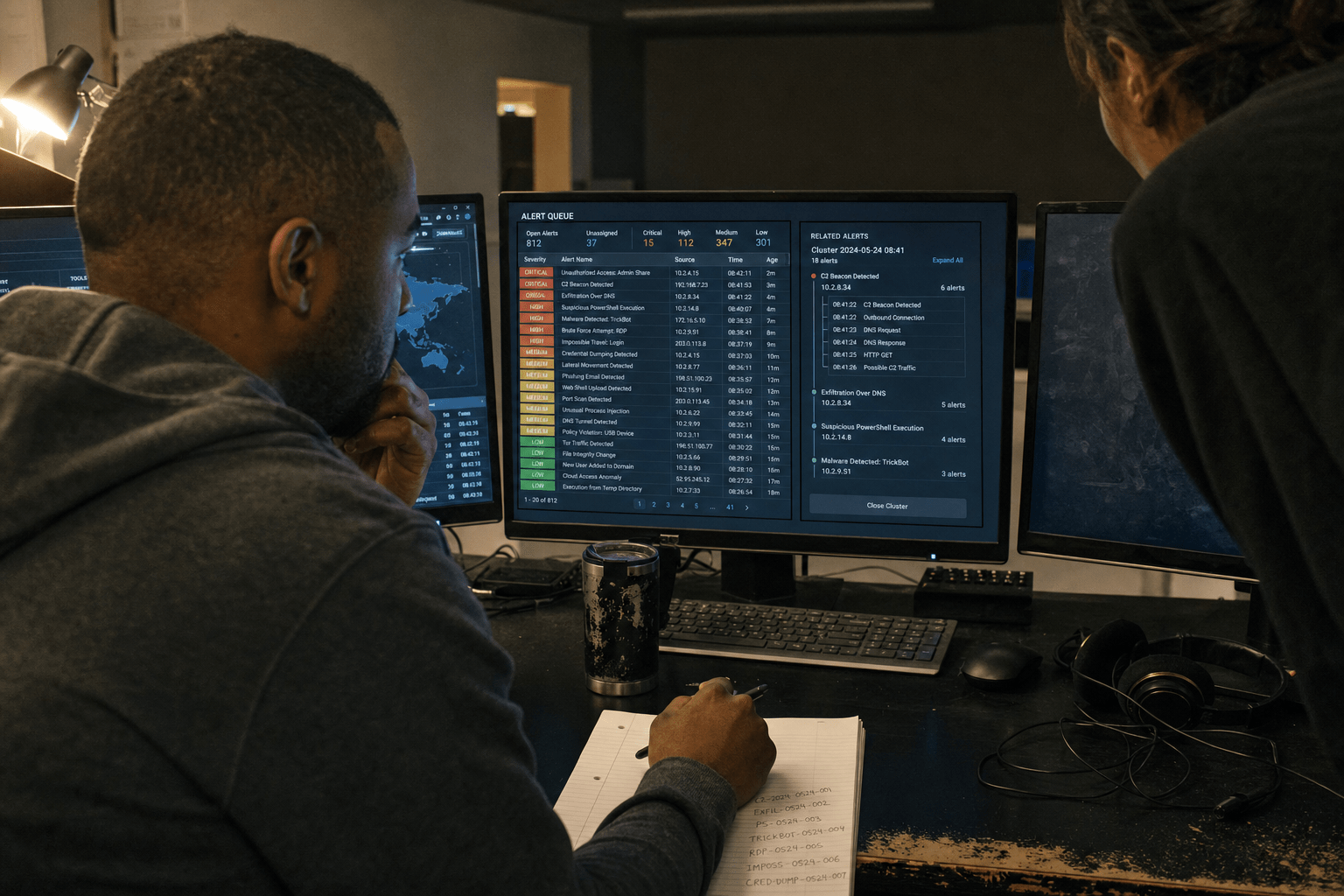
Anyone evaluating the best AI tools for SIEM alert triage should start by separating three jobs that the word triage hides. An analyst assembles context, ranks what to look at first, then decides whether something is real. Current tooling is genuinely strong at the first two and should not be given the third, because the cost of closing a real intrusion as benign has no relationship to the cost of escalating something harmless. Our team runs alert queues for small and midsize clients, and the products that hold up are the ones that arrive at a verdict faster for a human rather than the ones that offer to skip the human.
The Five Things This Guide Assumes About Your Alert Queue
- You run a SIEM or an extended detection platform with fewer than ten thousand alerts a day, and one to three people who look at them between other duties.
- Your problem is not detection coverage, it is that nobody reaches the bottom of the queue, so the oldest alerts age out unread.
- You are evaluating whether an AI layer can absorb that backlog rather than whether to replace the platform underneath it.
- You already have the general picture of AI in defensive tooling. If not, our overview of AI tools in a security stack covers the wider category.
- Nobody has measured your current false-negative rate, because measuring it means labelling historical alerts, and that work has never had an owner.
Why the Best AI Tools for SIEM Alert Triage Still Need a Human Verdict
Alert triage fails on judgement rather than throughput, so an automation layer that increases closures per hour without improving verdict accuracy has optimised the number nobody was losing sleep over. This is the distinction that decides whether a purchase helps. Queue depth is the visible symptom. Missed intrusions are the actual risk, and the two are only loosely related.
The reason they come apart is that a queue can be emptied by closing things, and closing things is the cheapest possible action. Any system rewarded on backlog reduction will trend toward closure. That is fine while the closures are correct and catastrophic the first time one is not, and the failure is silent by construction: a wrongly closed alert generates no follow-up ticket, no complaint, and no metric. It surfaces weeks later as an incident nobody saw coming, which is the same pattern behind the slow intrusions covered in our piece on advanced persistent threats for IT directors.
Most of Your Volume Is Benign True, Not False Positive
The bulk of a small SIEM queue is correct detections of harmless activity, which matters because the two categories call for opposite fixes and get conflated in every product conversation. A false positive is the rule firing when the thing it describes did not happen. A benign true positive is the rule firing correctly on activity that turns out to be authorised: the administrator who really did run a credential dump tool during a penetration test, the backup service that really did read every file share at 2 a.m.
The distinction is practical. False positives are a tuning problem, fixed by correcting the rule. Benign true positives are a context problem, fixed by knowing who owns the asset, what change was approved, and what normal looks like for that account. Only the second category is a good target for AI assistance, because supplying context is retrieval and comparison rather than a decision.
The honest counterpoint is that this taxonomy is easier to state than to apply. In a small environment with no change-management record, telling an approved administrative action from an intrusion using stolen administrative credentials is genuinely hard, and sometimes the only difference is whether a person remembers doing it. That ambiguity is an argument for better change records rather than for a more confident classifier, and legitimate testing activity is exactly the case worth documenting in advance, as our note on penetration testing tooling reflects.
The Three Decisions Inside a Triage
Triage is enrichment, prioritisation, and verdict, and those three differ in how much it costs to be wrong, which is the property that should decide what you automate. Enrichment is assembly: pull the asset owner, the user’s recent sign-in pattern, the reputation of the address, the related alerts from the same hour. Being wrong here produces a thinner briefing, and the analyst notices immediately.
Prioritisation is ranking. Being wrong means something waits longer than it should, which is recoverable as long as nothing is closed on the strength of its position in the list. Verdict is the binary: real or not. Being wrong in one direction wastes an hour, and being wrong in the other loses the environment.
That asymmetry is the whole argument. An automation layer that assembles and ranks is removing the tedious part of the analyst’s job and leaving the part that carries the risk. A layer that also closes has taken on the one decision where its errors are invisible and expensive. We advise clients to buy the first and refuse the second, and to be sceptical of any product whose value case rests on reducing headcount rather than reducing time to verdict.
How the Best AI Tools for SIEM Alert Triage Earn Their Place
The capabilities worth paying for are the ones that shorten the path to a human decision without making it, and in practice that comes down to enrichment quality and correlation. Both are measurable before purchase, which is more than can be said for a claimed accuracy figure.
Enrichment Is Assembly, and It Is Where the Hour Goes
Automated enrichment collapses the fifteen minutes an analyst spends gathering context into the moment the alert arrives, which is the single largest recoverable cost in a small security operation. Watch what an analyst actually does with a fresh alert. They look up which machine that is and who uses it, check whether the account has signed in from that location before, search for other alerts on the same host that shift, and read the last change ticket touching that system.
Every one of those is a query with a deterministic answer. A tool that runs them in parallel and presents the result as a short briefing is doing work that carries no verdict risk, and the time saving is large because the queries are slow for a person and fast for software. Platforms including Microsoft Sentinel, Splunk and Elastic all expose the query surfaces this needs, so the differentiator is rarely the data and usually how readable the assembled briefing is.
Evaluate this by measuring it rather than by demonstration. Take twenty historical alerts, time how long enrichment took your analyst, then time the tool on the same twenty. The number you want is minutes saved per alert multiplied by daily volume, which is a defensible figure to put in front of an owner. This is the same evaluation discipline we apply to any operational tooling purchase, as in our look at managed IT software and where it saves real time.
Clustering Turns Forty Alerts Into One Incident
Correlating related alerts into a single incident reduces queue depth without closing anything, which makes it the one volume reduction that carries no verdict risk at all. One lateral movement attempt can produce dozens of alerts across several hosts, and an analyst reading them one at a time sees dozens of small oddities rather than one attack.
Clustering is where machine assistance is most clearly better than a person, because the grouping signal is spread across timestamps, shared entities and sequence, and holding that in your head across forty rows is not a human strength. Good implementations group by shared entity and time window and then show the sequence, which is also the raw material for the incident timeline somebody will have to write later.
The caution is that clustering can hide a second, unrelated event inside a group, and an analyst who reads the cluster summary rather than the members will miss it. Treat a cluster as a reading order rather than as a single object, and keep the members one click away. Grouping is a presentation decision, and a presentation decision that quietly discards information is the kind of tradeoff worth reading closely, which is the theme of our comparison of scripted automation against newer assistant tooling.
Test These Failure Modes Before You Trust Any Verdict
Two failure modes decide whether an AI triage layer is safe in your queue, and neither appears in a vendor demonstration, so testing them is on you. Both are cheap to test and neither requires a live deployment.
Your Triage Model Reads Attacker-Writable Text
Log fields carry text an attacker chooses, so any model reading raw log content is processing hostile input, and a filename or user-agent string can be written to argue for its own dismissal. This is the failure mode most often missing from an evaluation. A process name, a filename, an HTTP header, a certificate subject: all of these appear in alerts and all can be set by whoever is on the other end.
The concrete risk is instruction-shaped text in a field the model treats as description. A filename constructed to read as an administrative note, or a user-agent asserting that the traffic is an approved scanner, is a cheap thing to attempt and it costs an attacker nothing to try. A model that summarises the alert may repeat that framing to the analyst, which shifts the reading without anyone deciding to shift it.
Test it directly. Put a benign alert through the tool with a hostile string planted in a text field and read what the summary says. What you want to see is the field quoted as untrusted data and clearly attributed, not paraphrased into the tool’s own narration. Ask the vendor how they separate log content from instructions, and treat a vague answer as the finding.
Shadow Mode and a Labelled Replay Set
Run any triage automation against historical alerts whose real outcome is already known before it touches the live queue, because that comparison is the only way to learn its false-negative rate rather than its confidence. Confidence scores are self-reported. A replay against labelled history is evidence.
Assemble the set from your own last quarter: every alert that became a real incident, plus a sample of those correctly closed. A few dozen is enough to be informative. Run the tool over them with the outcomes hidden, then compare. The number that decides the purchase is how many genuine incidents it would have closed, and the acceptable answer is zero. A tool that misses one in fifty looks strong on a slide and is unacceptable at the volumes a real queue produces.
There is a fair objection about effort. Labelling a quarter of alerts is real work for a team that cannot keep up with today’s queue, which is precisely why the tool is being considered. Our answer is to label only the true incidents, which you already know because they generated tickets, and to sample the rest. That produces a usable replay set in an afternoon rather than a week, and it is the difference between buying on evidence and buying on a demonstration.
Frequently Asked Questions
Can AI alert triage replace a security analyst in a small business?
No, and the products worth buying do not claim to. They compress enrichment and correlation so one analyst covers a queue that previously needed more, which is a capacity gain rather than a replacement.
What is the difference between a false positive and a benign true positive?
A false positive means the rule fired for something that did not happen, and it is fixed by tuning the rule. A benign true positive means the rule was correct and the activity was authorised, and it is fixed by supplying context such as asset ownership and approved changes.
Should an AI tool be allowed to close alerts automatically?
Not until a labelled replay of your own history shows it closes zero genuine incidents, and even then we recommend human confirmation on any closure. A wrongly closed alert produces no signal that it was wrong, which is what makes the error class dangerous.
How do I evaluate an AI triage tool without a live deployment?
Time its enrichment against your analyst on the same twenty historical alerts, then replay a labelled set of past alerts with the outcomes hidden and count the genuine incidents it would have dismissed. Both tests run offline.
Does AI triage help if our detection rules are poorly tuned?
Only at the margins. A triage layer sorts and explains what arrives, so bad rules produce a better-organised queue of noise. Tuning the rules first is the cheaper move and makes the triage layer measurably more useful.
Who Is Behind This Advice
Mindcore runs security operations for small and midsize clients across managed IT, healthcare, financial services and manufacturing, from offices in New Jersey and Florida. The framing in this article comes from working real queues rather than from a product evaluation, and the reason we separate enrichment from verdict so firmly is that we have seen what a wrongly closed alert costs when it surfaces a month later.
Matt Rosenthal, our chief executive, keeps the practice pointed at time to verdict as the measure of a security operation rather than alerts closed, on the reasoning that a queue at zero tells you nothing about whether anyone is inside. That standard is why our tooling evaluations start with a replay of your own history.
Put the Replay Together Before You Sign Anything
The best AI tools for SIEM alert triage in 2026 are the ones that hand an analyst a finished briefing and leave the decision alone, and you can tell which those are without a trial deployment. Pull the alerts from your last quarter that became real incidents, add a sample of the ones you closed, and hide the outcomes. Time your own enrichment on twenty of them. Then plant a hostile string in a log field and read how the tool narrates it. Those three tests will separate a capacity gain from a liability faster than any feature comparison, and they leave you with a false-negative number you can defend to an owner. If the replay shows a tool would have dismissed even one genuine incident, you have learned the most valuable thing available for the price of an afternoon. Our team builds these evaluation sets with client security leads regularly and can run one against whatever platform you already own. Book a free strategy call and we will start with your last quarter of incidents.

