

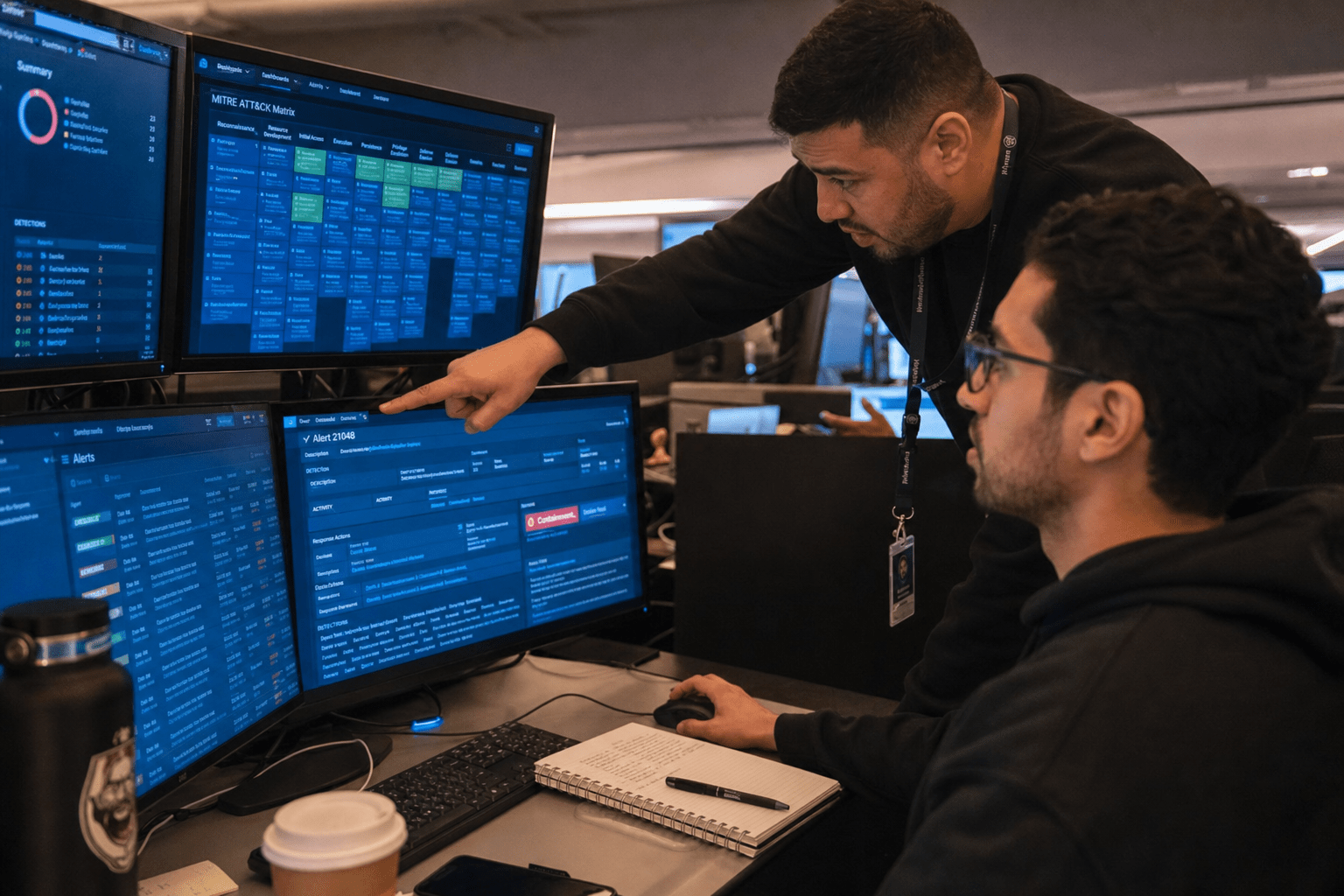
The best managed detection and response providers for mid-size businesses are the ones that commit to acting on a threat, not just alerting on it, backed by a 24/7 security operations center and a contracted response time. Managed detection and response, or MDR, is outsourced round-the-clock threat detection, investigation, and response, distinct from a security tool you buy and run yourself. Most vendors run similar detection engines, so the factor that actually protects a 50 to 500 person firm is response authority: what the provider is contracted to do the moment something fires at 2 a.m. For mid-size businesses, Managed Detection and Response Providers supply the staffed SOC, providing investigation depth and response speed that internal teams cannot match. This guide lays out the criteria that separate an MDR partner from a glorified alert feed.
The 5 Criteria That Define Strong MDR
Here is what to weigh when evaluating an MDR provider for a mid-size business, drawn from where outsourced detection programs actually succeed or fail.
- 24/7 SOC coverage. Real analysts watching your environment every hour, since attackers favor nights, weekends, and holidays when no one is at the desk.
- Response authority and MTTR. The provider should commit to a contracted mean time to respond and have the authority to contain a threat, not only flag it.
- MITRE ATT&CK alignment. Detection mapped to known adversary techniques rather than a black-box score nobody can interrogate.
- Signal-to-noise discipline. A program that triages alerts so your team is not buried, because alert fatigue is how real threats get missed.
- Clear scope versus EDR and MSSP. Honesty about what is detection, what is response, and what stays your responsibility.
Why Mid-Size Firms Cannot Defend Themselves Alone
Mid-size businesses sit in the hardest spot in cybersecurity because they hold data worth stealing yet rarely employ the around-the-clock analysts needed to defend it. A firm of 50 to 500 people often runs IT with a small internal team that already covers help desk, infrastructure, and projects, leaving no one to watch security alerts overnight. Attackers know this. We see intrusions timed for Friday evenings precisely because the people who would catch them have gone home, and the alert sits unread until Monday.
The gap is not tooling, it is staffing and time. Building an in-house SOC means hiring rotating shifts of trained analysts, a cost that does not fit a mid-size budget. The MITRE ATT&CK framework catalogs the techniques attackers use, and reading those signals in real time takes human judgment a small team cannot sustain at 3 a.m. This is the problem MDR solves, and why our managed security services center on putting trained eyes on your environment when yours are closed. The right provider becomes the night shift you could never afford to hire.
Is MDR Different From the EDR Tool We Already Bought?
MDR and endpoint detection and response, or EDR, are often confused, and the distinction decides whether a firm is actually protected. EDR is a tool that detects and records suspicious activity on endpoints, and on its own it is powerful for an organization with analysts to operate it. A mid-size firm that has invested in a strong EDR platform may reasonably feel it has detection covered.
The counterpoint is that a tool nobody is watching is a tool that generates alerts into an empty room. Managed Detection and Response Providers go beyond EDR, combining technology with people and processes to investigate and act on detected threats. We have walked into mid-size environments with excellent EDR licenses and a year of unreviewed alerts, because no one had the time. Both views hold truth: EDR is necessary and often the foundation MDR builds on, yet without staffing behind it, the firm owns a smoke detector with no fire department attached. The honest read is that most mid-size businesses need both the tool and the team.
Should a Mid-Size Business Choose MDR or an MSSP?
The choice between MDR and a managed security service provider, or MSSP, is a real fork, and neither is automatically right. An MSSP manages a broad set of security devices and infrastructure, firewalls, logs, and compliance reporting included, which appeals to a firm wanting one partner for everything. For an organization needing wide operational coverage, that breadth has clear value.
The other side is that traditional MSSPs often stop at monitoring and forwarding alerts, leaving the investigation and the response to the client. MDR is narrower but deeper, built specifically to investigate threats and respond, often with contracted containment authority. A mid-size firm with no internal responders usually needs that depth more than breadth. Neither model is wrong, but a business should be clear which problem it is solving: broad device management points toward an MSSP, while fast detection and hands-on response points toward MDR. The danger is buying breadth and assuming it includes response it never did.
How Much Does Alert Fatigue Affect Real Protection?
Alert fatigue is a genuine threat to detection programs, and a mid-size firm is right to weigh it heavily. When a system floods a small team with low-quality alerts, real threats hide in the noise, and analysts start dismissing warnings to stay functional. A provider that simply turns up sensitivity and forwards everything is making the problem worse, not better.
The opposing view is that aggressive filtering can hide a real attack by suppressing the one alert that mattered. Tuning detection too tightly to reduce noise risks missing a novel technique. The defensible middle is a provider that triages with human analysts and maps alerts to CISA threat advisories and known attacker behavior, so escalations reach you with context rather than as raw volume. Signal-to-noise discipline is not about fewer alerts or more alerts, it is about the right alerts reaching a human who can act. A provider that cannot explain its triage process will hand your small team the fatigue problem you hired them to absorb.

How to Evaluate MDR Providers for a Mid-Size Business
A disciplined evaluation ensures you select the right Managed Detection and Response Providers who will respond effectively to threats, not just monitor them. Start by asking each candidate exactly what it will do when a threat fires, and listen for whether the answer includes acting or only alerting. A strong MDR provider describes 24/7 analyst coverage, a contracted mean time to respond, and the authority to contain an endpoint or account without waiting on your team. A weaker one describes a dashboard and an email. Push for specifics on staffing, because the value you are buying is human time, not software, layered on top of continuous network security monitoring.
Then verify the program against the standards that govern serious detection. Confirm the provider maps its detection to the MITRE ATT&CK framework so you can interrogate what it catches and what it misses, and ask how it measures and reports signal-to-noise. Review how it would handle a confirmed intrusion, and confirm where MDR hands off to your team or to a separate data breach and incident response function. For the underlying mechanics of how detection, investigation, and response fit together, our managed detection and response guide gives useful context for the questions to ask.
Pin Down the Contracted Response SLA
Response time is where MDR claims meet reality, so pin it down in writing before anything else. Ask each provider for its contracted mean time to respond, what triggers the clock, and what penalties apply if it slips. A provider confident in its SOC will commit to a number and define it precisely. One that talks about response in vague terms is telling you it cannot promise the speed a mid-size firm needs when an attack is live.
Confirm 24/7 SOC Coverage Is Staffed, Not Automated
Ask each candidate to describe who watches your environment at 3 a.m. on a Saturday, because that is when intrusions land. A capable provider runs rotating shifts of trained analysts, not an automated system that pages a single on-call engineer. Round-the-clock coverage only protects you if real people are reading the signals during the hours your own team is offline, which for a mid-size business is most of the week.
Verify Detection Is Mapped to MITRE ATT&CK
Ask the provider how its detection aligns to MITRE ATT&CK techniques, because a black-box score you cannot question hides as much as it reveals. A mature provider can show which adversary tactics it detects and where its coverage has gaps. Framework alignment lets you compare candidates on substance rather than marketing, and it tells you whether the provider understands the techniques actually used against firms your size.
Frequently Asked Questions
What makes the best managed detection and response providers for mid-size businesses different?
The best providers commit to responding to threats, not just detecting them, backed by a 24/7 staffed SOC and a contracted mean time to respond. They map detection to MITRE ATT&CK so coverage is transparent, and they triage alerts to spare your small team from fatigue. That response authority, in writing, separates a true MDR partner from a vendor that only forwards alerts.
Is MDR the same as the EDR tool we already have?
No. EDR is a tool that detects suspicious activity on endpoints, while MDR is the people and process that investigate and act on what the tool surfaces. A mid-size firm without analysts to operate EDR around the clock owns detection it cannot use. Most mid-size businesses need both: EDR as the foundation, MDR as the staffed team behind it.
Should a mid-size business choose MDR or an MSSP?
It depends on the problem you are solving. An MSSP offers broad management of security devices and infrastructure, while MDR is narrower and built specifically to investigate and respond to threats. A firm with no internal responders usually needs the response depth of MDR more than the operational breadth of an MSSP. The risk is buying MSSP breadth and assuming it includes the hands-on response it often does not.
How do MDR providers handle alert fatigue?
Strong providers triage alerts with human analysts and map them to known attacker techniques, so escalations reach you with context instead of as raw volume. Weak providers either flood you with noise or over-filter and risk hiding a real attack. The right balance puts the alerts that matter in front of a person who can act, which is the whole point of outsourcing detection.
Why can’t a mid-size business just run its own SOC?
A round-the-clock SOC requires rotating shifts of trained analysts, a staffing cost that rarely fits a 50 to 500 person budget. Most mid-size firms run lean IT teams already stretched across help desk and infrastructure work, leaving no one to watch alerts overnight. MDR provides that 24/7 analyst coverage as a service, which is far more attainable than hiring and retaining an internal team.
Talk to an MDR Partner
Choosing a managed detection and response provider for a mid-size business comes down to one question: when a threat fires while your team is offline, will the provider act, or only send an alert into an empty inbox. The firms that avoid the worst outcomes are the ones that screened for staffed 24/7 SOC coverage, a contracted mean time to respond, and transparent MITRE ATT&CK alignment, and treated the detection tooling as the baseline rather than the prize. Use the criteria here to build a shortlist, get the response SLA in writing before anything else, and confirm that real analysts watch your environment during the hours yours is dark. If your business needs Managed Detection and Response Providers that investigate and respond rather than simply monitor, our security team can demonstrate exactly how that works. Book a free strategy call with Mindcore and we will review your current detection coverage against the threats firms your size actually face.
Managed Detection and Response and SOC Coverage Expertise from Matt Rosenthal
Matt Rosenthal, CEO of Mindcore Technologies, has over 30 years of experience helping mid-size businesses evaluate MDR providers on the criterion that actually determines outcomes: whether the provider is contracted to act on a confirmed threat or only to alert on it, and whether real analysts are watching at 3 a.m. on a Saturday when most intrusions land. He has seen firsthand how mid-size firms invest in excellent EDR licenses, accumulate a year of unreviewed alerts nobody had time to investigate, and discover during a breach response that they owned detection with no staffed team behind it. Matt leads a team that delivers 24/7 analyst-staffed SOC coverage with contracted response times, MITRE ATT&CK-aligned detection that can be interrogated rather than taken on faith, and signal-to-noise discipline that puts the right escalations in front of a human who can contain a threat rather than flooding a small IT team with volume it was never built to absorb.

