

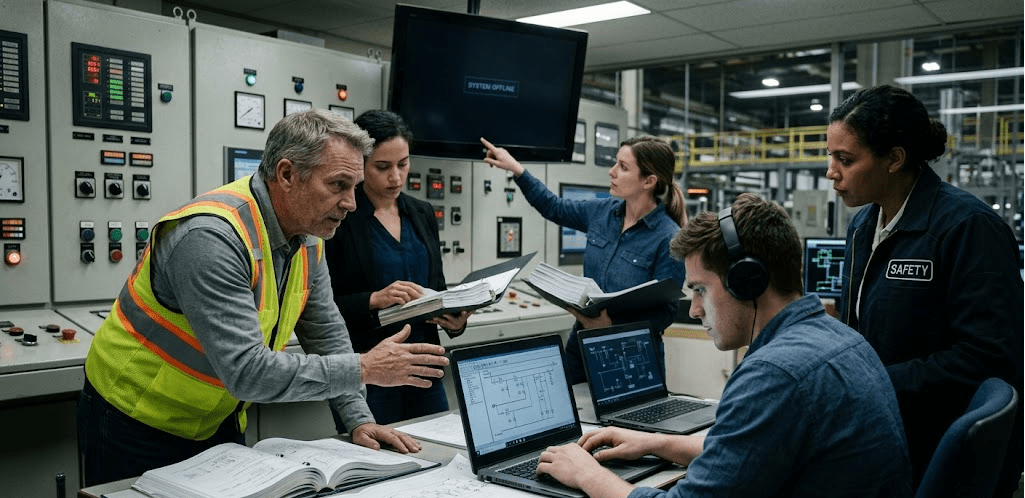
Ransomware in a manufacturing plant does not stop at the IT network. It threatens the operational technology systems that control physical production, and every hour those systems are offline carries a direct, calculable cost that accumulates faster than in almost any other industry.
Production lines idle. Delivery commitments slip. Raw materials sit unprocessed or spoil. Equipment restart procedures add hours to recovery timelines. Customer penalties activate. And the downstream supply chain consequences extend beyond your facility into the operations of every customer who was depending on your output.
The technical recovery response for manufacturing ransomware is more complex than standard enterprise recovery because it must simultaneously address IT systems and OT systems, manage production continuity through manual processes, coordinate with a supply chain that cannot simply pause, and in some facilities navigate safety system implications that create risk if the wrong recovery decisions are made in the wrong sequence.
If ransomware is active in your manufacturing environment right now, this article tells you exactly who to call, in what order, what to do with production systems immediately, and what decisions to make and avoid in the first hours.
Manufacturing organizations preparing for ransomware should also review cybersecurity services, managed IT services, and incident response services.
If Ransomware Is Active in Your Manufacturing Plant Right Now
Three immediate actions before anything else.
Stop production on any line where control systems are affected or potentially affected. Do not attempt to continue production through workarounds on lines whose control systems may be compromised. Ransomware that has reached OT systems can corrupt control logic in ways that cause equipment damage, product quality failures, or safety hazards that are not immediately visible. Safe production requires confirmed clean control systems.
Do not shut down affected systems. Volatile memory on affected computers and servers contains forensic evidence that is destroyed permanently on shutdown. Disconnect affected IT systems from the network by pulling network cables, but keep them powered on. For OT systems, follow your safety system operator’s guidance before taking any action that affects physical process control.
Activate your production downtime procedures. Every manufacturing facility should have documented procedures for operating without automated systems. Those procedures must activate now for affected production areas, not after the technical situation is assessed.
The Manufacturing Emergency Call Sequence
First Call: Cyber Insurance Carrier
Call your cyber insurance carrier’s emergency line within the first 15 minutes of confirmed ransomware. Provide your policy number, facility location, and a description of which systems are affected including whether OT systems are involved.
The carrier activates a breach coach who coordinates the response and ensures that subsequent vendor engagements generate covered costs. For manufacturing incidents involving OT systems, confirm immediately that the carrier’s approved incident response vendors have OT-specific expertise. General enterprise incident response firms without OT experience will reconstruct manufacturing system knowledge during your incident rather than applying it, which extends recovery timelines in an environment where every additional hour of production downtime has a direct financial cost.
The breach coach also begins the regulatory and legal assessment immediately. Manufacturing organizations with government contracts may have DFARS reporting obligations. Organizations in regulated manufacturing sectors including food and beverage, pharmaceutical, and defense have industry-specific regulatory obligations that activate at discovery.
Most importantly, the breach coach manages the vendor approval process that determines which incident response firms can be engaged with covered costs. Manufacturing incidents that engage OT-specialist firms without prior carrier approval face the same coverage gap that all industries face when bypassing the carrier’s approval process, which is costly enough in enterprise environments and more costly in manufacturing where OT remediation requires specialized expertise at premium rates.
Manufacturers with regulatory or contract exposure should also review cybersecurity compliance services and CMMC consulting services.
Second Call: Plant Manager and Operations Leadership
Call your plant manager and operations leadership immediately after the insurance carrier. Operations leadership decisions in the first 30 minutes include which production lines must stop, what manual production procedures can activate, what safety implications exist from the affected systems, and how to communicate with the production workforce about the situation.
These are operations decisions that cannot be made by IT or security personnel. The plant manager knows which lines are running critical customer orders with no delivery slack, which equipment restart procedures create safety risks if executed improperly, which raw materials will spoil if production does not resume within a specific window, and which customer commitments are most exposed to the production disruption.
Operations leadership briefing must happen fast enough that production decisions are made with awareness of the technical situation rather than after operational consequences have already accumulated from continued production on potentially compromised systems.
Third Call: Safety Officer
If safety systems are potentially affected by the ransomware event, your safety officer must be activated immediately alongside operations leadership. Safety system compromise in manufacturing environments creates risk that extends beyond operational disruption to personnel safety and regulatory compliance.
Safety system assessment must occur before any production decisions are made on affected lines. The safety officer must confirm which safety systems are operational, which may be affected, and what the operational implications of affected safety systems are for personnel working in or near affected production areas.
Do not restart production on any line where safety system status is uncertain. The regulatory and liability consequences of a safety incident during a ransomware event, where the safety system compromise could be shown to have contributed to the incident, far exceed the production downtime cost of waiting for safety system confirmation before restarting.
Fourth Call: Your IT Support or Managed IT Provider
IT support receives the fourth call with specific instructions about what to do and what not to do based on the guidance the breach coach and incident response firm will provide. IT support’s immediate role is executing containment actions: disconnecting identified infected systems from the network, disabling remote access connections to the facility, and providing environmental documentation.
IT support must not attempt OT system remediation without OT-specialist guidance. IT personnel without OT-specific training who attempt to apply standard IT remediation procedures to OT systems create risk of corrupting control logic, disrupting safety systems, or requiring vendor involvement to restore systems that would otherwise have been recoverable.
Manufacturers that need extended response coverage should also evaluate co-managed IT services and network security monitoring.
Fifth Call: OT Vendor Support
For OT systems that are confirmed or suspected to be affected, contact the OT system vendor’s support line immediately. PLC vendors, SCADA system vendors, MES vendors, and other OT system vendors have specific restoration procedures for their systems that are not documented in general IT recovery playbooks. Engaging vendor support early ensures that the vendor’s restoration guidance is available when the technical recovery team needs it and that any on-site vendor support requirements are initiated before the recovery reaches the point where they are needed.
OT vendor support contacts, including after-hours emergency numbers, must be documented outside the production environment and accessible without system access. An OT vendor support contact stored only in a system that is encrypted during the incident is not accessible when it is most needed.
Sixth Call: Key Customers and Suppliers
Once operations leadership has assessed the production impact and has a realistic recovery timeline estimate, proactive communication with your most critical customers and suppliers must begin. Do not wait for a complete picture before communicating. Customers who discover your production disruption through their own supply chain systems before receiving communication from you lose more confidence in the relationship than customers who receive early, honest communication about the situation and the recovery timeline.
The communication must be factual, based on what is known at the time, and reviewed by legal counsel before it is sent. It should acknowledge the situation, provide what timeline information is available, and commit to regular updates as the situation develops. It should not characterize the nature of the incident in more detail than has been cleared by legal counsel.
Immediate Production Actions: The First 30 Minutes
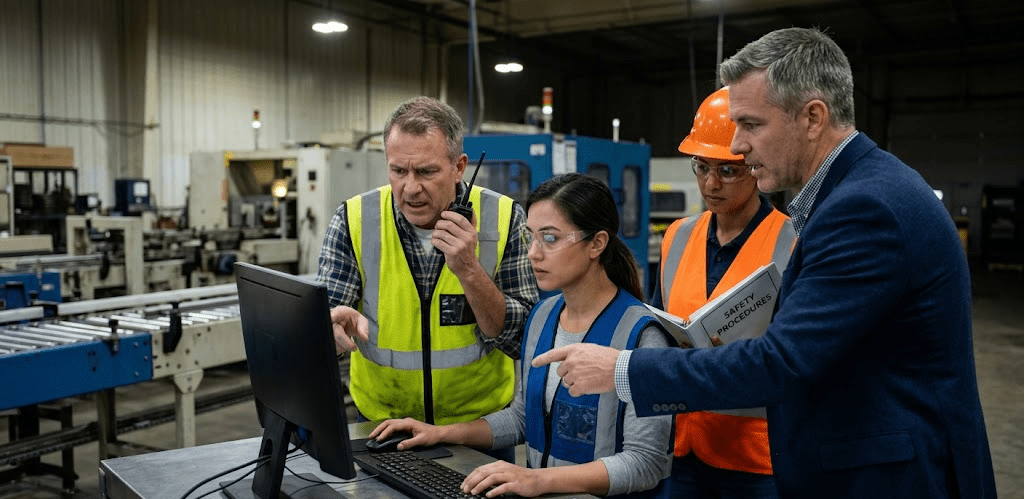
While emergency calls are being made, production decisions cannot wait.
Stop Affected Production Lines
Stop production immediately on any line where control systems are confirmed infected or are connected to confirmed infected systems. This is not a recovery action. It is a safety and quality action.
Ransomware that has corrupted control logic on a production line can produce quality failures that are not immediately visible, equipment damage that manifests later, or safety conditions that develop during continued operation. The cost of stopping a production line for the duration of the technical assessment is consistently lower than the cost of a quality failure that requires product recall, an equipment damage event that extends recovery by additional days or weeks, or a safety incident that creates regulatory and liability consequences independent of the ransomware event.
The decision about which lines to stop requires the plant manager’s knowledge of which control systems are affected and which lines are connected to affected systems. Lines whose control systems are confirmed unaffected and physically isolated from affected systems may continue operation under enhanced manual monitoring.
Activate Manual Production Procedures
Activate documented manual production procedures for affected lines immediately. Manual procedures in manufacturing environments are often outdated, unfamiliar to current production staff, or undocumented in sufficient detail to execute without specific training. The quality of your manual procedures and the familiarity of your staff with them is the primary determinant of how much production continuity is achievable during the recovery period.
If manual procedures are inadequate or undocumented, operate the affected lines on reduced capacity or halt them entirely rather than attempting improvised manual operation that creates quality and safety risk. The production loss from halting a line is a known, bounded cost. The consequences of quality failures from improvised manual operation are neither bounded nor predictable.
Assess Raw Material and Work-in-Process Status
Immediately assess the status of raw materials and work-in-process on affected lines. Time-sensitive materials with limited shelf life that cannot be processed during the downtime period require decision-making about whether they can be held, redirected to unaffected lines, or must be disposed of. Work-in-process that is mid-cycle on affected lines requires assessment of whether it can be held safely in its current state or must be completed, scrapped, or redirected.
These decisions require the plant manager’s knowledge of the specific materials, production processes, and holding tolerances involved. They must be made quickly enough that the window for redirecting or holding time-sensitive materials has not already closed when the decision is finally made.
Document Production Status at Time of Incident
Document the production status of every line at the time of the incident: what was running, at what stage of the production cycle, with what materials and in-process inventory. This documentation is required for the insurance claim, for regulatory reporting in some industries, and for the customer communication that must accurately characterize the production impact of the incident.
Documentation that is created after the fact from memory is less accurate and less credible than contemporaneous documentation created at the time of the incident. Assign a specific person to production status documentation as an immediate action alongside the emergency calls.
The IT and OT Separation Challenge
The defining technical challenge of manufacturing ransomware recovery is managing the boundary between IT systems and OT systems in a way that enables IT recovery without disrupting OT systems that may be operational, and that enables OT assessment without compromising IT forensic evidence.
Confirm OT System Status Before IT Recovery Begins
Before IT recovery actions proceed, the status of OT systems must be confirmed. OT systems that appear unaffected may have been reached by the ransomware through IT-OT network pathways that were not adequately segmented. OT systems that appear affected may be experiencing connectivity issues caused by IT network changes rather than direct OT compromise.
The OT status assessment requires personnel with OT-specific knowledge and, in most cases, physical access to OT systems to examine their status directly rather than through remote monitoring that may itself be affected.
Separate Recovery Tracks for IT and OT
IT recovery and OT recovery should proceed as separate coordinated tracks rather than as a single recovery process. IT recovery follows standard enterprise ransomware recovery procedures: forensic preservation, threat elimination, backup restoration, and validation. OT recovery follows vendor-specific procedures for each affected OT system: vendor engagement, configuration validation, control logic verification, and production validation before restart.
The coordination between tracks is the recovery team’s responsibility: ensuring that IT recovery actions do not create network or authentication changes that affect OT system connectivity, and that OT recovery validation is coordinated with IT recovery completion so that OT systems restart into a confirmed clean network environment.
OT System Validation Before Restart
No production line should restart from a ransomware-affected OT system before that system has been validated as clean and correctly configured by personnel with OT-specific expertise. The validation process includes confirming that control logic matches pre-incident backups or vendor-provided reference configurations, confirming that safety system interlocks are functional, and confirming that the system is operating correctly in test mode before production load is applied.
In regulated manufacturing sectors including pharmaceutical, food and beverage, and defense, OT system restoration may require formal validation documentation and in some cases regulatory notification before production resumes. Confirm with your quality and regulatory team whether restored OT systems require formal re-validation under applicable regulations before production restart.
The Supply Chain Response
Manufacturing ransomware events propagate through the supply chain in both directions. Customers who depend on your output and suppliers whose deliveries depend on your production schedule both require proactive communication and coordination that must begin within the first few hours of confirmed production impact.
Customer Communication
Customers with open orders and delivery commitments require factual, timely communication about the production impact and recovery timeline. The communication hierarchy should prioritize customers with the most time-sensitive commitments, customers with no alternative supply options, and customers where delivery failure activates contractual penalties.
Customer communication during a manufacturing ransomware event requires legal review before it is sent. Some customers may have their own regulatory reporting requirements triggered by supply chain disruptions from key suppliers. Early, accurate communication gives customers the information they need to manage their own obligations and demonstrates the supply chain reliability that sustained relationships require.
Supplier Communication
Suppliers with pending deliveries that depend on your production schedule require notification that their delivery timing may change. Suppliers of time-sensitive materials that require specific receiving and storage conditions may need to redirect deliveries if your receiving operations are affected. Suppliers whose delivery terms include contractual penalties for schedule changes require early notification to minimize those penalties.
Review material contracts for notification provisions and supply chain disruption clauses before communicating with suppliers. Legal counsel should advise on the specific communication and notification obligations that material supply contracts impose.
What Manufacturing Plants Need Before an Incident
The manufacturing plants that minimize ransomware downtime do so because specific preparation investments were made before the incident required them.
OT asset inventory and network documentation mapping every OT system in the facility, its operating system and software version, its network connectivity to IT systems, its vendor support contacts, and its backup and restoration procedures. Recovery teams that encounter an undocumented OT environment reconstruct this information during the incident rather than applying it.
IT and OT network segmentation that prevents ransomware from traversing from IT systems to OT systems through shared network pathways. This is the single highest-impact technical control for limiting OT exposure in a manufacturing ransomware event.
Documented and practiced manual production procedures for every production line, maintained in printed form accessible in production areas, reviewed annually for accuracy, and practiced through downtime drills that confirm production staff can execute them.
OT system configuration backups that enable restoration of PLC logic, HMI configurations, and MES settings without requiring full vendor involvement for every system. Where vendor involvement is unavoidable, vendor support contacts and support agreements must be documented outside the production environment.
A supply chain communication plan with pre-approved messaging templates, contact lists for key customers and suppliers, and decision authority for communication timing and content.
Isolated and tested backups of IT systems, maintained in architecture that ransomware cannot reach, tested through actual restoration against defined recovery time objectives.
An incident response retainer with a firm that has manufacturing-specific and OT-specific incident response experience, so that expert support can be engaged immediately rather than identified and vetted during an active incident.
Manufacturing organizations improving resilience should also review business continuity planning, cloud services, and air-gapped backup strategies.
Mindcore’s cybersecurity services and managed IT services help manufacturing organizations build the integrated IT and OT security infrastructure and incident response capability that minimizes ransomware downtime.
Meet Our CEO, Matt Rosenthal
With more than 30 years of experience in business and technology leadership, Matt Rosenthal has guided manufacturing organizations through ransomware events where the interaction between IT and OT systems, production continuity requirements, and supply chain obligations created recovery challenges that standard enterprise incident response approaches do not address. As President and CEO of Mindcore Technologies, Matt leads a team that provides cybersecurity services and managed IT services for manufacturing organizations navigating the specific security and recovery requirements of production environments.
Matt’s approach to manufacturing ransomware preparedness recognizes that the production downtime cost of an unmanaged ransomware event in manufacturing is among the highest in any industry, and that the preparation investments that reduce that cost are consistently justified by the downtime cost reduction they produce.
Frequently Asked Questions
Should we attempt to continue production on unaffected lines during recovery?
Lines whose control systems are confirmed unaffected and physically isolated from affected systems can continue production if operations leadership determines that continuation is safe and appropriate. The determination requires confirmation from your IT and OT teams that the unaffected lines are genuinely isolated from affected systems, not merely appearing isolated based on initial assessment. Enhanced manual monitoring of continuing lines during the recovery period is appropriate given the uncertainty of the overall system situation during active incident response.
How do we know if our OT systems are affected if they appear to be running normally?
OT systems that appear to be running normally may have been reached by ransomware but not yet encrypted, may have been reached and compromised in ways that do not immediately affect visible operation, or may be genuinely unaffected. The determination requires active assessment by OT-specialist personnel who can examine system logs, compare current configurations against known good baselines, and confirm that control logic has not been modified. Operational appearance alone is not sufficient confirmation of OT system health during an active ransomware event.
What if our OT systems do not have backups of their configurations?
OT systems without configuration backups require vendor involvement to restore, which significantly extends OT recovery timelines. If your facility is in this situation during an active incident, engage OT vendor support immediately and begin the process of reconstructing configurations from whatever documentation exists, including commissioning documents, validation records, and operator manuals. After this incident, implementing OT configuration backup procedures is the highest-priority preparedness investment for your facility.
How do we handle customer contracts that impose penalties for late delivery?
Contractual force majeure provisions in manufacturing supply contracts may provide relief from delivery penalties for events outside the manufacturer’s control. Whether ransomware qualifies as a force majeure event under a specific contract depends on the contract language and applicable law. Legal counsel must review the specific contract terms and advise on whether force majeure notice is appropriate, what the notice requirements are, and what the realistic likelihood of contractual relief is. Force majeure notice should be issued promptly when it is appropriate, as most contracts impose time limits on force majeure claims.
Should we pay the ransom to restore production faster?
The payment decision in manufacturing requires the same analysis as in any other industry: assess backup availability first, identify whether free decryption tools exist for your variant, screen the attacker group against OFAC sanctions, involve legal counsel and the insurance carrier, and understand that payment does not eliminate the mandatory forensic remediation that must occur before production systems are confirmed safe to operate. For manufacturing-specific OT systems, decryption from a provided key does not validate that control logic is correct and safe. OT systems must be validated by qualified personnel regardless of how their files were restored. Payment does not shorten the OT validation timeline that is the primary determinant of production restart timing for affected OT systems.
Get Help Now
If ransomware is active in your manufacturing facility right now, contact Mindcore immediately. Production downtime accumulates by the hour, and every hour of delay in expert engagement extends the timeline.
Mindcore’s cybersecurity services and managed IT services support manufacturing organizations through emergency ransomware response and the ongoing security infrastructure that reduces ransomware risk and production downtime impact. If your facility has not established the OT security documentation, manual production procedures, and incident response relationships that manufacturing ransomware requires, contact Mindcore to build that capability before production stops.
Source content adapted from uploaded file. :contentReference[oaicite:0]{index=0}

