

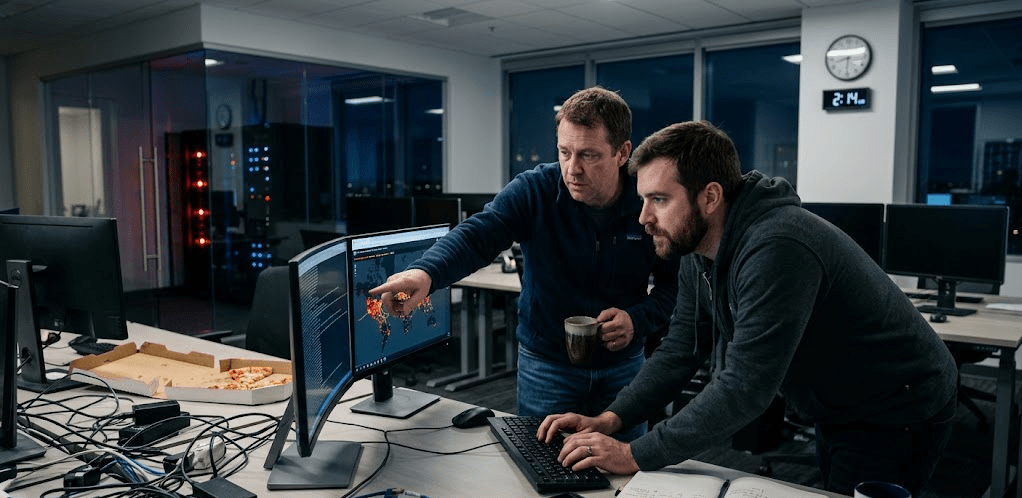
When ransomware is confirmed in your environment, two response tracks activate simultaneously. The remote track begins immediately: containment guidance, forensic preservation instructions, and initial investigation work can all start within minutes of first contact with an incident response firm. The on-site track follows a different timeline determined by geography, mobilization logistics, and the specific work that requires physical presence in your environment.
Understanding both tracks, what each covers, how fast each can realistically activate, and what determines the gap between them, is essential for building a ransomware response plan that accounts for actual deployment timelines rather than best-case assumptions.
The organizations that manage ransomware events most effectively have designed their response around realistic timelines. They know which response work can begin remotely in the first hour and which work requires on-site presence. They have established the relationships and infrastructure that shorten both timelines. And they have built the internal capability to execute containment actions in the window before external help arrives, because that window exists regardless of how prepared the external resources are.
What Remote Response Covers and Why It Starts Immediately
The majority of critical ransomware response work can begin remotely without on-site presence. Understanding what remote response covers clarifies why the on-site timeline, while important, is not the primary determinant of recovery outcomes for most incidents.
Containment Guidance
Remote containment guidance can begin within minutes of first contact with an incident response firm. The guidance covers which systems to isolate and how, how to disable remote access infrastructure, how to segment affected network areas using existing network management tools, and what not to do during the containment phase.
The execution of this guidance requires your internal team to take physical and administrative actions in your environment. Remote responders cannot pull network cables or disable switch ports on your behalf. What they can do is tell your team exactly what to do and in what sequence, which systems to prioritize, and what actions would make the situation worse.
The quality of remote containment guidance depends on the incident response firm’s familiarity with your environment. Firms that have a prior relationship with your organization and have documented your environment can provide more specific and faster guidance than firms engaging with an unknown environment for the first time.
Forensic Evidence Preservation Instructions
Remote responders can immediately guide your team through forensic evidence preservation actions that do not require specialized tools. Photographing ransom notes, documenting affected systems, capturing screenshots of encrypted directories, and preserving log files that may be overwritten can all begin under remote guidance within the first 30 minutes.
More specialized forensic work including memory capture from affected systems requires either remote tool deployment through existing management infrastructure or on-site physical access. Remote deployment of memory capture tools is possible when the incident response firm can reach systems through management interfaces that are not themselves compromised, which is not always the case.
Initial Investigation and Variant Identification
Remote investigation begins immediately using whatever telemetry is available from your environment. Endpoint detection and response tool logs, security information and event management data, firewall logs, and Active Directory event logs can all be accessed remotely if the management infrastructure for those tools remains accessible.
Ransomware variant identification through submission of encrypted file samples and ransom note content to identification tools can happen remotely in minutes. Knowing the variant early informs whether free decryption tools exist, what the attacker group’s typical techniques are, and whether OFAC sanctions exposure exists for the payment decision.
Legal and Regulatory Coordination
Legal coordination, regulatory notification assessment, insurance communication, and payment decision analysis all happen remotely throughout the incident. These functions do not require on-site presence and must begin within the first hours of the incident to meet applicable notification timelines.
What Requires On-Site Presence
On-site presence is required for specific response work that cannot be completed through remote access. Understanding which work falls into this category clarifies the operational urgency of on-site deployment.
Physical System Access for Evidence Preservation
Memory capture from systems that cannot be reached through remote management infrastructure requires physical access. Removable media evidence collection, examination of systems that are not connected to management networks, and physical documentation of system states all require someone to be physically present with the equipment.
For small environments where all systems are in a single location, on-site presence enables comprehensive evidence preservation that remote-only response cannot achieve. For large environments with distributed locations, on-site presence at the primary location combined with remote guidance to personnel at remote locations is the practical approach.
Network Infrastructure Physical Access
Containment actions that require physical access to network infrastructure, including switch port disabling when remote management access is unavailable, access point power cycling, and physical cable management in complex environments, require on-site presence.
Remote management of network infrastructure is possible when network management tools are accessible and not compromised. When the ransomware event has affected the management infrastructure itself, or when management credentials are among the compromised credentials, physical access to network equipment may be the only available containment mechanism.
Complex Environment Assessment
Large environments with complex dependencies, multiple server roles, and interconnected systems benefit significantly from on-site assessment that allows the responder to directly examine system states, review physical infrastructure, and conduct interviews with personnel who are most familiar with specific systems and their dependencies.
Remote assessment works well for environments that are well-documented and where log access is comprehensive. Environments with documentation gaps or limited remote telemetry require on-site presence to reconstruct the environmental picture that recovery planning depends on.
On-Site Personnel Coordination
Coordinating the response activities of multiple internal team members who are executing containment, evidence preservation, and business continuity actions simultaneously is significantly more effective when a responder is physically present to direct the work in real time. Remote coordination through phone or video conference introduces communication delays and misunderstandings that slow the response when speed is critical.
What Determines On-Site Response Time
The time between first contact with an incident response firm and an on-site responder arriving at your location is determined by several factors that vary based on your preparation level, your geography, and the time of day the incident occurs.
Prior Relationship and Retainer Status
Organizations that have established incident response retainer agreements with a firm before an incident activate on-site deployment faster than organizations engaging a firm for the first time during an active event.
Retainer agreements pre-establish the engagement terms, the scope of services, and the fee structure, eliminating the contract negotiation that delays cold engagements. They also establish the organizational familiarity that allows the firm to begin remote response immediately rather than spending the first hours gathering basic environmental information.
For retainer clients, on-site mobilization can begin within one to two hours of first contact. The logistics of travel still apply, but the decision and contracting delays are eliminated.
For cold engagements, the time required to establish the engagement, negotiate terms, and gather sufficient environmental information to begin meaningful work adds two to four hours before meaningful remote response can begin and additional time before on-site mobilization is authorized.
Geographic Distance
Physical travel time from the incident response firm’s nearest personnel to your location is the largest single variable in on-site response time. Firms with geographically distributed personnel have shorter travel times to more locations. Firms concentrated in major metropolitan areas have longer travel times to rural locations.
For organizations in major metropolitan areas served by large incident response firms, on-site arrival within two to four hours of first contact is achievable for retainer clients. For organizations in rural or remote locations, on-site arrival of four to twelve hours or longer is realistic even for retainer clients, because travel time is a physical constraint that preparation cannot fully eliminate.
This geographic variable is one of the primary arguments for maintaining strong internal response capability. Organizations in locations where on-site response requires significant travel time must be more self-sufficient during the window before on-site help arrives, because that window is longer than for organizations in major metropolitan areas.
Time of Day and Day of Week
Ransomware encryption events are deliberately timed by sophisticated attackers to begin outside business hours, specifically because detection and response capability is lower after hours and on weekends. On-site response during these periods takes longer to mobilize than during business hours.
Incident response firms with 24/7 on-call personnel can initiate mobilization at any hour, but travel logistics at 2am differ from travel logistics at 2pm. The availability of direct flights, the time required to reach airports, and the practical limitations of overnight travel all affect the actual time from mobilization authorization to on-site arrival.
Organizations that have established managed security service relationships with 24/7 monitoring capability have remote response activating immediately regardless of time of day, which reduces the operational significance of the on-site arrival delay by providing active remote response in the gap.
Incident Complexity and Personnel Requirements
Complex incidents affecting large environments, multiple locations, or specialized systems including operational technology may require multiple on-site responders or responders with specific expertise. Assembling a team with the right composition takes longer than deploying a single generalist responder.
For incidents where OT systems are affected, for example, an incident response team that includes OT-specific expertise must be assembled, which may require coordinating personnel from different locations rather than deploying the nearest available responder.
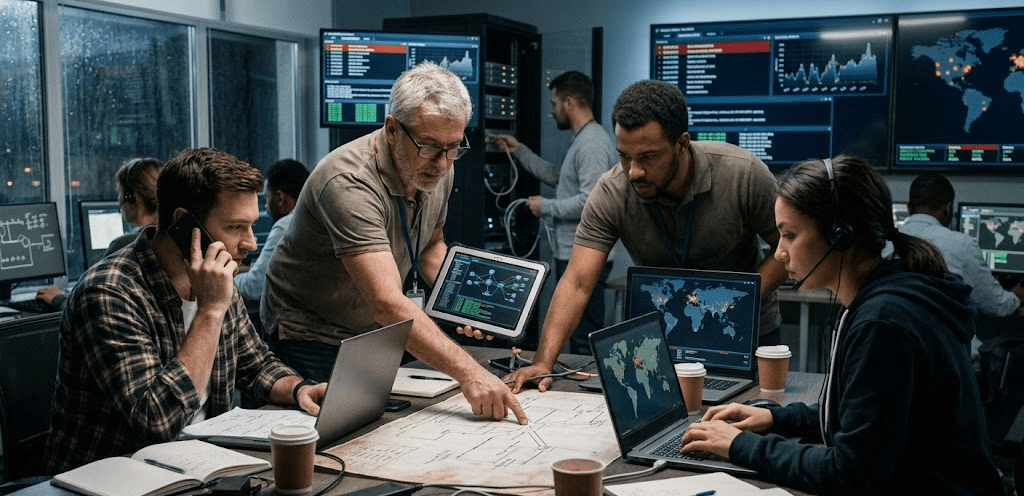
What Your Team Should Do Before On-Site Help Arrives
The window between detecting the incident and on-site responders arriving is operationally critical. The actions your internal team takes during this window determine how much additional damage occurs and how much of the evidence that on-site responders will need is preserved.
Execute Immediate Containment Actions
Your internal team can and must execute containment actions immediately without waiting for on-site help. These actions require no specialized expertise and produce immediate benefit.
Disconnect infected systems from the network by pulling network cables or disabling wireless connections. Do not shut down infected systems. Keep them powered on and network-isolated.
Disable VPN and remote access infrastructure through your administrative consoles. If those consoles are not accessible due to the incident, disable external access at the firewall level or through your internet service provider’s management interface.
Disable switch ports serving confirmed-infected network segments if your team has access to network management tools and knows how to use them. If not, do not attempt this action and report to the remote responders which switches are involved so they can provide specific guidance.
Gather Environmental Documentation
While waiting for on-site help, collect whatever environmental documentation is immediately accessible. Network diagrams, system inventories, backup locations and credentials, vendor contact information, and administrative credentials for network infrastructure all support the work that on-site responders will need to begin immediately upon arrival.
If this documentation is in systems that are affected by the incident, do not attempt to access those systems for documentation purposes. Report to remote responders what documentation exists and what systems it is stored in so they can advise on how to safely access it.
Preserve Physical Evidence
Photograph ransom notes on screens before anything is done with the affected systems. Screenshot affected file directories. Document which systems are affected, when each was identified, and what symptoms each is showing. Write down the exact text of any ransom note. This physical documentation preserves information that may be lost if screens go dark or if systems are inadvertently modified before on-site responders arrive.
Maintain Out-of-Band Communication
Establish a communication channel that does not depend on potentially affected organizational infrastructure and use it for all response coordination. Personal mobile phones and personal email accounts provide communication capability that does not depend on the incident’s scope.
Brief your internal team through this out-of-band channel on what to do, what not to do, and who is authorized to make decisions during the response. Unauthorized remediation attempts by well-intentioned employees who are not coordinating with the response team are a consistent source of evidence destruction and containment complications.
Building On-Site Response Speed Into Your Preparedness Program
The organizations that achieve the fastest on-site response times do so through preparation investments that shorten the time from detection to on-site arrival. Those investments are made before an incident requires them.
Establish an incident response retainer before an incident. A retainer agreement with an established firm eliminates the contracting delay that extends cold engagement timelines and commits the firm to defined response time targets for retainer clients. The retainer cost is a fraction of what incident response costs during an active engagement and is often partially or fully covered by cyber insurance as a covered preparedness expense.
Select a retainer firm with personnel near your location. Geographic proximity is the primary determinant of on-site arrival time and cannot be overcome by preparation alone. When selecting an incident response firm for a retainer relationship, evaluate the proximity of their nearest on-site capable personnel to your primary location and understand the realistic travel time under different departure conditions.
Build internal containment capability that does not depend on external help. The actions your internal team can execute before on-site help arrives determine how much additional damage occurs during the mobilization window. Training your team on the specific containment actions for your environment, documenting those actions in an accessible format, and practicing them through tabletop exercises reduces the damage that accumulates in the window before on-site help arrives.
Maintain network and system documentation outside your production environment. On-site responders who arrive at an undocumented environment spend their first hours reconstructing environmental information that documented environments provide immediately. Network diagrams, system inventories, backup locations, and administrative credential stores maintained outside the production environment accelerate on-site response from the moment responders arrive.
Engage a managed IT provider with 24/7 security monitoring. Continuous security monitoring means remote response activates at the moment of detection regardless of time of day. Remote response in progress when on-site responders arrive produces significantly better outcomes than an environment in which no response has begun during the mobilization window.
Mindcore’s managed IT services and cybersecurity services provide organizations with the 24/7 monitoring capability, incident response relationships, and environmental documentation that reduce the effective impact of on-site response timelines by ensuring that meaningful remote response is active from the first minutes of an incident.
What to Expect When On-Site Responders Arrive
Understanding what on-site responders will do when they arrive allows your team to prepare for their arrival in ways that accelerate their work.
On-site responders will begin by reviewing whatever containment actions your team has taken, assessing whether those actions were appropriate and complete, and identifying any remaining containment work that was not completed before their arrival.
They will then conduct a physical walkthrough of affected systems, gathering information that was not available through remote access, examining system states, reviewing physical infrastructure, and conducting interviews with personnel most familiar with the affected systems.
The on-site forensic work that follows includes memory captures from systems where remote capture was not possible, physical evidence collection, and assessment of systems that were not accessible through remote management infrastructure.
Your team’s most useful contribution when on-site responders arrive is accurate information about what happened, what your team did in response, and what documentation is available. Preparing a written timeline of events from detection through the responders’ arrival, along with the environmental documentation gathered during the remote response phase, is the most effective preparation for the on-site team’s arrival.
Meet Our CEO, Matt Rosenthal
With more than 30 years of experience in business and technology leadership, Matt Rosenthal has guided organizations across healthcare, finance, legal, manufacturing, and defense through ransomware events where response speed, both remote and on-site, determined recovery outcomes. As President and CEO of Mindcore Technologies, Matt leads a team that provides managed IT services, cybersecurity services, and incident response support designed around the realistic timelines that ransomware response requires.
Matt’s approach to on-site response planning is grounded in the recognition that the window before on-site help arrives is as consequential as the on-site response itself. Organizations that have built internal containment capability, maintained environmental documentation, and established remote monitoring do not lose that window to inaction while waiting for physical presence.
Frequently Asked Questions
Is remote response sufficient for most small business ransomware incidents?
For small business incidents with limited environmental complexity and where the business has maintained accessible backup infrastructure, remote response is often sufficient to guide the containment and recovery work. The specific work that requires on-site presence, memory capture from systems not reachable through remote management and physical network infrastructure access, may be less critical in simple environments where adequate backups reduce the operational dependency on forensic completeness. However, the regulatory and legal dimensions of the response require expert coordination regardless of whether on-site responders are present.
How do we ensure on-site responders can access our facility outside business hours?
Facility access for on-site responders arriving outside business hours requires pre-established access arrangements or someone with facility access authority who can provide access when responders arrive. Include facility access contact information and the process for after-hours access in your incident response plan. If your facility has security personnel who control after-hours access, those personnel need to know that during a cybersecurity incident, authorized responders may arrive at any hour and need to be granted access.
Should we wait for on-site responders before beginning any remediation?
Yes, with the exception of immediate containment actions. Containment actions including network isolation, remote access disabling, and switch port disconnection should be executed immediately by your internal team under remote guidance. Remediation actions including system wiping, backup restoration, and decryption tool execution should wait for on-site responders or for remote responders to confirm that threat elimination is complete and that restoration can safely proceed.
What if we need help faster than any firm can provide on-site?
If you need physical expertise faster than a specialized incident response firm can provide, your managed IT provider, if you have one, can provide on-site presence faster than a remotely engaged incident response firm in many cases. The managed provider’s familiarity with your environment and their existing access arrangements make them the fastest source of qualified physical presence in many incidents, with the incident response firm providing specialized ransomware expertise remotely while the managed provider executes guidance on-site. This combined approach is often more effective than waiting for incident response firm personnel to travel to your location.
Does cyber insurance cover the cost of on-site incident response?
Most cyber insurance policies that cover incident response costs cover on-site response costs for approved vendors. Coverage typically includes travel costs, on-site labor at approved rates, and equipment costs associated with on-site forensic work. Confirm the specific coverage terms for on-site response with your carrier during the first call, including whether any cost limits apply specifically to on-site work, what the approval process is for on-site mobilization, and whether travel costs are covered in addition to labor costs.
Build the Response Infrastructure That Makes Every Minute Count
The time between ransomware detection and expert engagement, whether remote or on-site, is the window during which the incident expands. Organizations that minimize that window through preparation, established relationships, and internal containment capability experience better recovery outcomes than those discovering their response options during an active incident.
On-site response speed is one component of that preparation. The internal containment capability that limits damage before external help arrives, the managed service relationships that activate remote response immediately, and the retainer agreements that eliminate mobilization delays are the preparation investments that make on-site response time a smaller factor in the overall outcome.
Mindcore’s managed IT services and cybersecurity services help organizations across healthcare, finance, legal, manufacturing, and defense build the response infrastructure that minimizes the window between detection and effective response, regardless of whether that response is remote, on-site, or both. If your organization has not assessed its current response capability against the realistic timelines that ransomware incidents require, contact Mindcore to close that gap before an incident determines how long that window actually is.

