

Cybercriminals do not need to be sophisticated. They just need one person to click.
That is the reality Matt Rosenthal, CEO of Mindcore Technologies, sees every single day. His company responds to cybersecurity breaches across industries, and the pattern is almost always the same. Someone clicked a link in an email. Someone entered their credentials on a fake login page. Someone handed over the keys without knowing it.
This is not a technology problem. It is a human behavior problem. And until organizations treat it that way, the breaches will keep happening.
The Most Common Entry Point in Cybersecurity
Phishing is the number one attack vector in cybersecurity today. Not zero-day exploits. Not advanced persistent threats. A deceptive email.
According to Rosenthal, nearly every breach Mindcore encounters traces back to a single moment: a user interacting with a malicious email.
“Almost every single breach that we deal with, and we deal with them every single day, somebody either clicked on an email that had a link in it, or they actually clicked on it, opened it and entered some information. As soon as you do that, you’re giving people a key to the front door.”
That quote is not a metaphor. It is a technical reality. Once credentials are entered on a phishing page, attackers have authenticated access. Firewalls, endpoint protection, and security software become irrelevant at that point.
Organizations looking to strengthen defenses should evaluate layered cybersecurity services alongside user awareness training and identity protection strategies.
Why Phishing Works So Well
Phishing is effective because it targets the weakest point in any security architecture: human judgment under pressure.
Attackers craft emails that look legitimate. They impersonate banks, HR departments, software platforms, and even internal leadership. The goal is to create enough urgency or familiarity that the recipient acts before thinking.
Here is what makes a phishing email convincing:
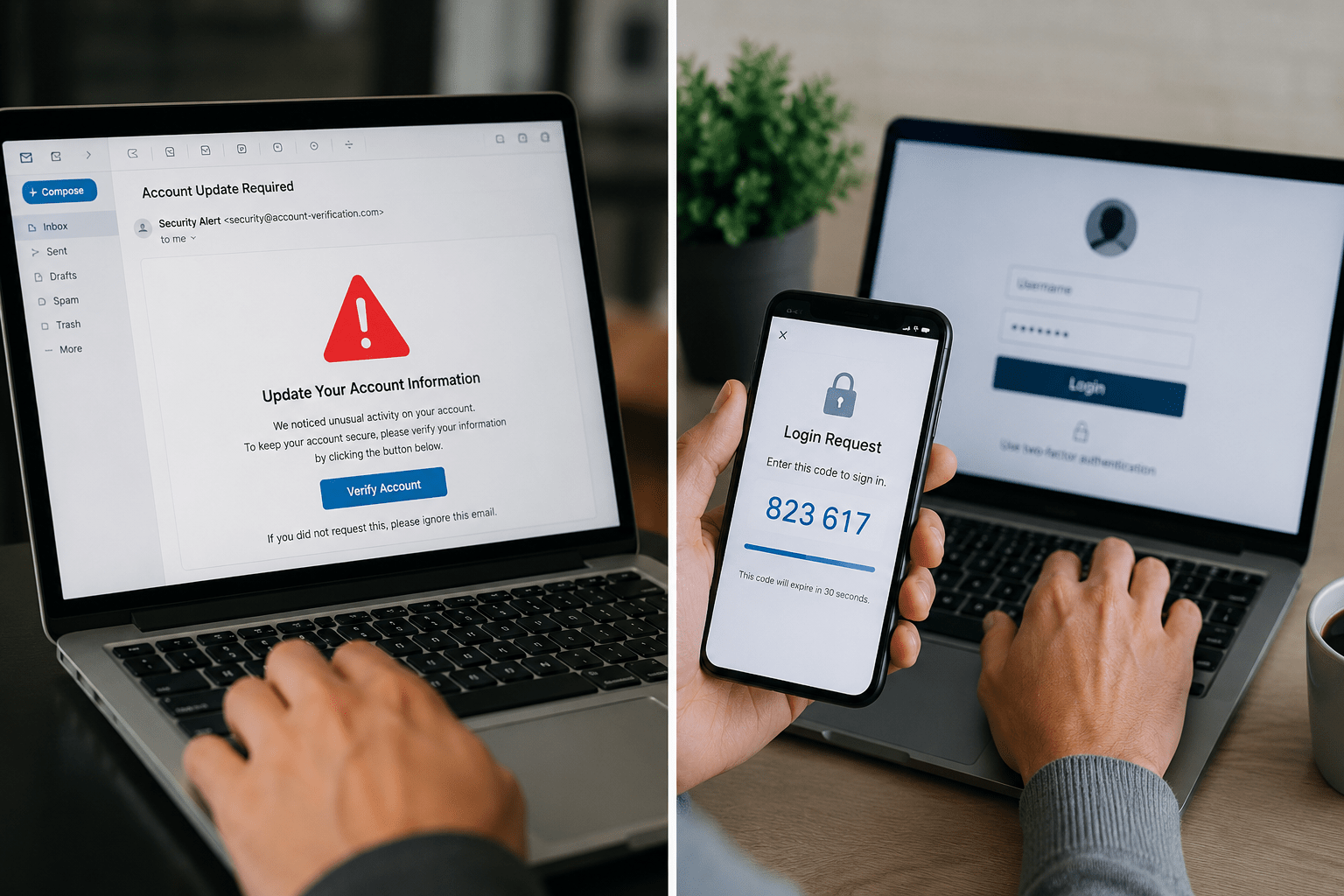
- Sender spoofing: The “from” name looks like a trusted contact, even if the actual email address is not
- Urgency language: “Your account will be suspended,” “Action required,” “Verify now” create pressure to respond quickly
- Branded visuals: Logos, formatting, and color schemes mimic real companies with precision
- Legitimate-looking links: URLs are designed to look close enough to real domains that users do not notice the difference
- Contextual relevance: Attackers research targets and send emails that fit the recipient’s role or current activity
Businesses that invest in security awareness training and multi-factor authentication are significantly better positioned to reduce phishing-related risk.
The Canvas Attack: A Platform-Level Example
The recent cyberattack on Canvas, the widely used learning management platform, illustrates exactly how far a single breach point can reach.
The ransomware group ShinyHunters claimed responsibility, allegedly threatening to release personal data unless ransoms were paid. The attack disrupted colleges and universities nationwide, including Baylor University, forcing rescheduled final exams and raising widespread concerns about data exposure.
Cybersecurity expert James Turgal put the scale in context:
“When you hit a platform, it’s not like hitting an individual application. You’re literally hitting the platform that affects probably some 9,000 schools and up to 275 million students, teachers and staff.”
This is what happens when a single entry point, whether a phishing email, a compromised credential, or an exploited vulnerability, connects to a platform used by millions.
Organizations managing distributed users and sensitive systems are increasingly exploring secure workspace solutions and Zero Trust security models to reduce exposure.
What Organizations Are Getting Wrong
Most organizations invest in perimeter security. Firewalls, antivirus software, network monitoring. These are necessary, but they do not stop a user from willingly entering their password into a fake login page.
The gap is in human layer security.
Specifically:
- Infrequent or ineffective security awareness training: Annual training does not change daily behavior
- No simulated phishing programs: Employees who have never experienced a test phishing email are unprepared for a real one
- Weak password practices: Reused passwords mean one compromised account becomes many
- MFA not enforced: Without multi-factor authentication, a stolen password is all an attacker needs
Rosenthal is direct about MFA:
“You’ve got to turn that on for every single account that you have. It should be your email, the banks, the credit cards. If you don’t have that turned on, you’re literally asking for a problem.”
Companies reviewing security gaps should also assess IT risk assessments, vulnerability assessments, and ongoing network security monitoring.
What a Strong Defense Actually Looks Like
Stopping phishing attacks requires layering technical controls with human behavior change. Neither alone is sufficient.
Technical Controls
- Email filtering that flags suspicious senders, domains, and link patterns
- Multi-factor authentication enforced across all accounts and systems
- DNS filtering to block known malicious domains before the page even loads
- Endpoint detection and response to catch activity that follows a successful phish
Human Layer Controls
- Regular, role-specific security awareness training
- Simulated phishing campaigns with immediate feedback
- Clear internal reporting channels so employees can flag suspicious emails without fear
- Leadership culture that treats security as a shared responsibility, not just an IT issue
Organizations that combine technical controls with strategic leadership often benefit from working with experienced CISO consulting and managed security services providers.
Actionable Steps to Reduce Phishing Risk
Whether you are an individual user or an IT decision-maker, these steps reduce your exposure significantly:
- Enable MFA on every account – Email, banking, software platforms, cloud services. No exceptions.
- Use unique passwords for every account – A password manager makes this practical. Reused passwords multiply risk.
- Pause before clicking links in emails – Hover over links to preview the actual URL. Go directly to the website instead of clicking through.
- Verify unexpected requests through a separate channel – If an email asks you to take urgent action, call or message the sender directly to confirm.
- Report suspicious emails immediately – Do not delete them quietly. Your IT or security team needs visibility.
- Keep software and systems updated – Phishing often leads to malware that exploits unpatched vulnerabilities.
For organizations concerned about phishing resilience, employee security awareness training and proactive penetration testing can uncover weaknesses before attackers do.
FAQ: Phishing and Cybersecurity Basics
What is phishing and how does it work?
Phishing is a cyberattack method where criminals send deceptive emails, messages, or websites designed to trick users into revealing passwords, financial information, or other sensitive data. Once a user clicks a malicious link or enters credentials, attackers gain access to accounts or systems.
How do most cyberattacks start?
The majority of cyberattacks begin with a phishing email. A user clicks a link or enters information on a fake page, giving attackers authenticated access to systems. From that point, attackers can move laterally across a network, install malware, or exfiltrate data.
Does multi-factor authentication stop phishing?
MFA significantly reduces the risk of a successful phishing attack. Even if an attacker obtains a password through phishing, they cannot access the account without the second authentication factor. It is one of the most effective and accessible security controls available.
What should I do if I clicked a phishing link?
Change your passwords immediately, starting with your email and any financial accounts. Enable MFA if it is not already active. Notify your IT or security team right away. Monitor your accounts for unusual activity and consider placing a freeze on your credit if personal data may have been exposed.
The Bottom Line
Phishing is not going away. The tools attackers use are becoming more convincing, and AI is making it easier to craft personalized, believable emails at scale. The only reliable response is a combination of technical controls and a workforce that knows how to recognize and respond to an attack.
Mindcore Technologies works with organizations across industries to build security programs that address both layers. If your team is not running regular phishing simulations, does not have MFA enforced across all systems, or lacks a clear incident response process, your risk is higher than it needs to be.
Schedule a consultation with Mindcore to assess your current security posture and close the gaps before an attacker finds them.

