

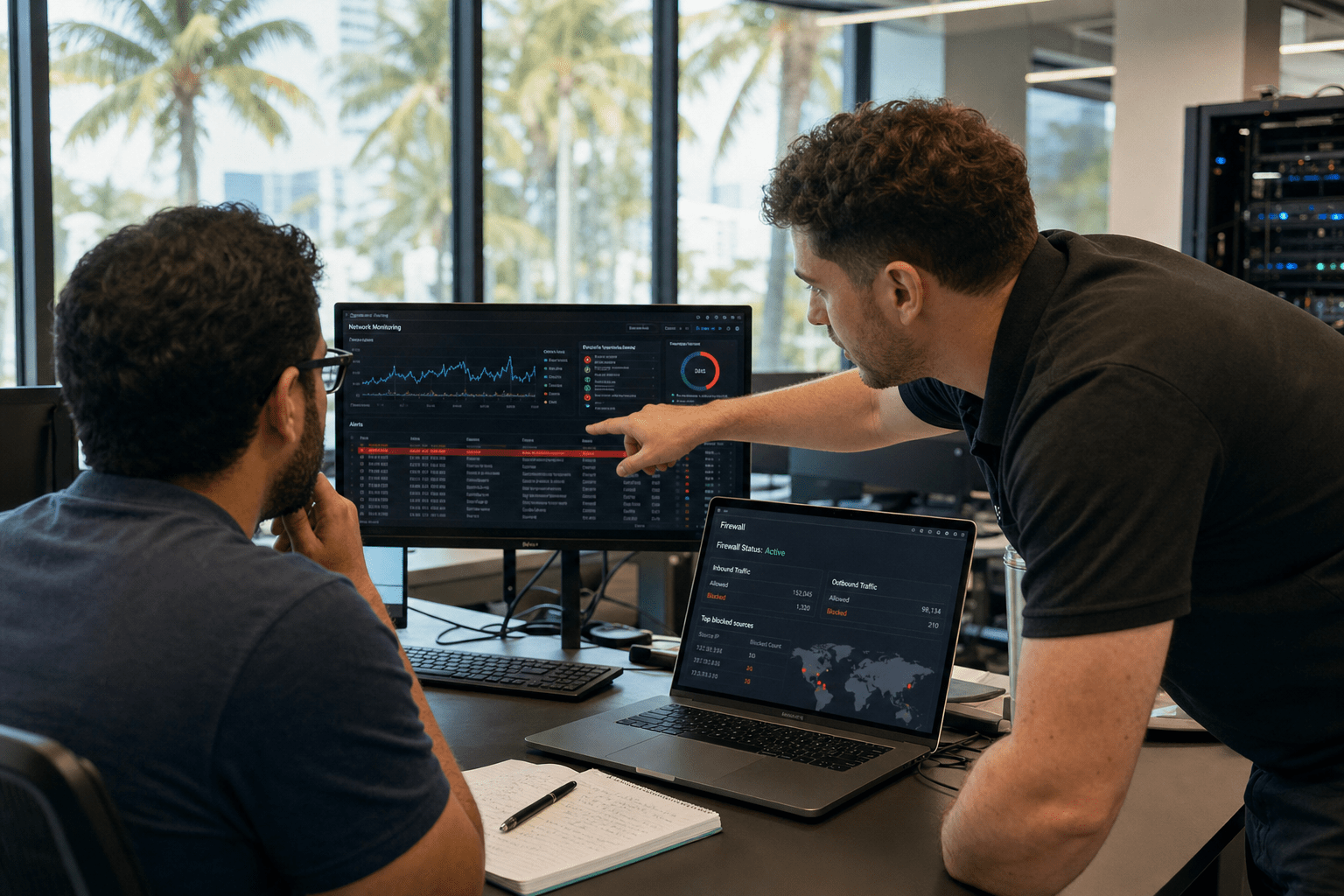
Miami cybersecurity services protect your business by combining round-the-clock monitoring, tested defenses, and compliance support into one program that catches attacks early instead of cleaning up after them. For a small or midsize company in South Florida, that means fewer surprises, faster response when something looks wrong, and a clear plan for the regulations you already answer to. The goal is simple: keep the business running and keep client data where it belongs. This guide walks through what strong Miami Cybersecurity Services look like locally, what to ask a provider, and how a Miami-focused program differs from a generic checklist.
Five things to know about Miami cybersecurity services
- Miami’s economy leans on finance, trade, logistics, and real estate, so attackers often chase wire transfers and client records specific to those sectors.
- Round-the-clock monitoring matters more here because business hours stretch across partners and clients in different time zones.
- Compliance rarely stops at one framework. Many local firms answer to HIPAA, PCI, or client security questionnaires at the same time.
- Most breaches at this size start with a stolen password or a convincing email, not a movie-style hack.
- The right partner acts as your guide, handling the day-to-day defense so your team can focus on the work that grows the company.
Why Miami businesses face a specific kind of risk
South Florida companies sit at a crossroads of money and data, which makes them a steady target for attackers who follow the cash.
Miami is a gateway for cross-border finance, international trade, and real estate deals. That mix draws attackers who focus on wire fraud, business email compromise, and the theft of client financial records. A law firm handling closings, an accounting practice at tax time, or a logistics company moving freight all hold the kind of information criminals can turn into money quickly. The threat is not abstract, and it does not wait for a convenient moment.
Size makes the problem sharper. Many local firms run lean IT teams, or none at all, so a single missed alert can sit unanswered for days. Attackers know this. They test smaller companies because the odds of slipping past thin defenses are higher. Good Miami Cybersecurity Services close that gap by putting real monitoring and response behind your business, not just software you have to manage yourself.
The threats that hit local firms most
Three patterns show up again and again for Miami SMBs.
The first is phishing and business email compromise, where an attacker poses as a vendor or executive to redirect a payment. The second is ransomware, which locks files and halts operations until you pay or restore from backup. The third is credential theft, where a reused or weak password opens a door that should have stayed shut. None of these require deep technical skill from the attacker. They require your defenses to be watching.
Why a local focus changes the plan
A national template treats every business the same. A Miami-focused program weighs the sectors and deadlines that actually apply here. That might mean tighter controls around payment approvals for a real estate firm, or extra attention on client portals for a wealth manager. The point is to spend effort where your real exposure lives, not on a generic list that ignores how you make money. A local provider also knows the seasonal rhythms that shift your risk, from the tax-season rush at accounting firms to the peak deal flow that keeps real estate offices busy, and it plans coverage around those windows instead of treating every month the same.
What a strong Miami cybersecurity program includes
A complete program pairs constant watching with tested defenses and a clear response plan, so nothing depends on a single tool or a single person.
Protection works in layers. Any one control can fail, so the program stacks several so a gap in one is covered by another. Below are the parts that carry the most weight for a small or midsize Miami company.
Round-the-clock monitoring and response
Threats do not keep office hours, and neither should your defense. Continuous monitoring watches your network, servers, and endpoints for signs of trouble and flags them the moment they appear. When an alert is real, a response team steps in to contain it before it spreads. This is the heart of managed security services: a team that owns detection and response so your people are not stuck guessing at 2 a.m.
Testing your defenses before attackers do
Penetration testing and vulnerability assessments probe your systems the way a real attacker would, then hand you a ranked list of what to fix first. This turns security from a hopeful assumption into something you can measure. Pairing regular testing with managed firewall services keeps the front door locked while you close the smaller gaps behind it.
Compliance support that reduces real work
Many Miami firms answer to more than one set of rules at once. A healthcare vendor deals with HIPAA, a retailer with PCI, and almost everyone with client security questionnaires. A capable partner maps your controls to those requirements, documents the evidence, and keeps it current, so audits and client reviews stop eating entire weeks. Compliance done this way is a byproduct of a real security program, not a separate scramble.
How to choose the right cybersecurity partner in Miami
The best provider acts as a steady guide, taking on the technical load while keeping you in the driver’s seat on decisions.
Start with response time. Ask how fast the team acts when an alert fires, and who is on the other end at night and on weekends. A provider that only works business hours leaves you exposed during the quiet windows attackers prefer. Next, ask how they prioritize. A good partner explains what to fix first and why, in plain language, instead of handing you a wall of jargon.
Look at how they handle your existing tools and managed IT services. Security that fights the rest of your technology creates friction and gets bypassed. It should fit the way your team already works. Finally, ask for references from companies your size and in sectors like yours. A firm that already protects South Florida businesses will understand your risks without a long ramp-up.
Questions worth asking on the first call
Bring a short list to any provider conversation. How do you detect a threat, and how fast do you respond? What frameworks do you support, and how do you keep the evidence current? Who owns the relationship day to day? What happens in the first hour of a suspected breach? Clear answers signal a partner who has done this before. Vague ones are a warning.
Frequently Asked Questions
How much do Miami cybersecurity services cost?
Cost depends on your size, the sensitivity of your data, and the frameworks you answer to. Smaller firms with straightforward needs pay less than a regulated company handling client financial records. The better question is value: a program that prevents one wire-fraud loss or ransomware shutdown usually pays for itself many times over. Ask any provider to tie their pricing to the specific risks they are covering.
Do small businesses in Miami really need this?
Yes, and often more than large ones. Attackers target smaller firms precisely because their defenses tend to be thinner. A lean IT team, or no team at all, means alerts can go unanswered for days. Managed protection gives a small company the same round-the-clock coverage a large enterprise has, without hiring a full security staff.
What is the difference between managed IT and cybersecurity?
Managed IT keeps your technology running, handling setup, updates, and support. Cybersecurity focuses on protecting that technology and your data from attack. The two work best together: a partner who manages both can build security into your systems from the start rather than bolting it on later. Many Miami firms choose one provider for both so the pieces fit.
How fast can a provider respond to an attack?
With continuous monitoring in place, a strong team detects and begins containing a threat within minutes, not hours. The speed comes from watching your systems around the clock and having a rehearsed response plan ready. Ask any provider for their typical detection and response times, and confirm someone is on call outside business hours.
Can you help with compliance audits?
Yes. A good partner maps your security controls to the frameworks you answer to, documents the evidence, and keeps it current so audits and client security reviews go smoothly. This turns compliance into a steady part of your program instead of a last-minute scramble every time a questionnaire arrives.
Get a free strategy call with Mindcore
Miami businesses deserve a security program built around their real risks, not a generic checklist. Mindcore acts as your guide, taking on monitoring, testing, and compliance so your team can focus on growth. If you want a clear view of where you stand and a plan to close the gaps, book a free strategy call and we will map it out with you. You can also see our Miami Cybersecurity Services to learn how we support South Florida companies.

