


New Orleans businesses rely on managed IT services to navigate a complex economy spanning tourism, healthcare, logistics, creative industries, insurance, manufacturing, and SMBs. But with that diversity comes complex IT needs: data security, compliance, uptime, cloud adoption, legacy systems, and disaster recovery. For a small business on the Gulf Coast, the value of managed IT isn’t the feature list every provider prints on their site. It’s whether that provider can put a technician on your problem fast when a storm knocks out half the parish, and whether your data comes back the same day. That single test, local response time plus proven recovery, is what separates a real partner from a vendor with a nice brochure.
Mindcore Technologies delivers managed IT services New Orleans businesses can rely on to secure operations, minimize downtime, and support scalable growth. Our office at 1100 Poydras Street, Suite 2900, serves businesses across Metairie, Kenner, Gretna, Slidell, Covington, and the broader Greater New Orleans metro.
The Five Things New Orleans Small Businesses Should Weigh First
- Local response time is the real product. A four-hour on-site window means little during hurricane season when roads flood. Ask for average response times measured over the last storm season, not a marketing number.
- Disaster recovery has to be documented, not promised. You want a written recovery plan with tested restore times, offsite backups, and a failover you have actually seen run.
- The local talent pool is thin. Skilled IT staff are hard to hire and harder to keep in a mid-sized market, so a managed provider often gives you deeper coverage than a single in-house hire could.
- Security is not optional for small firms. Attackers target small businesses because they assume the defenses are weak. Your provider should treat security as a baseline, not an upsell.
- Flat, predictable pricing protects cash flow. Break-fix billing punishes you exactly when things go wrong. A monthly model aligns your provider with keeping you running.
What “Managed IT Services” Entails
Choosing managed IT means gaining a comprehensive technology partner that manages, supports, and evolves your IT infrastructure seamlessly. Key elements include:
- 24/7 system, network, and security monitoring
- Help desk and end-user support
- Regular patching, updates, and maintenance
- Network infrastructure design and management
- Cloud and hybrid environment support
- Backup, disaster recovery, and business continuity
- Cybersecurity protections and compliance alignment
- IT strategy, planning, and consulting
- Co-managed or augmentation support if you have internal IT teams
Managed IT services act as a virtual IT department, providing local businesses with operational stability and strategic technology direction.
Why Small Businesses in New Orleans Need a Local Managed IT Partner
Small businesses here need a local partner because the risks are regional, not generic. A firm running IT from another state can sell you monitoring, but it cannot get boots on the ground when a transformer blows in Metairie or when floodwater takes out a server room in the Warehouse District. National providers have missed service windows during storms because their nearest technician was six hours away by clear road, and there were no clear roads.
Hurricane season runs June through November every year, and it forces a question inland businesses rarely face: if your office is dark for a week, does your business keep running or does it stop? For a New Orleans small business, a tested continuity plan is the difference between reopening Monday and losing customers to a competitor who stayed online.
How local response time actually changes outcomes. IT problems compound by the hour, and distance turns a small incident into a shutdown. When a point-of-sale system fails at a busy restaurant, an hour of downtime is lost covers and frustrated staff. A provider with a technician already in the metro can triage remotely and dispatch same-day. A provider without local presence leans entirely on remote tools, which works until the internet line itself is the problem. Plenty of issues genuinely resolve over a remote session, and a strong remote team can outperform a slow local one, so the right answer is a provider strong on both, with the local coverage documented and provable.
Why the local talent shortage favors a managed model. A small business rarely needs, or can keep, a full IT department. Hiring one systems administrator in New Orleans is expensive, and that person takes vacations, gets sick, and eventually leaves for a larger firm. When they go, your institutional knowledge walks out with them. A managed provider spreads coverage across a team, so no single departure leaves you exposed. An in-house hire does bring real value, knowing your business intimately and never splitting attention across other clients, and some firms genuinely outgrow a shared model. For most small businesses here, though, the math favors the team. When a business already has one IT person and wants to extend them rather than replace them, a co-managed arrangement keeps that person and adds depth behind them.
Core Components & Benefits of Managed IT
24/7 Monitoring & Proactive Issue Resolution
In New Orleans, weather, power fluctuations, and infrastructure disruptions are real risks. Managed IT provides 24/7 monitoring to detect anomalies like disk failures, network congestion, and suspicious activity, remediating issues before they impact operations. Monitoring and help desk support work together as the daily backbone: monitoring catches the failing drive or the spike in failed logins before it becomes an outage, while the help desk handles the human side, the password reset, the printer that quit, the email that won’t send. The practical test of whether monitoring is real or cosmetic: are the same tickets coming back? If they are, something’s being patched over rather than fixed.
Help Desk & User Support
Your staff should not waste hours waiting on technical fixes. Managed IT services provide responsive help desk support for common troubles, password resets, application errors, device configuration, keeping your team productive.
Patch Management & Updates
Patching and updates are automated across servers, workstations, and networks to maintain cybersecurity and reduce vulnerability exposure.
Network & Infrastructure Management
From historic French Quarter buildings with older wiring to modern office parks in Metairie, New Orleans infrastructure varies widely. Managed IT adapts by designing secure networks, implementing VLANs, and ensuring Wi-Fi reliability across genuinely different physical environments, not applying one template everywhere.
Cloud & Hybrid Integration
Many New Orleans firms are adopting hybrid models, some workloads in the cloud, others staying local for latency or compliance reasons. Managed IT helps design, migrate, and maintain such hybrid environments seamlessly.
Backup, Disaster Recovery & Continuity
Backup and disaster recovery here must be built around the certainty of storms, not the possibility. A backup that has never been restored is a hope, not a plan. Restores should be tested on a schedule, with copies kept offsite and out of region, so a storm hitting the Gulf Coast cannot take out both your office and your recovery in one blow. Full geographic redundancy and instant failover cost real money, and a very small firm may not need the fastest recovery tier; the right target depends on how long your specific business can afford to be down. What is not negotiable is that the plan exists, is written down, and has actually been tested.
Cybersecurity & Compliance
Cybersecurity for a small business has to assume you are a target, because attackers automate their way to whoever is unprotected. Small firms often believe they’re too small to notice, and that belief is exactly what ransomware crews count on; CISA’s Cyber Essentials guidance is blunt that small organizations face the same threat classes as large ones with far fewer defenders. The reasonable pushback is cost: a small business cannot fund an enterprise security stack, and over-buying tools you cannot manage is its own risk. The answer is proportion, not maximalism. Start with the controls that stop the most common attacks: multi-factor authentication everywhere, endpoint detection that actually responds, patched systems, and email filtering, then scale from that baseline as the business grows, aligned to the NIST Cybersecurity Framework so coverage is structured rather than a pile of disconnected products. For regulated sectors, healthcare, finance, hospitality, compliance (HIPAA, PCI, SOX, state privacy laws) gets baked into that same baseline rather than bolted on separately.
Strategic Planning & IT Consulting
Beyond day-to-day operations, managed IT services help you plan for growth: technology roadmaps, vendor selection, future migrations, emerging trends like AI and zero-trust, and alignment of IT with your business objectives.
Industries We Serve in New Orleans
- Healthcare: HIPAA compliance, EHR management, secure communications
- Financial services: SOX and SEC compliance support, secure data environments
- Legal: client confidentiality, document security, remote access
- Insurance: regulatory compliance, data protection, claims system support
- Manufacturing and logistics: OT/IT convergence, industrial network architecture, uptime management for environments where operational technology and standard IT infrastructure meet
- Architecture and engineering: large file management, project collaboration, CAD/BIM support
- Hospitality: PCI-compliant payment systems, guest Wi-Fi, uptime through peak tourism season
- Nonprofit and government: predictable costs, secure cloud collaboration, continuity planning for public-facing operations
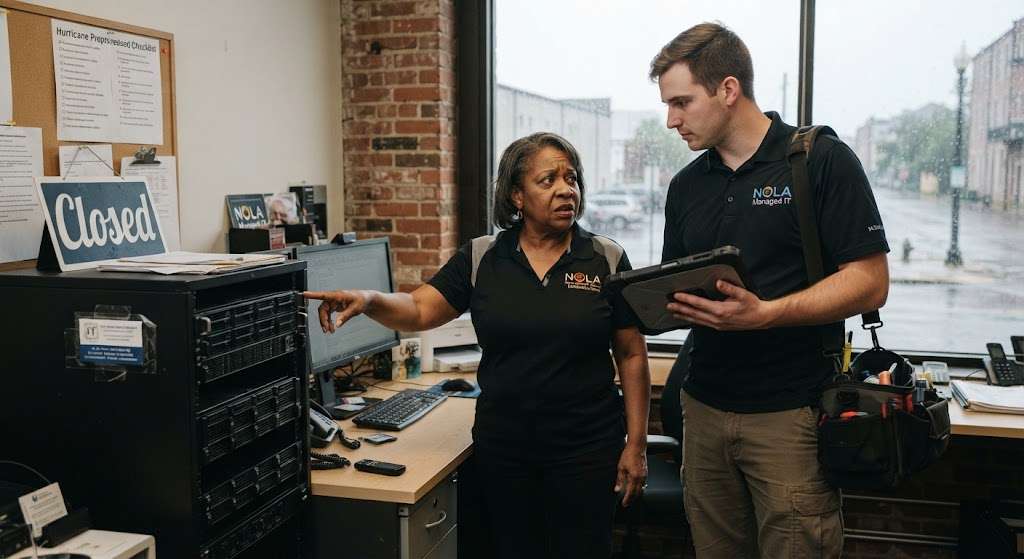
Why Businesses in New Orleans Need Managed IT Services
Predictable costs and budget simplicity. A consistent monthly fee replaces unpredictable break-fix bills, making budgeting easier and eliminating surprise capital expenditures.
Access to specialized expertise. Maintaining in-house expertise across security, networking, cloud, and compliance is expensive and risky. Managed IT gives you a full team of specialists without hiring overhead.
Greater reliability and uptime. In a city where natural events and utility challenges are nontrivial, businesses can’t afford downtime.
Risk mitigation. Data breaches can cost a great deal, or run a company out of business entirely. Managed IT drastically lowers risk through continuous protection and monitoring.
Scalability and flexibility. As your business grows, your technology should scale with you.
Local responsiveness and knowledge. A provider specializing in this market understands local infrastructure, storm risks, ISP options, and regulatory requirements, enabling faster and more effective support.
What Managed IT Actually Costs
Managed IT services for small and mid-sized businesses in the New Orleans area typically fall in the low thousands per month, with larger or more complex environments paying more. Most providers price per user or per device on a flat monthly model, which makes budgeting predictable. The right number depends on your headcount, your security needs, and your recovery requirements, so a proper assessment beats a blind quote every time.
Frequently Asked Questions
Why do businesses in New Orleans need managed IT services?
Businesses in New Orleans need managed IT services to maintain secure, reliable, and scalable technology infrastructure while accounting for the region’s specific hurricane and flood risk. These services reduce downtime, protect critical data, and ensure operational efficiency.
How much do managed IT services in New Orleans cost?
Managed IT services for small and mid-sized businesses in this market typically fall in the low thousands per month, with the exact figure depending on headcount, security needs, and recovery requirements. Confirm current pricing directly with a provider rather than relying on a single published number.
What is the difference between managed IT and break-fix support?
Managed IT is a proactive, flat-fee model where a provider monitors and maintains your systems continuously, while break-fix bills you each time something goes wrong. Break-fix can look cheaper until an outage hits, since it charges you exactly when you’re least able to absorb the cost.
Do small businesses in New Orleans really need cybersecurity?
Yes. Automated attacks don’t check company size before targeting a business. Small firms are hit precisely because they assume they’re too small to matter. A baseline of multi-factor authentication, endpoint protection, and email filtering stops the majority of common attacks.
How fast should a New Orleans managed IT provider respond?
Response times should be defined in writing, usually measured in minutes for critical issues and a few hours for on-site needs. Ask specifically how those times held during the last hurricane season, since that’s when response matters most.
Can a managed IT provider work alongside our current IT person?
Yes. A co-managed arrangement keeps your existing staff and adds a provider’s team, tools, and after-hours coverage behind them, suiting a business that values in-house knowledge but needs more depth than one person can give.
How can businesses evaluate a managed IT provider in New Orleans?
Evaluate based on experience, service coverage, SLAs, documented response times measured through actual storm seasons, client references, cybersecurity expertise, cloud capabilities, and disaster recovery testing history.
Measuring ROI & Key Metrics
Engaging managed IT should be viewed as an investment with measurable returns, though the specific figures used to illustrate this vary by source and shouldn’t be quoted as guaranteed outcomes:
Downtime savings. Estimates for the per-hour cost of downtime vary considerably by source and business size. Avoiding even a modest number of outage hours annually can add up to meaningful savings. Confirm a realistic figure for your own operation.
Breach avoidance. Preventing even one cybersecurity incident, commonly cited as running well into the tens or hundreds of thousands of dollars in cost, often offsets years of managed IT fees.
Productivity gains. Even modest time savings compound: a business with 40 to 50 employees each saving 15 minutes weekly gains roughly 500 to 650 hours annually.
Operational cost reduction. Less spending on spare hardware, fewer break/fix calls, reduced power and cooling needs.
License and waste optimization. Eliminating unused software and consolidating services.
Compliance and audit savings. Avoiding fines, reducing insurance premiums, maintaining reputation.
Metrics to track: uptime percentage, mean time to repair, ticket resolution times, cost per user, number of security incidents, compliance audit pass rates.
Local Challenges & How Managed IT Solves Them
Environmental risks. Hurricanes, floods, and power outages can cripple unprepared businesses; managed IT builds disaster recovery frameworks with offsite, out-of-region backups.
Aging infrastructure. Historic buildings often limit cabling or power upgrades; managed IT adapts with wireless technologies and cloud-forward strategies.
Compliance demands. Healthcare providers, hotels, financial firms, and insurers must comply with sector-specific regulations; managed IT incorporates compliance into daily operations rather than treating it as an annual scramble.
Connectivity issues. Internet access and ISP options vary across neighborhoods; managed IT plans for redundancy and hybrid connectivity.
Legacy systems. Many businesses depend on older applications; managed IT integrates these with modern systems, phasing in upgrades gradually.
Best Practices & Tips
- Require clear SLAs for response time and availability
- Embed security and compliance from the start, not after an incident
- Maintain transparent dashboards and reporting
- Pair systems with employee training
- Enforce least-privilege access and network segmentation
- Routinely test disaster recovery plans, at least annually
- Reevaluate contracts, licenses, and infrastructure each year
Why Mindcore Is the Right Partner for New Orleans
Mindcore Technologies brings national standards with local awareness, headquartered at 1100 Poydras Street, Suite 2900, and serving the full Greater New Orleans metro. Our offering includes:
- 24/7 monitoring, support, and infrastructure management
- Cybersecurity, compliance, and audit readiness
- Cloud and hybrid integration
- Backup, disaster recovery, and continuity planning built around the region’s actual storm risk
- Strategic IT consulting and roadmaps
- Flexible models: full management, co-managed, or hybrid
We recognize New Orleans’ challenges, storm risks, legacy infrastructure, regulatory demands, industry mix, and design solutions that thrive in that environment.
Ready to Shift from Reactive IT to Strategic Advantage?
Schedule a consultation with Mindcore Technologies today.
Matt Rosenthal’s Expertise in Managed IT Services in New Orleans
Matt Rosenthal, CEO and President of Mindcore Technologies, brings decades of IT, cybersecurity, cloud, and business technology leadership experience. He helps businesses in New Orleans select providers, implement proactive monitoring, secure networks, and optimize cloud and on-premises infrastructure, with particular attention to the region’s hurricane exposure and industry mix.

