

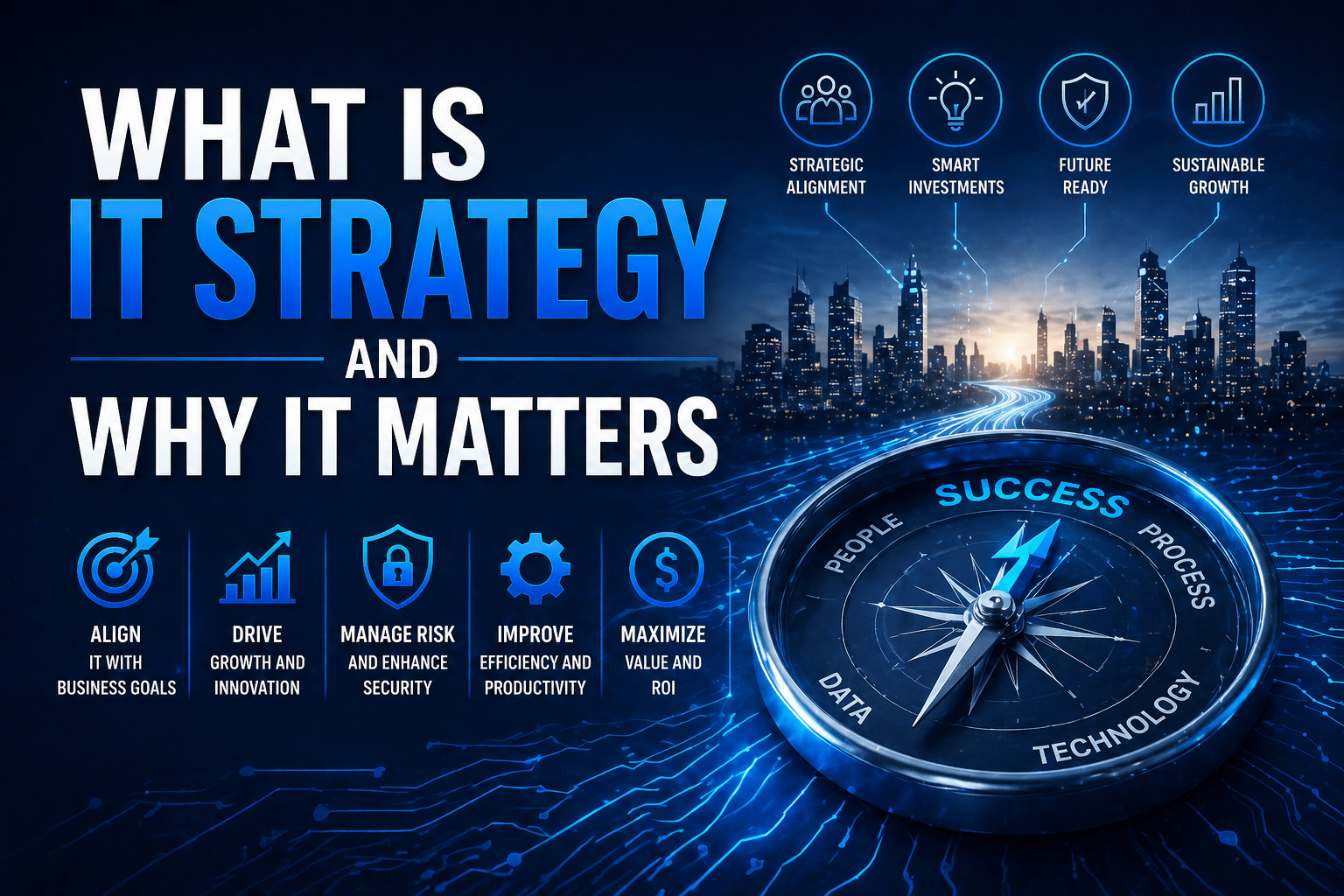
IT strategy is the plan that connects a business’s technology decisions to its business goals. It defines what technology the organization will invest in, when, at what cost, and why — and it ensures that those decisions are made deliberately rather than reactively.
Most businesses have IT. Far fewer have IT strategy. The difference is visible in the outcomes: organizations with IT strategy make technology investments that compound over time, building toward a coherent, capable environment. Organizations without IT strategy make technology decisions in response to immediate problems, accumulating technical debt, compatibility gaps, and security exposure that become progressively more expensive to address.
IT strategy is not a document that sits on a shelf. It is a living planning function — maintained by someone with both technology and business fluency, updated as goals and circumstances change, and operationalized through the IT decisions made every quarter.
For businesses working with managed IT services providers, IT strategy is often delivered through a virtual CIO (vCIO) function embedded in the engagement — ensuring the operational IT work is directed by a coherent plan rather than just maintaining the status quo.
Overview
IT strategy translates business objectives into technology decisions. It covers infrastructure architecture, technology investment priorities, vendor selection, security and compliance posture, and the roadmap that sequences those decisions over time. It is the function that ensures IT spending produces business value rather than just operational continuity.
- IT strategy connects technology decisions to business goals
- A technology roadmap is the primary output of IT strategy — the plan that sequences investments over time
- IT budget discipline is a direct product of having a strategy to plan against
- Security and compliance posture belong in IT strategy, not just IT operations
- Strategy is maintained, not written once — it is updated as business direction and technology options change
The 5 Why’s
- Why do businesses without IT strategy consistently overpay for technology while underperforming technologically? Without a strategy, technology purchases are made in response to immediate needs — which is the most expensive and least effective way to build an IT environment. Reactive purchases produce overlapping tools, incompatible platforms, and architecture that does not support the business’s actual direction. A strategy produces planned investments that build toward a coherent outcome.
- Why is technical debt the primary cost of absent IT strategy? Technical debt is the accumulated cost of short-term technology decisions that create long-term complexity. Every reactive purchase that bypasses architecture planning, every legacy system kept running past its useful life, every integration built to solve an immediate problem rather than designed for scalability — these accumulate into an environment that is expensive to maintain and hard to change. IT strategy prevents technical debt by making decisions with the long-term architecture in mind.
- Why does IT strategy require both technology and business expertise to be effective? A technology plan made without business context is an engineering exercise. A business plan made without technology context produces requirements that the IT environment cannot support. Effective IT strategy requires the ability to translate between business goals and technology capabilities — a function delivered by a vCIO or an experienced IT consulting partner.
- Why is security an IT strategy matter, not just an IT operations matter? Security posture is determined by architecture decisions: which platforms are used, how access is managed, what the network topology looks like, how data is classified and stored. Those are strategic decisions. An organization whose security is determined reactively — buying tools to address immediate threats rather than building a planned security architecture — has a security program shaped by attackers rather than by its own risk management.
- Why do businesses in growth phases specifically benefit from having IT strategy in place before they need it? Growth compounds technology requirements. Adding employees, opening locations, integrating acquisitions, and scaling revenue all create IT demands that are easier and cheaper to meet if an architecture designed for growth is already in place. Organizations that plan their IT for where they are going scale more smoothly than those that build for where they are and scramble when they outgrow it.
What IT Strategy Covers
Current State Assessment
Understanding the existing IT environment honestly — what is working, what is aging, where the gaps are, and where the costs are concentrated. A current state assessment is the foundation from which strategy is built.
Business Goal Alignment
Understanding where the business is going and what IT capabilities that direction requires. Growth plans, new product lines, regulatory changes, and market expansion all have IT implications. IT strategy identifies those implications before they become urgent problems.
Technology Roadmap
The sequenced plan for technology investments over a one to three year horizon. The roadmap defines what will be built, replaced, or retired — and in what order, at what approximate cost, and for what business reason. It provides visibility and budget predictability.
Architecture Decisions
The fundamental design choices that determine how the IT environment is structured: cloud vs. on-premises, centralized vs. distributed, which platforms and vendors anchor the environment, and how components integrate. Architecture decisions constrain or enable future flexibility — they deserve deliberate consideration, not just immediate-problem-solving.
Security and Compliance Strategy
How the organization’s security posture will be maintained and improved over time, which compliance frameworks apply, and what the investment required to meet those requirements looks like. Cybersecurity compliance requirements belong in the IT strategy, not just in the compliance team’s domain.
Vendor Strategy
Which technology vendors the organization relies on, how those relationships are managed, when contracts are reviewed, and how vendor performance is evaluated. Vendor sprawl — too many vendors, too many contracts, too little oversight — is a common and expensive consequence of absent IT strategy.
IT Budget Framework
The annual IT budget built against a plan rather than based on last year’s spend plus or minus a percentage. IT budget discipline enables business leaders to understand what IT should cost and why — and to make informed decisions when investment priorities compete.
Signs Your Business Lacks IT Strategy
- Technology purchases are made in response to failures or urgent requests rather than a plan
- The IT budget grows without a clear explanation of what it is buying
- Security and compliance gaps are identified at audit time rather than addressed proactively
- Different parts of the organization use incompatible tools that do not integrate
- Major technology decisions — platform changes, cloud migrations, ERP implementations — are made under time pressure rather than planned
- Nobody can describe what the IT environment will look like in two years and why
Final Takeaway
IT strategy is the planning function that separates technology spending that compounds into a capable, aligned environment from technology spending that accumulates into technical debt and operational frustration. It requires ongoing investment — a person or team with the time, expertise, and access to maintain the plan and ensure it is reflected in actual technology decisions.
IT Strategy and vCIO Services From Mindcore Technologies
Mindcore’s IT consulting services include IT strategy development, technology roadmapping, and virtual CIO advisory for businesses that need technology planning aligned with their business goals. We work with organizations across Louisiana and the Gulf South to build IT strategies that support growth, manage risk, and produce value from technology investment.
Talk to Mindcore About IT Strategy for Your Business
Contact our team to assess your current IT environment and build a strategy that reflects where your business is going.

