

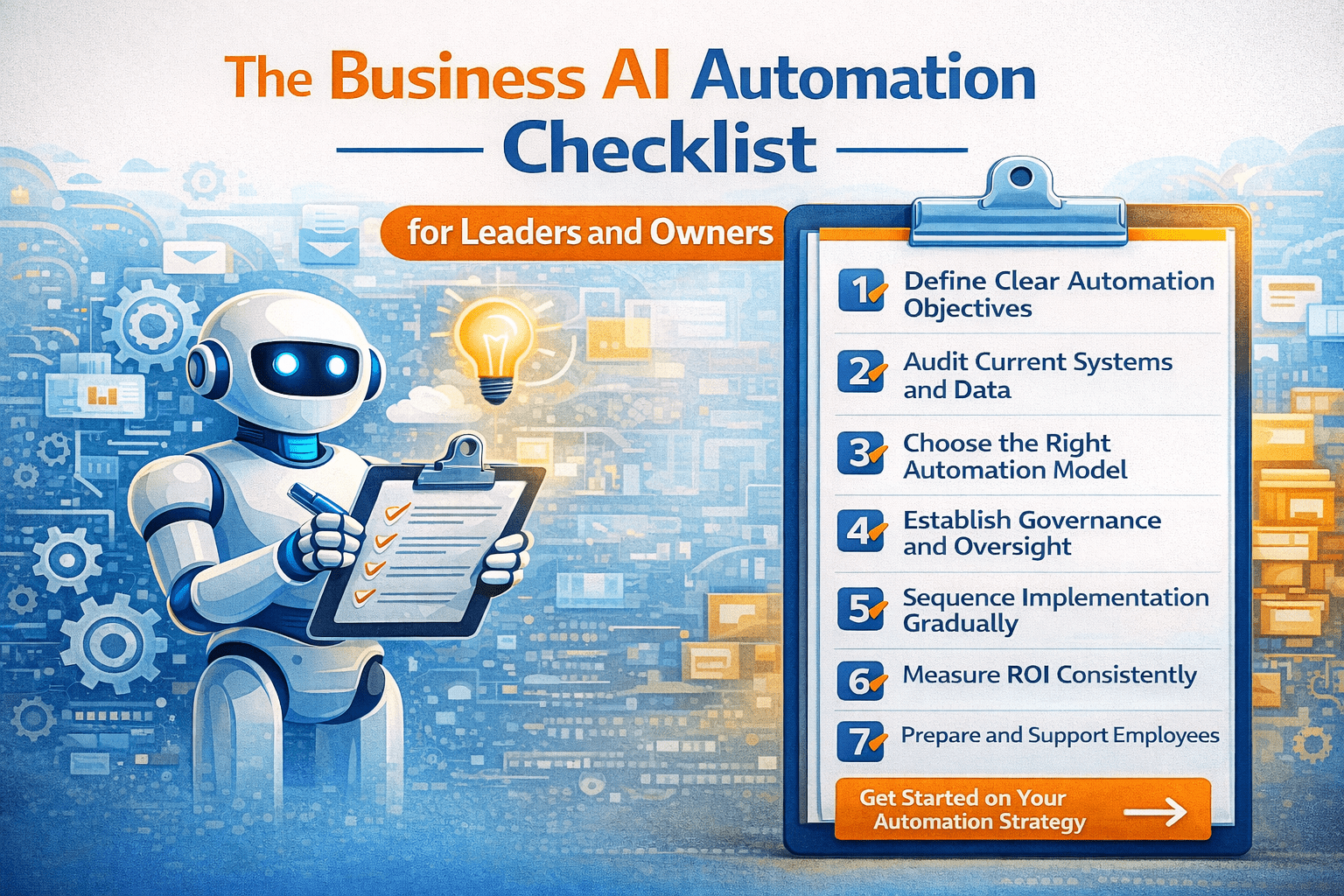
AI automation should never begin with software selection. It should begin with leadership clarity. Business owners and executives must validate readiness, define objectives, and structure rollout before introducing AI agents into operational workflows.
The broader automation framework is outlined in AI Process Automation for Business: Complete Guide to Operational Excellence, where automation is positioned as operational infrastructure rather than a tool purchase.
This checklist ensures disciplined deployment.
Define Clear Automation Objectives
Before evaluating tools, confirm:
• What manual processes are consuming the most time?
Identify measurable pain points.
• Where are delays impacting revenue?
Focus on customer-facing bottlenecks.
• Which workflows are repetitive and predictable?
Ideal candidates for automation.
Process elimination discipline is expanded in How to Eliminate Manual Business Processes with AI Agents.
Audit Current Systems and Data
Automation depends on system compatibility and data quality.
Validate:
• CRM accuracy
Remove duplicate records.
• Accounting integration readiness
Ensure clean financial data.
• Workflow documentation clarity
Prevent automating confusion.
• API compatibility across platforms
Avoid integration failure.
Provider evaluation is detailed in Business AI Automation Providers: Comparing Enterprise and Local Options.
Choose the Right Automation Model
Leaders must determine whether traditional automation or AI agents are appropriate.
Consider:
• Workflow complexity
Multi-system coordination favors AI agents.
• Scalability requirements
Growing businesses need adaptable automation.
• Budget constraints
Smaller organizations may prioritize phased deployment.
Comparison clarity is reinforced in Business Process Automation: AI Agents vs. Traditional Solutions.
Establish Governance and Oversight
Automation requires accountability.
Confirm:
• Who owns automation decisions?
Clarify leadership responsibility.
• How will performance be reviewed?
Schedule periodic evaluation.
• Are compliance requirements documented?
Protect operational integrity.
Challenge mitigation strategies are outlined in AI Automation Challenges in Business: Executive and Small Business Solutions.
Sequence Implementation Gradually
Avoid overwhelming operations.
Rollout discipline should include:
• Start with one high-impact workflow
Build internal confidence.
• Monitor performance closely
Catch errors early.
• Expand gradually
Maintain operational control.
Implementation sequencing is detailed in AI Agent Implementation: Reducing Business Operational Overhead.
Measure ROI Consistently
Automation must produce measurable value.
Track:
• Administrative hours saved
• Reduction in reporting time
• Improved invoice collection speed
• Increased customer response consistency
• Error reduction rates
ROI validation ensures automation remains aligned with business goals.
Prepare and Support Employees
Automation adoption requires workforce clarity.
Provide:
• Clear communication
Position AI as support.
• Training guidance
Reduce uncertainty.
• Knowledge automation tools
Improve workflow understanding.
Workforce enablement is explored in Employee Training AI: Automating Staff Support and Guidance.
Common Checklist Failures
• Automating before auditing processes
• Ignoring integration complexity
• Scaling too quickly
• Failing to measure performance
• Under-communicating with staff
Automation must be structured.
Key Takeaways
The business AI automation checklist ensures leaders define clear objectives, audit systems and data readiness, select the appropriate automation model, establish governance oversight, sequence implementation gradually, measure ROI consistently, and support employees throughout adoption. When automation deployment is disciplined and structured, AI agents become operational assets that reduce overhead, improve efficiency, and strengthen long-term business performance.

