

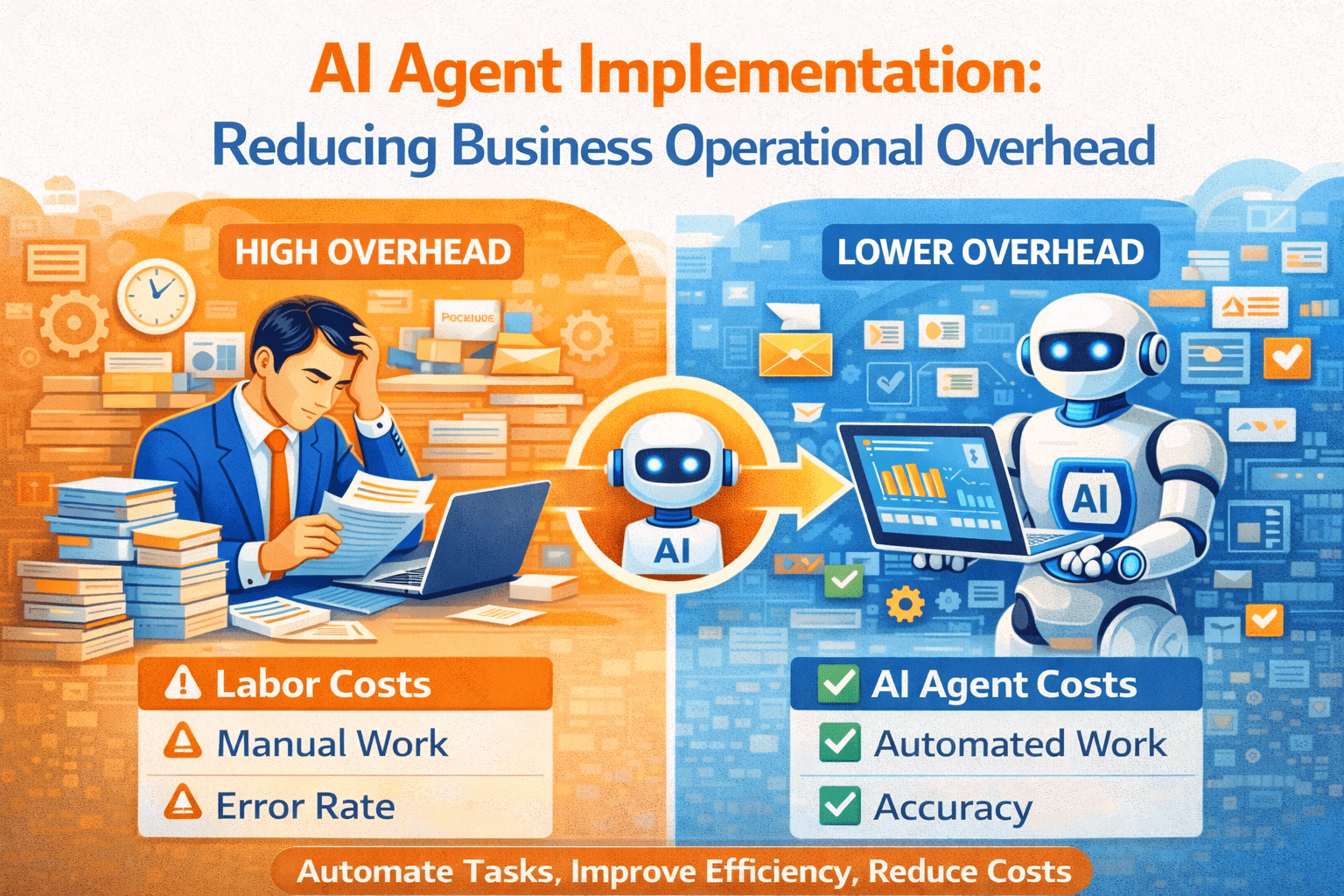
Operational overhead quietly erodes profit margins. Administrative workload, duplicated data entry, manual reporting consolidation, approval delays, and inefficient communication workflows increase labor cost without increasing value. AI agent implementation directly targets these inefficiencies.
The broader operational framework is introduced in AI Process Automation for Business: Complete Guide to Operational Excellence, where automation is positioned as infrastructure for sustained efficiency.
Reducing overhead requires disciplined implementation.
Step 1: Quantify Current Operational Overhead
Before deploying AI agents, measure baseline inefficiencies.
Evaluate:
• Hours spent on administrative tasks
Quantify non-revenue-generating workload.
• Manual reporting preparation time
Identify executive bottlenecks.
• Approval cycle duration
Measure internal delay points.
• Customer follow-up lag time
Track responsiveness impact.
Structured evaluation is reinforced in The Business AI Automation Checklist for Leaders and Owners.
Step 2: Prioritize High-Cost Manual Processes
Focus on areas with measurable cost impact.
Common high-overhead areas:
• Accounts receivable management
Late payments increase financial strain.
• CRM data synchronization
Repetitive updates consume staff time.
• Inventory monitoring
Manual tracking leads to errors.
• HR onboarding documentation
Administrative strain slows growth.
Elimination strategy is expanded in How to Eliminate Manual Business Processes with AI Agents.
Step 3: Deploy AI Agents for Workflow Orchestration
AI agents reduce overhead by automating multi-step tasks.
Examples include:
• Automated invoice follow-up sequences
Shorten payment cycles.
• Conditional approval routing
Reduce internal communication delays.
• Real-time KPI aggregation
Eliminate spreadsheet consolidation.
• System-triggered alerts
Prevent operational disruptions.
Model comparison clarity is detailed in Business Process Automation: AI Agents vs. Traditional Solutions.
Step 4: Integrate Systems to Remove Redundancy
Disconnected systems increase overhead.
Implementation should ensure:
• CRM and accounting synchronization
Reduce duplicate data entry.
• HR system alignment
Streamline employee management.
• Reporting dashboard consolidation
Improve executive visibility.
Provider evaluation discipline is discussed in Business AI Automation Providers: Comparing Enterprise and Local Options.
Step 5: Monitor and Optimize Performance
Overhead reduction must be measurable.
Track:
• Administrative hours reduced
• Reporting cycle acceleration
• Reduction in approval turnaround time
• Decrease in manual errors
• Improved invoice collection speed
Challenge mitigation strategies are reinforced in AI Automation Challenges in Business: Executive and Small Business Solutions.
Step 6: Support Workforce Adaptation
Operational overhead reduction should not create workforce confusion.
Ensure:
• Clear communication of automation goals
Reduce resistance.
• Transparent workflow visibility
Maintain accountability.
• Training reinforcement
Increase adoption confidence.
Workforce enablement is detailed in Employee Training AI: Automating Staff Support and Guidance.
Common Implementation Pitfalls
• Automating without process mapping
• Ignoring integration compatibility
• Expanding too quickly
• Failing to measure cost savings
• Overlooking employee training
Implementation discipline protects ROI.
Key Takeaways
AI agent implementation reduces business operational overhead by targeting high-cost manual processes, orchestrating multi-step workflows across systems, synchronizing disconnected tools, accelerating reporting cycles, and improving approval efficiency. Success depends on quantifying baseline inefficiencies, prioritizing high-impact areas, sequencing rollout carefully, monitoring measurable performance improvements, and supporting workforce adaptation. When deployed strategically, AI agents convert administrative burden into scalable operational efficiency that strengthens profitability and long-term business resilience.

