

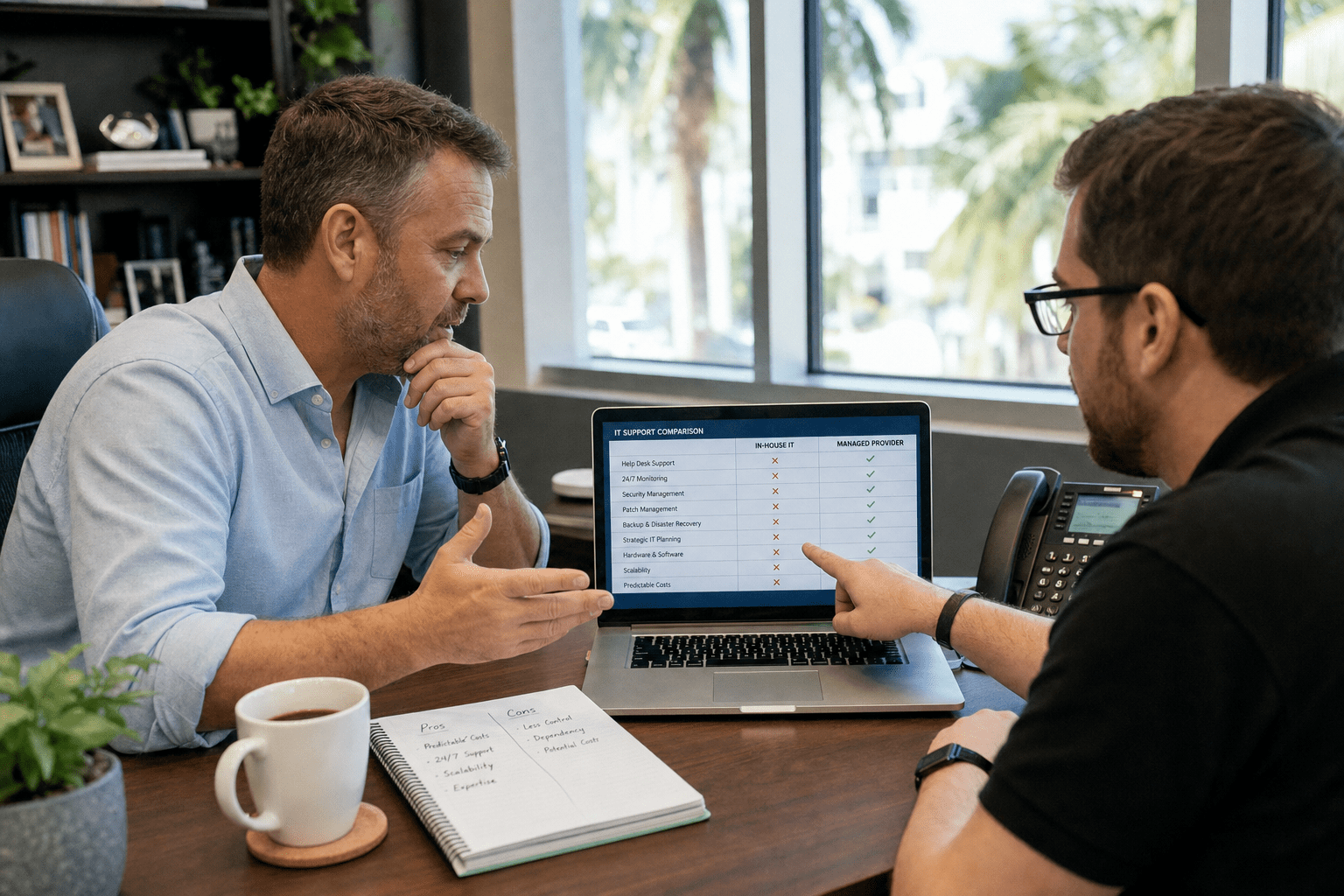
The choice between building an in-house IT team and engaging an Orlando It Company is usually framed as all-or-nothing, but understanding how a local provider can complement internal staff is key. Most growing Orlando businesses do not actually face a binary. They face a question of which slices of IT to keep in-house, which to hand to a partner, and where to blend the two. Framed as fully internal versus fully outsourced, the decision pushes companies to overpay on one side or expose themselves on the other. Framed as a portfolio of responsibilities, it produces a model that fits. This article lays out the genuine pros and cons of each approach for a 10-to-500-person Orlando company, then shows why the co-managed middle so often wins.
The Tradeoffs in Brief
If you are weighing in-house IT against an Orlando IT company, hold these points in mind:
- Fully in-house gives control and presence but is expensive and hard to staff for 24/7 coverage.
- Partnering with an Orlando It Company provides breadth, coverage, and predictable costs while supplementing internal resources without requiring full in-house staffing.
- Evaluating an Orlando It Company fairly means considering total cost, after-hours coverage, and specialized expertise, not just the monthly fees.
- Most Orlando SMBs land on a blend, keeping some functions internal and outsourcing depth and coverage.
- The right split depends on your size, your compliance needs, and how critical uptime is to revenue.
The Case for an In-House IT Team
The case for in-house IT rests on control, presence, and deep familiarity with your specific environment. An internal team sits with you, learns your systems intimately, and is immediately available to walk to a desk and fix something. For companies whose technology is genuinely a competitive differentiator, or who have constant hands-on needs, that closeness has real value. The objection is cost, and it is a large one. Hiring skilled IT staff in Orlando means competing for talent in a growing tech market, and the federal labor statistics for IT roles show steady demand and rising pay across the field. Beyond salary, you carry benefits, training, tools, and the risk that a small team’s knowledge walks out the door when someone leaves.
The deeper problem with a small in-house team is coverage. One or two people cannot realistically cover the full range of modern IT, from networking to cybersecurity to cloud to compliance, and they certainly cannot cover it around the clock. They go on vacation, get sick, and sleep. A skeptic might say you can hire enough people to cover the gaps, and large enterprises do exactly that. For an SMB, though, the headcount required to cover breadth and 24/7 availability is usually out of reach, which is what pushes most companies toward outside help for at least part of the picture.
Where In-House Genuinely Wins
In-house genuinely wins for the work that benefits from constant presence and institutional memory: the daily user support, the quick fixes, the projects that need someone who knows every quirk of your setup. Keeping that layer internal preserves responsiveness and the relationships that make support feel personal. The mistake is assuming that because in-house works for those functions, it must work for everything, including the specialized, after-hours, and rapidly changing areas where a small team cannot keep pace.
The Case for Hiring an Orlando IT Company
The case for an outside IT company rests on breadth, coverage, and predictable cost. A managed provider spreads a deep bench of specialists across many clients, so you get networking, security, cloud, and compliance expertise without hiring four different people. You get monitoring and response outside business hours, which a small internal team simply cannot sustain. And you trade unpredictable internal costs for a regular fee that makes budgeting easier. Industry bodies like CompTIA track the steady shift of SMBs toward managed services for precisely these reasons. Our managed IT services are built around giving a small company access to capabilities it could never staff alone.
The honest counterpoint is that an outside company is not physically in your office every day, and some leaders worry about responsiveness and about handing control to a third party. Those concerns are legitimate and worth addressing directly. A good provider mitigates them with fast remote response, scheduled onsite visits, and clear service commitments, and being based in Orlando means onsite help when it is genuinely needed. The control concern is often really a communication concern, solved by a partner who reports transparently rather than operating as a black box. Still, if your needs are constant and hands-on, pure outsourcing can feel a step removed, which again points toward a blend rather than a wholesale handoff.
Watch the Total Cost, Not the Sticker Price
Total cost is where the in-house versus outsourced comparison usually gets distorted, because companies compare a provider’s fee against staff salaries alone. The fair comparison adds the full cost of employment: benefits, payroll taxes, training, software licensing, turnover, and the productivity lost when an understaffed team falls behind. It also prices the cost of gaps, like the breach that happens at 2 a.m. when no one is watching. Counted honestly, an outside company often costs less than a comparably capable internal team, while delivering broader coverage. The reverse can be true for very large or highly specialized needs, which is why the answer is a calculation, not a slogan. Our guide on what to consider before hiring an IT company walks through how to run that comparison fairly.
Why Most Orlando SMBs Land in the Middle
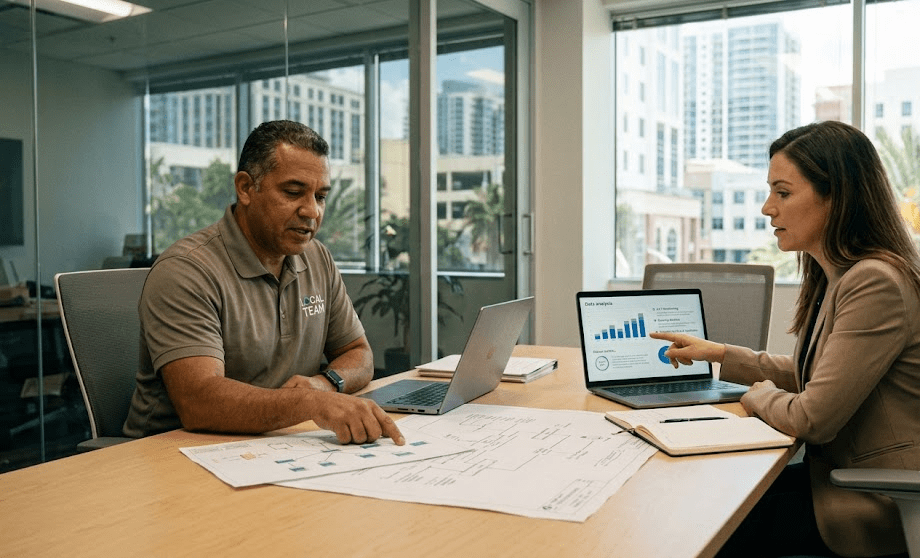
Many businesses in Orlando leverage an Orlando It Company within a co-managed IT model to balance internal familiarity with outsourced expertise and 24/7 monitoring. In a co-managed arrangement, your internal staff handle the daily, hands-on work they do best, and an outside partner adds the specialized depth, after-hours monitoring, and surge capacity a small team cannot provide. The result is presence where presence matters and breadth where breadth matters.
How a Co-Managed Split Usually Works
A co-managed split usually keeps user support and day-to-day administration internal while the partner takes on cybersecurity, 24/7 monitoring, strategic planning, and the projects that need specialized skills. This is not a sign that your internal team is inadequate; it is a recognition that no small team can be expert at everything, and that pairing them with a partner makes both stronger. Our co-managed IT services are structured exactly this way, augmenting an internal team rather than replacing it. The objection that two parties create confusion is real if responsibilities are vague, which is why a good co-managed relationship defines who owns what in writing. Done clearly, it is the model that fits the largest share of growing Orlando companies, because it stops forcing a false choice.
Frequently Asked Questions
Is it cheaper to outsource IT or hire in-house in Orlando?
Outsourcing is often cheaper than building a comparably capable in-house team once you count the full cost of employment, including benefits, training, turnover, and after-hours coverage. For very large or highly specialized needs, in-house can win. The honest way to decide is to compare total cost of ownership for the specific coverage you need, not provider fees against salaries alone.
Can I keep some IT in-house and outsource the rest?
Yes, and that co-managed blend is what most Orlando SMBs actually choose. You keep day-to-day support and administration internal while a partner handles cybersecurity, 24/7 monitoring, and specialized projects. The key to making it work is defining clearly who owns which responsibilities, so the two sides complement each other rather than overlap or leave gaps.
How do I know if my business has outgrown its in-house IT?
You have likely outgrown in-house IT when your team cannot keep up with security, after-hours issues go unwatched, or projects stall because no one has the specialized skills. Those gaps are signals that breadth and coverage have exceeded what a small team can provide. The usual fix is not replacing your staff but adding a partner to cover the areas they cannot.
Does an Orlando IT company provide onsite support?
A good Orlando IT company provides onsite support when it is genuinely needed, combining fast remote response for most issues with scheduled or as-needed visits for the rest. Being locally based means a technician can reach you for hardware problems or projects that require hands on site. Most day-to-day issues, though, are resolved remotely far faster than waiting for someone to drive over.
Talk to an Orlando IT Team About the Right Split
The in-house versus Orlando IT company decision gets clearer the moment you stop treating it as all-or-nothing. Decide which tasks to keep in-house and which to outsource to an Orlando It Company, ensuring that the small team’s gaps are filled without duplicating effort or inflating costs. For most growing Orlando companies that math points to a co-managed blend, which is why so many land there. If you want a clear read on which functions to keep, which to outsource, and what each path would actually cost your business, book a free strategy call with the Mindcore team.
In-House vs Outsourced IT Strategy and Co-Managed IT Expertise from Matt Rosenthal
Matt Rosenthal, CEO of Mindcore Technologies, has over 30 years of experience helping Orlando SMBs move past the false all-or-nothing framing of in-house versus outsourced IT and into co-managed models that keep institutional knowledge and daily presence internal while adding the specialist depth, 24/7 monitoring, and after-hours coverage a small team cannot sustain alone. He has seen firsthand how companies compare provider fees against staff salaries without counting benefits, training, turnover, and the cost of a 2 a.m. breach nobody was awake to catch. Matt leads a team that structures co-managed arrangements around clearly defined responsibility splits, so internal staff and outside partner complement each other rather than duplicate effort or leave critical functions unowned.

