


Healthcare Ransomware Attacks target medical centers because attackers know mid-size healthcare facilities hold valuable patient data but often have limited security resources, creating high leverage for ransom demands. This is not a coincidence of scale. It is a deliberate targeting strategy, and the organizations that understand it are the ones that survive it.
Why Healthcare Ransomware Attacks Target Medical Centers Specifically
The question most medical center IT managers never get a straight answer on: why us and not the big hospital network down the road?
The Mid-Size Pressure Point Attackers Exploit
In Healthcare Ransomware Attacks, attackers prioritize targets based on the sensitivity of patient data and the organization’s likelihood to pay quickly, making mid-size medical centers especially vulnerable. Large hospital systems have high data value but also dedicated security operations centers and incident response retainers. Small private practices have limited upside. Mid-size medical centers, roughly 50 to 500 staff serving a defined geographic community, hit the sweet spot on both variables.
Your electronic health records contain personally identifiable information, insurance data, and clinical history that sells for significantly more on illicit markets than standard financial records. Your IT team is typically one to three people managing everything from network switches to compliance reporting. When ransomware encrypts your imaging systems at 6 AM, you do not have an on-call incident response team. You have a ticket in a queue and a waiting room that opens at eight.
That combination is a structural reality of how mid-size healthcare is organized, and attackers have specifically tooled their campaigns to exploit it.
Life-Critical Uptime as Leverage
The second reason medical centers are disproportionately hit: The consequences of Healthcare Ransomware Attacks are immediate: downtime in critical systems such as EHR, imaging, or medication records can directly threaten patient safety and operational continuity.
Attackers know this. The American Hospital Association has documented how threat actors specifically time attacks around high-census periods or shift changes, when pressure to restore operations is highest and staff available for recovery is thinnest.
The ransom payment decision at a mid-size medical center is typically not made by the IT manager. It is made by the CEO or COO at 2 AM after the emergency department has run on paper for six hours. The attacker does not need to outmaneuver your security tools at that point. They have already won the psychological battle.
HIPAA Creates a Second Payment Pressure
Beyond the operational pressure, Healthcare Ransomware Attacks often trigger HIPAA breach notifications, placing additional regulatory pressure on medical centers to demonstrate that ePHI was not compromised during the attack. That notification obligation, 60 days to notify affected individuals, with potential OCR investigation for incidents affecting more than 500 individuals in a state, runs in parallel to the ransomware recovery itself.
The attacker’s pitch is not just “pay to get your files back.” It is “pay and we will give you deniability on the exfiltration.” The leverage point is real.
How Healthcare Ransomware Attacks Differ From Other Sectors
Healthcare ransomware attacks differ from other industries because the consequences extend beyond financial loss to direct patient care disruption, and the regulatory aftermath creates compliance obligations that persist for years.
The Data Profile Is More Valuable and More Permanent
A credit card number can be canceled within minutes of a breach notification. A patient’s medical record cannot be replaced. The date of birth, insurance policy numbers, clinical diagnoses, and medication histories in your EHR system are permanent identifiers that remain exploitable for identity theft and insurance fraud for years. Healthcare data depreciates more slowly than any other stolen data category.
A breach in healthcare requires more aggressive notification, more extensive identity protection for affected patients, and more prolonged legal exposure than a comparable breach in retail or professional services. Attackers factor this asymmetry into their ransom demands.
The Recovery Timeline Diverges From Enterprise Playbooks
Enterprise security frameworks, including NIST SP 800-53 and controls common to large hospital systems, assume dedicated incident response staff, pre-negotiated cyber insurance with a 24-hour breach coach provision, and tested backup restoration procedures run quarterly. That infrastructure does not exist at most mid-size medical centers.
What we see in practice: backup systems exist but have not been tested for full environment restoration in 12 to 18 months. The cyber insurance policy was purchased but coverage terms for ransomware extortion versus business interruption were never reviewed against the actual network architecture. The incident response plan names a vendor that no longer has a contract with the organization. None of this means negligence. It means running a mid-size healthcare operation with limited staff and competing priorities.
The effective recovery timeline after a full ransomware encryption event is often two to four weeks of partial operations, not the two to three days a large hospital network would target. That extended timeline compounds the original attack cost directly.
Attackers Are Now Targeting Healthcare-Specific Software Vendors
The Microsoft security research team has documented a growing pattern of ransomware groups targeting healthcare-specific EHR vendors, medical device platforms, and billing software providers as a vector into their customer base. A single compromise of a widely used healthcare SaaS vendor can propagate access across dozens of customer organizations at once.
Your exposure is not limited to the security posture of your own network. It extends to every vendor with administrative or API access to your systems. Third-party vendor risk management is not a large-enterprise problem. Our team encounters it as an active breach vector at organizations with under 200 staff.
Why the Defensive Playbook for Medical Centers Differs From Enterprise Healthcare Security
The defensive playbook for mid-size medical centers must prioritize recovery speed and vendor risk over perimeter defense, and operate within IT staffing constraints that make continuous monitoring impractical without managed support.
Network Segmentation Calibrated for Clinical Operations
The first control our team implements at mid-size medical center clients is network segmentation that isolates clinical systems, specifically imaging, EHR, and medical device networks, from administrative and guest networks. The execution for a 150-person medical center differs from a hospital network because a single IT administrator may need to manage and troubleshoot all segments simultaneously.
Practical segmentation at this scale means VLAN separation with firewall rules preventing lateral movement between clinical and administrative networks, plus documented procedures for rapid segment isolation without vendor support. Complexity is the enemy. An enterprise-grade zero-trust architecture that requires a security engineer to operate is not viable for an organization with one IT generalist. For a deeper look at secure workspace design for healthcare environments, that page outlines the specific architecture we deploy.
Backup Architecture Designed for the Two-Hour RTO
Recovery time objective planning for a mid-size medical center should target two hours for critical patient-facing systems, not the 24 to 72-hour RTOs in general business continuity frameworks. Achieving that requires immutable, air-gapped backups of EHR data taken at minimum every four hours, with a tested restoration procedure the IT manager has personally executed within the last 90 days.
The “tested” component is where most organizations fail. The backup exists. The restoration process has never been run against the actual environment under time pressure. Our team runs tabletop recovery exercises specifically to surface the gap between the documented procedure and the actual time required. In most cases, the first tabletop extends the estimated recovery time by a factor of three. Identifying that gap in a tabletop costs nothing. Identifying it during an active ransomware event costs weeks.
Managed Detection and Response as the IT Staff Force Multiplier
A mid-size medical center with one to three IT staff cannot realistically operate continuous security monitoring. A SIEM platform generates alert volumes a small team cannot process alongside day-to-day responsibilities. Managed detection and response provides 24/7 monitoring, alert triage, and incident escalation without in-house security analyst headcount.
MDR at this scale is the closest equivalent to the security operations center large hospital networks maintain internally. For organizations looking to understand their current ransomware exposure before committing to a full MDR engagement, a vulnerability assessment scoped to internet-facing RDP, unpatched VPN appliances, and phishing susceptibility is the right starting point. Our ransomware response services are structured to move from assessment to active monitoring without a multi-month implementation timeline.
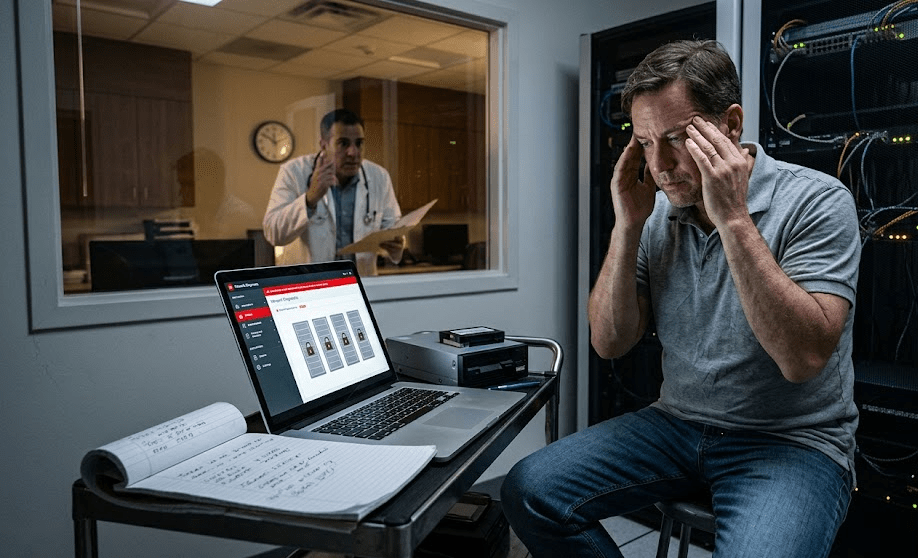
HIPAA Compliance in the Context of Healthcare Ransomware Attacks
HIPAA compliance requirements directly shape how a medical center must prepare for, respond to, and report a ransomware attack. Organizations treating security and compliance as separate workstreams are consistently less prepared when an attack occurs.
The Risk Analysis Requirement as a Security Planning Anchor
HHS guidance is clear that a comprehensive risk analysis is a foundational HIPAA Security Rule requirement and the most direct input into a ransomware preparedness plan. It identifies where ePHI lives, how it moves, who has access, and what controls exist, and every element maps directly to ransomware attack surface.
In practice, many mid-size medical centers complete a risk analysis at initial HIPAA implementation and do not revisit it for three to five years. During that period, the network adds new endpoints, new vendors get administrative access, new cloud storage is adopted, and the risk analysis becomes an inaccurate picture of the actual environment. For a detailed breakdown of how HIPAA intersects with ransomware response, that resource covers the specific notification timeline and documentation requirements.
Breach Notification Decisions Under Ransomware
The HHS presumptive breach standard means that unless the organization can demonstrate through forensic evidence that ePHI was not accessed or exfiltrated, the incident must be treated as a reportable breach. That forensic determination requires log data, which requires logging was enabled, retained at a useful granularity, and accessible in a system not itself encrypted during the attack.
Organizations that maintain centralized, off-network log storage with at least 180 days of retention are in a meaningfully better position to make that determination quickly. Organizations that store logs only on local servers that were encrypted during the attack are essentially unable to demonstrate the absence of exfiltration. This is a logging architecture decision with direct consequences for how a breach notification decision goes.
Vendor Business Associate Agreements as a Security Control
Every vendor with access to ePHI is required to have a signed Business Associate Agreement. The BAA establishes the vendor’s security obligations and breach notification responsibilities, and it is relevant to both the compliance response and any insurance claim or litigation after a vendor-originated attack.
Our team consistently finds that mid-size medical centers have BAAs on file for their primary EHR vendor and billing platform, but not for IT support vendors with remote access, cloud storage providers used for imaging, or scheduling platforms integrated into the EHR. Each un-BAA’d vendor is both a compliance gap and a potential ransomware entry point. Closing the BAA gap and closing the vendor access control gap are the same work.
Frequently Asked Questions
Are mid-size medical centers more vulnerable to ransomware than large hospital systems?
Mid-size medical centers face a different risk profile than large hospital systems: a higher ratio of attack exposure to security resources, not necessarily a higher absolute risk. Large hospital networks maintain dedicated security operations centers and tested recovery infrastructure. Mid-size medical centers typically operate with one to three IT generalists handling both day-to-day support and security. The same ransomware campaign a large network contains in hours may take a mid-size medical center days to identify and weeks to recover from. Our healthcare industry security page outlines the specific controls we recommend for this tier.
Does paying a ransomware demand guarantee data recovery?
Paying a ransomware demand does not guarantee data recovery, and it does not guarantee exfiltrated data will not be published or sold. FBI and CISA guidance consistently advises against payment because it funds further attacks and provides no contractual enforcement mechanism. The payment decision requires input from legal counsel, cyber insurance, and law enforcement. The organizations best positioned to decline payment are those with tested, restorable backups and a realistic two-hour recovery time objective.
What is the first action a medical center should take after detecting a ransomware attack?
The first action is network isolation, disconnecting affected systems from the broader network to prevent lateral spread, before any remediation or communication with the attacker. The second is preservation of available log data from systems not yet encrypted. The third is contacting your cyber insurance breach coach, who coordinates legal counsel, forensic investigation, and ransom negotiation. For a full incident response sequence calibrated to healthcare environments, our lessons from recent ransomware breaches resource walks through each phase.
How often should a medical center test its ransomware recovery procedures?
A medical center should test ransomware recovery procedures at minimum twice per year, with at least one full tabletop that includes clinical operations staff, not just IT. The most common failure mode is a technically sound backup architecture that clinical staff do not know how to operate in a degraded environment. Downtime procedures for scheduling, medication administration, and imaging all need to be tested. Testing once at implementation and then assuming the process holds is consistently the gap that extends recovery timelines from hours to weeks.
Does a ransomware attack automatically require HIPAA breach notification?
Under HHS guidance, a ransomware attack involving ePHI is presumed to be a HIPAA reportable breach unless the covered entity can demonstrate through forensic evidence that ePHI was not accessed or exfiltrated. Organizations without centralized, off-network logging are typically unable to make that demonstration, which means the presumptive breach standard applies. Notification timelines run 60 days from discovery, with media notification required for incidents affecting more than 500 individuals in a state. OCR investigation risk increases significantly above that threshold, making early forensic log availability a direct compliance asset.
Protect Your Medical Center Before the Next Attack Window Opens
Mid-size medical centers are not collateral damage in healthcare ransomware attacks. They are the primary target, chosen because high-value data, life-critical uptime pressure, and thin IT staffing make them more likely to pay quickly and less likely to detect an intrusion before it reaches critical systems. Preventing Healthcare Ransomware Attacks requires proactive measures, including tested recovery procedures, secure backups, and expert cybersecurity partners who understand the operational constraints of healthcare organizations.
If your medical center has not had a ransomware-specific risk assessment in the last 12 months, that is the right starting point. Our team works with mid-size medical centers to identify the attack surface gaps most commonly exploited in healthcare ransomware campaigns, build a defensible backup and recovery architecture calibrated to clinical RTO requirements, and put managed monitoring in place without additional in-house headcount. Schedule a free strategy call with our team for a direct read on where your current posture stands.
CISO Consulting Selection and Security Leadership Expertise from Matt Rosenthal
Matt Rosenthal, CEO of Mindcore Technologies, has over 30 years of experience helping SMBs hire security leadership that owns decisions and transfers capability to internal teams rather than producing frameworks nobody follows and dependencies that outlast the engagement. He has seen firsthand how companies hire on resume length and certification count, then find themselves a year later holding a thick security policy the consultant wrote, with every actual risk decision still unowned and every real fix still unbuilt. Matt leads a team that approaches CISO consulting as an accountable operating role, not an advisory one, sizing the security program to each client’s actual headcount and budget, owning written risk decisions, and building internal capacity that persists after the engagement ends.

