

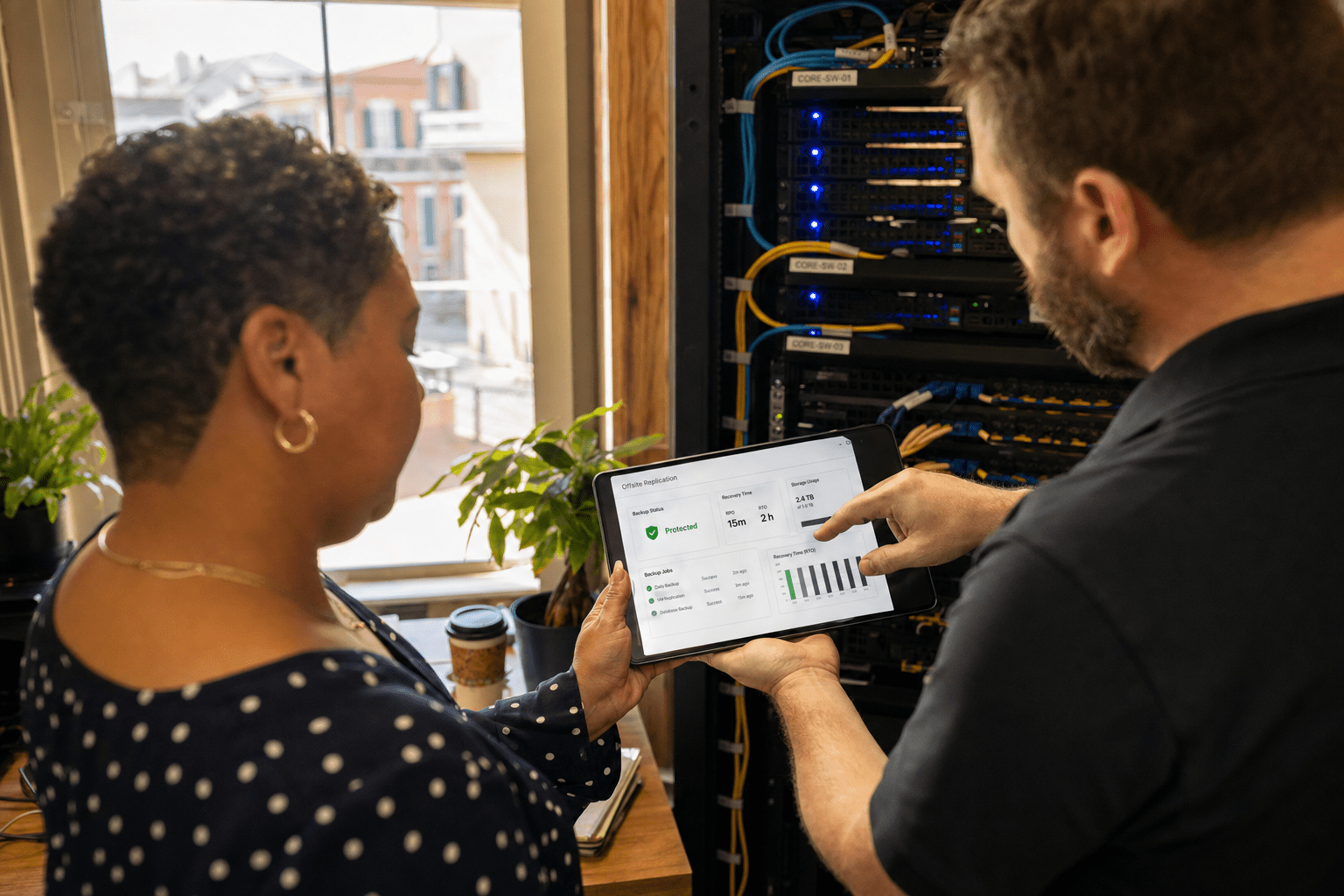
Backup and disaster recovery in New Orleans LA is the paired practice of copying your business data to a location outside the Gulf Coast and rebuilding your working systems fast enough to keep operating through a storm, a flood, or a ransomware attack. For a business here, that second half is not theoretical. This is a city that has watched hurricanes close offices for weeks and watched a ransomware event take down local government for months. A backup that sits on a drive in the same building you just evacuated is not a plan. It is a copy you are about to lose alongside the original.
Most owners evaluating Disaster Recovery New Orleans already run some kind of backup, but fewer have proven they can restore operations after a major outage. Far fewer can answer the harder question: if the office floods on a Friday, are we invoicing clients again by Monday? That gap between having a copy and being able to operate is what this guide is about.
Five Recovery Decisions Every New Orleans Business Should Get Right
Businesses planning Disaster Recovery New Orleans should make critical decisions about offsite storage, recovery speed, remote operations, ransomware protection, and restore testing before an incident. Use them as the frame for everything below.
- Offsite means outside the region, not across the parking lot. A hurricane that reaches your office reaches a second local site too.
- Recovery is measured in hours you can survive, not in vendor averages. Your recovery time objective has to match how long your business can actually be dark.
- The plan assumes the whole office is gone. Staff evacuated, power out, building inaccessible, and work still has to resume from somewhere.
- One backup copy is beyond an attacker’s reach. Ransomware is a local reality here, and it targets the backups first.
- You test restores before the storm, not during it. An untested backup is a guess you make at the worst possible moment.
Why New Orleans Raises the Recovery Bar
Backup and disaster recovery in New Orleans LA carries a higher bar than the same service inland, because the events you plan for take out the whole location at once. In most cities a disaster plan protects against a failed server or a mistaken deletion. Here it also has to protect against a named storm that floods the office and forces every employee to leave the parish for a week. That single difference reshapes what you buy and where you keep it.
The federal business continuity guidance is blunt about this: businesses in high-hazard regions need an offsite strategy, because on-site redundancy fails exactly when the hazard arrives. For a New Orleans business, offsite has to mean a data center safely outside the Gulf Coast, so the same weather system cannot take the primary and the backup together.
Hurricane season sets your recovery deadline
Disaster Recovery New Orleans should set recovery deadlines according to how long the business can operate while its office remains closed during hurricane season. When a storm forces an evacuation, the question is not whether your data survived, it is whether your team can log in from a hotel in another state and keep serving customers. That points toward cloud-based recovery, where an encrypted copy replicated out of the region can bring up a working environment while your building is still dark. Our business continuity disaster recovery planning starts from that evacuation scenario, not from a routine hardware failure.
Ransomware is a local pattern, not a distant risk
New Orleans learned firsthand that ransomware can cripple an organization for months, when the city itself was hit and had to declare a state of emergency. Attackers know that a business without clean backups will pay, so they go after the backup system first. The defense is a copy the attacker cannot reach: one backup kept immutable or air-gapped, so encrypting the live network does not encrypt the recovery set. This is the single control that separates a business that restores and moves on from a business that negotiates a ransom. The NIST Cybersecurity Framework treats recoverability as a core function for this reason.
Downtime here can outlast a single event
A Gulf Coast outage is rarely clean or short. Power can stay out after the water recedes, staff can be displaced for weeks, and the local vendors you would normally call are recovering from the same storm. That is why we plan recovery that does not depend on anyone physically reaching your office. A working environment that lives in the cloud and restores over the internet keeps the business alive even when the building, the power, and the local support are all still down.
Building a Recovery Plan That Survives a Gulf Coast Storm
A reliable Disaster Recovery New Orleans plan assigns clear owners, uses realistic evacuation timelines, and maintains a tested recovery copy outside the Gulf Coast. The plan is something your team rehearses before the season, not a document you open once the forecast turns. Businesses that pair this with strong local support, like the firms in our roundup of top IT support companies in New Orleans, fold these steps into a standing schedule.
Set targets from your real downtime tolerance
Start with two numbers. The recovery time objective is how fast you must be working again. The recovery point objective is how much recent work you can lose, measured in time. A medical billing office or a law practice mid-deadline may need both close to zero, which points toward continuous replication and cloud backup. A quieter operation may accept a longer window. Derive the numbers from how long your revenue can stop, then buy technology that meets them, rather than accepting whatever a product delivers by default.
Apply 3-2-1, with offsite meaning out of state
The durable baseline is three copies of your data, on two kinds of media, with one copy offsite. In New Orleans, offsite has to mean geographically distant, replicated to a data center outside the hurricane corridor. Then harden the set against ransomware by keeping one copy immutable. This combination handles both threats a local business actually faces: the storm that destroys the building and the attacker who encrypts the network. Our disaster recovery work builds this layout so no single event reaches every copy.
Test restores before the season starts
A backup is a claim until you restore it. We recommend a full restore test before each hurricane season, plus a spot restore after any change to your systems. Document each test: what you restored, how long it took, what failed. That record proves your recovery time objective is real and gives you confidence that the plan works before the day you need it. Testing during an actual evacuation is the most expensive time to discover a broken backup.
Cloud, Local, or Hybrid for a New Orleans Business
Disaster Recovery New Orleans often uses a hybrid setup that combines fast local restoration with an encrypted out-of-region cloud copy. Each model carries a real trade-off, and the honest choice depends on your risk and your budget.
Why cloud recovery fits the Gulf Coast
Cloud recovery wins on geography. An encrypted copy replicated to a distant data center survives the flood or wind that would destroy on-site equipment, and it lets your team work from anywhere they evacuated to. The counterweight is that recovery depends on connectivity and on a provider whose security you have vetted. A business handling regulated data has to confirm where the copy lives and who can reach it. For a region that evacuates, though, the geographic advantage usually outweighs the trade-off.
Why some local copy still helps
A local copy restores fastest for the common case, a deleted file, a failed drive, a corrupted database, because you are not pulling everything back over the internet. For large data sets, that speed is real and worth keeping. The counterweight in New Orleans is unavoidable: a copy that shares the building shares the building’s fate in a flood. This is why we rarely recommend local alone here, and why the hybrid model tends to win. It keeps the everyday speed while the out-of-region copy carries the business through the events that define this coast.
Frequently Asked Questions
What does backup and disaster recovery in New Orleans LA actually protect against?
It protects against the two events local businesses face most: a hurricane or flood that destroys the office, and a ransomware attack that encrypts your systems. Backup keeps a copy of your data, and disaster recovery is the tested ability to rebuild working systems fast enough to keep operating through either event.
Why do New Orleans businesses need offsite backup outside the region?
Because a storm that reaches your office can reach any nearby backup site too. Keeping an encrypted copy in a data center outside the Gulf Coast means the same weather system cannot take both your primary systems and your recovery set at once, which is the whole point of offsite protection here.
How fast can a business recover after a hurricane with cloud recovery?
With an out-of-region cloud copy and a tested plan, a business can often bring up a working environment within hours and let staff log in from wherever they evacuated. The exact speed depends on your recovery time objective and on testing that setup before the season, not during an actual storm.
Does backup and disaster recovery protect against ransomware too?
Yes, when one backup copy is kept immutable or air-gapped so an attacker cannot encrypt or delete it. New Orleans has seen ransomware shut down major operations, and attackers target backups first, so an unreachable recovery copy is the control that lets a business restore instead of paying.
How often should a New Orleans business test its recovery plan?
At minimum once a year, ideally before hurricane season begins, plus a spot restore after any major system change. Each test should be documented so the business can confirm its recovery time objective is real and fix any gap while there is still time.
Talk to a Team That Plans for the Storm You Actually Face
A New Orleans business does not need another backup product; it needs a recovery process built for a full evacuation and a local ransomware threat. That means targets drawn from your real downtime tolerance, an encrypted copy kept safely out of the region, a plan that names owners, and restore tests you run before the season, not during it. Get those right and a storm becomes a hard week instead of a closed business. Our team builds recovery plans around the way Gulf Coast businesses actually operate, from the evacuation backward, with your data protected the whole way. If you want a clear read on where your business stands today and what it would take to close the gap, book a free strategy call and we will walk your risk with you.

