

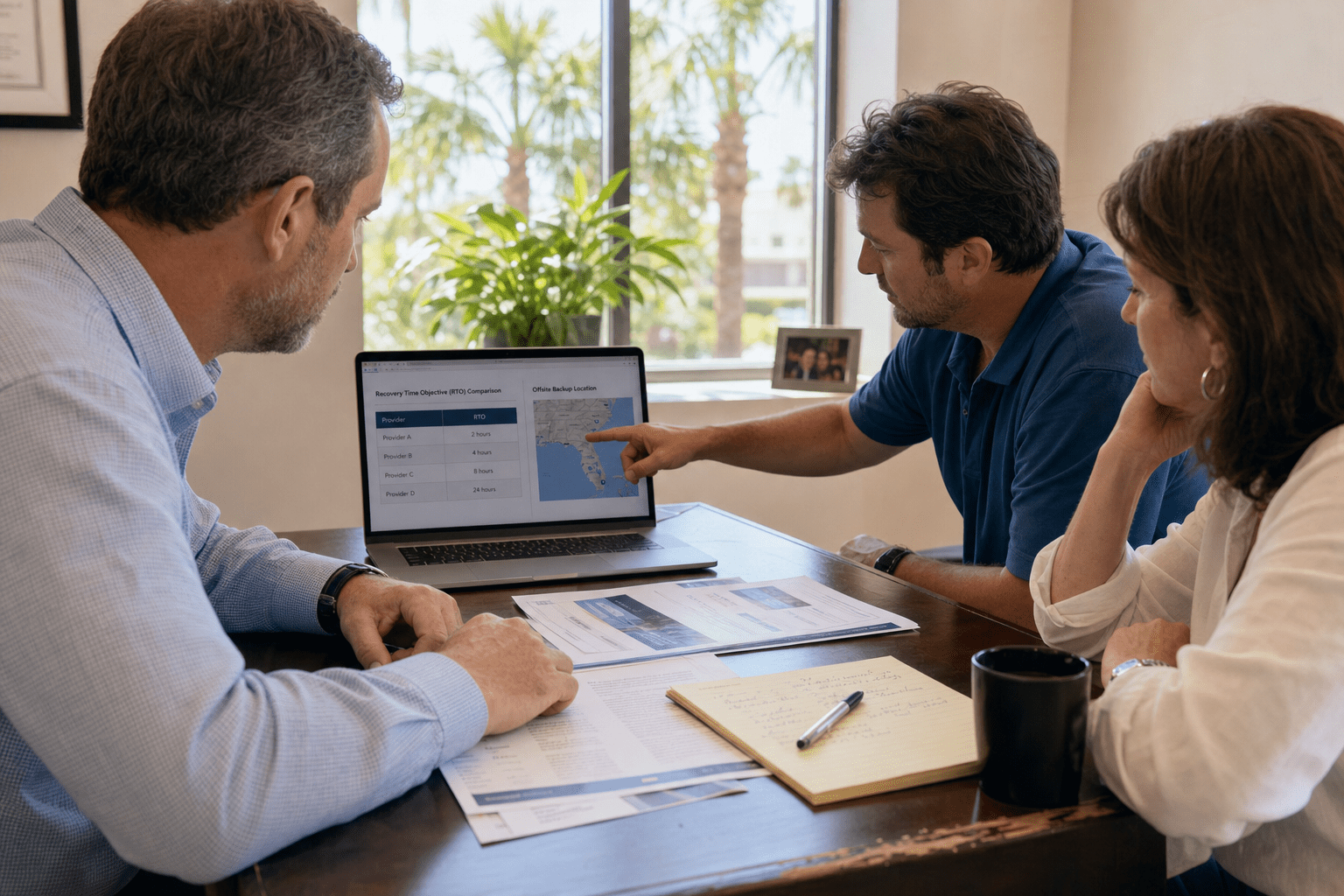
Backup and disaster recovery in Florida is the paired practice of copying your business data to a location outside the state’s storm corridor and rebuilding your systems fast enough to keep operating through a hurricane, an outage, or a ransomware attack. For a Florida business, the buying decision is unusual, because the state exposes you to storm risk on two coasts at once. A system that threatens Tampa on the Gulf side and a separate one that threatens Jacksonville or Miami on the Atlantic side means “offsite” cannot just mean the next county. This guide is written for the owner who already knows they need recovery and now has to choose a provider well.
Most businesses using Florida Backup and Disaster Recovery Services already have backups, but many still lack tested failover and recovery procedures. Where they get stuck is evaluating providers, because every vendor claims the same features. The questions that actually separate them are about geography, failover speed, and whether the recovery copy can survive ransomware. Those are the buying criteria this guide walks through.
Five Things a Florida Buyer Should Confirm Before Signing
Businesses that choose recovery well tend to confirm the same five things before they commit. Use them as your evaluation checklist.
- Where the offsite copy physically sits. It has to be outside Florida’s hurricane corridor, not a second local data center in the same path.
- How fast the provider can fail systems over. During an evacuation you need a working environment in the cloud within hours, not a multi-day rebuild.
- Whether the recovery copy is immutable. A backup an attacker can encrypt is not a recovery plan.
- What the recovery time and recovery point targets are. These numbers, written down, tell you how much downtime and data loss you are actually buying.
- How restores are tested and proven. A provider should test and document restores, not just report green backup jobs.
Why Florida Changes What You Should Buy
Florida Backup and Disaster Recovery Services should be bought against the state’s specific hazard profile, because a plan that works in a low-risk region can leave a Florida business exposed. In much of the country, a recovery plan protects against a failed server or a bad deletion. In Florida it also has to protect against a named storm that floods an office and forces staff to evacuate, and that reality should shape every part of the buying decision.
Federal business continuity guidance is direct about high-hazard regions: on-site redundancy fails when the hazard arrives, so an offsite strategy is required. For a Florida buyer, that translates into a hard question for any provider, where does my offsite copy actually live? If the answer is another Florida facility, the same storm season can reach both, and the offsite protection you paid for is weaker than it looks.
Two coasts mean geography is your first buying criterion
A backup replicated inland or out of state survives a system that a same-state copy would not. When you evaluate cloud backup, ask exactly which region the data lands in and confirm it is outside the storm corridor. This one criterion filters out a surprising number of otherwise reasonable-looking offers, and it is the difference between a copy that survives the season and one that shares your risk.
Failover speed decides whether you operate during an evacuation
Florida Backup and Disaster Recovery Services should provide a documented recovery time objective and a proven process for restoring systems during an evacuation. When a hurricane closes your office, the value of the plan is measured by whether your team can log in from wherever they evacuated and keep serving customers. Ask a provider for the recovery time objective they will commit to, and ask how the failover actually works, whether it spins up a cloud environment automatically or waits on a manual rebuild. Our business continuity disaster recovery planning is built around the evacuation case, because that is the event that tests a Florida plan.
Ransomware resilience is a criterion, not an add-on
Florida businesses face rising ransomware alongside the weather, and attackers reach for the backups first so a victim has no way out but to pay. The buying question is whether the recovery copy is immutable or air-gapped, so encrypting the live network cannot encrypt the recovery set. If a provider cannot explain how their backups resist tampering, that is a gap you will feel at the worst moment. The NIST Cybersecurity Framework names recoverability as a core function, and an immutable copy is what makes it real rather than aspirational.
How to Compare Florida Recovery Providers
Compare Florida Backup and Disaster Recovery Services by reviewing committed recovery targets, storage geography, ransomware protection, and documented restore tests. Every vendor lists backup, replication, and monitoring. The differences that matter are in the specifics you make them state in writing. Businesses across our Florida service area use the criteria below to turn a pile of similar-looking proposals into a real decision.
Make the provider commit to recovery targets
Ask for two numbers in writing. The recovery time objective is how fast the provider will have you operating again; the recovery point objective is how much recent data you could lose. A vendor who answers “it depends” without ranges is selling a product, not a recovery outcome. Match those numbers to your own tolerance: a business that cannot afford to lose a day of transactions needs continuous replication, while a quieter operation may accept a wider window and a lower cost. The point is that the numbers, not the brochure, define what you are buying.
Confirm the storage geography and the encryption
Push past “we store offsite” to the actual answer. Where is the primary copy, where is the offsite copy, and is each one encrypted at rest and in transit? For a Florida business, the offsite location has to be out of the storm corridor, and for any regulated data, you need to know who can access the copy and under what agreement. A provider who is vague about location or encryption is asking you to trust a claim you cannot verify, which is not a basis for a recovery contract.
Require proof that restores are tested
A backup is a claim until someone restores it, so ask how the provider tests recovery and whether they will share the results. The strongest disaster recovery partners run scheduled restore tests, document how long each took, and review the findings with you. A vendor who only reports that backup jobs completed is showing you the easy half. Restores are where plans fail, and a provider willing to prove them is telling you their plan actually works.
Cloud, On-Premises, or Hybrid for a Florida Business
Florida Backup and Disaster Recovery Services often use a hybrid architecture that combines fast local restores with an encrypted out-of-state cloud copy. Each model carries a real trade-off, and a good buyer weighs both sides rather than accepting a one-size pitch.
Why cloud-first fits Florida
Cloud recovery wins on geography and on speed to operate during an evacuation. An encrypted copy in a distant data center survives the flooding or wind that would destroy on-site gear, and it lets staff work from anywhere. The counterweight is that recovery depends on connectivity and on a provider you have vetted for security and location. For a state that evacuates on a schedule most years, the geographic advantage usually justifies making cloud the primary recovery path, provided you confirmed where the copy lives.
Why some local copy still earns its place
A local copy restores fastest for the common case, a deleted folder, a failed drive, a corrupted database, because you are not pulling everything back across the internet. For businesses with large data sets, that everyday speed is worth keeping. The counterweight is plain: a copy in the building shares the building’s fate in a flood, so local alone leaves you exposed to the exact disaster Florida is known for. The hybrid model resolves the tension, keeping local speed for routine failures while the out-of-state copy carries the business through hurricane season.
Frequently Asked Questions
What should a Florida business look for in a backup and disaster recovery provider?
Look for three things above the feature list: an offsite copy stored outside Florida’s storm corridor, a committed recovery time objective with fast cloud failover, and a recovery copy that is immutable against ransomware. A provider who can state all three in writing is offering a recovery outcome, not just a backup product.
Why does the offsite backup location matter so much in Florida?
Because Florida faces storm risk on both coasts, a backup stored elsewhere in the state can be hit by the same season that hits your office. Keeping the offsite copy inland or out of state means one weather system cannot destroy your primary systems and your recovery set together, which is the entire purpose of offsite protection here.
How fast can a Florida business recover after a hurricane?
With an out-of-state cloud copy and a tested failover plan, a business can often bring up a working environment within hours and let staff work from wherever they evacuated. The actual speed depends on the recovery time objective your provider commits to and on whether that failover has been tested before the storm.
Does backup and disaster recovery in Florida also cover ransomware?
It should. Ransomware is a growing threat to Florida businesses, and a strong plan keeps one backup copy immutable or air-gapped so an attacker cannot encrypt or delete it. That unreachable copy is what lets a business restore its systems instead of paying a ransom.
How can I tell if a provider’s backups actually work?
Ask how they test restores and whether they will share the documented results, including how long recovery took. A provider who only reports that backup jobs completed is showing the easy half; restores are where recovery plans fail, so proof of tested restores is the clearest sign a plan will hold up.
Talk to a Team That Answers the Hard Buying Questions
A Florida business does not need another vendor reciting the same feature list; it needs a recovery partner who can tell you where your offsite copy lives, how fast systems fail over during an evacuation, and how the recovery copy resists ransomware. Get straight answers on geography, committed recovery targets, and tested restores, and you can choose with confidence instead of hoping the plan works when the season turns. Our team builds recovery around the way Florida businesses actually operate, across both coasts and through hurricane season, with your data protected the whole way. If you want a clear read on where your business stands today and what to ask any provider you are considering, book a free strategy call and we will walk your risk with you.

