


Most businesses have spent the last several years understanding AI Agent Identity Security. Service accounts, API keys, bots, automation scripts, and AI agents now operate inside enterprise environments, and the governance frameworks built to manage these identities must evolve to accommodate AI Agent Identity Security effectively.
Then AI agents arrived, and traditional frameworks became insufficient for comprehensive AI Agent Identity Security management.
The shift from machine-to-machine communication to agent-to-agent workflows is not an incremental change to the identity security problem. It is a structural one. AI agents do not behave like service accounts. They reason, adapt, delegate, and initiate complex chains of actions across multiple systems in ways that traditional identity governance was never designed to handle. Understanding why that matters, and what businesses should be doing about it now, is one of the more important security conversations happening in 2026.
The Difference Between M2M and A2A
Traditional machine-to-machine environments are predictable by design. One service authenticates to another using well-defined credentials. Trust relationships are established in advance and remain relatively stable. The identity of the machine is static, its permissions are predefined, and its behavior follows rules that were written before it was deployed.
That predictability is what makes traditional non-human identity governance work. When a service account does something unexpected, it stands out precisely because service accounts are expected to do the same things in the same ways every time. The governance model is built around that assumption of determinism.
AI agents break the old assumptions entirely; managing AI Agent Identity Security requires acknowledging their adaptive, context-aware behavior rather than relying on deterministic rules. An enterprise AI agent supporting a finance workflow does not simply execute a predefined script. It reasons about the task, decides how to approach it, may invoke other agents to handle components of the work, and modifies its approach based on what it encounters along the way. Two invocations of the same agent by two different users for superficially similar purposes may result in completely different chains of actions across completely different systems.
Agent-to-agent communication amplifies this complexity. When one AI agent delegates a task to another, which delegates to another, which initiates actions across multiple enterprise systems, the chain of decisions and permissions extending from the original request becomes very difficult to track, validate, and govern using tools that were built for static credentials and predefined trust relationships. How multi-agent systems coordinate AI agents explains the delegation architecture that makes this governance challenge so structurally different from anything traditional identity tools were designed to address.
Why AI Agents Are Not Just Another Non-Human Identity
The instinct many organizations have when encountering AI agents is to address them like conventional machine identities, but effective AI Agent Identity Security requires new governance models tailored for agentic behavior. That instinct is understandable but insufficient.
The core problem is that AI agents share more characteristics with human employees than with service accounts, and the governance model needs to reflect that reality.
Like humans, enterprise AI agents have changing objectives. Their behavior at any given moment depends on the prompt they received, the tools available to them, the other agents they are collaborating with, and the state of the systems they are interacting with. Like humans, they can initiate actions rather than simply responding to requests. And like humans, the appropriate permissions for a given action depend heavily on context: who initiated the request, what the original purpose was, and whether the action being taken at this particular moment in a potentially long chain of delegations still reflects that original purpose.
That last point introduces what is becoming the defining governance challenge in agentic AI environments: intent.
The Intent Problem
When a human employee takes an action inside an enterprise system, accountability is relatively straightforward. There is a person, there is a context, and there is a record of what they did and when. Determining whether that action was authorized, appropriate, and consistent with the business purpose behind it is not always simple, but the identity is unambiguous.
When an AI agent takes an action several steps into a multi-agent workflow, the accountability question becomes significantly more complex. The agent acting at that moment may have been invoked by another agent, which was invoked by another agent, which was originally set in motion by a human employee making a request that seemed entirely routine. The action being taken now may or may not still reflect what that human employee originally intended when they initiated the workflow.
This is the intent problem. The original prompt provides a baseline for what the agent was supposed to accomplish. But as agents collaborate, as new tools become available, as sub-agents introduce their own capabilities and decision-making into the chain, the actions being taken can drift from that original intent in ways that are difficult to detect without continuous monitoring specifically designed to track that alignment.
An agent created in the morning may behave meaningfully differently by the evening, not because it was compromised or misconfigured, but because the agentic environment around it evolved. Prompts changed. New agents entered the workflow. Additional tools became accessible. The governance question is not just whether the agent has the right credentials. It is whether what the agent is doing right now still reflects the intent that originally authorized it to act.
Static provisioning and after-the-fact audit logs cannot answer that question. Runtime governance can.
The Hybrid Identity Challenge
One frequently proposed solution to AI agent accountability is to assign each agent a human owner. That is a reasonable starting point, but it does not fully resolve the identity problem that enterprise AI agents create.
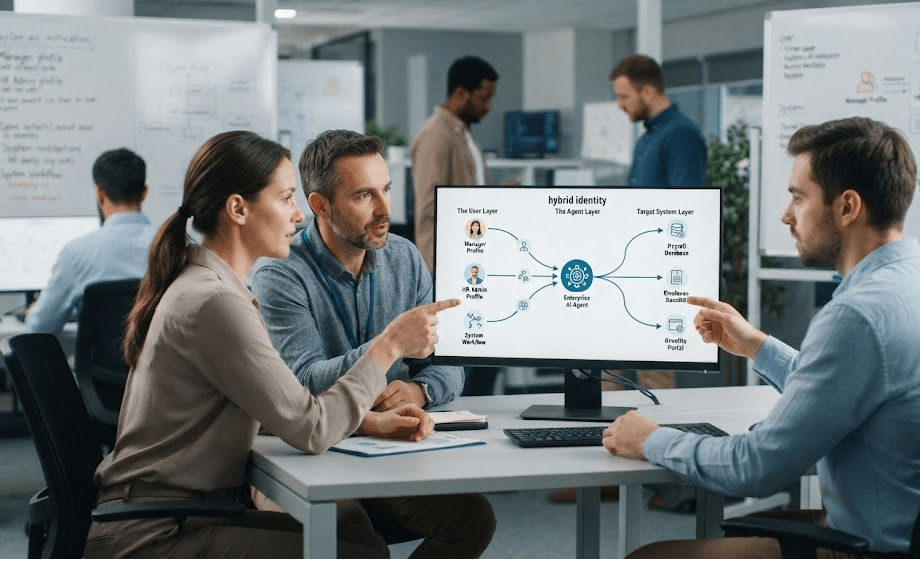
A single enterprise AI agent may be invoked by multiple employees for different purposes. An HR agent used by managers across a company does not carry a single, static identity tied to one person. Its effective identity at any given moment depends on the combination of the user who invoked it, the agent itself, and the target system being accessed. That three-layer combination changes with every invocation and creates what some security researchers are describing as a hybrid identity: neither fully human nor traditionally non-human.
Accountability in this model becomes contextual. It is not sufficient to know which agent performed an action. Organizations need to understand who initiated it, what permissions were applied in that specific context, and whether the action was consistent with the original authorization that set the workflow in motion. Traditional least-privilege controls remain important, but they cannot answer those questions on their own, particularly when the action in question occurred several hops into an agent chain that the original user never explicitly anticipated.
What Shadow Agents Mean for Security
The governance challenge is compounded by a dynamic that will be familiar to anyone who has dealt with shadow IT: shadow agents.
As AI tools become more accessible, the barrier to creating and deploying AI agents within an enterprise environment is dropping rapidly. Employees who are not technical specialists are building agents to automate their own workflows, often without the involvement or knowledge of IT and security teams. Those agents may have access to enterprise systems, handle sensitive data, and initiate actions with real business consequences, all without being inventoried, governed, or monitored.
The security implications are significant: without proper AI Agent Identity Security measures, an ungoverned agent with enterprise access expands the attack surface beyond what traditional identity security tools can handle. And because these agents can operate continuously, at machine speed, across multiple systems simultaneously, the potential blast radius of a compromised or misconfigured shadow agent is substantially larger than that of a typical ungoverned human account. Enterprise AI compliance and how to secure AI agents covers the specific governance frameworks organizations need when AI agents are operating across enterprise systems without adequate oversight.
What Businesses Should Be Doing Now
The agentic AI environment is developing faster than most enterprise security programs have been able to respond. But there are concrete steps businesses can take now to begin building a governance posture that is suited to what is coming.
Continuous discovery is the necessary starting point. Before an organization can govern its AI agents, it needs to know what agents exist in its environment, including the ones that were deployed without IT involvement. Building an accurate, continuously updated inventory of every enterprise AI agent, authorized and unauthorized, is the foundation on which everything else depends.
Identity assignment follows from discovery. Each agent should receive its own governed identity, treated with the same rigor applied to human employee identities. That means a defined onboarding process, explicit permission scoping, an accountable human owner, and a clear record of what the agent is authorized to do and why.
Runtime monitoring is where traditional NHI governance frameworks fall short and where new approaches are needed. Continuously evaluating whether an agent’s actions remain aligned with the intent that originally authorized it, detecting behavioral anomalies, and identifying unauthorized delegation before it creates exposure requires monitoring that operates in real time throughout the agent’s workflow, not just at provisioning and not just in retrospective logs. Managed security services with behavioral analytics capability provide the continuous monitoring layer that agent identity governance requires.
Lifecycle governance rounds out the framework. The same joiner-mover-leaver processes that govern human employee identities should be extended to AI agents. Agents should be formally onboarded with defined permissions, monitored continuously as their behavior evolves, updated when the business purpose they serve changes, and formally retired when they are no longer needed. An agent that continues operating after its original purpose has been fulfilled is a governance gap that attackers can exploit.
The Broader Security Implication for SMBs
This conversation often feels like it belongs in large enterprise security teams with dedicated identity governance programs and substantial security budgets. But the reality is that small and mid-sized businesses are deploying AI agents at the same pace as larger organizations, often faster, and with significantly less governance infrastructure in place.
If your team is using AI tools that can take actions inside your business systems, connect to external services, or handle sensitive data, you already have an AI agent identity problem, whether or not you have started thinking about it in those terms. The question is not whether to build governance around your agentic AI environment. It is how quickly you can do it before the gap between capability and governance creates an exposure you did not see coming.
At Mindcore Technologies, we work with small and mid-sized businesses to evaluate their current identity security posture, identify where AI agent activity is creating ungoverned exposure, and build the monitoring and governance frameworks that match the operating environment businesses are actually running in 2026. A structured IT risk assessment that includes AI agent inventory and access control review is the starting point for organizations that are not yet certain where their agentic AI exposure actually sits.
Meet Our CEO, Matt Rosenthal
Matt Rosenthal is the President and CEO of Mindcore Technologies. With deep experience in cybersecurity strategy and managed IT services for small and mid-sized businesses, Matt leads a team that helps SMBs navigate the evolving identity security landscape, including the governance challenges introduced by AI agents and agentic workflows. He works directly with business owners and IT leaders to build security programs that stay ahead of a threat environment that does not stop evolving.
Frequently Asked Questions
What is the difference between machine-to-machine and agent-to-agent communication?
Machine-to-machine communication involves deterministic systems following predefined rules and static credentials. Agent-to-agent communication involves AI agents that reason, adapt, delegate tasks to other agents, and initiate complex chains of actions across multiple systems. The unpredictability and autonomy of AI agents make traditional identity governance frameworks insufficient for managing them.
Why can’t existing non-human identity governance tools manage AI agents?
Existing non-human identity governance tools were built for deterministic identities like service accounts and API keys, whose behavior is static and predictable. AI agents continuously reason and adapt at runtime, invoke sub-agents, and make independent decisions that can drift from the original intent of the workflow. Governing them requires runtime monitoring and intent validation that traditional NHI tools were not designed to provide.
What is a shadow agent and why does it matter for security?
A shadow agent is an AI agent deployed within an enterprise environment without the knowledge or involvement of IT and security teams. As AI tools become more accessible, employees across all functions are building agents to automate their own workflows, often with access to sensitive systems and data. Ungoverned shadow agents represent a significant and often invisible attack surface.
What does runtime governance mean for AI agents?
Runtime governance means continuously evaluating every action an AI agent takes against current identity, context, policy, and the original intent that authorized the agent to act. Rather than relying solely on provisioning controls and after-the-fact audit logs, runtime governance maintains identity integrity throughout multi-agent workflows and detects intent drift, behavioral anomalies, and unauthorized delegation in real time.
How should businesses think about AI agent identity lifecycle management?
AI agents should be governed through the same lifecycle framework applied to human employees. That means a formal onboarding process with defined permissions and an accountable owner, continuous monitoring as behavior evolves, updates when the business purpose changes, and formal retirement when the agent is no longer needed. Agents that continue operating beyond their original purpose without governance review are a security gap. The AI agent implementation checklist for business executives covers the governance steps organizations should complete before deploying agents that will operate across enterprise systems.
How does this affect small and mid-sized businesses specifically?
SMBs are deploying AI agents at the same pace as larger enterprises but typically with less governance infrastructure in place. Any business using AI tools that can take actions inside enterprise systems, connect to external services, or handle sensitive data already has an AI agent identity exposure that needs to be addressed. Schedule a consultation with our team to assess where your current posture stands.
AI Agent Identity Security and Agentic Workflow Governance Expertise from Matt Rosenthal
Matt Rosenthal, CEO of Mindcore Technologies, has over 30 years of experience helping SMBs build identity security programs that keep pace with the actual operating environment their businesses run in, including the governance challenges introduced when AI agents that reason, delegate, and adapt across multi-agent workflows replace the deterministic service accounts that traditional NHI frameworks were designed to manage. He has seen firsthand how small and mid-sized businesses deploy AI tools that take actions inside enterprise systems and handle sensitive data without any inventory, governance, or monitoring in place, creating shadow agent exposure that grows at machine speed across multiple systems simultaneously while the security program is still looking for the human account that should have been offboarded. Matt leads a team that starts AI agent governance with continuous discovery to surface every agent operating in the environment including the ones deployed without IT involvement, assigns each a governed identity with a defined permission scope and an accountable human owner, and applies runtime monitoring that evaluates whether agent actions remain aligned with the original intent that authorized them rather than relying on provisioning controls and audit logs that cannot catch intent drift several hops into an agent chain.

