

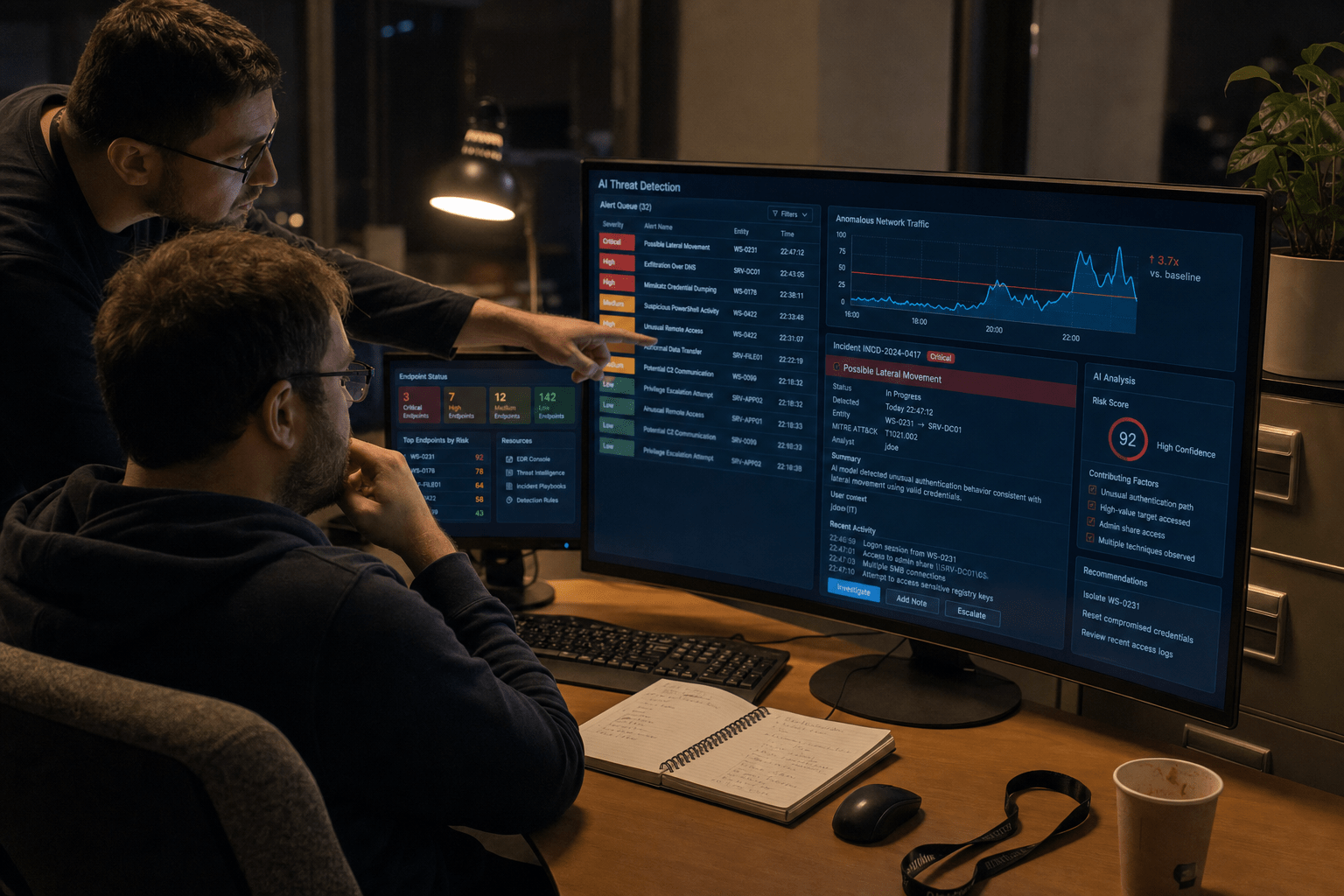
AI in cybersecurity operations means using machine learning, behavioral analytics, and automated response to detect and contain threats faster than a human analyst can read an alert queue. For a 50 to 500 employee company, it works, and we see it work every week. The exposure is not the model. It is everything the vendor demo leaves out: who reviews an automated containment at 2 a.m., who retunes the detection logic after a network change, and who answers the auditor asking why a machine quarantined a payroll server. Those seven gaps are what we walk through below.
Overview: What Small Security Teams Need to Know First
Five points carry this whole article, written for the IT manager or fractional security lead at a 50 to 500 employee firm who already owns too much:
- AI shifts the workload, it does not remove it. Triage volume drops, tuning and review work goes up. Nobody staffs for the second half.
- Automated response needs a written blast radius. An agent that can isolate an endpoint can isolate the wrong endpoint during month-end close.
- Detection quality decays. A model trained on last quarter’s traffic pattern quietly loses accuracy after a migration, a merger, or a new SaaS rollout.
- Auditors want the reasoning, not the verdict. If your tooling cannot show why it acted, your compliance evidence has a hole in it.
- Attackers use the same tooling. Voice cloning and machine-written phishing raised the floor on what a convincing lure looks like.
Why AI in Cybersecurity Operations Fails Small Teams First
AI in cybersecurity operations fails small teams first because the technology assumes a staffed security operations center behind it, and most SMBs are running one generalist and a service desk. Enterprise buyers pair the platform with three analysts and a detection engineer. The platform does not know it is missing them. It keeps producing high-confidence findings that sit unread.
The Alert Volume Argument Cuts Both Ways
Alert triage is the strongest case for AI in cybersecurity operations, and it is also where the most damage happens. In favor: behavioral models collapse thousands of raw events into a handful of ranked incidents, and a one-person team finally gets a queue they can finish. Against: ranking is a judgment call the model makes on your behalf, and a medium-confidence lateral movement signal can sit at position 40 while a noisy but harmless backup job holds the top slot.
Both readings are correct at once. Ranked queues are better than raw ones. They are also opaque, and an SMB rarely has the bench depth to sample what the model deprioritized. Our practice is to review a random sample of low-ranked findings weekly, which is unglamorous work that catches real intrusions.
Tuning Debt Is Real Debt
Every detection platform ships with baseline logic that assumes a stable environment. Add a warehouse VLAN, move file shares to SharePoint, or onboard 30 seasonal staff, and the baseline is wrong. The optimistic view holds that self-learning models re-baseline on their own, and modern platforms genuinely do adapt. The skeptical view holds that adaptation is what hides the drift, because the model normalizes the attacker’s activity along with everything else.
We treat tuning as a standing monthly task, not a project. Teams that skip it get a system that is confident and quiet at the same time, which is the worst pair of properties a detection tool can have. Our approach to continuous AI operations monitoring exists because that drift is invisible from inside the dashboard.
The Staffing Math Nobody Runs Before Signing
Vendors price on endpoints. Cost lands on hours. A platform that saves 15 triage hours a week and adds 6 hours of tuning, review, and escalation handling is still a strong trade, but it is not the zero-headcount story in the sales deck. We ask clients to write down who owns three named duties before purchase: model review, response approval, and after-hours escalation. If two of the three land on the same person, the deployment will drift within a quarter. Firms mapping this out early usually start with a realistic cybersecurity budget rather than a tool list.
Risks 1 Through 4: Detection, Data, and Vendor Claims
The first four risks in AI in cybersecurity operations sit inside the detection layer itself, where confidence scores are easy to read and easy to trust more than they deserve.
Risk 1 and 2: False Confidence and Silent Coverage Gaps
Risk 1, confidence inflation. Scores are calibrated against the vendor’s training population, not your network. A 92 percent finding in a healthcare client’s environment and a 92 percent finding in a manufacturing client’s environment are not the same claim. Treat the score as a sort order, never as a verdict.
Risk 2, silent coverage gaps. The platform reports on what it ingests. Miss a log source, an unmanaged contractor laptop, an OT segment, a legacy line-of-business server, and the dashboard still reads green because absence of telemetry looks identical to absence of threat. We run a quarterly source inventory against the asset list, and we have never once found them matched on the first pass.
Risk 3 and 4: Training Data Exposure and Vendor Opacity
Risk 3, what leaves your network. Some platforms send file content, email bodies, or full packet captures to a shared cloud tenant for analysis. That may be acceptable. It may also be a business associate agreement problem, a CMMC scoping problem, or a client contract problem. Read the data-flow appendix before the marketing page. Teams under federal contract obligations should map this against their CMMC certification scope rather than assume the vendor handled it.
Risk 4, unexplainable decisions. When an auditor asks why an account was disabled on the 14th, “the model flagged it” is not evidence. Insist on a decision log that captures the triggering signals, the rule or model version, and the human who approved the action. This is the thin layer that turns automated response into defensible cybersecurity compliance documentation.
Risks 5 Through 7: Identity, Attackers, and Governance
The last three risks are the ones that show up during an incident rather than during a review, which is why they stay invisible until the worst possible week.
Risk 5 and 6: Automated Response Blast Radius and After-Hours Ownership
Risk 5, containment that overreaches. Auto-isolation is the highest-value automation available to a small team and the fastest way to cause a self-inflicted outage. We scope it in writing: which asset classes an agent may isolate without approval, which ones require a human, and which are permanently excluded. Domain controllers, ERP hosts, and clinical systems belong in that third group. Getting the scope right is the same discipline behind reducing cybersecurity risk without slowing operations.
Risk 6, the unowned night shift. This is the failure we see most. Automation fires at 1:40 a.m., contains one endpoint, and posts a notification into a channel nobody reads until 8. The attacker had six hours on the rest of the network. We covered the pattern in detail when we mapped the after-hours blind spots in AI security operations, and the fix is procedural, not technical: a named on-call human with an acknowledgement clock, backed by a real emergency cybersecurity response path.
Risk 7: The Attackers Adopted It First
Risk 7, adversarial parity. Machine-written phishing removed the grammar tells your staff were trained to spot, and voice cloning has made callback and helpdesk-reset fraud far more convincing. Awareness training built around “look for typos” is now actively misleading. Rebuild it around process verification, out-of-band confirmation for payment changes, and hard rules for credential resets. That is why refreshed security awareness training matters more now, not less, and why email remains the number one threat vector even in an AI-defended environment.
How SMBs Put AI in Cybersecurity Operations to Work Safely
SMBs deploy AI in cybersecurity operations safely by narrowing the automation scope, naming the humans in the loop, and reviewing the model’s misses on a schedule. Four moves, in this order:
- Start read-only. Run detection and enrichment for 30 days with no automated action. You learn the false-positive shape of your own network before you hand it authority.
- Write the response matrix. Asset class by asset class, note auto-approved, human-approved, or excluded. One page. Signed by whoever owns the outage risk.
- Assign the three duties. Model review, response approval, after-hours escalation, with a named person and a backup on each.
- Sample the misses monthly. Pull 20 low-ranked findings and read them properly. This is the single practice that separates a working deployment from an expensive dashboard.
None of that requires a security operations center of your own. It requires an owner. Our cybersecurity services team runs this exact sequence with clients who want the speed of automation without inheriting the assumptions attached to it.
Frequently Asked Questions
Is AI in cybersecurity operations worth it for a company under 200 employees?
Yes, for detection and triage, where it compresses work a small team cannot otherwise finish. The value depends on someone owning model review and after-hours escalation, so budget the hours alongside the license rather than treating the platform as a headcount replacement.
Can AI replace a security analyst at an SMB?
No. It replaces the first pass of alert triage, which is roughly the lowest-value hour of an analyst’s day. Judgment calls on containment, business context, and communication during an incident stay human, and the automation actually increases the volume of those calls.
What is the most common mistake SMBs make with AI security tooling?
Turning on automated containment before mapping which systems it may touch. The second most common is leaving the after-hours notification path unowned, so an overnight detection sits unread until morning.
Does AI in cybersecurity operations create compliance problems?
It can, in two ways. Some platforms move sensitive data to a shared cloud tenant, which needs review against your contracts and framework scope, and automated actions without a decision log leave you unable to show an auditor why a control fired.
How do we tell whether our AI detection is still accurate?
Sample what it ranked lowest, not what it ranked highest. Pull 20 low-confidence findings monthly and read them in full. Rising numbers of real signals in that sample mean the baseline has drifted and the detection logic needs retuning.
Talk to Mindcore About AI in Cybersecurity Operations
AI in cybersecurity operations earns its place in a small security program when the automation scope is written down, the review work is owned, and the after-hours path has a human name on it. Skip those three and you have bought a faster way to generate findings nobody reads. The firms getting real value from this are not the ones with the largest platform. They are the ones who decided in advance what the machine is allowed to do alone, and who checks its work. If you want a second set of eyes on a deployment you already own, or a plan for one you are considering, book a free strategy call with our team and we will walk your environment with you.

