

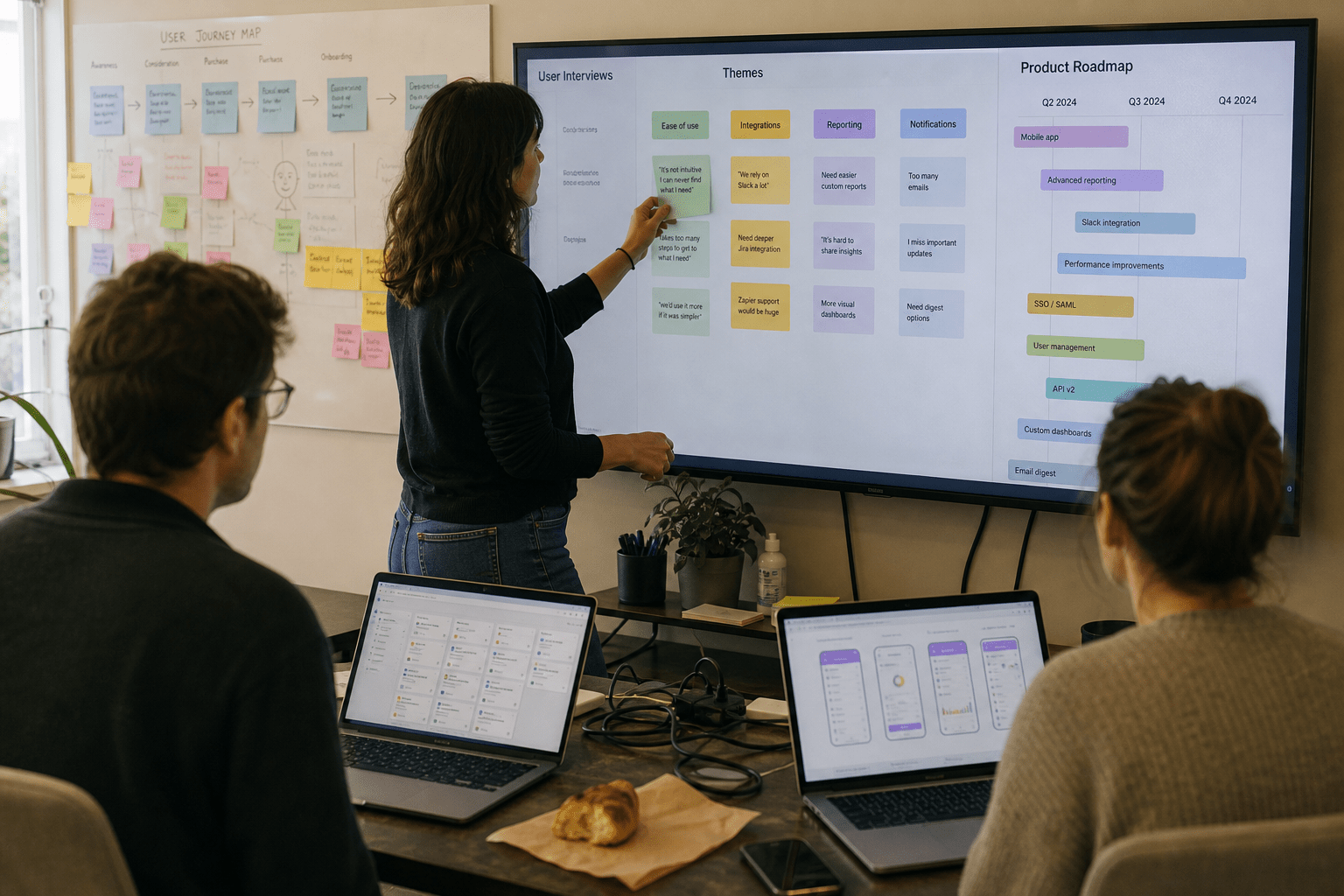
The best AI tools for product teams in 2026 cover four jobs: synthesizing user research, keeping the roadmap and its inputs current, writing specifications, and getting to a working prototype quickly. Dovetail and Grain handle research synthesis, turning interview recordings into extracted themes and shareable highlights. Productboard organizes roadmap inputs. Claude and Notion carry specification writing. Amplitude covers product analytics, Crayon and Klue competitive intelligence, and Lovable and v0 generate working prototypes from a description. Teams adopting these well report reclaiming five to ten hours a week per manager. They also, almost always, adopted them without anyone reviewing where the customer recordings went.
Five Things to Settle Before the Team Adds Another Tool
We put these five to product and engineering leaders, because product organizations adopt faster than any other function and the questions rarely get asked until something goes wrong.
- Customer research is personal data. Interview recordings carry names, faces, voices, employer details, and candid opinions about products and colleagues. That is regulated material in most jurisdictions and it deserves better handling than it usually gets.
- Self serve adoption outruns governance. Product tools are bought on a card in five minutes. By the time anyone asks what is in use, the answer is a dozen products nobody reviewed.
- Prototype output is not production code. Generated applications are excellent for validating an idea and carry the security assumptions of whatever produced them. Shipping one unreviewed is how avoidable vulnerabilities reach customers.
- Roadmap and competitive data are commercially sensitive. Unreleased plans and win loss analysis are exactly what a competitor would pay for, and they get pasted into general assistants routinely.
- Measure hours returned, not tools adopted. The stack grows easily. The only figure worth defending is what came back to the team, and it needs a baseline.
Product Teams Are the Largest Unmanaged AI Footprint in Most Companies
Product organizations adopt AI faster than anyone else in the business, and that speed is a genuine advantage attached to a governance problem nobody has scoped. This is not a criticism of product people. The function rewards moving quickly, the tools are cheap and self serve, and waiting weeks for a review would cost real velocity. The consequence is predictable. A researcher uploads twenty customer interviews to a synthesis platform. A manager pastes the unreleased roadmap into an assistant to draft a stakeholder update. A designer generates a prototype containing what looks a great deal like the production data model. None of it passed a review, all of it made sense to the person doing it, and the company’s actual AI footprint is far larger than any inventory shows. The first time this surfaces properly is usually during a security questionnaire from an enterprise customer asking which subprocessors handle their data.
Customer Research Data Deserves Real Handling
Interview recordings and transcripts are the most sensitive material a product team touches, and they are routinely treated as working files. Consider what a single research session contains: the participant’s name and face, their employer, their role, candid criticism of a product they pay for, and sometimes commercially confidential detail about how their own company operates. Participants consented to research, and that consent rarely mentioned a third party AI platform retaining the recording indefinitely and possibly training on it. The workable arrangement is not complicated. Use one approved synthesis platform rather than several, confirm in the contract that recordings are not used to train shared models, set a retention period and actually enforce it, and update the participant consent language to describe what really happens. Doing this once removes a category of risk permanently, and it costs a fraction of the effort of unwinding it after a customer asks.
An Approved List Beats a Prohibition Every Time
Telling a product team to stop using AI tools does not reduce usage, it reduces visibility, which is strictly worse. We have watched organizations issue that instruction and then discover twice as many tools in use six months later, now paid for personally and invisible to finance. The arrangement that works pairs a short published list of approved tools with a fast route to add something new. Fast means days, not a quarterly review board, because the entire reason people go around the process is that the process is slower than their deadline. Name which data classifications each approved tool may handle, using categories product people actually recognize, such as customer recordings, unreleased roadmap, production data, and public material. Then make the approved options genuinely good, since an approved tool nobody wants to use produces the same shadow adoption as a ban. Our overview of choosing team collaboration tools covers the same principle applied more broadly.
Best AI Tools for Product Teams by Job
The best AI tools for product teams sort by job, and adopting one job at a time keeps the stack comprehensible and the value measurable. Research tooling is judged on time from session to shareable insight. Roadmap tooling is judged on whether inputs stay current without chasing. Specification tooling is judged on adoption. Prototyping is judged on decisions reached faster. Here is where the field currently sits.
User Research and Customer Insight
Research synthesis is where the largest single block of manual time disappears. Dovetail organizes qualitative research and surfaces themes across sessions, which is the difference between a researcher who can analyze five interviews properly and one who can analyze twenty. Grain records and transcribes interviews and customer calls, identifies key moments, extracts quotes, generates summaries, and builds highlight reels that can be shared with stakeholders, which matters because the highlight reel is what actually changes an executive’s mind. Reports of synthesizing twenty interview recordings into structured insights within minutes are broadly consistent with what we see, with the caveat that the synthesis needs a researcher’s judgment applied afterward. The pattern that fails is treating extracted themes as findings. The pattern that works is treating them as a fast first pass a human then interrogates for what the model flattened. That last word carries the risk worth naming. Synthesis tools cluster by similarity, which means they reliably surface what several participants said and reliably bury the one participant who said something nobody else did. In research, the outlier is frequently the most valuable observation in the set, because it points at a segment or a use case the team had not considered. A researcher reading raw transcripts notices it. A dashboard of ranked themes does not present it, since by definition it appears once. The practical habit is to keep reading a sample of full sessions rather than working exclusively from the summary, and to treat any theme that appears only once as worth a second look rather than as noise to be filtered out.
Roadmap, Specifications, and Delivery
This category succeeds on integration rather than on capability. Productboard AI organizes roadmap inputs, connecting customer feedback, sales requests, and support signals to the prioritization decision so the roadmap reflects evidence rather than the loudest recent conversation. Linear has become the default for many teams on delivery tracking, with AI assisting triage and summarization inside a workflow engineers already live in. For specification writing, Claude and Notion AI both draft capably from rough input, and the practical constraint is that a specification is a thinking artifact, so a generated draft is a starting point rather than a deliverable. Airtable ProductCentral schedules tasks dynamically and triggers actions on status changes, which suits teams coordinating across several workstreams. Where product work happens inside Microsoft Teams, keeping the discussion, the decision, and the artifact in one place matters more than any individual tool’s features.
Prototyping, Analytics, and Competitive Intelligence
Prototyping tools have changed what a product team can validate in a week. Lovable generates full stack web applications from minimal input, and v0 produces interface code quickly, which together mean a question that used to require engineering time can often be answered with a working artifact instead of a slide. The discipline that has to accompany this is clear: generated applications are for validation, and anything heading toward production needs the same review, dependency checks, and security assessment as hand written code. On analytics, Amplitude applies AI to behavioural data so a product manager can ask a question directly rather than filing a request with a data team. For competitive intelligence, Crayon and Klue track competitor movement continuously, which replaces the scramble that used to precede every quarterly review. Our note on AI cybersecurity tools covers the review side of that pipeline.
Judge the Stack on Hours Returned, Not on Tools Adopted
Product organizations accumulate tools easily and evaluate them rarely, which is how a stack reaches a dozen subscriptions nobody can justify individually. The counting habit that helps is simple and unpopular. Before adopting a tool, write down the specific activity it is meant to shorten and roughly how long that activity takes today: hours per week synthesizing research, days from request to a first specification draft, time from idea to something a customer can react to. Sixty days later, measure the same thing. Reported gains of five to ten hours a week per manager are plausible and they are averages across teams that adopted deliberately, not guarantees attached to a licence. Some tools will not deliver, and finding that out cheaply is the point of measuring rather than an indictment of the experiment. Run a quarterly review of what is actually being used, cancel what is not, and consolidate where two products overlap. Teams that do this keep a stack they can explain to a finance director, and more usefully, one that new joiners can learn without a fortnight of orientation.
What Product AI Needs From Company IT
Product teams sit closer to production systems and customer data than almost any other function, which makes their tool choices an infrastructure question rather than a departmental one. The specific exposures are worth naming. Prototyping tools often want repository access. Analytics platforms connect to production event streams. Research tools hold recordings of identifiable customers. Each is a legitimate integration and each is a path into something that matters. Single sign on across the approved stack, named accounts rather than a shared team login on a corporate card, scoped tokens for anything touching a repository, and an offboarding process that actually reaches these tools are the baseline. That last one fails constantly, because a departing product manager’s accounts on a dozen self serve platforms are invisible to an offboarding checklist built around the core systems. Our overview of managed IT services software covers the operational tooling that makes this manageable.
There is a further consideration specific to companies selling into enterprise customers. Those customers increasingly ask, in security questionnaires and in contract negotiations, which subprocessors touch their data, and a product team’s research and analytics stack is squarely within scope of that question. An organization that cannot answer confidently either delays a deal or answers inaccurately, and the second is considerably worse. Keeping a current list of which tools handle customer data, what each retains, and where it sits is not bureaucratic overhead in that context. It is a sales asset, and it is far easier to maintain continuously than to assemble under deadline while a procurement team waits. Teams that treat the inventory as a living document rather than an annual exercise find the questionnaire becomes routine rather than disruptive, and our note on unifying business communications covers a related consolidation benefit.
Frequently Asked Questions
What are the best AI tools for product teams right now?
Dovetail and Grain lead research synthesis. Productboard organizes roadmap inputs and Linear covers delivery. Claude and Notion AI handle specification drafting. Lovable and v0 generate working prototypes. Amplitude covers product analytics, with Crayon and Klue for competitive intelligence. Most teams run several rather than one.
Is it safe to upload customer interviews to AI tools?
It can be, with the right arrangement. Confirm the vendor does not train shared models on your recordings, set and enforce a retention period, restrict access to the research team, and make sure participant consent language actually describes what happens to the recording. Treat interview data as the sensitive personal information it is.
Can AI replace user research?
No. It compresses synthesis, which is the mechanical part, and it does not conduct the interview, read the hesitation in an answer, or decide which contradiction is worth chasing. Teams that treat extracted themes as finished findings tend to lose exactly the surprising detail that made the research worth doing.
Should we ship AI generated prototype code to production?
Not without the same review any code receives. Generated applications are outstanding for validating an idea quickly and carry whatever security and dependency assumptions the generator made. Treat the prototype as a decision aid, then build the production version with normal engineering review.
How do we manage AI tool sprawl on a product team?
Publish a short approved list with the data classifications each tool may handle, provide a genuinely fast route to add something new, and make sure offboarding reaches self serve platforms rather than only core systems. Prohibitions reduce visibility rather than usage, which leaves the company worse informed.
Who Is Behind This Guidance
Mindcore works with technology and product organizations on the layer beneath the tooling: single sign on across a sprawling stack, scoped access for platforms that reach repositories and production data, offboarding that actually reaches self serve subscriptions, and the vendor reviews that answer an enterprise customer’s subprocessor question. That is why this article leads with customer research data rather than with a product ranking. We have seen organizations discover their real AI footprint during a security questionnaire, which is the most expensive moment to find out. Matt Rosenthal, who leads Mindcore, has focused the company on organizations in exactly this position: moving fast enough that governance lags, lean enough that nobody internally owns it. The product decisions stay with your team. Making the environment underneath defensible is our part.
Book a Free Strategy Call Before the Stack Grows Again
Choosing among these tools becomes far easier once a product organization knows what it already runs and which data each tool holds. Research, roadmap, specification, and prototyping are four separate decisions, and adopting one at a time against a baseline of hours returned keeps the stack comprehensible instead of accumulating. Ahead of the next subscription, inventory what is genuinely in use today, publish a short approved list with clear data rules, and check that offboarding reaches the self serve tools rather than only the core systems. Those three determine whether speed stays an advantage or becomes a liability the first time a customer asks a hard question. If you want an outside read on where your environment stands, we will assess it and say plainly what to address first. Book a free strategy call with our team. Teams weighing the wider tooling question may also find our comparison of Microsoft Teams and the alternatives and our overview of IT tools for growing organizations worth reading.

