

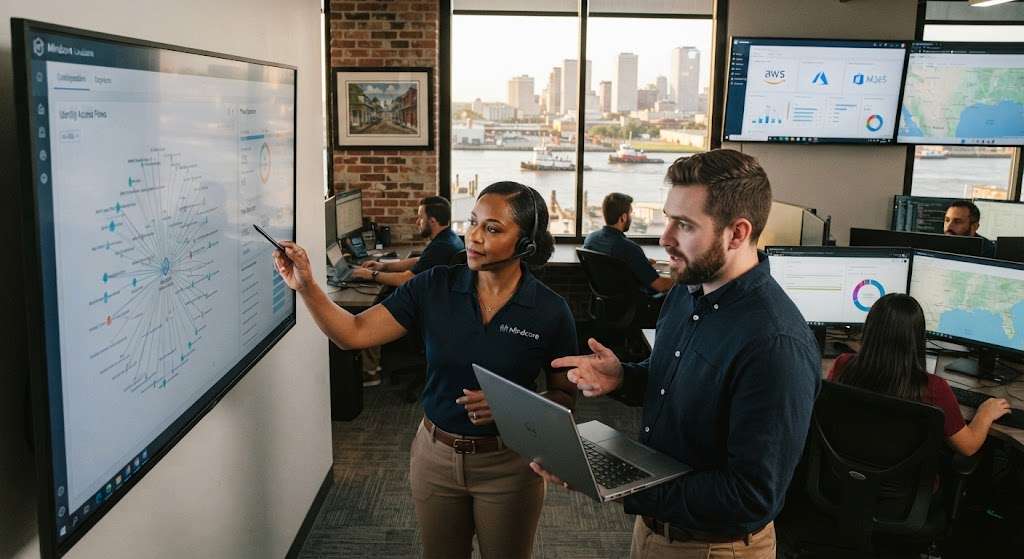
Cloud security for a New Orleans business is almost never about the cloud provider failing. Microsoft, Amazon, and Google secure their platforms better than any mid-market organization could. What breaks is the half of the arrangement that belongs to you: identity, permissions, sharing defaults, logging, and the applications your staff connected to the tenant without telling anyone. Mindcore operates from New Orleans and delivers cloud security to organizations across the region, including maritime and port operators, offshore energy support companies, healthcare providers, hospitality and food service groups, aerospace and defense suppliers, and professional services firms. If you are evaluating providers, ask each one to show you what they would actually check in your tenant during the first week.
What Our Cloud Security Services Cover
Identity and access hardening. Conditional access policy design, multi-factor enforcement including phishing-resistant methods, privileged role review, and break-glass account management.
Tenant configuration review. External sharing defaults, guest access, legacy authentication, mailbox forwarding rules, and the settings that ship permissive and stay that way.
Posture monitoring. Continuous checks for misconfiguration across Microsoft 365, Azure, and AWS, so drift gets caught rather than discovered.
Third-party and OAuth governance. Inventory and review of applications holding standing access to your tenant, which is the most overlooked path into cloud data.
Cloud backup. Independent, immutable backup of Microsoft 365 and cloud workloads, held outside the provider you are protecting against.
Logging and detection. Extending default log retention, centralizing telemetry, and monitoring for token theft and session hijacking rather than only failed passwords.
Compliance support. Evidence and control mapping for HIPAA, PCI DSS, NIST 800-171 and CMMC, and Coast Guard cybersecurity requirements. See our cybersecurity services.

The Shared Responsibility Gap
Every cloud provider publishes a shared responsibility model, and almost every organization we assess has read it as more favorable than it is.
The provider secures the infrastructure, the physical facilities, and the platform itself. You are responsible for identity, access permissions, data classification, configuration, and the security of anything you connect. When a cloud breach makes the news, the cause is almost always on the customer side of that line: a storage container left public, an administrative account without strong multi-factor authentication, a permission granted broadly during a migration and never narrowed, or a third-party application with more access than anyone intended.
The practical version of this is a checklist most organizations have never worked through. Is legacy authentication disabled. Do you know how many global administrators exist. Is external sharing set to something you chose deliberately. Can a user consent to a third-party application reaching corporate data without an administrator approving it. How long are your audit logs retained, and is that long enough to investigate something you find out about two months late. None of those questions are hard. They are simply nobody’s job by default, which is why we work through them during an IT assessment before recommending any tooling.
Identity Is the Perimeter Now
Once workloads move to cloud platforms, the network boundary stops being the control that matters and identity takes over. Attackers have adapted faster than most security programs have.
The technique that should shape your priorities is session theft. Information-stealing malware harvests authenticated session tokens from a browser, and those tokens let an attacker resume a logged-in session without a password and without triggering multi-factor authentication, because the authentication already happened. A password reset does not fix it. Revoking the session does. That single fact reorders what matters: token lifetime, sign-in risk detection, device compliance conditions, and the ability to revoke sessions quickly all outrank password complexity.
The second identity issue is non-human access. Service principals, application registrations, API keys, and integration accounts accumulate during every migration and every new tool rollout, they rarely expire, and they almost never appear in an access review. Increasingly they include AI assistants and agents holding delegated permissions into mailboxes, file stores, and ticketing systems. Those are privileged accounts, and treating them as configuration rather than as identities is how organizations end up with standing access nobody provisioned.

Your Cloud Provider Is Not Backing Up Your Data
This is the single most common dangerous assumption we encounter, and it costs organizations real data.
Microsoft, Google, and the major platform providers maintain their own infrastructure resilience. That is not the same as backing up your tenant for you. Recycle bins and retention policies are time-limited and configurable, which means they can be shortened, disabled, or exhausted. Neither protects you from an administrator deleting the wrong thing, a departing employee clearing a mailbox, a ransomware operator with valid credentials, or a retention policy someone changed a year ago.
Independent backup means a copy held outside the platform you are protecting, immutable within its retention window, restorable at the granularity you actually need, and tested. For most organizations the test is the missing piece. A backup that has never been restored is an assumption, and it belongs in the same conversation as the rest of your business continuity planning.
Industries We Support in the New Orleans Region
Maritime, port, and terminal operations. The Coast Guard’s Cybersecurity in the Marine Transportation System rule took effect in July 2025 for US-flagged vessels, Outer Continental Shelf facilities, and MTSA-regulated facilities. The personnel training requirement came due in January 2026, and by July 2027 owners and operators must designate a Cybersecurity Officer, complete a Cybersecurity Assessment, and submit a Cybersecurity Plan for approval. Cyber incidents that disrupt port operations are now treated as Transportation Security Incidents. For most operators a large share of the IT systems inside that assessment scope are cloud systems, which puts tenant configuration, identity, and logging directly into the compliance conversation.
Offshore energy and marine support services. Distributed workforces, vessel and rig connectivity with intermittent bandwidth, and contractor access that needs to be scoped and time-bound rather than standing.
Healthcare. HIPAA obligations applied to cloud environments, where the practical work is access control, audit logging, business associate agreements with every vendor touching protected health information, and backup that can actually restore.
Hospitality, restaurants, and food service. High turnover creating constant provisioning and offboarding volume, card handling bringing PCI DSS scope, and franchise or multi-property structures that fragment administration.
Aerospace and defense suppliers. Export-controlled technical data and controlled unclassified information constrain which cloud tenants and regions you can use and who may hold administrative access. See our CMMC compliance services.
Legal and professional services. Client confidentiality obligations, external sharing that has to be controlled without breaking collaboration, and email as the primary risk surface.
Cloud Does Not Mean Storm-Proof
New Orleans organizations moved to cloud platforms partly for resilience, and that logic is sound as far as it goes. Your tenant will survive a hurricane that takes your building.
What often does not survive is your access to it. Organizations running hybrid identity still authenticate through on-premises domain controllers or connectors sitting in the affected facility, so cloud applications that looked independent stop accepting logins when that hardware goes dark. Conditional access policies scoped to local IP ranges lock out your own evacuated staff the moment they log in from Texas or Georgia. Multi-factor infrastructure hosted on site fails with the site. Each of these is a design decision that can be checked in advance and fixed cheaply, and each is discovered at the worst possible moment when it is not.
We review these dependencies as part of continuity planning rather than treating cloud migration as having settled the question.
Why Organizations Work With Us
We are based in New Orleans, which means onsite work here is routine rather than a travel event, and we support organizations across multiple states from a small number of operations centers, so regional clients get the same security operations and engineering bench as our largest markets.
We also quote from an assessment rather than from a headcount, and we put excluded scope in writing before anyone signs. Cloud security proposals are unusually easy to compare badly, because two providers can both offer monitoring and mean very different things by it.
Common Questions About Cloud Security in New Orleans
Is Microsoft 365 secure by default? It is securely built and permissively configured. Several settings that matter most, including external sharing behavior, user consent to third-party applications, and audit log retention, ship in a state chosen for convenience rather than for your risk tolerance.
Do we still need backup if we are fully in the cloud? Yes. Platform resilience protects against the provider’s infrastructure failing. It does not protect against deletion, malicious insiders, ransomware with valid credentials, or a retention policy somebody changed.
How does MFA get bypassed if we have it enabled? Most commonly through stolen session tokens, which let an attacker resume an already-authenticated session. That is why session revocation, token lifetime, and device compliance conditions matter alongside enabling MFA.
Can you help with Coast Guard cybersecurity requirements? Yes for the IT and cloud portion of an assessment and plan. Confirm your applicability and the current deadlines with your facility security officer or counsel, since the rule carries phased dates and the Coast Guard has been publishing guidance as it goes.
What would you look at first in our tenant? Global administrator count, legacy authentication, conditional access coverage, external sharing configuration, OAuth application grants, and audit log retention. Those six answers describe most organizations’ actual cloud risk.
Talk to Us About Your Cloud Environment
If you are evaluating providers, ask each one what they would check in your tenant in week one and compare the answers. That question separates cloud security work from cloud security marketing faster than a feature list will.
Contact Mindcore to request a cloud security assessment for your New Orleans organization.

