

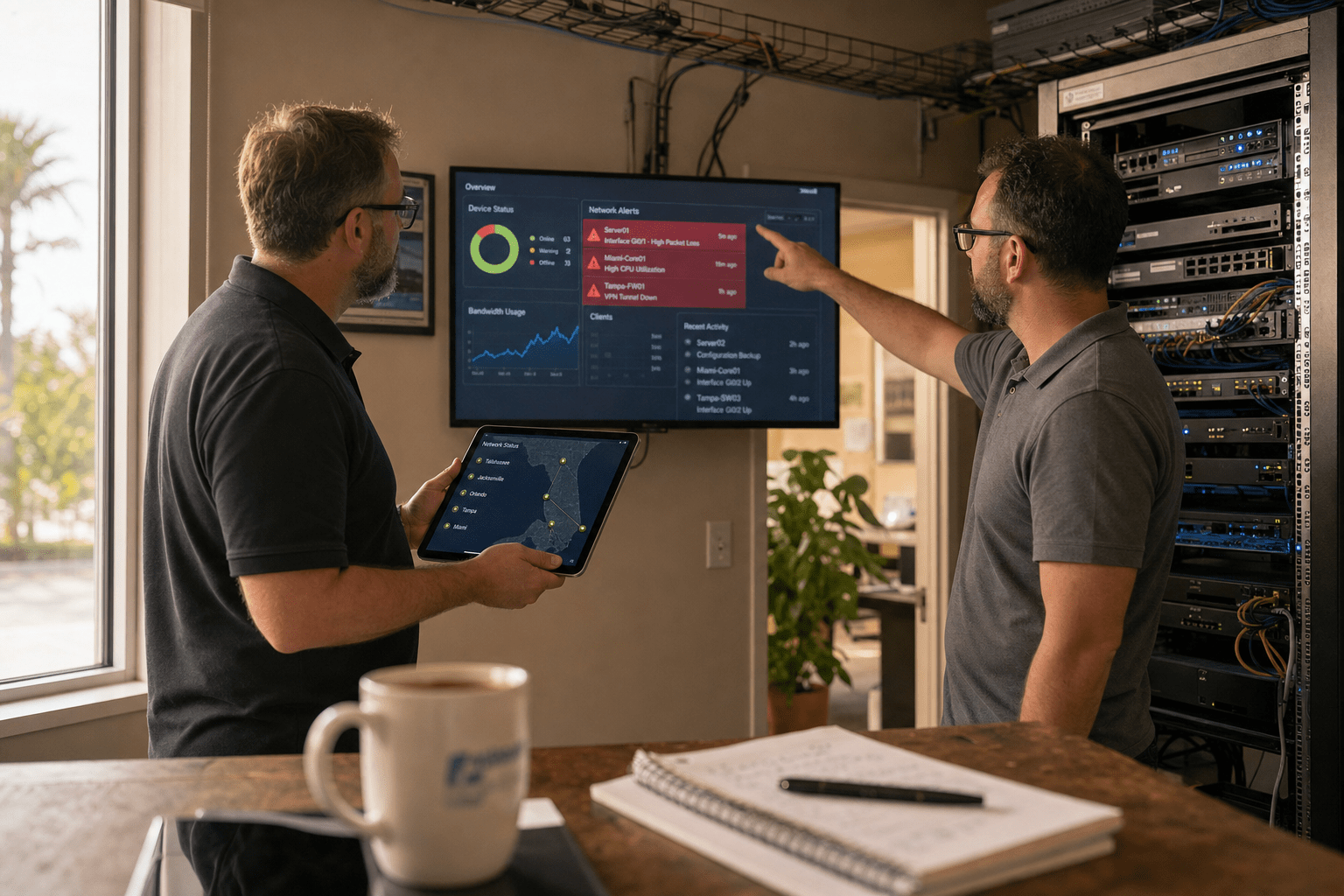
Managed IT support in Florida is failing when the provider reacts to outages instead of preventing them, cannot answer for every site during a storm, and measures itself by how fast it closes tickets rather than how few you file. Most Florida operations directors judge their provider on close-time alone. That number hides the signals that actually predict downtime: whether the team is ready for hurricane season, whether it can respond across every office at once, and whether it stops recurring problems at the root. We have walked into too many post-outage cleanups where the old provider looked fine on a dashboard and fell apart the first week of June. Here is what a slipping provider looks like before it costs you a week of revenue.
The 5 reliability signals that actually matter
Before the seven signs, hold these five principles in view. They separate a provider that looks busy from one you can build on.
- Prevention beats speed. A team that quietly stops tickets from happening is worth more than one that closes them quickly after they hurt you.
- Continuity is a Florida-specific test. Any provider can run a help desk in fair weather. The real exam is the third named storm of the season.
- Statewide reach is not the same as a statewide phone number. Multi-site businesses in Tampa, Orlando, and Miami need coordinated response, not one overloaded technician.
- Documentation is the reliability multiplier. If only one person knows how your network is wired, you do not have support, you have a single point of failure.
- Security and IT support are one job now. A provider that treats them as separate contracts will leave a gap an attacker walks through.
Keep those in mind as you read. A provider can miss on any one and still recover. Miss on three or more, and you are already living with unreliable managed IT support in Florida, whether the monthly report admits it or not.
Sign 1: Response is fast, but the same problems keep returning
Your provider closes tickets quickly, yet the same printer, VPN, or email failure comes back every few weeks. Fast response feels like good service, and on a metrics slide it reads as a win. The counterargument holds some truth: a quick fix keeps people working today, and not every recurring issue signals neglect, since some hardware simply ages out. Both sides deserve a fair hearing.
Weigh them honestly, though, and the pattern wins the argument. A provider that only closes tickets is treating symptoms. When we onboard a new Florida client, our first move is a root-cause pass on the top ten recurring tickets, because those repeats are the clearest evidence the prior team never looked past the surface. Reliable IT support is measured by the tickets you never have to file. If your volume is flat or climbing month over month, the speed number is hiding a deeper failure.
Sign 2: Nobody can tell you what happens during a hurricane
You ask how your systems stay up during a named storm and get a vague answer about backups. In Florida, storm-season continuity is the single hardest reliability test a provider faces, and a vague answer is itself the warning sign. Some argue that cloud hosting alone covers this, and there is merit there, since workloads in a hardened data center survive a regional power loss better than an on-site server closet.
But cloud hosting is not a continuity plan. A plan names your recovery time objective, the failover sequence, who declares an incident, and how staff work when the office loses power for four days. We run tabletop drills with clients before June so the first storm is not the first rehearsal. If your provider has never walked you through a documented continuity plan or a network outage emergency response, you are trusting luck. A deeper look at what real coverage means lives in our guide to reliable managed IT support for Florida companies.
Sign 3: Your multi-site offices get inconsistent service
Your Orlando office gets same-day help while your Miami and Jacksonville teams wait days. A provider offering statewide support should deliver the same standard to every location, and inconsistency across sites is a reliability failure even when the flagship office is happy. One reading defends the gap: the busiest office generates the most tickets, so it naturally gets the most attention, and smaller sites feel slower by comparison rather than by fact.
Look at the response logs by site, though, and the excuse usually collapses. Uneven service almost always means the provider staffed for one location and stretched thin across the rest. True statewide coverage means documented runbooks per site, a technician who knows each network, and routing that does not depend on one person’s calendar. We map every client location before go-live so a ticket from any Florida office reaches someone who already knows the environment. If your provider cannot describe how it covers businesses across Florida as one coordinated account, the inconsistency will only widen as you grow.
Sign 4: You are the one noticing problems first
You or your staff report outages before your provider does. Reliable managed IT support catches failures through monitoring before users feel them, so if your team is the early-warning system, the monitoring is either absent or ignored. The fairer counterpoint: no tool catches everything, and an alert user who flags a slow application is a healthy signal, not a broken one.
Granted, but there is a line between a user catching an edge case and a user catching the outage. When staff routinely report down email or a dead internet circuit before the provider calls you, proactive monitoring has failed. Our team treats a user-reported outage as its own incident to review, because it means an alert should have fired and did not. This is also where managed security services and IT support overlap: the same monitoring that catches a failing disk catches unusual traffic from a compromised account. A provider watching one but not the other leaves you exposed on both.
Sign 5: Everything depends on one person who knows your setup
There is a single technician who understands your network, and service stalls whenever that person is out. Reliability requires that any qualified member of the provider’s team can step into your environment, which means your setup has to be documented, not memorized. Some smaller providers argue the single-owner model gives you a dedicated expert who knows you personally, and that relationship has real value.
The value is real until that person takes vacation, quits, or gets sick during a storm. Then the relationship becomes your outage. We keep every client environment documented so coverage never rests on one memory, and we treat that documentation as a living deliverable, refreshed after each change. If your provider cannot produce current network documentation on request, the “dedicated expert” is a hidden risk. This is one reason a co-managed IT arrangement works well for growing firms: your internal staff and the provider share documented ownership instead of one person holding it all.
Sign 6: The monthly report looks great but you feel the pain
The dashboard shows green across the board while your team still fights daily friction. A reliability report should track outcomes you feel, not vanity metrics chosen because they always look good. In defense of the report, uptime and close-time are legitimate measures, and a provider is right to show them.
The problem starts when those are the only measures. Ninety-nine percent uptime reads well until you learn the one percent landed during your busiest billing day. Close-time looks strong until you count how many tickets should never have opened. We report on recurring-issue trends, prevented incidents, and continuity readiness, because those track the reliability you actually experience. If your provider’s report never changes and never surfaces a hard truth, it was built to reassure you, not to improve your service. For a fuller breakdown of what to demand from a provider, our Florida managed IT buyer’s guide walks through the questions that expose a weak contract.
Sign 7: Security gets treated as a separate problem
Your provider handles help desk and infrastructure but points elsewhere for security. In 2026, splitting IT support from security is a reliability failure, because the same environment, accounts, and endpoints carry both. The counterargument has history behind it: for years, managed IT and managed security were distinct disciplines with distinct vendors, and specialization produced depth.
Specialization is fine. A hard handoff between two vendors who blame each other during an incident is not. When ransomware hits a Florida SMB, the recovery is an IT problem and a security problem at the same second, and a divided response loses hours you do not have. Our team runs support and security as one account so an alert becomes an action without a vendor negotiation in the middle. We cover why this convergence matters in detail in our piece on choosing a provider that pairs security with IT support. If your current provider draws a hard line between the two, that line is where your next outage will start.
Frequently Asked Questions
What is managed IT support?
Managed IT support is an outside team that monitors, maintains, and fixes your technology for a predictable monthly fee instead of charging per incident. It covers help desk, infrastructure, monitoring, and increasingly security under one account. For a full definition and how the model works, see our overview of what managed IT support covers.
How do I know if my Florida IT provider is reliable?
A reliable Florida provider prevents recurring issues, holds a documented storm-season continuity plan, and delivers the same standard to every office you run. Ask to see recurring-ticket trends and a continuity runbook. If the provider cannot produce either, treat that as a warning sign rather than a minor gap.
Does managed IT support in Florida include hurricane continuity planning?
Strong managed IT support in Florida includes documented hurricane continuity as a standard part of the contract, not an add-on. That plan should name your recovery time objective, the failover sequence, and how staff work when an office loses power. A provider that only mentions backups is not offering true continuity.
Should IT support and cybersecurity come from the same provider?
Pairing IT support and cybersecurity under one provider removes the vendor handoff that costs you time during an incident. The same accounts and endpoints carry both risks, so a single coordinated team responds faster than two vendors negotiating ownership. Firms with mature internal staff can also split responsibility through a co-managed arrangement.
How fast should a managed IT provider respond to an outage?
A provider should detect most outages through monitoring before your staff report them, and respond to a critical outage within minutes, not hours. Speed matters, but response time alone is a weak measure of reliability. Judge the provider on how rarely critical outages happen in the first place.
Talk to a Florida provider that measures reliability the right way
If more than a couple of these signs sound like your current setup, the issue is not one bad month, it is a support model built to react instead of prevent. Reliable managed IT support in Florida shows up as fewer tickets, a continuity plan you have actually rehearsed, consistent service to every office, and one team that owns both your infrastructure and your security. Those are the things you feel in a busy week and during a storm, long after a green dashboard has stopped meaning anything. You do not have to wait for the next outage to find out where your provider stands. Our team will walk your environment, show you where the reliability gaps are, and map what coordinated statewide coverage looks like for your business. Book a free strategy call and we will start with the seven signs above, applied to your real network.

