

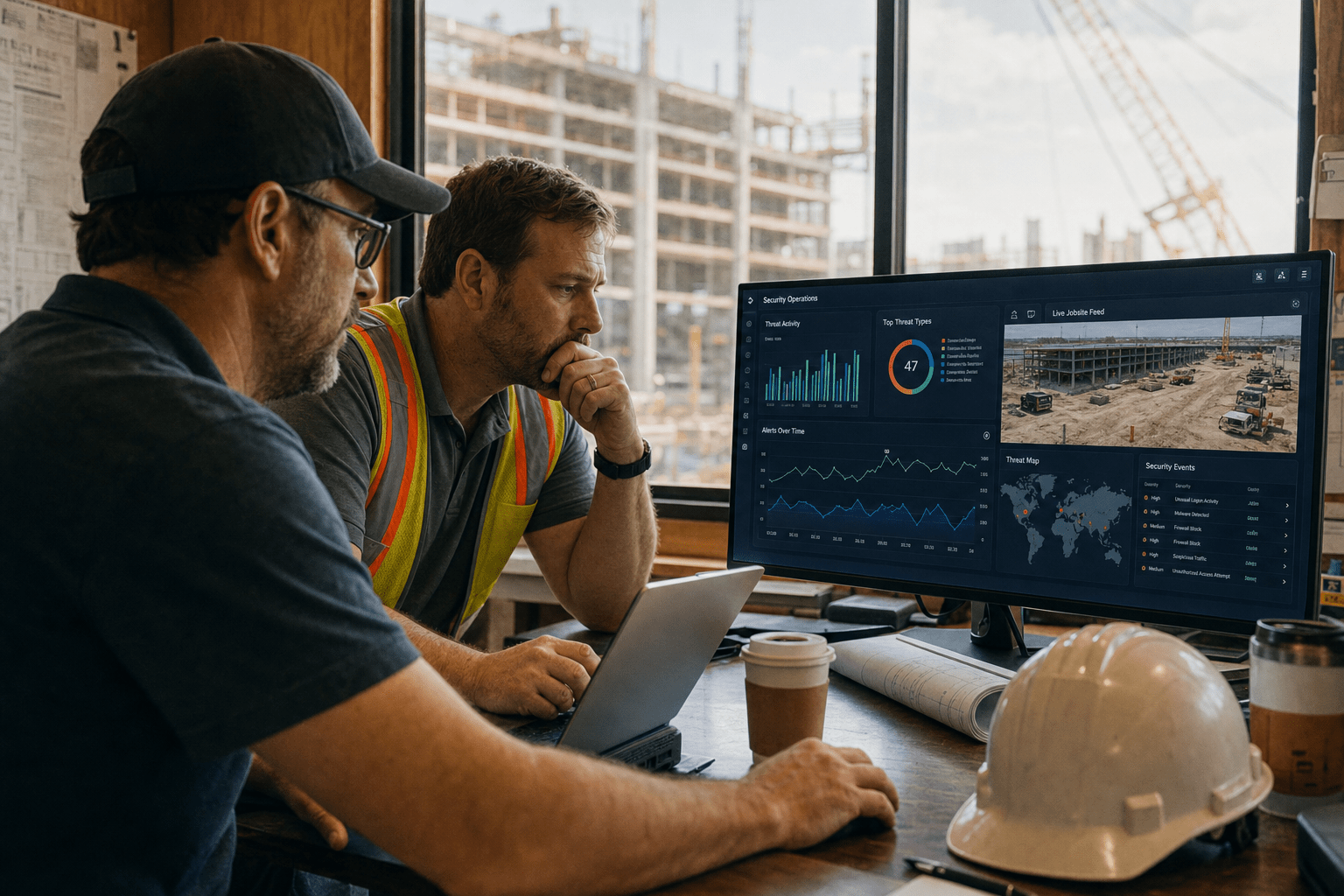
Cybersecurity for construction companies has to start where the money and the data actually move, which is the project supply chain, not the corporate office. A single commercial build can pull in dozens of subcontractors, an architect, a general contractor, equipment vendors, and a lender, and every one of them touches the same set of drawings, bid documents, and payment files. Each connection is a door. Most construction firms lock the front door, the office network, and leave the rest of the doors propped open on shared drives, personal email, and jobsite devices nobody is watching — a key gap in Cybersecurity for Construction Companies that attackers exploit. That is the gap attackers walk through, and it is the gap this guide is built to close.
The 5 things this guide gets right
We wrote this for IT managers and operations leaders at construction firms who are tired of generic advice that could apply to any industry. Here is what separates real construction security from a checklist someone copied off a template.
- The threat lives in the supply chain, not just the LAN. Your risk scales with the number of partners on a job, and each one is an unmanaged entry point into shared project data, highlighting why robust Cybersecurity for Construction Companies focuses on supply chain controls.
- Wire transfers are the prize. Construction moves large, scheduled payments, which makes business email compromise the single most expensive attack we see against the sector.
- Jobsites are full of connected devices. Cameras, sensors, badge readers, and connected equipment sit on networks no one monitors the way they watch the office.
- Downtime is the real cost. Ransomware does not just steal data, it stops the crane, the schedule, and the draw request, and delay penalties stack fast.
- Compliance is now a bid requirement. Government and defense-adjacent work increasingly requires proof of controls, so security has become a way to win contracts, not only a way to avoid loss.
Why construction firms are a soft target right now
Construction firms are a soft target because they run high-value operations on lean IT, and attackers have noticed. Over the past two years our team has watched the sector move up the target list quickly, and the reason is simple economics. A firm managing a nine-figure project portfolio often runs it with a handful of IT staff, aging hardware, and a workforce spread across trailers and job trailers that were never designed to be secure endpoints. That mismatch between what is at stake and what is protected is exactly what a ransomware crew looks for.
The data backs this up. IBM’s Cost of a Data Breach report puts the average breach cost in the multimillion-dollar range, and for construction the number climbs because the loss is not only the stolen data. It is the halted project. When a general contractor cannot access approved drawings or issue a payment, work stops on every site tied to that system. The attacker knows you will weigh the ransom against days of idle crews and liquidated damages, and they price it accordingly.
There is a counterargument worth holding: some firms decide the odds of being hit are low enough that heavy security spend is not justified against thin margins. That view is not baseless, since not every small subcontractor is a headline target. But it misreads how attackers pick victims. They rarely target you by name. They spray phishing across the supply chain and land wherever a door is open, which means a small firm connected to a large project inherits the whole project’s risk profile. Sitting out is not neutral, it is a bet.
Where the real attacks land
The attacks that actually hurt construction firms cluster into four patterns, and knowing them tells you where to spend first.
Business email compromise and fake payment changes
Business email compromise is the costliest threat to construction firms because the industry runs on large, expected wire transfers. The pattern we see in the wild is patient. An attacker quietly reads a compromised inbox for weeks, learns the draw schedule and the vendors, then emails your accounts payable team from a look-alike domain asking to update banking details before the next payment. It looks routine because it mirrors a real transaction. The fix is procedural, not just technical: require voice verification through a known phone number for any change to payment instructions, and never accept new banking details by email alone. Pair that with MFA on every mailbox so the original inbox compromise gets harder in the first place. Our cybersecurity services build these controls around your existing accounting workflow.
Ransomware that stops the schedule
Ransomware hits construction harder than most sectors because the damage is operational, not only informational, emphasizing the importance of proactive Cybersecurity for Construction Companies to maintain project continuity. When files are encrypted, you lose the drawings, the schedules, the submittals, and the accounting system at once, and every connected site feels it. The firms that recover fastest are the ones that treated backups as a project deliverable: offline, tested, and restorable in hours, not the untested backup nobody has ever run a full restore against. If an attack is already underway, speed matters more than anything, which is why we keep emergency cybersecurity support staffed to contain and restore before the ransom clock runs out.
The subcontractor and vendor chain
The subcontractor and vendor chain is the most underestimated risk on any job because every partner you connect is a partner whose security becomes yours — a critical consideration in Cybersecurity for Construction Companies strategies. Third-party access is the most underestimated risk on any job, because every partner you connect is a partner whose security becomes yours. A subcontractor with a weak password and no MFA, granted access to the shared project portal, is functionally a hole in your own network. Attackers increasingly move laterally through these trusted connections rather than attacking the strong perimeter directly. The practical answer is to treat partners like part of your attack surface: require baseline controls in the contract, give each vendor the narrowest access the job needs, and turn that access off the day their scope ends. Formalizing those requirements is where cybersecurity compliance turns a vague expectation into an enforceable standard.
Jobsite IoT and operational technology
Connected jobsite devices are a live entry point that most firms never monitor, and the count grows every year. Cameras, environmental sensors, badge and gate controllers, and connected heavy equipment all sit on networks that were stood up fast and secured slowly. The U.S. Cybersecurity and Infrastructure Security Agency flags these industrial and connected control systems as a growing target precisely because they blend physical and digital risk. A compromised gate controller is a safety issue, not just a data issue. The counterpoint is that ripping out every device is neither practical nor affordable mid-project, and that is fair. So the goal is not removal, it is segmentation: put jobsite devices on their own network, separate from the systems that hold financial and design data, so a breach on one cannot reach the other.
How to build a security program that fits construction
A construction security program works when it maps to how projects actually run, phased, distributed, and partner-heavy, rather than assuming a single fixed office. We recommend anchoring the program to the NIST Cybersecurity Framework, which organizes the work into a sequence any operations leader can follow.
Start by identifying what matters most. For a construction firm that is the project data, the accounting system, and the partner connections, in that order. Then protect those assets with the controls that block the top four threats: MFA everywhere, verified payment-change procedures, segmented jobsite networks, and tested offline backups. Add detection so you know when something is wrong before the crews do, through monitored endpoints and mailbox alerting. Finally, write the response plan before you need it, including who calls whom when a site goes dark at 2 a.m., because the middle of an incident is the worst time to invent a process.
One point our team stresses with every construction client: security is increasingly a bid qualifier, not only a safeguard. Public agencies and defense-adjacent owners now ask for documented controls, and firms pursuing that work need to demonstrate maturity. If you touch federal or defense projects, that path runs through CMMC readiness, which turns your security posture into a credential you can put in front of an owner. The firms treating this as a growth lever, not a cost, are the ones winning the larger, better-funded jobs.
Frequently Asked Questions
What is the biggest cybersecurity risk for construction companies?
The biggest risk for most construction firms is business email compromise leading to fraudulent wire transfers, because the industry moves large scheduled payments that attackers can redirect. Ransomware runs a close second, since it halts active projects and multiplies the cost through schedule delays. Both start with a phished inbox, which is why email security and payment verification are the highest-value places to begin.
How do subcontractors affect our cybersecurity?
Subcontractors and vendors expand your attack surface, because any partner granted access to shared project systems becomes an entry point into your data. A partner with weak credentials effectively lowers your own security to their level. Reducing that risk means setting baseline security requirements in your contracts and granting each partner only the access their scope requires.
Do small construction companies really need cybersecurity?
Yes, and often more than they expect, because attackers rarely target firms by name and instead exploit whichever door in a project’s supply chain is open. A small firm connected to a large project inherits that project’s risk profile. Core protections like MFA, tested backups, and payment verification are affordable and stop the majority of attacks we see.
How does ransomware affect a construction project?
Ransomware encrypts the files a project depends on, drawings, schedules, submittals, and accounting, which can stop work across every connected site at once. The financial damage is driven by downtime and delay penalties as much as by the ransom itself. Tested offline backups are the single most effective way to shorten recovery and reduce leverage.
What compliance standards apply to construction cybersecurity?
The NIST Cybersecurity Framework is the common baseline for organizing a construction security program, and firms pursuing federal or defense-adjacent work often need CMMC certification. Beyond formal standards, many private owners now require documented security controls as a condition of the bid. Meeting these requirements has become a way to qualify for larger contracts.
Ready to close the gaps on your next project
The construction firms that get security right are not the ones that spent the most, they are the ones that protected the right things in the right order: the payment process, the project data, the partner connections, and the jobsite devices. You do not have to solve all of it at once, and you should not try to. Start with the controls that block the costliest attacks, then build maturity as your projects and contracts demand it. Our team works with construction and contracting firms every day to turn a scattered set of tools into a program that fits how you actually build. If you want a clear picture of where your risk sits and what to fix first, book a free strategy call and we will walk your specific exposure with you.

