

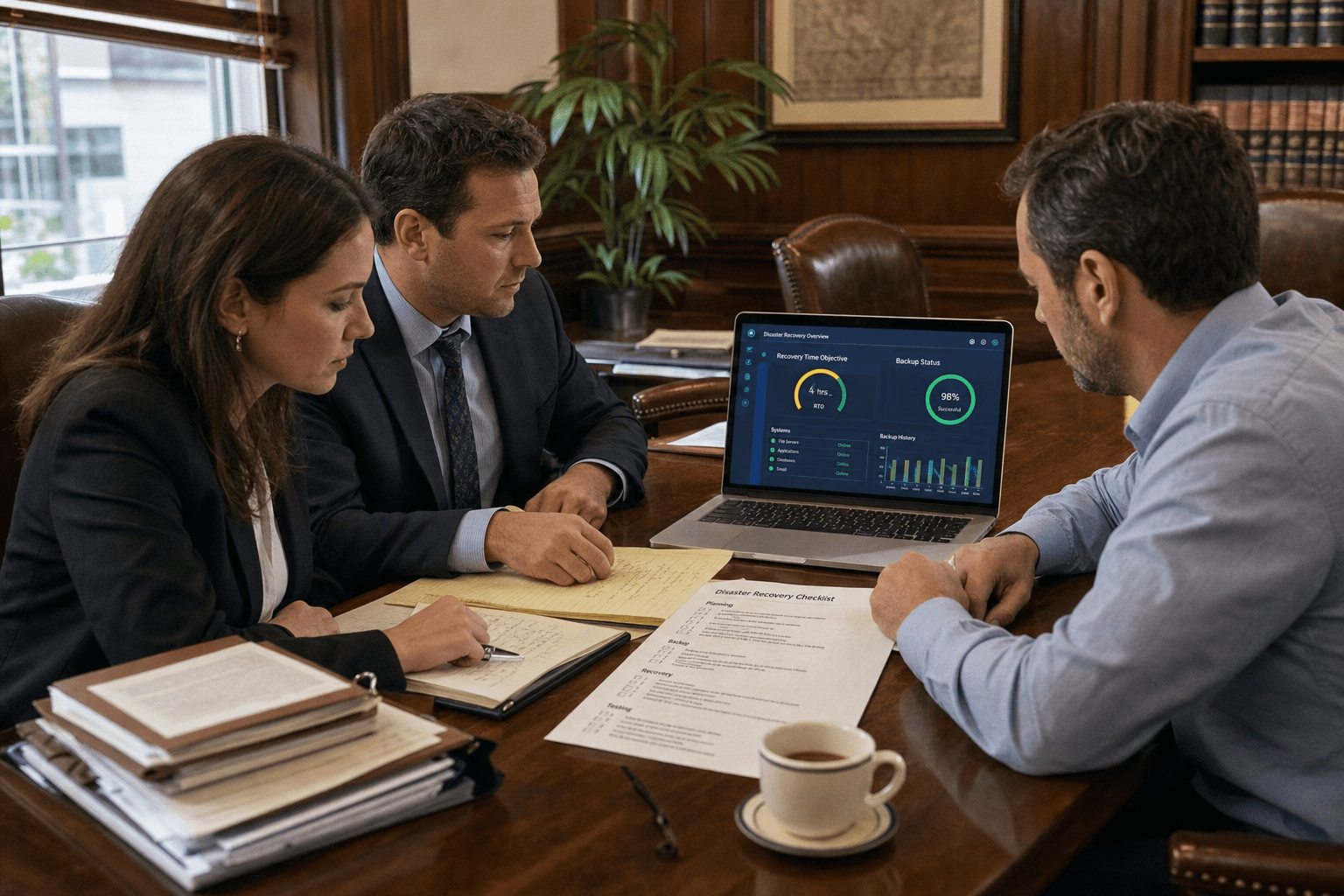
Backup and disaster recovery for law firms is the paired practice of copying legal data offsite and rebuilding the systems that run a practice, so that attorneys can resume filing, billing, and client work inside a deadline the court sets, not a deadline a vendor invents. The distinction matters more for a firm than for almost any other business. When a manufacturer loses a day, it loses revenue. When a firm loses a day, it can miss a statute of limitations, blow a filing window, or breach its duty to safeguard client property. That is why we measure recovery here against the court calendar first and the service agreement second.
Most firms we talk to already own a backup product, but law firm Backup and Disaster Recovery requires a tested process for restoring complete legal systems.fv Very few can tell us how long it would take to get a paralegal back into the document management system after a ransomware event. Those are two different questions, and the gap between them is where firms get hurt.
The Five Things That Decide Whether Your Firm Survives an Outage
A firm that recovers well tends to get five decisions right long before anything breaks. Use these as the frame for the rest of this guide.
- Recovery is measured in hours against a court date, not against a vendor promise. Your recovery time objective, the maximum time you can be down, has to be shorter than the tightest deadline on your docket.
- Backups live somewhere the fire, the flood, and the attacker cannot reach. On-site copies alone fail during the exact events you are preparing for.
- The plan names people, not just technology. Who declares the disaster, who calls clients, who restores the file server, in what order.
- You test restores, not just backups. A backup you have never restored is a guess, not a safeguard.
- The whole chain protects client confidentiality. Encryption, access control, and audit trails apply to the recovery copy as strictly as to the live system.
Why Generic Backup Fails Law Firms
Backup and disaster recovery for law firms breaks down when a firm buys a consumer-grade backup product and assumes the compliance work is done. We see this pattern constantly. The nightly job runs green for months, everyone relaxes, and then a drive fails or an attacker encrypts the network, and the restore either does not complete or completes far too slowly to matter.
Effective law firm Backup and Disaster Recovery goes beyond confirming that data exists by proving the practice can resume before critical deadlines pass. Legal practice asks a harder question: can we operate again before the harm becomes irreversible? The American Bar Association’s disaster resources frame this around continuity of client service, not storage. That reframing changes what you buy and how you test it.
The court calendar is your real recovery deadline
A law firm Backup and Disaster Recovery plan should set recovery deadlines according to the firm’s court calendar rather than a generic industry benchmark. A firm with a motion due Friday cannot accept a recovery estimate of “usually a few days.” If the document is trapped in an unrestored system, the deadline does not move because your server did. We build the recovery time objective backward from the docket. If the tightest filing window is four hours, the plan has to put a working system in front of an attorney inside four hours, which rules out a lot of slow, tape-style approaches that look fine on paper.
The duty to safeguard client property never pauses
An attorney’s obligation to protect client files does not switch off during an outage. State bar guidance treats client data as property the firm holds in trust, and a preventable loss can become an ethics problem on top of an operational one. That is why the recovery copy has to carry the same confidentiality controls as the live matter: encryption at rest, restricted access, and a record of who touched what. A recovery process that dumps files onto an open share to “get everyone working again” trades one violation for another.
Downtime compounds faster in a billable-hour model
A firm bills time, so idle time is lost inventory that never comes back. When attorneys and paralegals cannot reach the case management system, the loss is not only the recovery invoice, it is every hour that could not be billed and every client who watched the firm go quiet. We have seen firms absorb the technical cost of an outage and then feel the larger hit weeks later in write-offs and client attrition. Recovery speed is a revenue decision, not only a technical one.
How to Build a Recovery Plan That Holds Up
A dependable law firm Backup and Disaster Recovery plan assigns named owners, documents recovery steps, and tests restoration against actual legal deadlines. The plan is a document your team rehearses, not a binder nobody opens. Our business continuity disaster recovery practice starts every engagement by writing down what “recovered” actually means for that firm.
Set recovery targets from your docket
Start with two numbers. The recovery time objective is how fast you must be operating again. The recovery point objective is how much recent work you can afford to lose, measured in time. For a litigation practice mid-trial, both numbers are close to zero, which pushes you toward continuous replication and cloud backup rather than a single nightly snapshot. For a transactional practice with quieter weeks, the numbers may relax. The point is to derive them from your calendar, then buy technology that meets them, instead of accepting whatever a product happens to deliver.
Follow the 3-2-1 rule, then harden it
The durable baseline is three copies of your data, on two kinds of media, with one copy offsite. In a region exposed to hurricanes, flooding, or wildfire, offsite means outside the affected zone, not a second drive in the same building. Then harden it against ransomware: keep one copy immutable or air-gapped so an attacker who reaches the network cannot encrypt or delete the recovery set. This single control separates firms that pay a ransom from firms that restore and move on. The NIST Cybersecurity Framework treats recoverability as a core function for exactly this reason.
Test restores on a schedule, and document them
A backup is a claim until you restore it. We recommend a full restore test at least once a year, plus a spot restore after any change to your systems, a new practice management platform, a server migration, an office move. Document each test: what you restored, how long it took, what failed. That record does two jobs. It proves your recovery time objective is real, and it gives you an audit trail if a client or regulator ever asks how the firm protects their matter. Firms that partner with managed IT for law firms usually fold these tests into a standing schedule so they never slip.
Cloud, On-Premises, or Hybrid for Legal Data
A hybrid law firm Backup and Disaster Recovery architecture combines fast local restoration with encrypted offsite protection for major site-wide incidents. Each model carries a real trade-off, and the honest answer depends on your deadlines and your risk exposure.
The case for cloud-first recovery
Cloud recovery wins on geography and speed to stand up. An encrypted copy replicated to a data center outside your region survives the local hurricane or fire that would destroy on-site tapes, and modern disaster recovery services can spin up a working environment in the cloud while your office is still dark. The counterweight is that recovery depends on connectivity and on a provider whose confidentiality controls you have vetted. A firm handling sealed or privileged matters has to confirm where the data physically sits and who can access it.
The case for keeping copies close
A local copy restores fastest for the common case, a deleted folder, a failed drive, a corrupted database, because you are not pulling terabytes across an internet connection. For large matters with heavy document sets, that speed is real. The counterweight is equally real: a copy that shares a building with the live system shares the building’s fate. Fire, flood, and theft take both at once. This is why we rarely recommend on-site alone for a firm, and why the hybrid model tends to win. It holds both advantages without betting the practice on either single point of failure.
Frequently Asked Questions
What is the difference between backup and disaster recovery for a law firm?
Backup is the copy of your data; disaster recovery is the tested ability to rebuild working systems and resume practice within a deadline. A firm can have perfect backups and still fail recovery if restoring takes longer than the nearest court date allows. Both are required, and they are budgeted and tested separately.
How fast should a law firm be able to recover its systems?
Fast enough to meet the tightest deadline on your docket, which for active litigation can mean hours rather than days. Set your recovery time objective from your calendar, then confirm through restore testing that your technology actually meets it. An untested target is a hope, not a plan.
Does backup and disaster recovery help a firm meet its ethical duties?
Yes. State bar rules treat client files as property the firm must safeguard, and a documented recovery process with encryption and access controls shows the firm took reasonable steps to protect that property. A preventable, undocumented data loss can turn an outage into an ethics exposure.
How often should a law firm test its disaster recovery plan?
At minimum once a year, plus a spot restore after any major change to your systems. Each test should be documented, including how long recovery took, so the firm can prove its recovery time objective and correct any gap before a real event exposes it.
Is cloud backup secure enough for confidential legal matters?
It can be, when the copy is encrypted at rest and in transit, access is restricted and logged, and you have confirmed where the data physically resides. The security question is not cloud versus local, it is whether the recovery copy carries the same confidentiality controls as the live matter.
Talk to a Team That Measures Recovery in Deadlines
A firm does not need another backup product; it needs a recovery process that answers one question honestly: can we resume client work before the next deadline passes? That answer depends on targets drawn from your docket, backups an attacker cannot reach, a plan that names owners, and restore tests you actually run. Get those four right and an outage becomes a bad afternoon instead of a malpractice risk. Our team builds recovery plans around the way firms actually work, from the court calendar backward, with client confidentiality intact at every step. If you want a clear read on where your firm stands today and what it would take to close the gap, book a free strategy call and we will walk your risk with you.

