

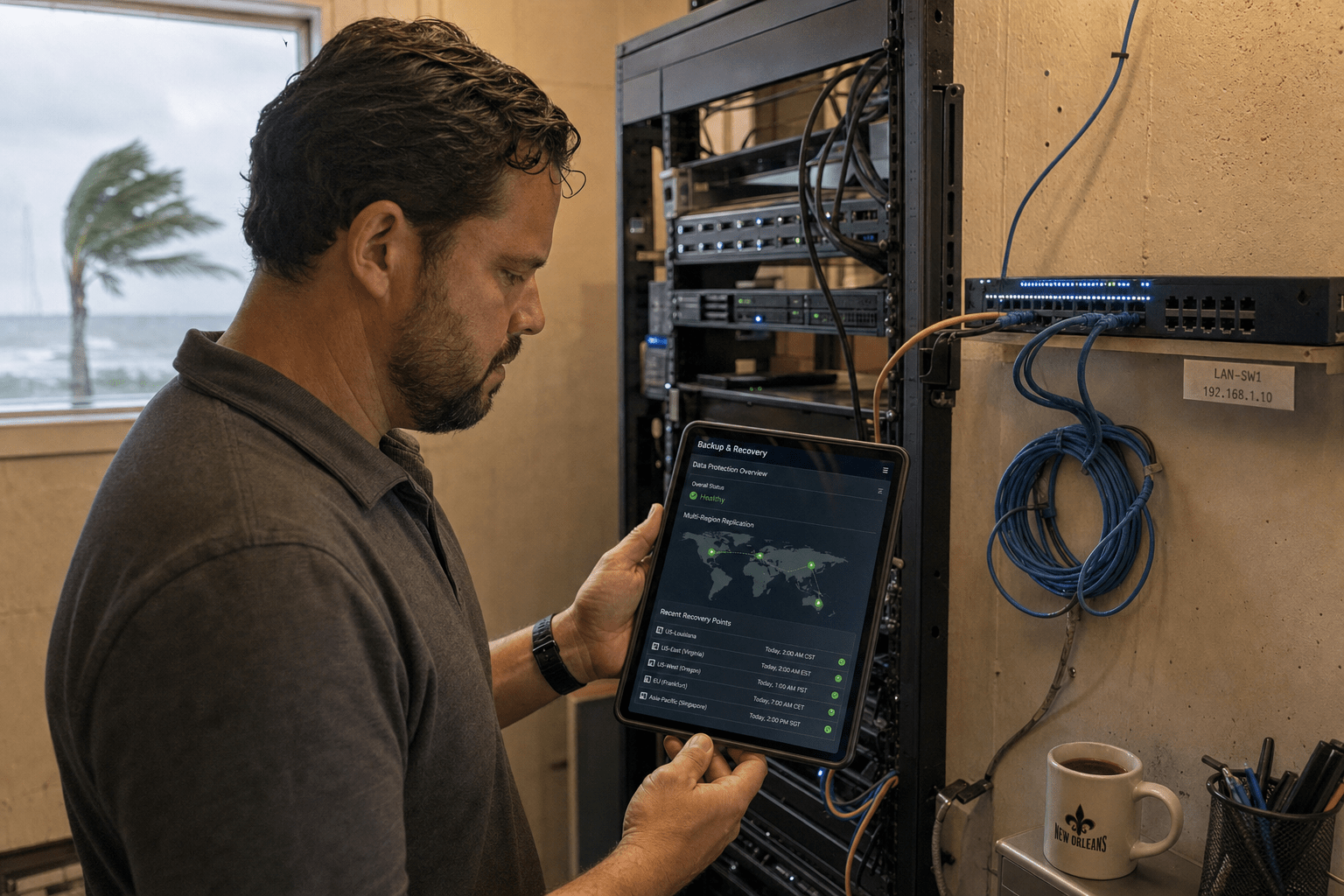
Backup and disaster recovery in Louisiana is not the same problem it is in a low-risk inland state, because the threat here is not only a failed drive or a ransomware note. It is a named storm that can take out power, connectivity, and physical access to your office for days at a time. A backup that lives on a server in the same building it is meant to protect is not a plan, it is a hope. Businesses with a reliable Disaster Recovery Louisiana plan decide before hurricane season where backup copies live, how quickly systems can be restored, and who leads recovery during an outage. This guide walks a Louisiana SMB through what actually matters, so you buy the plan that fits your address rather than the generic one.
What Backup and Disaster Recovery Really Means for Louisiana SMBs
Backup and disaster recovery in Louisiana means two connected jobs that too many owners treat as one. Backup is the copy of your data. Disaster recovery is the tested process that gets your business running again after an event, whether that event is a ransomware hit, a hardware failure, or a hurricane that floods the block your office sits on. A copy of your files is only the first piece. If it takes you a week to turn that copy back into a working environment, your business still lost a week. The federal Ready.gov business guidance is blunt on this point: continuity planning has to account for the disruptions your region actually faces, and in Louisiana that means storm season is a scheduled risk, not a surprise. A real plan pairs business continuity and disaster recovery design with backup, so the copy and the comeback are engineered together.
Backup Is a Copy, Recovery Is a Comeback
Disaster Recovery Louisiana closes the gap between having a backup and being able to restore complete business operations from it. A nightly backup that completes successfully every night still fails you if nobody has ever restored from it. The counterview is that any backup is better than none, and that is true as far as it goes. But an untested backup carries a quiet assumption that the restore will just work, and restores fail for ordinary reasons, corrupted images, missing application dependencies, credentials nobody wrote down. We treat the restore as the product, not the backup, which is why our disaster recovery work centers on documented, scheduled recovery tests rather than a green checkmark on last night’s job.
Why a Single Local Copy Is Not Enough Here
A single local backup makes sense for a business that only fears a lost laptop, and it is a genuine cost saving for that narrow risk. It stops making sense the moment the risk includes the building itself. If your only backup sits in the same office as your servers, a flood or a fire takes both at once. For a Gulf-coast address this is not a rare edge case, it is the specific thing hurricane season threatens every year. The fix is not complicated, it is a copy that lives in a geographically separate region, far enough away that one storm cannot reach both.
The Louisiana Factor: Planning for Hurricane Season
The Louisiana factor in backup and disaster recovery is regional resilience, the piece a plan built for a low-risk state leaves out. A design that assumes power and connectivity stay up during recovery is a design that has never met a Gulf storm. When a region-wide event hits, three things fail together: electricity, internet, and the ability to walk into your own office. Disaster Recovery Louisiana must keep working when regional electricity, internet connectivity, and physical access to the office are all unavailable. Cloud-based backup and recovery answers this well, because your second copy and your failover environment live outside the disaster zone, but only if the design puts them there on purpose. National providers quoting a single-region setup from out of state are pricing for a calmer address than yours.
Multi-Region Backup That Survives a Regional Outage
Multi-region backup keeps a Louisiana business running when a storm takes out the local zone, and skipping it is the false saving that surfaces at the worst possible moment. Storing a second copy in a separate geographic region costs more than a single-region setup, which is exactly why a lean quote leaves it out. For low-stakes data that you can live without for a week, a single region may be enough, and paying for more would be waste. For the systems your business cannot operate without, it is not a choice. We build cloud backup with a second region for our Louisiana clients because a single-zone failure during hurricane season is not a hypothetical in this state, it is a seasonal certainty somewhere along the coast.
Recovery Time and Recovery Point: The Two Numbers That Matter
A Disaster Recovery Louisiana strategy should define clear recovery time and recovery point objectives based on the business impact of downtime and data loss. Recovery time is how long it takes to get back online. Recovery point is how much data you can afford to lose, measured backward from the moment of failure. A plan with a four-hour recovery time and a one-hour recovery point is a very different purchase from one with a three-day recovery time and a full-day recovery point, and the price gap between them is real. The mistake is buying on backup frequency alone without ever setting these targets. We set both numbers with a client up front, in plain terms tied to what a day of downtime actually costs their business, so the plan is sized to the operation rather than to a vendor’s default tier.
How to Choose a Backup and Disaster Recovery Approach
Choosing a backup and disaster recovery approach in Louisiana comes down to matching the design to your real risk and your real budget, not buying the biggest tier on offer. Start by listing what your business genuinely cannot run without, the accounting system, the client files, the email, and separate those from the data that is merely nice to keep. Set a recovery time and recovery point for the critical systems. Then confirm that at least one copy lives in a separate region, and that a restore has actually been tested end to end. The CISA cybersecurity best-practices guidance and the NIST Cybersecurity Framework both frame recovery as a capability you validate, not a product you install, and that framing is the right one for an SMB spending carefully.
The 3-2-1 Rule and Where It Falls Short
The 3-2-1 rule, three copies of your data on two types of media with one copy off-site, is a solid starting point and worth following. Where it falls short for a Louisiana business is the word off-site, which people read loosely. A backup drive taken home by the office manager is technically off-site, but if home is two miles from the office, the same storm reaches both. The rule is sound, the interpretation is where the risk hides. For a Gulf-coast address, off-site has to mean a genuinely separate region, not the next town over.
Ransomware Changes the Equation Too
Ransomware has changed backup planning even for businesses that never worry about weather, because modern attacks hunt for and encrypt the backups first. A copy that is always connected and always writable is a copy an attacker can reach. This is where immutable backups, copies that cannot be altered or deleted for a set window, earn their cost. The counterargument that immutability is overkill for a small shop held up better a few years ago than it does now, when small businesses are squarely in the target set. Disaster Recovery Louisiana should combine region-separated backups with an immutable copy to protect against both Gulf Coast storms and ransomware attacks.
Frequently Asked Questions
How much does backup and disaster recovery cost for a Louisiana small business?
Backup and disaster recovery for a Louisiana small business varies with how fast you need to recover and how much data you can afford to lose. A basic single-region backup is inexpensive, while a plan with fast recovery times and multi-region resilience costs more because it is engineered to survive a regional storm. Setting your recovery time and recovery point targets first is the only way to get a real number for your operation.
Do I really need multi-region backup in Louisiana?
For any system your business cannot run without, yes. A single-region backup fails when a hurricane takes out the local zone, which is a seasonal risk on the Gulf coast rather than a rare event. A second copy in a geographically separate region is what keeps you running when your office and local infrastructure are offline.
How often should we test our disaster recovery plan?
At least annually, and ideally before hurricane season each year. A backup that has never been restored is an assumption, not a plan. Scheduled recovery tests confirm that the copy is usable, that recovery times are realistic, and that the people running the process know the steps before an emergency forces them to learn on the fly.
What is the difference between backup and disaster recovery?
Backup is the copy of your data. Disaster recovery is the tested process of turning that copy back into a working business after an event. You can have a perfect backup and still have no recovery if restoring it takes days or has never been practiced. A real plan engineers both together.
Can cloud backup protect us during a hurricane?
Yes, when it is designed for it. Cloud backup stored in a region outside the storm zone keeps your data and failover environment available even when your local power and connectivity are down. The key is confirming the design uses a separate region rather than defaulting to a single local zone.
Build Your Louisiana Recovery Plan Before the Next Storm
Backup and disaster recovery in Louisiana rewards the businesses that plan for the region they actually operate in and punishes the ones that buy a generic tier and hope. The pieces that decide whether you come back fast are all knowable ahead of time: a second copy in a separate region, recovery time and recovery point targets tied to what downtime costs you, an immutable copy that ransomware cannot reach, and a restore that has been tested before you need it. None of that is exotic, and none of it should wait for a storm to expose the gap. If you want a clear read on where your current backup would fail during hurricane season, our team serving businesses across Louisiana will walk your systems, set honest recovery targets, and build a plan sized for a Gulf-coast address. Book a free strategy call and we will start with the recovery test most plans never run. For deeper background, our complete guide to cloud backup services covers the fundamentals in one place.

