

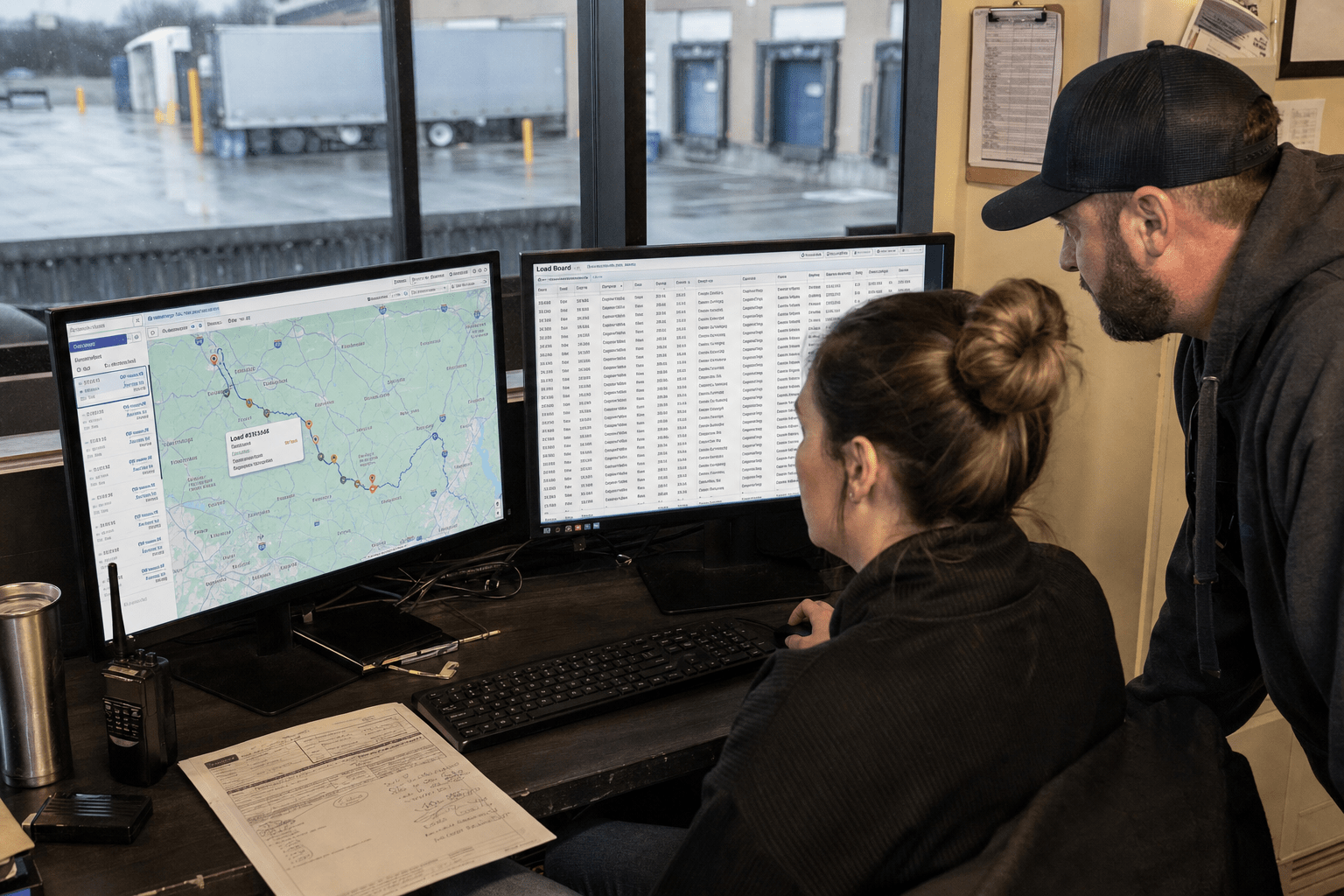
The best AI tools for logistics and supply chain companies in 2026 are the ones that produce usable answers from the carrier data an operator can realistically collect. Freight visibility, predictive arrival estimates, exception handling, and automated quoting all have working products, and the visibility networks in particular have real scale behind them. What decides whether a deployment delivers is carrier coverage: how many of your carriers actually transmit position data in a usable form, and how quickly. We rank by achievable coverage before platform capability, because a prediction engine covering sixty percent of your loads leaves your team working the other forty by phone exactly as before.
Why the Best AI Tools for Logistics Companies Underdeliver on Coverage
Most disappointing visibility deployments we have seen were not platform failures. The network onboarded the large carriers quickly, the small and regional carriers moved slowly or not at all, and the operations team ended up running two processes: dashboard for the covered lanes, phone calls for the rest. The promised reduction in check calls never materialized because the loads generating those calls were the uncovered ones.
Settle these five before signing:
- Measure carrier coverage against your own carrier list, not the network’s total. Ask the vendor to run your carrier file and report what percentage transmits usable data today. That number is the ceiling on everything else.
- Decide who owns carrier onboarding. Getting a small carrier transmitting is relationship work, not integration work, and it belongs with whoever manages that carrier.
- Separate visibility from decision automation. Knowing where a load is and letting software tender or price it are different risk levels bought too often in one decision.
- Confirm what happens on exception. An alert nobody works is noise. Route exceptions to a named role with authority to act, or the volume trains everyone to ignore it.
- Measure check calls and on-time performance. Both are already tracked. If neither moves, the platform is a dashboard, not an improvement.
Operators who measure coverage first buy accurately. Operators who buy on demonstration discover the gap in month three.
How to Rank the Best AI Tools for Logistics Companies by What They Touch
Ranking logistics AI by function beats ranking by vendor, because visibility, transportation management, and agent-driven execution differ in both data need and consequence of error. Start with visibility, where the data requirement is clearest.
Freight visibility and predictive arrival
Visibility is the foundation everything else builds on. These networks connect shippers, carriers, and forwarders, tracking loads in motion and producing predicted arrival times. Project44 combines live tracking with predictive analysis across a connected network, FourKites adds a resolution layer for high exception volume, and Shippeo, Tive, and Descartes MacroPoint cover overlapping ground with different regional and modal strengths.
The counter-argument is coverage, and it is the whole argument. Predicted arrival quality depends on position frequency, and a carrier reporting twice a day produces a prediction barely better than a schedule. Operators who succeed here treat carrier onboarding as an ongoing program with someone accountable for the percentage, reviewed monthly. Operators who treat onboarding as an implementation phase watch coverage plateau well below what they were sold.
Transportation management and pricing intelligence
Transportation management systems are where pricing and capacity decisions live. Revenova’s lane intelligence supports pricing optimization, with capacity matching added in early 2026 to speed coverage, alongside automated spot quoting and waterfall tendering. Logixboard sits differently, providing a customer-facing layer for freight forwarders that connects to an existing system rather than replacing it.
The case against replacing a transportation management system to get these features is switching cost, which in this industry is severe because the system holds rates, carrier relationships, and settlement. The case for the connected-layer approach is that it delivers customer-facing improvement without touching settlement. For most mid-size operators the layered path is the right one, and the replacement conversation belongs to a separate year.
Agent-driven booking and document handling
The newest category puts software into the execution loop. Pando connects shippers, carriers, and suppliers with automation handling booking, routing, and document validation, and Optimal Dynamics released an agentic layer in 2026 that searches, negotiates, and bids on freight across load boards, direct channels, email, and electronic data interchange.
The opposing view is straightforward and worth respecting: software that negotiates and commits capacity is making commercial decisions, and the failure mode is not a bad dashboard but a bad booking your operation is contractually holding. Operators adopting this well set hard boundaries, lane-level price ceilings and approval thresholds, before anything runs unattended. Document validation, by contrast, is low risk and often the better place to start.
Where Data Feeds and Partner Networks Limit What Operators Can Deploy
Data feeds and partner cooperation constrain logistics AI more than budget does. An operator controls its own systems and almost nothing about how its carriers, customers, and terminals transmit information, which is a different situation from most industries buying software.
What to require from a vendor before signing
Ask for four things: a coverage report run against your actual carrier file, documented onboarding support for small carriers, exportable data so your history is not trapped, and clarity on what the vendor does with your shipment data across its network. That last point matters commercially as well as legally, since aggregate movement data has value to parties other than you.
The other side deserves a hearing. Some operators refuse networked visibility entirely on competitive grounds, preferring direct integrations with major carriers. That preserves control and forfeits the network effect that makes coverage of smaller carriers achievable at all. Neither position is universally right, and it deserves a decision made on your carrier mix rather than on principle.
Why supply chain systems concentrate risk beyond your own walls
Connecting visibility platforms, transportation systems, and customer portals creates a web of integrations reaching well outside the operator’s own network, and every partner connection is a path. Logistics companies are targeted precisely because a disruption stops physical goods, which compresses the decision window during an incident. We have written about supply chain ransomware and vendor risk, and integration inventory is the control most often missing.
The balanced reading is that most operators have reasonable perimeter protection and poor visibility into their own integration surface, including credentials issued to partners years ago that nobody has reviewed. That operator can adopt these platforms safely if the integration review runs alongside, with ongoing monitoring covering what static controls miss.
How existing systems shape the sequencing
Where order, shipment, and rate data already sits decides how much of this is a purchase. An operator running a modern platform in a governed cloud environment integrates quickly, and where the enterprise system is already the backbone, our overview of supply chain management inside Microsoft Dynamics 365 covers what the platform handles natively. An operator with rates in spreadsheets and shipment status in email has consolidation ahead, and cloud infrastructure planning is where that starts. The broader question of sequencing technology decisions against operational priorities is covered in our guide to choosing the right technology for your business.
How Operators Prove a Logistics AI Tool Paid for Itself
A logistics AI purchase justifies itself when a number already on the operations report moves. Choosing the measure afterward guarantees a flattering one.
The numbers operations already reviews
Check calls per load, on-time pickup and delivery percentage, detention and demurrage charges, exception resolution time, and quote turnaround all work, because each is tracked regardless of any technology project. Baseline one across a defined lane set before adopting, then compare the same lanes afterward.
The fair objection is that freight performance swings with weather, capacity markets, and customer behavior nobody controls, so a raw comparison misleads. The workable answer is comparing covered lanes against uncovered ones in the same period, which holds market conditions constant and measures the platform rather than the quarter. Operators who set that comparison up in advance avoid an unwinnable argument.
Where the recurring cost accumulates
Subscription and per-shipment fees are visible and often not the largest line. Carrier onboarding effort, integration development, exception process redesign, and the operations time spent working alerts all consume capacity business cases tend to omit. Operators funding only the platform report weak results, and the software is usually not the reason.
Against that, carrier onboarding and integration cleanup are durable and serve whatever platform runs next, so they are better understood as operational infrastructure. Judging on first-year cost alone pushes operators toward the cheapest network, which is frequently the one with the weakest coverage on their actual carriers.
Who should run the evaluation
Evaluation belongs to operations, with someone qualified assessing integration security and someone from carrier management judging whether the onboarding ask is realistic for your carrier base. An operator without that internal capacity should bring it in rather than accept a coverage claim at face value. Our process automation work and project management practice begin at that assessment, and the broader case for automating operational workflow is covered in our piece on automation inside managed operations.
Frequently Asked Questions
What are the best AI tools for logistics and supply chain companies in 2026?
The best AI tools for logistics and supply chain companies in 2026 sort into three groups: freight visibility networks including Project44, FourKites, Shippeo, Tive, and Descartes MacroPoint; transportation management and pricing intelligence such as Revenova and Logixboard; and agent-driven execution from Pando and Optimal Dynamics. Start with visibility, since everything downstream depends on the position data it collects.
How much carrier coverage should we expect from a visibility platform?
Ask the vendor to run your own carrier file and report what percentage transmits usable position data today, rather than accepting a network-wide figure. Large carriers connect readily and small regional carriers often do not, so an operator with a fragmented carrier base may see materially lower coverage than the headline number suggests.
Are AI agents safe to let book or negotiate freight?
They carry real commercial consequence, since a booking is a commitment your operation holds. Operators using them responsibly set lane-level price ceilings and approval thresholds before anything runs unattended. Document validation and quote preparation are lower-risk entry points into the same category.
Does a visibility platform reduce check calls immediately?
Only for covered loads. Uncovered carriers still require the same manual follow-up, which is why teams sometimes report no reduction in workload despite a working dashboard. Measure check calls on covered lanes specifically, and track carrier coverage monthly as the number that governs the rest.
Should we replace our transportation management system to get AI features?
Usually not as a first step. Replacement is expensive because the system holds rates, carrier relationships, and settlement. Connected layers that add customer-facing visibility or pricing intelligence on top of an existing system deliver much of the value without the switching risk, and the replacement question deserves its own timeline.
Who Is Behind This Guidance
Our team has worked with distribution and transportation businesses on the groundwork that determines whether new platforms deliver: integration inventory across partner connections, credential review for accounts issued to carriers and customers, consolidating shipment and rate data out of spreadsheets and mailboxes, and recovery after incidents that interrupted physical movement. That work shaped the ranking approach used here. We have watched capable visibility platforms underdeliver at operators whose carrier base never onboarded, and modest deployments succeed at operators who treated coverage as an ongoing program.
Matt Rosenthal, our CEO, has built Mindcore around the operational groundwork that lets logistics businesses adopt new technology without widening their exposure. The principle guiding how our team runs these engagements is that when a disruption stops physical goods, the decision window is short, so the resilience work belongs before the capability work.
Your Next Step Toward Visibility That Covers Your Actual Freight
Choosing among the best AI tools for logistics and supply chain companies is the smaller half of the work. Operators who measure coverage against their own carrier file, assign ownership for carrier onboarding, separate visibility from decision automation, route exceptions to someone with authority, and pick an operations number before buying get real value. Operators who buy on a demonstration find the coverage gap in month three and start running two processes.
The sequence that works is direct. Send your carrier file to any vendor under consideration and require a coverage report against it, because that single number predicts your outcome better than any feature comparison. Inventory the integrations and partner credentials already reaching into your systems, since adding platforms multiplies a surface most operators have never mapped. Start with visibility and document handling rather than automated booking, and set price and approval boundaries before anything commits capacity on your behalf. Then measure covered lanes against uncovered ones so the market cannot obscure the result.
None of that requires an enormous budget. It does require someone who can assess an integration surface honestly and judge what your carrier base will realistically adopt. That is what our team brings to operators working through this decision, whether we run the whole technology function or work alongside an internal operations group.
If your company is weighing AI tooling this year and wants the groundwork assessed before contracts are signed, book a free strategy call with our team. We will review your current systems, integrations, and partner access, flag what needs attention first, and give you a straight answer about which category fits the freight you actually move.

